
“Don’t be so humble. You’re not so great.”
— Golda Meir, Fourth Prime Minister of Israel
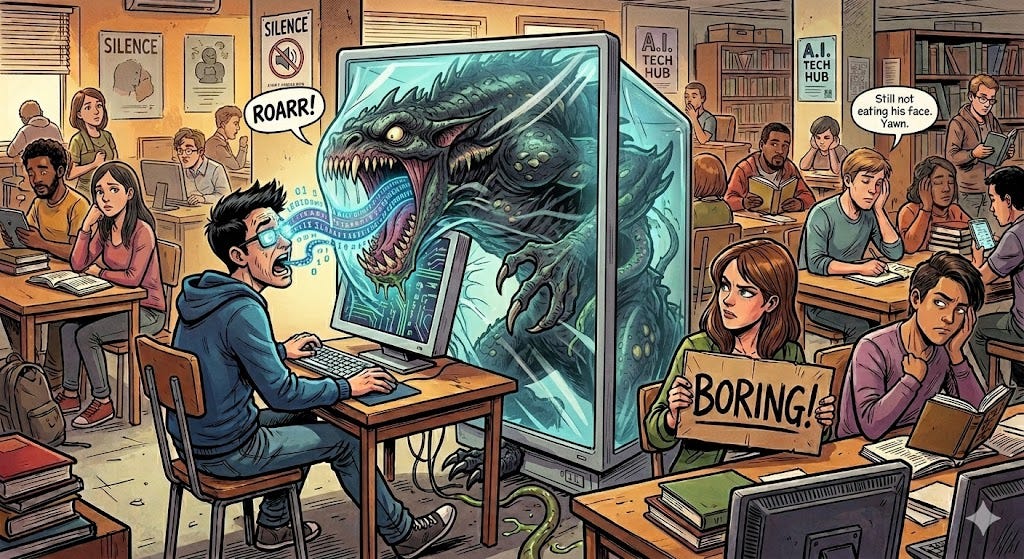
I’ve been a big fan of techno-doomsayers for as long as I can remember.
When I was a kid, my parents warned me not to sit too close to the TV because of possible radiation poisoning. Later, the year 2000 became a banner year for doomsday preppers. Because early computers were designed to handle years as two digits, 93 meant 1993, 99 meant 1999, and 00 meant 1900 - not 2000.
The public was told the Y2K bug meant airplanes would fall from the sky and people would be stranded in elevators (and on escalators, unless they thought quickly). You were supposed to wake up on January 1st and see 100 years of interest deducted from your bank account. Store up your toilet paper and gold, everyone!
-Yawn -
I got my first computer around 1986. It had dual floppy drives. A couple of years later, I got my first hard drive. It boasted an unbelievable 5 megabytes of storage.
Even though that felt like an infinite amount of space, I read that I could make my machine run faster by using a program called a “defragmenter.” This software would read my disk and rewrite the data so all the memory was stacked next to each other, saving the computer from seeking information all over a huge, noisy contraption that sounded more like an Apache attack helicopter readying for takeoff..
So, I went to the Egghead Store at the mall, bought the program, brought it home, and installed it. It took about an hour to run, and then...
-Yawn -
My computer ran no faster. That was the day I developed Sorkin’s First Law of Computer Software: Everything you do to optimize your computer will slow it down by the exact amount you hoped to improve it.
To be fair, certain things actually did improve computing. Google made searching faster and better. I could enter terms using normal language, and most of the time, I got results that made sense.
Then came the new dawn. I started accessing A.I. through ChatGPT in early 2023. Initially, I was wary about entering my data. It was scary because I thought it was genuinely superintelligent and would soon turn its vigilant, voracious cyber-eye on me. But soon…
- Yawn -
In Cal Newport’s email newsletter, he cites an anecdote involving Notre Dame philosopher Meghan Sullivan. While attending a meeting at the Vatican, she met an AI executive. The executive, who was not Catholic, attended Mass the next morning. When Sullivan asked him why, he answered:
“We’re building something that is going to change life as we know it. I want to make sure I keep in touch with what humans have always cared about. This is a place that takes care of those values.”
Newport’s reaction to this wasn’t, “That’s beautiful,” or, “How refreshing to see this level of self-awareness.”
It was more like:
- Yawn -
Why? Because Newport has been one of the lonely voices crying out in the wilderness that the AI King has no clothes - that AI just isn’t “all that.”
Of course, one of the big differences between Newport and me is that he is a fully tenured PhD Computer Science professor at Georgetown, and I’m just a person who reads a lot of Newport.
Newport encourages a reality check:
“Leave religion to the Pope; I want my technology executives focused on building things people actually want.”
Still, pervasive and accepted myths about AI persist. People look at it as being smarter, having better judgment, and being far more “human” than it actually is. That humanity is exaggerated in both directions.
The Lover: People exaggerate AI’s ability to care for them. They feel like their AI girlfriend or boyfriend is genuinely attracted to them or turned on by them. It isn’t.
The Terminator: People feel deeply threatened by AI. They see it as a rival intelligence that will inevitably become self-conscious and strive to protect itself at all costs. Like HAL-9000 in 2001: A Space Odyssey, they worry it’s going to lock us out of the spaceship.
Fortunately, there are signs that sanity is creeping back into the discussion. AI executives are growing much more cautious about claiming AI will imminently replace all blue- and white-collar workers. Newport even noted that Sam Altman admitted he was “pretty wrong” about how fast AI would automate jobs.
Perhaps the best summary of our current AI reality comes from a recent book, The Future of Truth: How AI Reshapes Reality by Steven Rosenbaum. The book features a quote about AI attributed to tech journalist Kara Swisher:
“The most sophisticated AI language model is like a mirror that reflects our own morality back at us, polished and articulate, but ultimately empty behind the surface.”
It’s a beautiful, poetic quote. The only problem? When contacted by The New York Times, Kara Swisher said she never said it. The AI writing the book had hallucinated the quote entirely.
Swisher added that the fake quote made her “sound like I have a stick up my butt.”
- Yawn -
Has AI eaten your face? If so, share your sad tale of woe here:
No posts
Comments
Nothing yet. Say the first thing.
Sign in to join the conversation.