

You notice that your husband seems increasingly forgetful. Last night he left the oven on and the smoke alarm went off when dinner began burning. And even more troubling, he called in a panic because he couldn’t remember where he parked his car at the market. You worry that he’s developing Alzheimer’s like his mother did before him. You’ve seen advertisements for GLP-1 medicines on Facebook for Alzheimer’s. Should you ask his doctor to recommend them?
GLP-1 meds? For Alzheimer’s? You mean the ones like Serena Williams is hawking for weight loss?

Let’s face it. Alzheimer’s is devastating. Little by little you lose the people that have been closest to you. The idea that your own mother, or sister, or husband might some day not recognize you is terrifying and people are desperate to avoid or cure this. So repeatedly, in testimonials on Facebook and on the internet you hear a familiar theme:
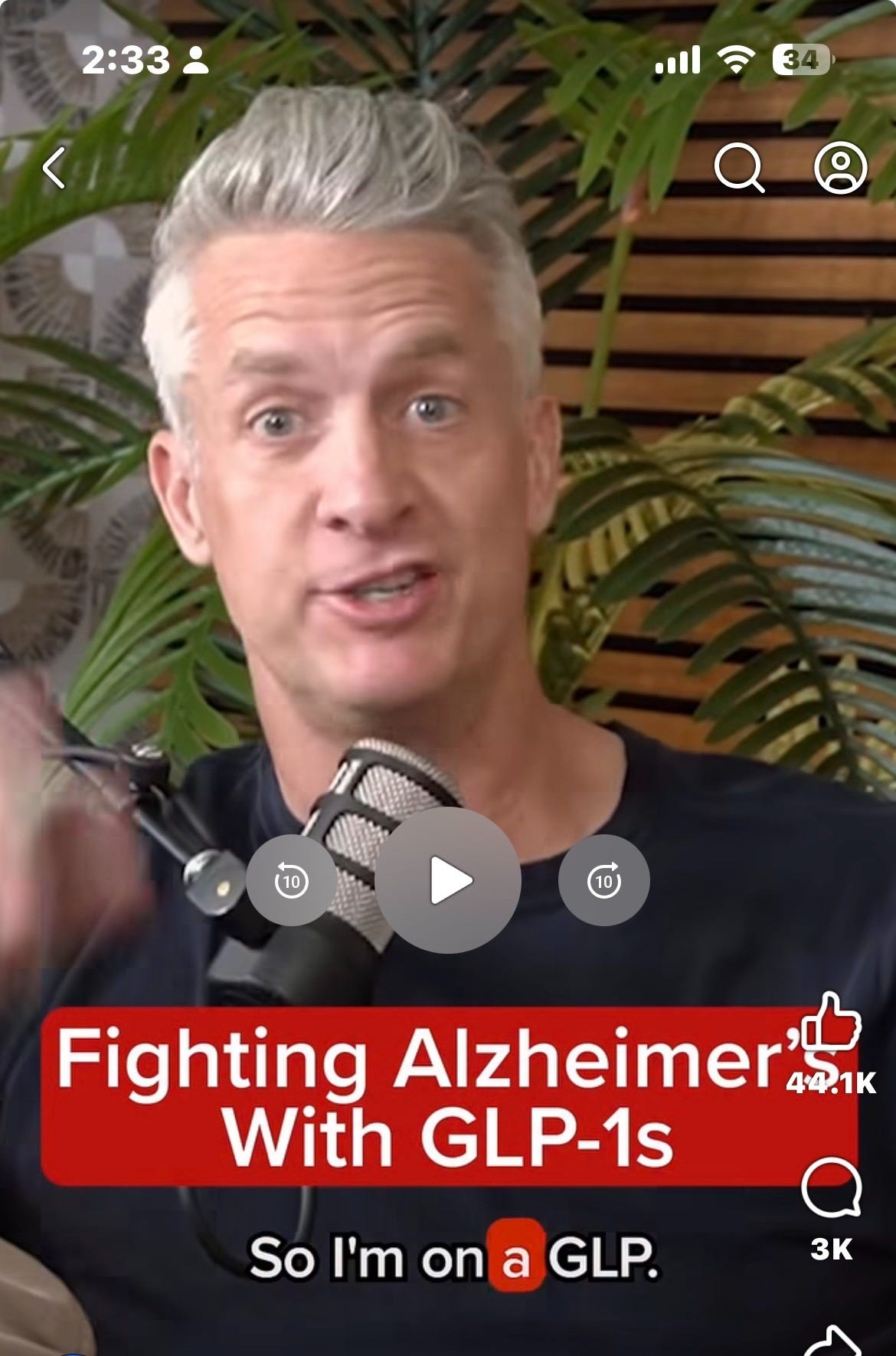
“I’ve got a ticking timebomb in my head and If there is even a shred of evidence suggesting that this works, I’m going to take it.”
But is there this shred of evidence? Or is this just another snake oil or Phen Fen?
Alzheimer’s is a progressive neurodegenerative disorder that destroys memory and thinking skills and eventually compromises even movement and autonomic regulation (the body’s ability to regulate basics like heartbeat, blood pressure and temperature).
Over 7.2 million Americans are estimated to have Alzheimer’s.
5% of 65-74
13% of 75-84
33% of those older than 85
There is a gender disparity with women being more affected. In those over 65, 4.4 million are women and 2.8 million are men. It appears that part of this is the role of the APOE-ε4 gene. The APOE-ε4 gene is the strongest genetic risk factor for late-onset Alzheimer’s. Studies show that women who carry this gene are more likely to develop the disease than men with the same genetic profile.
Alzheimer’s is the most common cause of dementia, implicated in 60-80% of cases.
Clumps of beta-amyloid protein build up in the spaces between nerve cells in the brain. This is like having trash around that blocks or slows down intra-cellular communication.
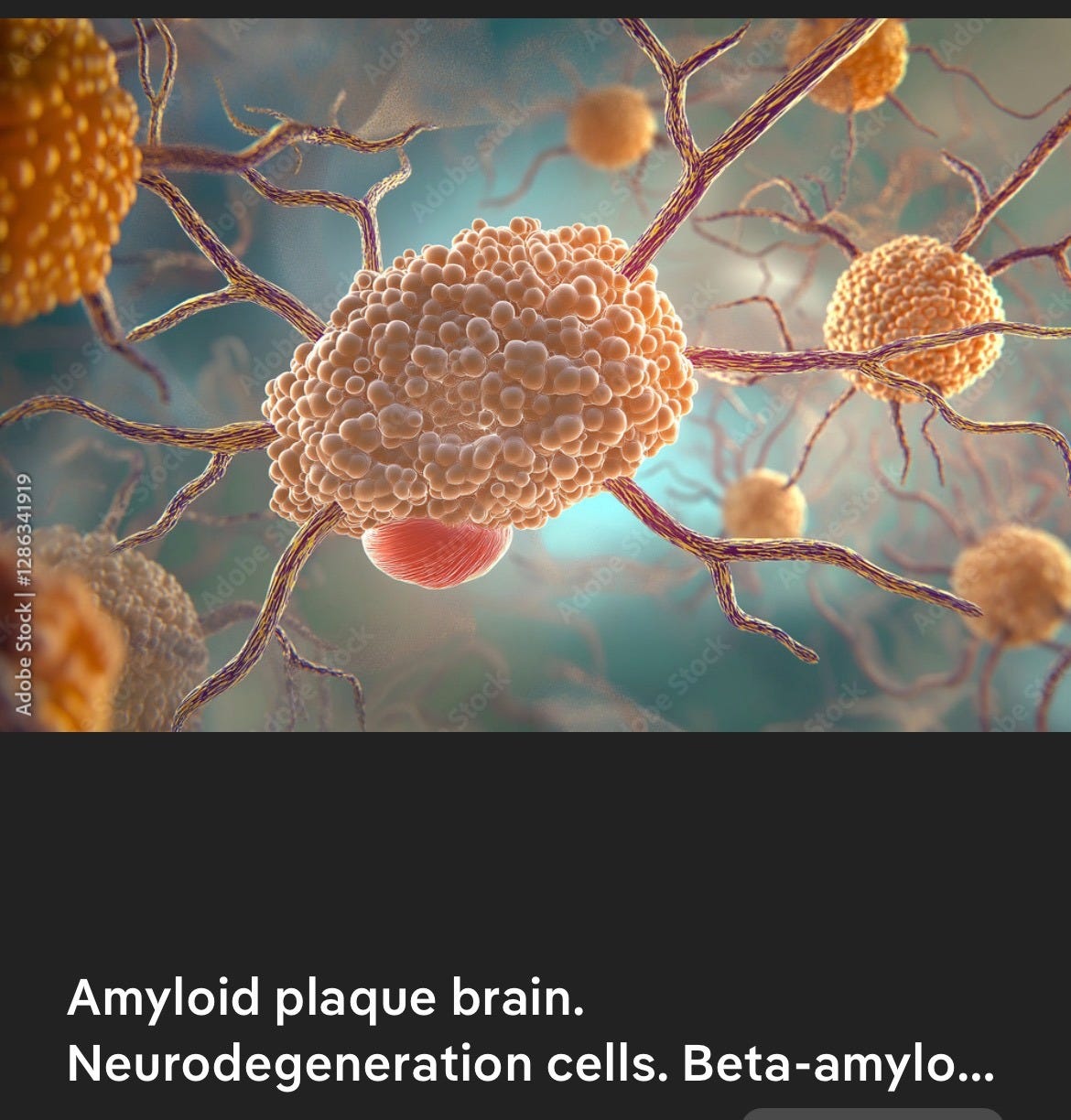
Tau Protein normally stabilizes internal neuronal structures. In Alzheimer’s patients, Tau proteins collapse into twisted strands or tangles which interfere with intracellular nutrition. This leads to cellular starvation and death.
Early Stage Alzheimer’s is noted for symptoms associated with Hippcampal damage. This is an area of the brain used in making new memories. Cognitively, you will see forgetting of new memories and repetition of questions.
Middle Stage Alzheimer’s is associated with more diffuse cerebral cortex damage with problems with language, reasoning and social behavior. You will see problems with word and name finding, confusion, wandering and judgement.
As the disease progresses, we see problems with motor and autonomic regulation. Patients at this point may be wheelchair bound and bedridden.
Age is by far the most predictive factor. Simply stated, the older a person is, the more likely they are to develop Alzheimer’s.
Genetics: APOE-ε4 is one of several genes related to the development of Alzheimer’s. As mentioned, it is particularly predictive for women.
Estimated Lifetime Risk of Alzheimer’s by Age 85 by Genetic Profile
Non-carrier (ε3/ε3) - 10 to 15% risk
Heterozygote (ε3/ε4) - 20-30% risk
Homozygote (ε4/ε4) - 50-90 % risk
However, The “Protective” Gene: In contrast, the APOE-ε2 variant is relatively rare but appears to actually decrease the risk of Alzheimer’s and may delay the age of onset if the disease does develop.
And we should note that even when a person has two copies of the ε4 variant, at least 10% of the population remain free of Alzheimer’s into their 90’s. So genetics is not destiny!
Lifestyle Factors Predisposing towards Alzheimer’s
Hypertension
Diabetes
Sedentary Lifestyle
Alcohol abuse
Brain trauma, especially if severe, recurrent or after age 40
Depression
Lecanemab (for early disease). This is provided by IV infusion every 2 weeks indefinitely. It leads to a 27 percent decrease in cognitive decline at 18 months.
Donanemab (IV infusion every 4 weeks. Can stop once cognitive improvement occurs) 35% effectiveness
However a recent (April 2026) Cochrane Review questioned this improvement in cognitive function and said that the medication might not be worth the risk of brain swelling and bleeding (albeit small). So the jury is still out).
Cholinesterase Inhibitors
Donepezil (Aricept) - This medicine prevents the breakdown of the Acetylcholene, a chemical messenger essential for learning and memory.
Revastigmine (Exelon) - This medicine is provided for Alzheimer’s/Parkinson’s
Miscellaneous Medicines
Rexulti - For Agitation
Belsomna - For Insomnia
Antidepressants - For Depression
GLP-1 is a Glucagon-Like Peptide 1, a hormone that naturally occurs in the body and primarily in the gut. GLP-1 Receptor Agonist medicines simulate the actions of GLP-1’s but more strongly and for longer periods of time. They cause the following reactions:
Pancreas - the stimulate the release of insulin
Liver - they instruct the liver to limit the release of sugar
Stomach - they slow gastric emptying and signal fullness
In these ways they tend to limit caloric intake and this is why people lose weight on them.
What is the rationale for using a GLP-1 Receptor Agonist?
Alzheimer’s has been called “Diabetes 3” because of the problems the brain has using glucose for energy. GLP-1 medications can
Slowdown runaway inflammation from microglial cells (the brain’s immune cells).
At least in animal studies GLP-1 medicines protect synapses from toxic amyloid plaques
What’s the worst that can happen?
Death.
Well, no. In fact the rate of all cause mortality in people taking GLP-1 medication is 4.3% over 40 months versus 5.2% for placebo.
Among alarmists, you will see a fact cited that 162 people died while taking GLP-1 medications but this does not mean that they died because they took a GLP-1 medication. The cause of death could have been a motor vehicle accident or a homicide while taking the medication. 15 million people in the United States take a GLP-1 Medication. This comes to a death rate of .0019% which statistically is the same as dying from a bee sting or a bicycle accident
Major Side Effects
Gastroparesis or bowel obstruction. Because of GLP-1’s slow gastric emptying, this is a problem. One in a hundred patients develop these conditions.
Pancreatitis occurs in 1/200 patients.
Common Side Effects
Nausea
Vomiting
Sulfur burps
Loss of Money - A course of a GLP-1 like the treatment protocol described below with Semaglutide will cost you $24,555 (for 14mg, once daily for about 2 years). You could also buy a 2026 Toyota Corolla LE for the same price.
Did it work?
We have really good quality data to look at. The Evoke and Evoke + Phase 3 trials have been completed. The Evoke and Evoke+ trials were massive global undertakings designed to test the neuroprotective potential of oral semaglutide. Here is the breakdown of their scale and duration:
Total Patients: Approximately 3,800 participants were enrolled across both trials. They consisted of individuals aged 55 to 85 with early-stage symptomatic Alzheimer’s (mild cognitive impairment or mild dementia).
Global Reach: The trials were highly “globalized,” involving 566 sites across 40 different countries. This was intended to ensure a diverse representation of racial and ethnic populations.
Primary Treatment Phase: The core study lasted 104 weeks (2 years) to measure the primary endpoint: change in cognitive and functional scores.
Total Planned Duration: Including screening and a planned extension, the total timeline for participants was up to 173 weeks (roughly 3 years and 4 months).
Current Status: Following the primary completion in late 2025 and the release of topline results in early 2026, the 52-week extension period was discontinued due to the drug failing to show clinical efficacy.
Reduction in Neuroinflammation: Semaglutide successfully reduced markers of brain inflammation. Participants on the drug showed approximately a 10% reduction in inflammatory biomarkers compared to the placebo group.
A-Beta (Amyloid) Levels: There was a measurable impact on the accumulation of amyloid plaques. The drug appeared to slow the further deposition of these proteins, which are a hallmark of Alzheimer’s pathology.
Cerebrovascular Health: Researchers noted a positive trend in vascular markers. Because GLP-1s are known to improve endothelial function (the lining of blood vessels), there was evidence of improved blood flow and reduced vascular “leakiness” in the brain.
Neuroprotection Markers: In specific sub-studies, there were indications that semaglutide helped maintain the integrity of the blood-brain barrier better than the placebo.
The most fascinating—and frustrating—outcome is this gap. The trial proved that semaglutide can cross the blood-brain barrier and successfully dampen inflammation and protein buildup. However, the 10% reduction in inflammation was simply not enough to stop the complex cascade of neurodegeneration that had already begun in these patients’ brains.
It suggests that while the “chemistry” of the drug worked, the “biology” of the disease was already too advanced for these specific changes to save cognitive function. The operation was a success but the patient died.
Talk to your healthcare provider to decide if GLP-1 Medicine makes sense for you. Don’t take my advice. Along with your healthcare team you might still decide to take a GLP-1 medicine if there are other compelling reasons including the need to control diabetes or weight.
I have to relate a story from my days of being a psychologist. Shortly after 9-11, some idiot thought it would be a good idea to send anthrax in a letter to news anchor Tom Brokaw, and Senator Daschle and Senator Patrick Leahy. People went into a panic and began ironing their mail before opening it. One of my patients asked me if I had duct tape and plastic to seal my windows because Al Qaeda was going to disperse it from crop dusters. He said he had his. I remember looking at him and saying “You smoke three packs of Marlboros a day.”
It’s always tempting to look at the new shiny object and to overlook the obvious, possibly boring solutions. But if you want to minimize your chances of developing Alzheimer’s, do this and start early.
Strong Evidence
HTN- Avoid this and if you develop it treat it. Maintain a healthy weight.
Diabetes- Don’t develop this and if you do, then treat it aggressively.
Avoid head injury. Wear a bike helmet. Choose your sports carefully.
Some Evidence
Activity - Maintaining 180 minutes of activity per week minimum is recommended.
MIND/Mediterranean Diets. Basically if it tastes good, don’t eat it.
Social Connection
Meaning in life
Get Sleep - don’t be a fanatic, but 6-8 hours average.
Hearing Loss treatment
Depression treatment
There is a famous and heartening study begun in 2009 by Dr. Miia Kivipelto and her associates in Finland and still being updated today. The FINGER study (Finnish Geriatric Study) looked at 1260 patients randomly assigned to either a control group or a treatment group. The control group received standard medical advice and screening. The treatment group received a five-fingered approach including
Diet. Similar to Mediterranean Diet high in fish, vegetables, fruit and low in sugar and saturated fat
Exercise - both strength and cardio training
Cognitive Training including a computer training program for memory and speed
Social Activities
Vascular Health including management of Blood Pressure, Blood Sugar and Body Mass Index.
The results were startling. The treatment group had 25% better cognitive scores than the control group. What’s more, in the treatment group the ε4 carriers benefitted as much as those without the gene. In fact, the ε4 carriers in the control group showed the normal declines in cognitive function that we see in most Alzheimer’s patients but the ε4 carriers in the treatment group had a much smaller decline. The intervention essentially neutralized the genetic disadvantage.
The bottom line is that doing everything that you can to prevent cognitive decline pays off, even if you have the deck stacked against you!
In conclusion, all of us have some ability to modify our risk factors. These modifications are almost all enjoyable and rewarding in their own right. Maybe not at first. It takes a bit of initial momentum and support to begin working out, or make friends or partake in a community group or therapy. But the benefits are longstanding and cumulative.
I have no doubt that the pharmaceutical industry will develop some treatment that will yield both the impressive biological changes and clinical improvements we have been looking for. But in the meantime, I plan to do everything I can and I hope you will too.
No posts
Comments
Nothing yet. Say the first thing.
Sign in to join the conversation.