
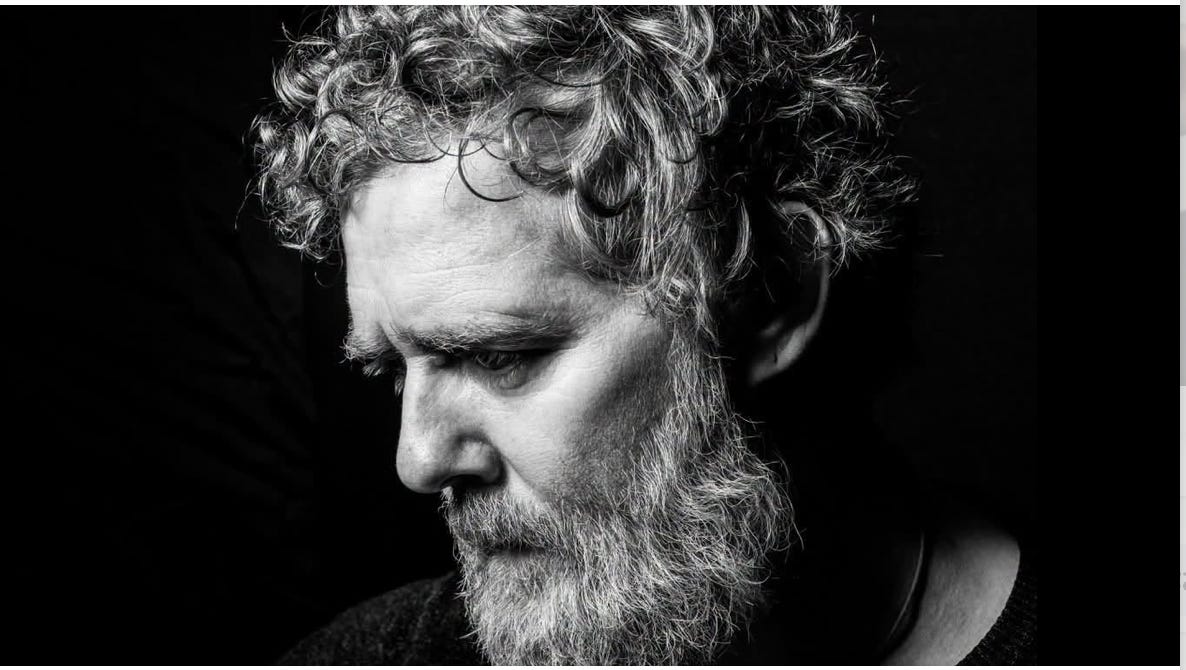
I first met the late Glen Hansard in a bar. The year was 2007, and Hansard—who died, tragically and horribly, in motorcycle crash in Dublin two days ago—was out promoting Once, the folk-rock film musical in which he co-starred with Czech singer and pianist Markéta Irglová.
The buzz around that indie movie was undeniable. Directed by John Carney, it had already won the Audience Award at Sundance. Once was then picked up by a major film distributor, the same one that had made a hit out of Garden State.
But sitting in an Irish pub in downtown New York, Hansard was very much the fatalistic Celt. “No one will be happier than me if this film is successful,” he told me. “But Garden State was full of stars and probably made for $20 million. Once is a tiny fish in an ocean of whales. In terms of expectations, everybody needs to be realistic.”
All true, but Once nonetheless became a phenomenon, raking in $20 million worldwide; “Falling Slowly,” which Hansard and Irglová had co-written, won the Oscar for Best Original Song. The movie also eventually begat a Tony-winning Broadway musical. Not bad for an indie starring two musicians with precious little acting experience between them and a narrative that made unheard songs part of the plot. You couldn’t help but cheer it on.
Hansard himself led multiple musical lives: on his own, with his band the Frames and with the Swell Season, his duo project with Irglová. No matter the setting, Hansard was always one of the most emotive troubadours of his generation. Every word he sang was fraught with desperation and intensity, and he didn’t seem to be strumming his guitar so much as punishing it. He rightly reminded some of the late Jeff Buckley; coincidentally, both had played Sin-é, the East Village coffeehouse, in the early days of their careers.
Cut to two years after Once. Life had become more complicated for Hansard. He was attempting to balance his solo work and the Frames, and he and Irglová became romantically involved, until they weren’t. Although they had dissolved as a couple, they reunited in a recording studio in 2009 and made Strict Joy, the second of what would eventually be three Swell Season albums.
That fall, Hansard and I reconnected by phone to discuss the impact of Once and his renewed work with Irglová on the sonically and emotionally rich Strict Joy. He was calling from Kildare, just west of Dublin. In honor of his life, here’s the transcript of that talk, published for the first time.
In light of the success of Once, I would imagine you’re facing certain expectations you’ve probably never encountered in your career before.
Realistically, we all knew that what happened with Once was lightning in a bottle. It was an amazing thing to happen. To try to match that commercially or put the same amount of people in rooms, to follow its success, would be suicide. It’s that idea that you have this great moment and try to sustain that moment.
A lot of bands fall into that. They get used to the lifestyle and try to stay there and that’s not foolish but shortsighted. You have to say to yourself, “Right—that was amazing. Now, back to work!” Which is what got me here.
So, no, not at all [in terms of pressure]. I was happy with this record. There were expectations only to make something decent.
And you made this new Swell Season album in Connecticut?
In Bridgeport, yeah. We have a friend in the National who recommended going up there. We had a few days off and were looking for someone to throw down some ideas with. It worked out really well; we kind of knocked it out. We didn’t think there was an album there. We went in to just start recording. But there was no thought of, “This is it—we’re going in to make our record.” We went in to see how it felt.
The Frames came onboard. We’ve been touring with that lineup and developing songs in that context. It was so natural. I’ve been working with those boys forever, all my life. They’re my E Street Band.
But I did take some more musicians, like [guitarist] Javier Mas, who plays with Leonard Cohen. The people you know well, you kind of know what they’re going to do sometimes. The Swell Season has afforded me the freedom to make those decisions instead of just being locked into a band. Sometimes sex with a stranger is exactly what you need.
Did you and Markéta already have songs written?
We had some. During the beauty and the madness of what happened to us, we were thrilled. So it made sense to document that period. Even if this happens to be the last Swell Season record, it was important to make another one just to say, “Okay, now at least we’ve seen the whole chapter through.”
Why might this be the last Swell Season album?
It’s always really hard to say these things. It feels like this is not the closing chapter. Naturally speaking, now that me and Markéta aren’t in each other’s everyday lives—she’s not in my house right now—it means we’re writing fewer songs together. In terms of writing songs together, that will slow because we’re not around together. Naturally, then, that begs the question, “Why then does the Swell Season continue?” At the same time she’s an amazing person to be onstage with. So I can’t say, “Well, that’s over.”
[My note: With Irglová, he made one more Swell Season album in 2025, and at the time of Hansard’s death, the two had completed a score for a musical version of the film Waking Ned Devine. In a sign of their ongoing creative rapport, Hansard took a first shot at the music, then brought Irglová on board to complete it.]
You and Markéta became a couple after the movie. Did you break up before you made this album?
Yeah.
Under those circumstances, what was it like for both of you to work together?
It’s kind of difficult to explain. What happened with me and Markéta … I guess we never really had a typical relationship, let’s face it. So when we broke up, it wasn’t a typical breakup. We just graduated into being friends again. We didn’t go through that period of pain.
There were moments, for sure, of “Fuck this.” But whatever little satellite issues were going on in each other’s lives, like breaking up or graduating back into our original relationship, we’d go on stage and it was fine. We were back to being what we always were. “Broke up” seems to suggest something was broke. I don’t know how well suited we were in the first place—as lovers, I mean—so it was really easy for me to get beyond that. Really easy for her too, to go into the studio and sing.
What should we be reading into these songs in terms of describing your relationship: “The Rain,” for instance?
“The Rain” is probably more a reflection of my relationship with the Frames, just before I got cynical with success. It’s me talking to the band, saying, “I know we’re not where I promised we’d be right now. You’re a band, a gang.” But somehow, subtly, you feel responsible for everybody’s happiness. Decisions I make determine how these guys live.
Some of the songs are about [him and Irglová], of course, and that can be a little bit odd. [Chuckles] It feels a bit like being in Fleetwood Mac. At the same time, if you’re being honest with yourself, you can traverse these situations really easily. Even this idea that you break up with someone and become their enemy—we’ve just carried on being pals.
Is “Fantasy Man,” which she sings, one of those songs about you? “So go on now, you are forgiven/Let’s put it down to life/The story of two lovers/Who danced both edges of the knife.”
Yeah, I helped write that and I wrote other songs. I was utterly aware at the time that I’m singing about this fucking loser she’s with. [Laughs] Part of my Catholic self-deprecating side got a kick out of it, I suppose. Or I’m just fucking weird.
No posts
Comments
Nothing yet. Say the first thing.
Sign in to join the conversation.