
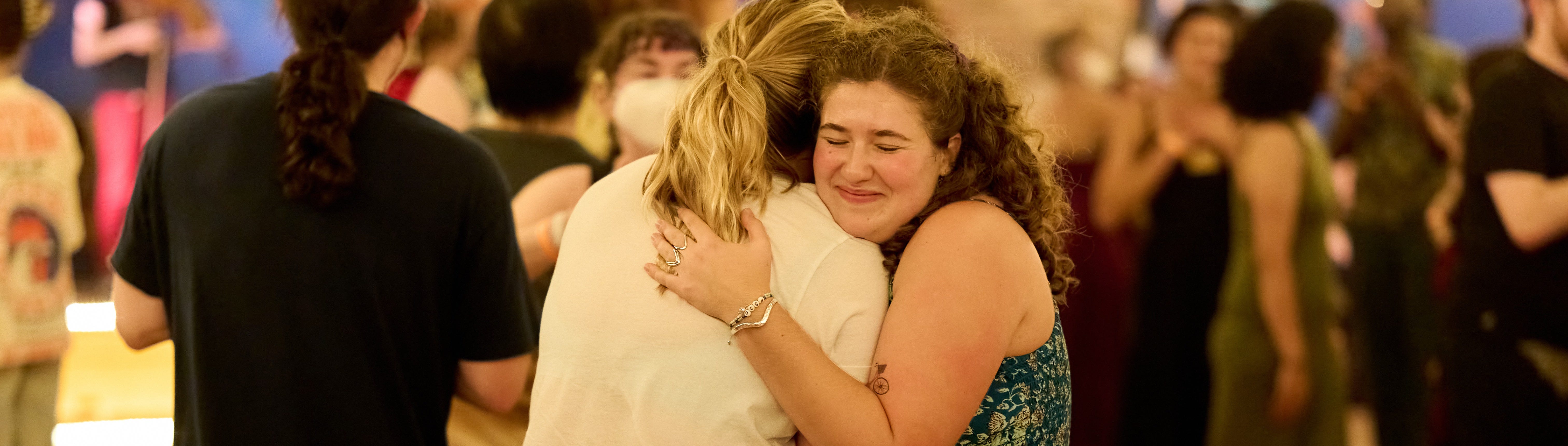
I love the minutes after a dance ends - the raucous applause swelling, then fading, and the smiley, rosy-cheeked dancers turning to each other. Hugs, sighs, comparing favorite moments. Someone is humming the last melody, and the organizers begin to shuffle equipment and brooms around the room. And the dancers just… linger. They keep the warmth in the room as long as possible, and then filter out the door looking forward to the next dance.
That same spirit of lingering warmth, with anticipation of what comes next, has pervaded the last few years of Brooklyn Contra’s annual planning process. Through hard work, good foundations, and a few bits of good luck, we’ve had a wonderful few years, and we reflect on those high points as we sit down to make our plan.
While it might seem easier to stick to the same plans every year, annual planning gives us a way to keep thinking about exciting projects and building the dance towards a vision of what it could be. Choosing to spend two or three Saturdays sitting together reflecting and planning helps us do three things:
Deepen our work
An open and expansive planning process allows us to consolidate learnings from the year and debate what’s next. We discuss what is working in our organization, what isn’t, and where we would like it to be. Should we focus on dancer retention? Or dancer attraction? Do we have enough committee members? What level of financial reserve is adequate?
Expand our work
In regularly sitting down to discuss our broader dance ecosystem we’re able to think “outside our dance hall”. What do we need to succeed? Is there a need in our area for more callers? What about a workshop for our dancers? Or bringing in dancers via outdoor dances and public partnerships? Who do we admire and want to work with, or how can we share what we’ve learned? This blog project came out of our annual planning this past December!
Rein in our work
By making a detailed plan once a year and sticking to it, we’re able to keep focus on our goals more easily. Partially the focus comes from a full plate of Key Results, but our plan also gives us a filter through which to view potential opportunities and a designated time and place to put big discussions and ideas. Oh, want to write a big grant that just came our way? Maybe wait till next year and make it a Key Result. Want to discuss changing our mission? Let’s wait until our three-year planning cycle is ready to re-start.
The core of our annual planning is a two day retreat where we set Key Results, and, every three years, new Objectives. These would be meaningless without a means of actualizing our plans via monthly check-ins and the taking on of specific key results by members of the organizing committee. You can find agendas for each of our meetings in the resource section below.
Every Three Years
We look at our organization’s Mission and Vision and decide if they are still useful and applicable to our work. The Mission and Vision are then used to create five broad Objectives that cover the aspects of our work. We have in the past adjusted them, and we look forward to refreshing our Objectives, and considering if our Mission and Vision need refreshing, for 2026-2029.
Every Year
For each Objective we take about thirty minutes to jot down all the possible projects or outcomes we think of that could help us reach the Objective, then narrow down that list into ~4-5 Key Results per objective. The aim is for Specific, Measurable, Achievable, Relevant, and Time-bound (SMART) goals to use as Key Results. We try our best to make them outcomes-based.
One (or three) organizers are assigned to each Key Result as the “bottom-liner”.
Every Month
Once a month our organizers come together for a meeting, in part to check in on progress made towards our Key Results. Key Results are sorted into two groups, and the “A” and “B” OKRs alternate on each month’s agenda. The check-in can be succinct as, “I haven’t had time to make progress on this,” but having it on the agenda allows us to keep each other accountable and communicative; and provides a structured time to propose actions for the group to approve.
Generally, all of our lessons learned fall under the rubric of “It's Just F*ing Folk Music”. We (obviously) love this nerdy shit, but also, if we let the process get in the way of our core search for joy and connection then is it really productive? Don’t take this too seriously, or we won’t be effective.
Tailor your planning tool to suit your needs:
We know that some of our Key Results may not look like A-game, professional OKRs. They are more about keeping us to the process, or maybe they don’t have a perfect measurable outcome. OKRs are a very professional tool that has the capacity to drive an organization forward but also can drive joy out of creating in white-collar settings and be alienating to more working-class organizers with less experience in corporate settings. Sitting in the room, we’re mindful of making it fun and achievable as well as rigorous. Does a Key Result seem too big for us to handle, but has a kernel of interest? Let’s set the bar at an exploratory meeting, or we’ll plan to write a plan. Do we want to declare a Key Result to set better boundaries on our time and just reflect on that every two months to see if we’re doing a good job? Great! There is a real place for rigor and refinement in this process, do make sure you have some really really good Key Results, but make it fun and nourishing in the process.
Take on some things that aren’t in your Key Results:
You're gonna get great opportunities, or have great ideas every year that you want to do now, but they aren’t Key Results. Don’t do all of them, but do some, especially if they fall under your objectives and if they could be Key Results next year. Last year we rented a house at Flurry because it was fun, and this year we codified it into a Key Result to plan more out-of-town trips.
Fail:
There is a great practice: when you fail, throw up your hands, say “How Fascinating,” and learn from it. We have failed a lot during this process. First by completely ignoring our OKRs (before 2020 when we started doing this), by setting too many Key Results without enough supporting process in 2023, and then by setting some unachievable Key Results in 2024. Through all of this we’ve learned a ton, and also accomplished a lot. And after all, it’s just f*cking folk music.
When we set them in 2022, we had the following Objectives:
I. We will build a broad audience for Contra Dancing in NYC
II. We will build a collaborative team and structure that propels our mission forward.
III. We will produce events that nourish and serve a vibrant, diverse, and evolving dance community.
IV. We will pioneer collaborations across folk traditions and beyond.
V. We will cultivate financial resilience to support our mission.
Our 2025 Key Results:
I. We will build a broad audience for Contra Dancing in NYC
100 people per dance average in Q4
2 community partnerships to drive attendance
Advertise 1x/quarter in a neighborhood or community
Roll out branding project
2 earned media hits
Explore one retention strategy and run pilot to support it
II. We will build a collaborative team and structure that propels our mission forward.
6 Volunteers per dance by Q4
8-9 committee members
Hold 4 board meetings, one each quarter
Each organizing task will have at least two people trained on how to do it
Each committee member will write at least 1 document detailing the steps and procedures of an organizational role they hold.
Improve our abilities to set boundaries both individually and organizationally
Realistically assessing capacity to do partner events
Realistically assessing individual workloads
III. We will produce events that nourish and serve a vibrant, diverse, and evolving dance community.
Draft comprehensive calendar of planned events
Baseline of 2 dances each month (except one of July or August)
3 advanced/double dances
2 park/outdoor dances (using their equipment)
1 new themed dance - ie Pride
1 commissioned beginner’s lesson OR complete grant deliverables re: workshop series
Put on a 3-day dance weekend with a committee including at least 2 non-BkC members
IV. We will pioneer collaborations across folk traditions and beyond.
Continue building relationship with Camp Friendship through 1 or more work days and continued equipment support.
Support dancer and organizer travel to major contra events: Flurry, Pinewoods work weekend and/or camp, + 1 more event to be identified
Participate in Dance Parade (May 17)
Reach out to Flurry about presenting/running a workshop in 2026
Write 6 blog posts in the year, sourced from org team and guest posters
V. We will cultivate financial resilience to support our mission.
Write NYSCA Grant in May to support next 3 years of programming
Reach $1,000 in monthly membership support Q4 by executing a membership restructuring plan.
Retain $25,000 in savings by end of year
Quickbooks done monthly, with quarterly budget report to board and organizing committee
Sample Agendas from Brooklyn Contra Annual Planning and Our OKRs from 2023-2025
Our Annual Budgeting Tool.
We have a pretty good budgeting tool at this point…but we don’t have the capacity to make it a “tool” for public use right now. If you’re a tiny bit excel savvy, write us and we’ll share a copy and jump on the phone to explain it! info@brooklyncontra.org
Us! We love this stuff, can you tell? We’re always happy to have a one-off convo about what you all are doing, your challenges and your process, write us at info@brooklyncontra.org
Comments
Nothing yet. Say the first thing.
Sign in to join the conversation.