
The idea for this post has been sitting with me for a couple months, so I’m taking you back to April, when I attended the Publishing Professionals Network conference in my hometown of Berkeley, California, with Jane Friedman keynoting. The title of her talk, “What Is the Publisher For?” was bold given that she was presenting to a roomful of publishing professionals.
Jane and I have come up in publishing on parallel paths. We’re about the same age with the same number of years in the industry. We’re both industry watchers, though from different perches. She’s a publishing expert—an independent industry commentator, educator, and business strategist. I’m a book publisher—an editor, author advocate, and a memoir expert. We share an ethos that publishing is not an either/or proposition, and that there’s no one right publishing path.
We’ve occasionally gone toe-to-toe over the years as hybrid publishing has evolved. She’s been skeptical of the actors entering this space, as have I, which I’ve written about on Jane’s site. Her Key Book Publishing Paths chart has evolved alongside industry, sometimes giving hybrids their own space and recognition, and sometimes lumping them together with service providers. I care about what Jane’s thinking about both because she’s got her finger on the pulse of an industry I’m deeply entrenched in, and also because my authors hang on her every word.
So, it was with our many years of history that I found myself in the tiered theater seating of Berkeley’s Brower Center in late April, ready for whatever Jane might have to say about what publishers are for. Her talk has stuck with me over these months because she spoke to the value proposition of publishing in an era when authors can do everything themselves. She spoke to an industry in crisis as it faces what’s basically a freefall into this new era of AI, content splintering, and competition for eyeballs.
She contrasted “AI publishing” and “what a publisher is for” to spotlight the value publishers can bring to authors in this modern era where authors have so much choice. In the context of her keynote, “AI publishing” speaks not to authors who might use AI to publish books, but to publishers whose acquisitions strategies are purely algorithmic, or who’ve deprioritized what I’d argue is the most important part of book publishing: the author relationship.
These are Jane’s slides contrasting these two approaches:
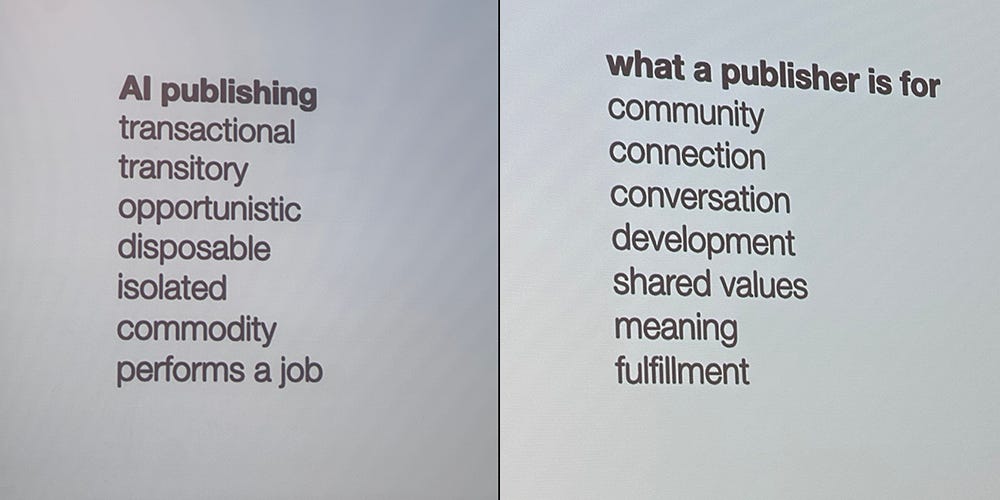
I was gratified to see this because my hybrid press, She Writes Press, checks every single one of the boxes for “what a publisher is for.” And, in fact, She Writes Press was one of the case studies in Jane’s talk, much to my surprise and deep honor.
Here’s Jane sharing about meeting the fun and very extroverted SWP author Deb Miller, who introduced herself to Jane at a writers’ conference and showed off her purse—fashion and marketing in one.
In April, ahead of Jane’s keynote, I wrote here on Substack about why I think hybrid publishing has finally arrived. In part this post was inspired by a local Bay Area publisher who’d approached me to talk through how they might integrate hybrid publishing into their publishing program. Since then, two more publishers have reached out to inquire on this same topic. I do understand that the impulse is about money and survival, but it also stems from publishers wanting to publish important books that are too risky to carry the full financial weight of all on their own.
In one case, an East Coast publisher wants to be able to expand into publishing more spiritual memoirs. They’ve been approached by a few authors with good but not stellar author platforms. The projects are very much in their wheelhouse, but they don’t think the books will necessarily earn out in this publishing environment. Five or ten years ago, maybe they would have earned out. Today, with the aforementioned content crisis, maybe/probably not.
With Jane’s language in mind, I think about this particular publisher that has an excellent reputation in the spiritual space, and I imagine the memoirists they want to sign would be thrilled for the opportunity to share the risk if it means being published on this imprint. Supposing the projects on the table are author-subsidized, will the publisher still bring community, connection, conversation, development, shared values, meaning, and fulfillment? I imagine they will.
At ALA’s Annual Conference last week, I sat on a panel where I was tasked with defining how hybrid publishing is different from traditional publishing. There are numerous differences, but for reputable hybrids with traditional distribution, the primary one is the flow of the money. In traditional publishing, the author gets an advance (or sometimes no advance but the publishing costs are covered), which they have to earn out. In hybrid publishing, the author invests (meaning they pay the cost to publish), which they have to recoup.
In both cases, the author’s job is to get to zero:
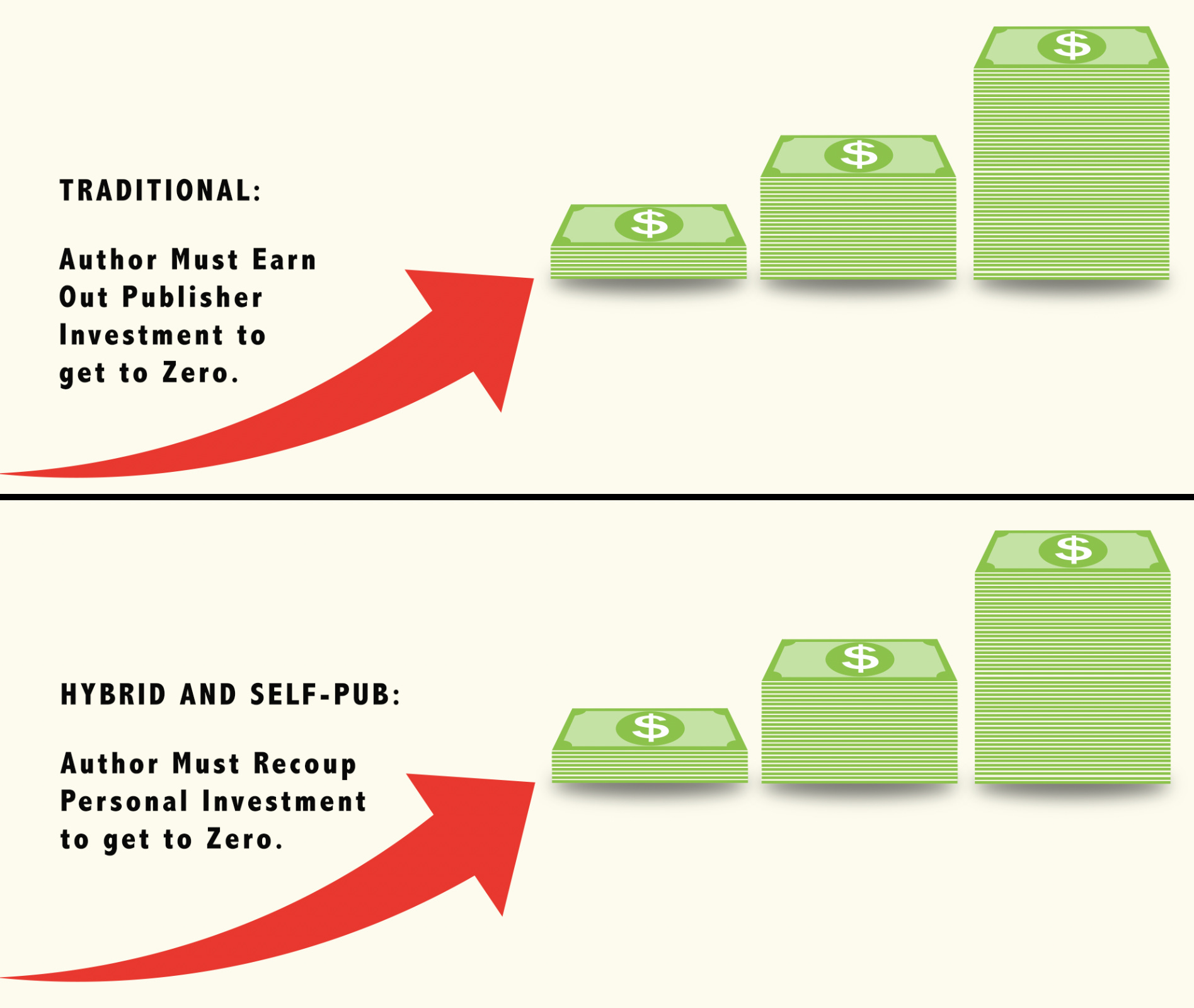
You might argue that authors who get big advances are golden because they already got their payout, so even if they don’t reach zero, they’re ahead. I disagree with this sentiment because publishers who don’t recoup their investments on the books they acquire are disinclined to ever publish those authors again. An unearned advance is a cross to bear, not something to celebrate. The industry has set up its own pressure cooker, too, because it’s this expectation of advances, and the increasingly low likelihood of authors earning out, that’s causing traditional publishers to turn away meaningful projects, and/or to start considering cutting hybrid deals so that they can publish books they really want to publish by sharing the risk with authors.
I hope this post inspires aspiring authors to really consider the value proposition of the publishers they’re wanting to work with, and to take in the importance of the soft metrics. When people ask me what sets She Writes Press apart, I most often answer: the community; the education; the fact that you will not alone on your publishing journey. These aren’t the only things we offer, but they’re consistently the things that authors tell me they value. And you won’t find any of these listed in our author contract because they’re not aspects of our program we can or try to monetize. They’re just baked into the ethos of who we are and what we do.
Which brings me back to Jane’s question from the stage in Berkeley: What is the publisher for? The answer doesn’t lie in who’s fronting the money. It lies in the relationship, which is the commitment a publisher and an author make to a shared vision for the book and its journey from the author’s head to the reader’s imagination.
Upcoming publishing classes:
July 9: Today’s Key Book Publishing Paths, with Jane Friedman
Jane is a wealth of information, as many of you already know. I encourage you to subscribe to her newsletter, “The Bottom Line,” and I’m spotlighting this upcoming class for authors who are trying to get a lay of the publishing landscape, and/or who are interested in learning more about key publishing paths.
From Page to Pitch to Submission, with Brooke Warner, Grant Faulkner, Courtney Maum (Before and After the Book Deal), Dan Blank, and The Book Doctors
This fall, Memoir Nation is hosting a book proposal/pitch/submission intensive aimed at supporting memoirists to develop a book proposal, to write and refine a written and verbal pitch, and to follow through with submitting. The course covers the pitch, the proposal, author platform, author mindset, and culminates in a live Pitchapalooza and three live “submit sessions” to support you to see the work of submitting through in real time.
Thanks for sharing with an author or writer in your life . . . ⤵
No posts
Comments
Nothing yet. Say the first thing.
Sign in to join the conversation.