
You might not expect it, but some of the more radical voices of the American Revolution came from farmers.
“Wealthy men make laws to protect their wealth, not to do justice to the poor.” Herman Husband, farmer and preacher, 1770
“We will no longer be oppressed by those who enrich themselves at our expense.” George Sims, farmer and teacher, 1765
Their actions raged against the wealthy men who promised liberty and justice only to those who could afford them. The rich were, in their words, “moneyed parasites who did not live by their own labor.”
Revolutionary War era farmers wanted an end to the oppression by the wealthy elite. Oppression from both Loyalists and Patriots alike. Their voices should have been heard. They were the masses; 19 out of every 20 white people lived in rural areas.
The farmers wanted control over local courts and a voice in the government that ruled their lives. They described wealthy elected officials as men whose “highest study is the promotion of their wealth,” while “the interest of the public” was ignored. They went after the men profiting from that arrangement: government officials, lawyers, speculators, landlords, and corrupt sheriffs who served a system built for men “whose interest it was to oppress, and make gain of the labourer.”
Farmers wanted credit to improve their farms and land their families could actually keep. Many worked as tenants under wealthy landlords. Some became tenants after losing their land to richer men with competing land claims. Others owned land but they were still crushed unfairly by taxes and fees.
These are the farmers of my story.
I won’t be talking about the plantation owning farmers, like George Washington, Thomas Jefferson and James Madison, besides to mock them, but that portion of the story is for paid subscribers.
Before the American Revolution, farmers were already fighting a war against the rich. In 1745, farmers armed with clubs, axes, and crow bars marched to a jail to demand the release of a man imprisoned for cutting down trees on land claimed by their wealthy, slave-owning governor. They tore the entire jail door off and freed him. When more farmers were arrested for resisting, 300 farmers came back and freed them too.
In 1766, 200 farmers went after an oppressive landlord, saying they had “marched to murther [murder] the lord...and level his house.” Again and again, farmers freed men arrested for rising up against the wealthy. In one story, they broke prisoners out of custody, arrested the corrupt sheriff instead, and brought him to a different jail.
The spirit of resistance was in farmers across colonial America…
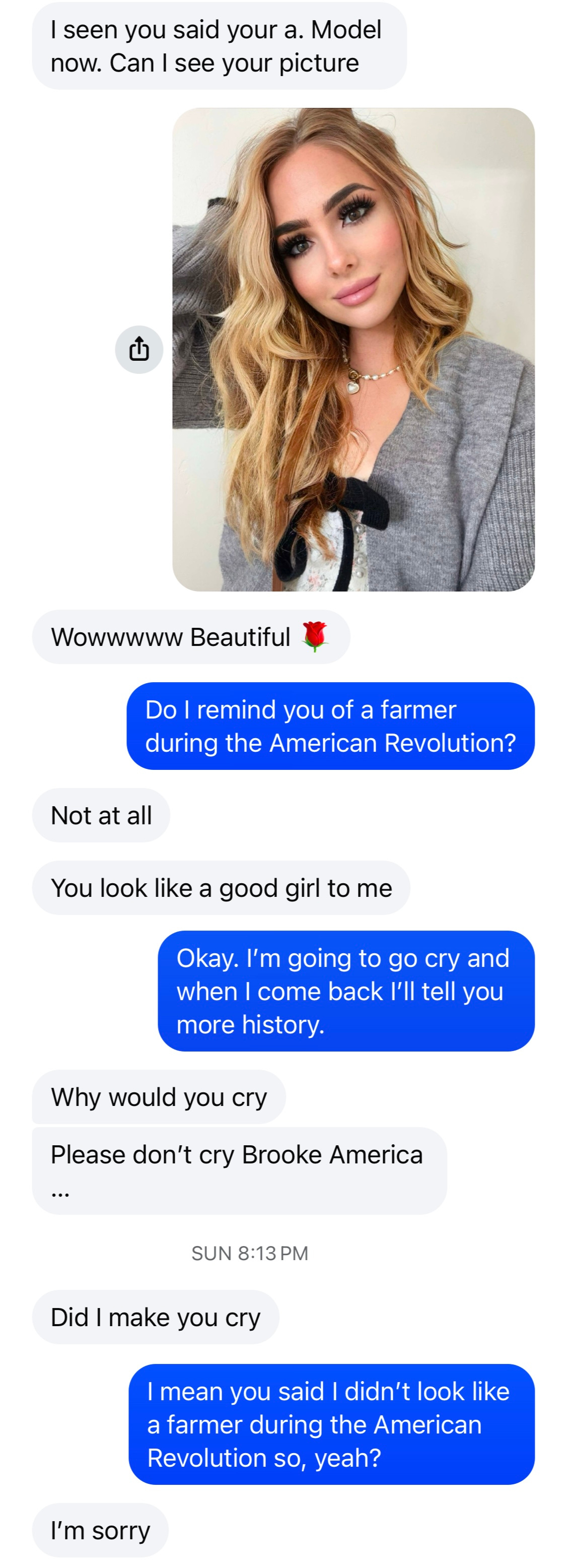
Contestant A
(As a reminder I do not know these men. They are right-wing men messaging a satirical Facebook profile of me as a conservative.)
I would appreciate if you heart reacted this post for me. More engagement means more people might see my work. ♥️
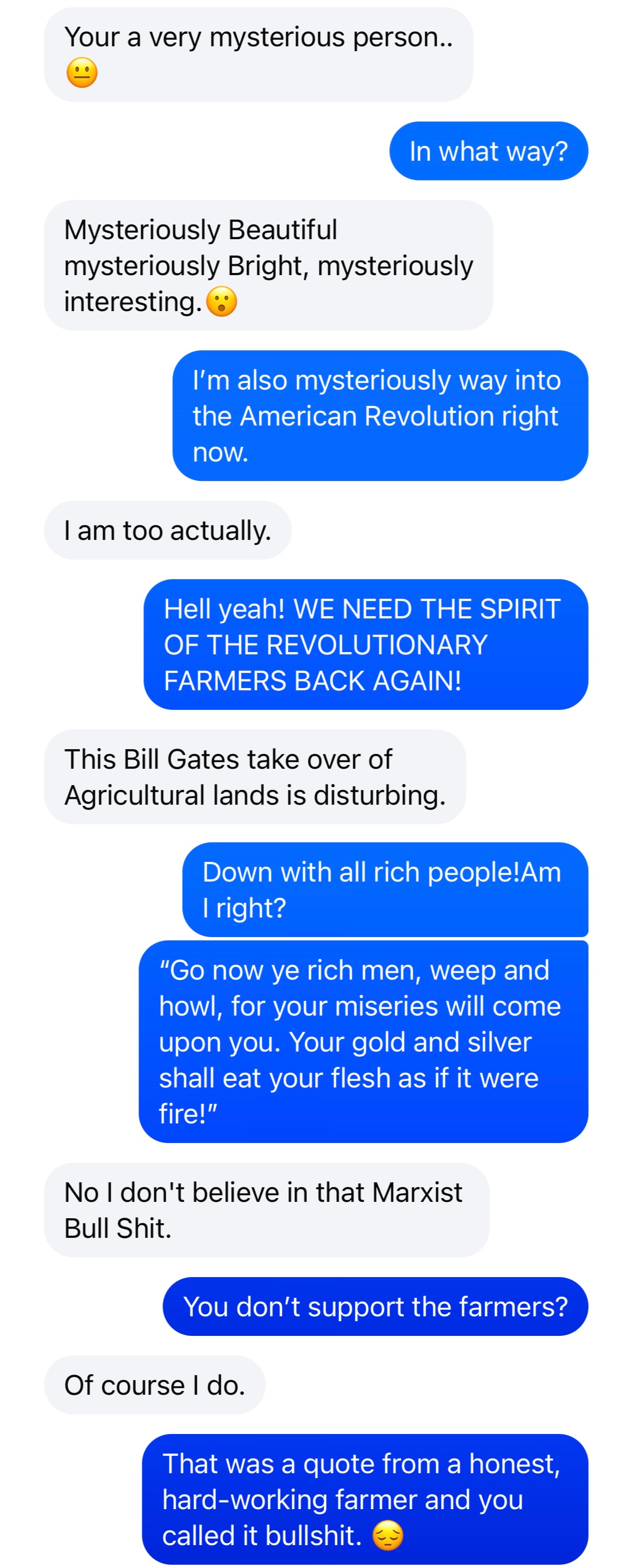
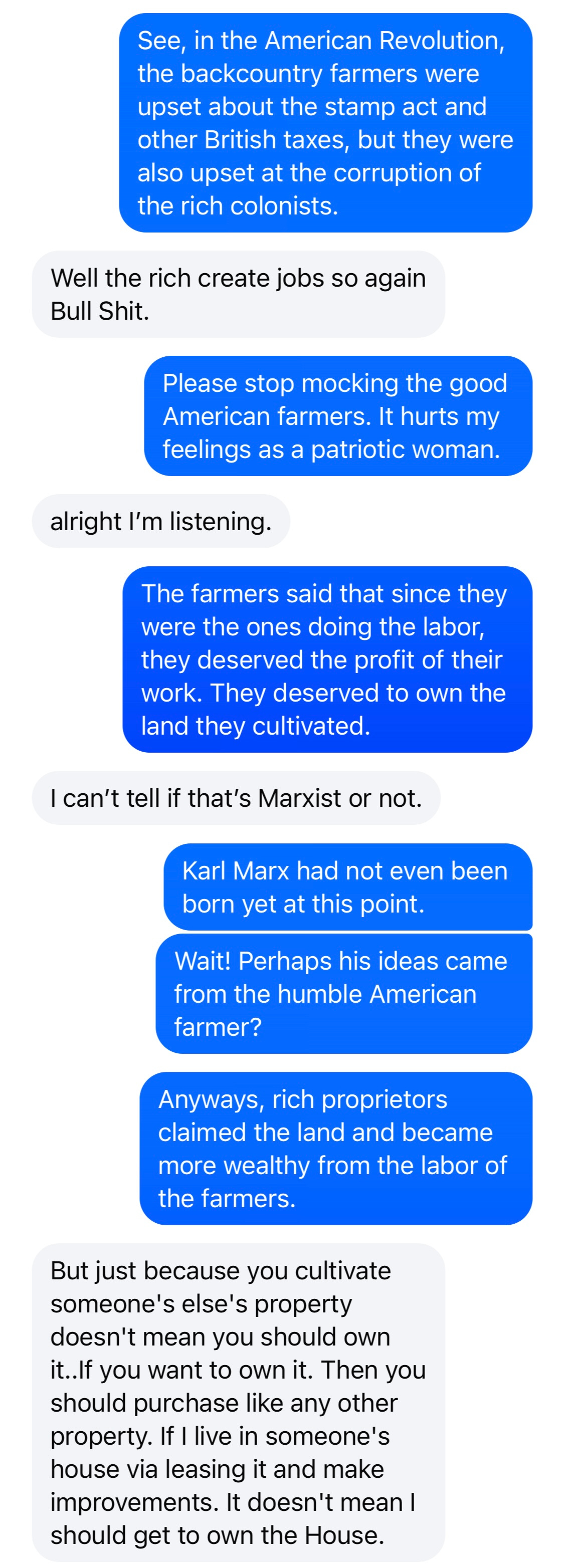
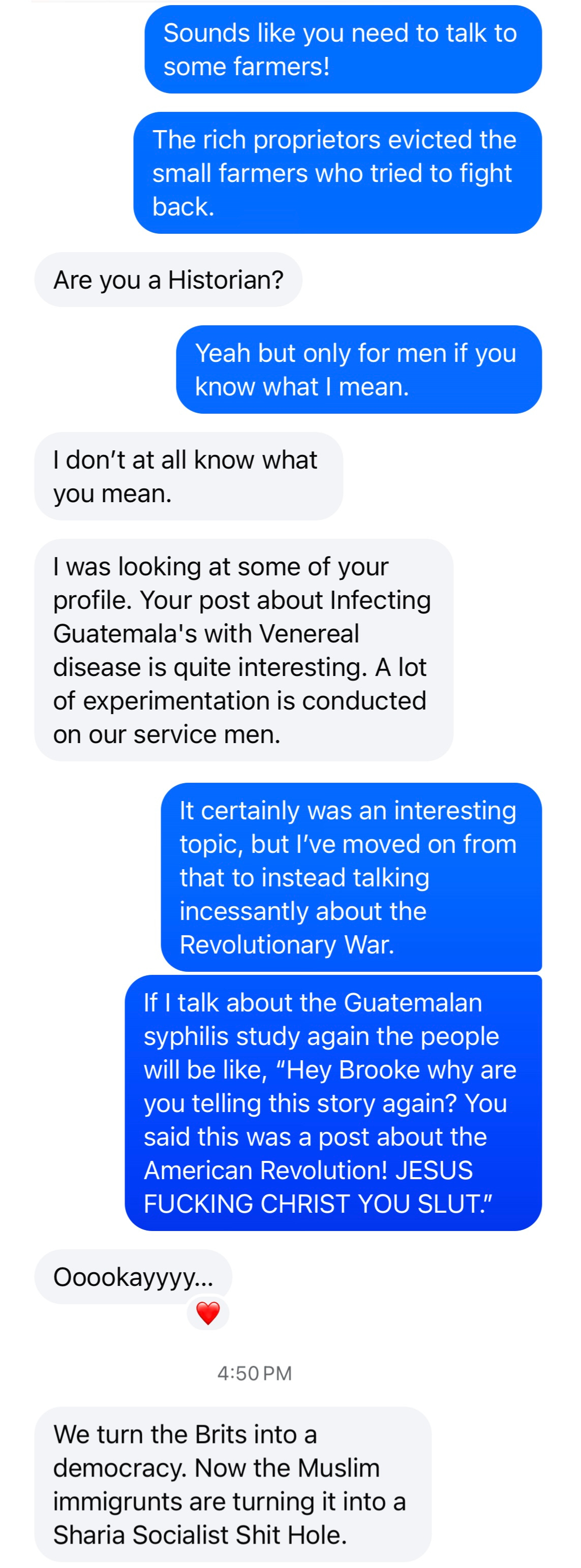
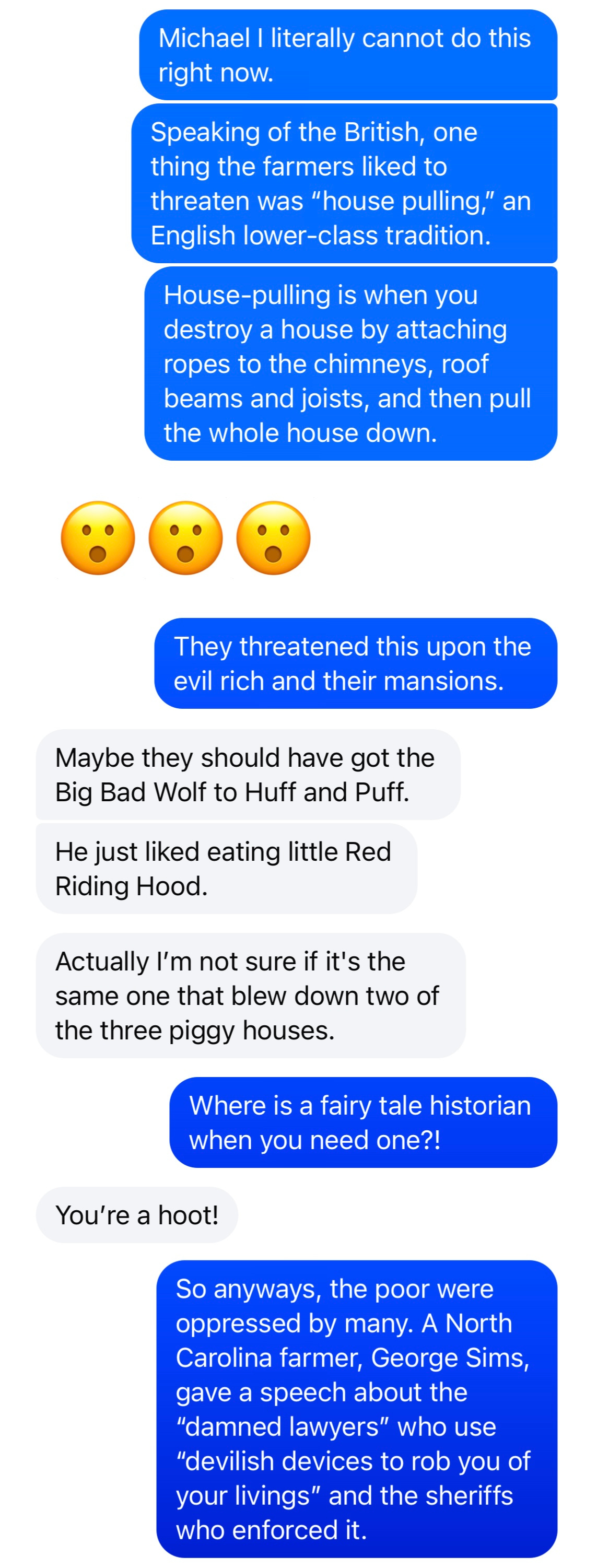
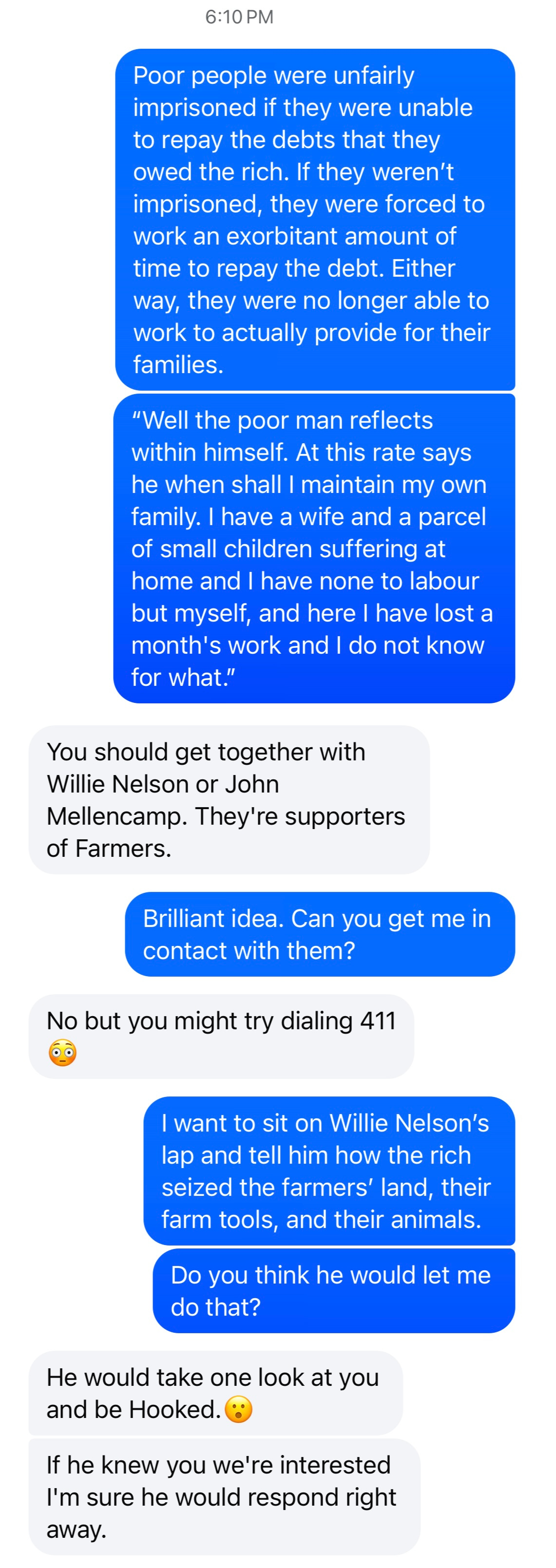
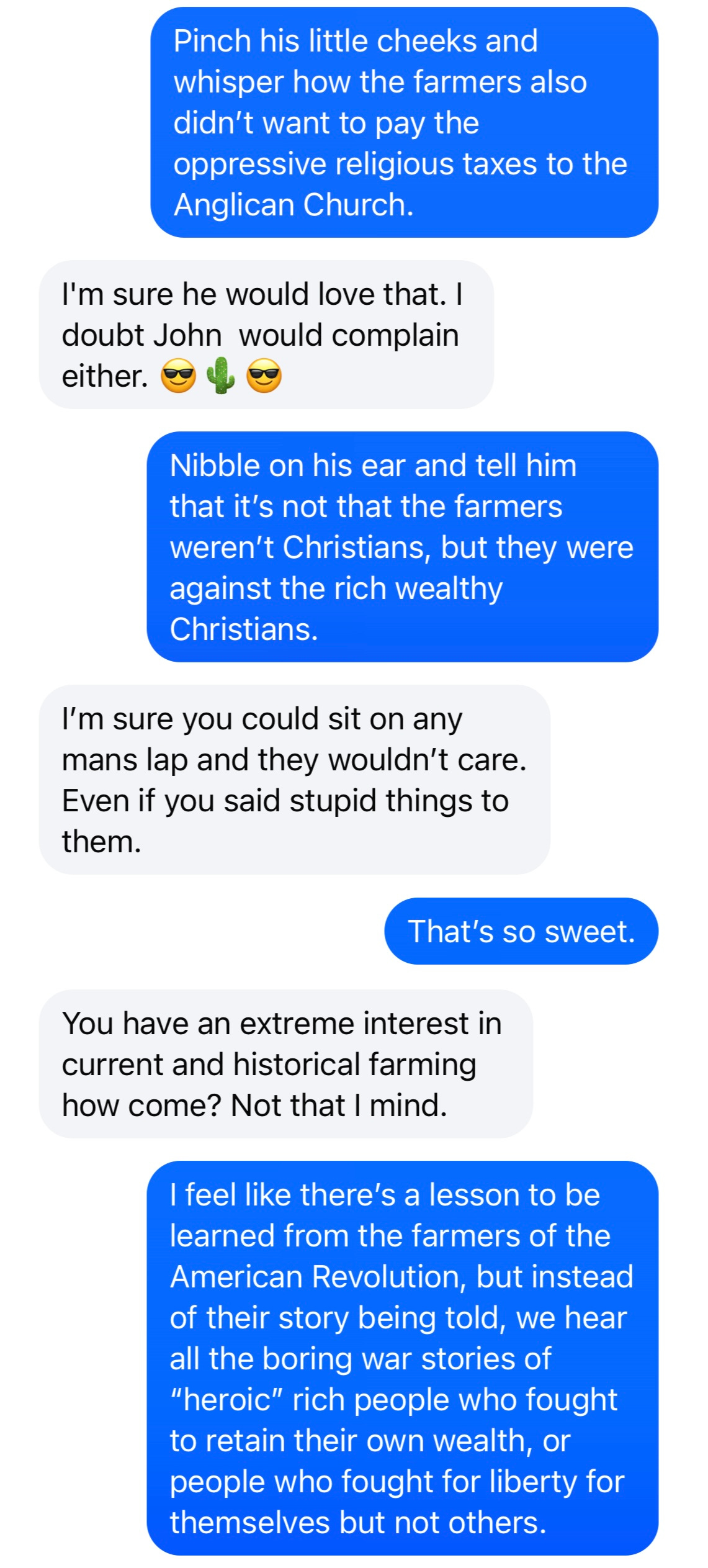
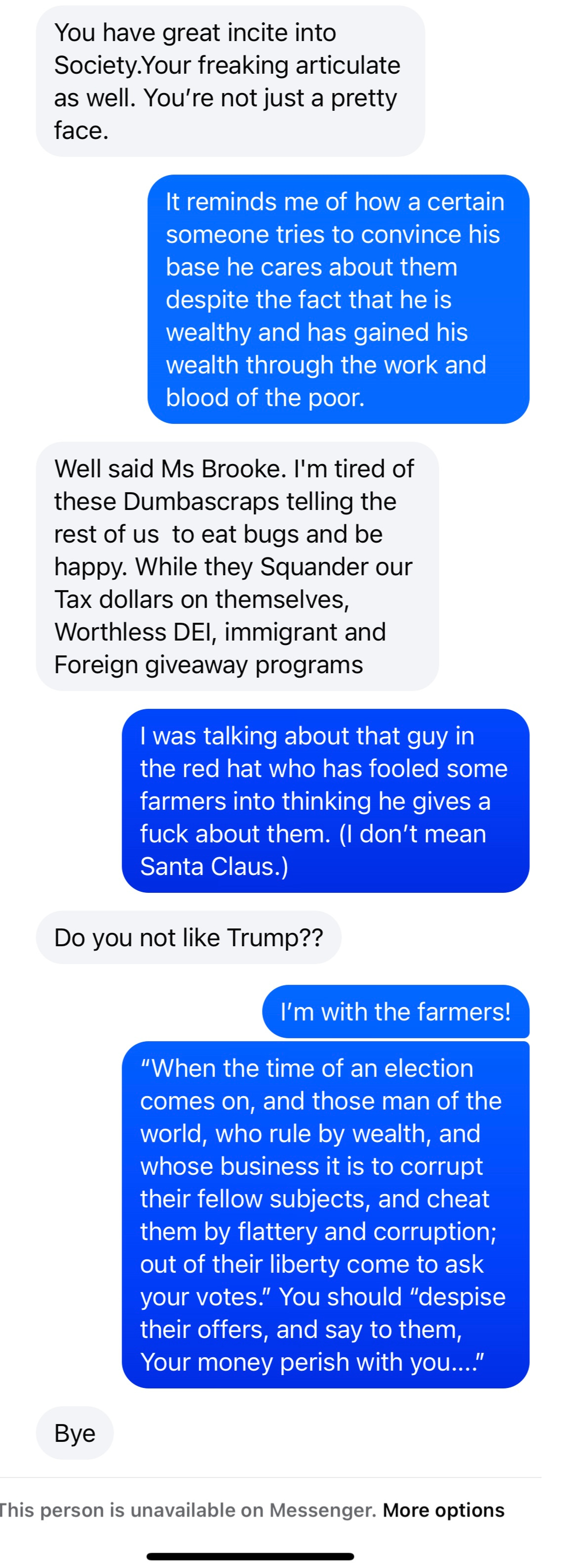
You can find the story about Guatemala here. To be clear, he did not know who I really was. He was referring to a post I had put up on my right-wing profile.
Groups of farmers pulling down the houses of the rich. Beautiful.
One farmer warned that if a rich proprietor caused more people to be jailed, “they wod go… and pull [his] House down about his Ears!” And because Contestant A was so worried about Marxism, I should mention that one farmer even said he wanted members “of the same society to mutually assist each other according to their abilities.”
Contestant B (Daddy)
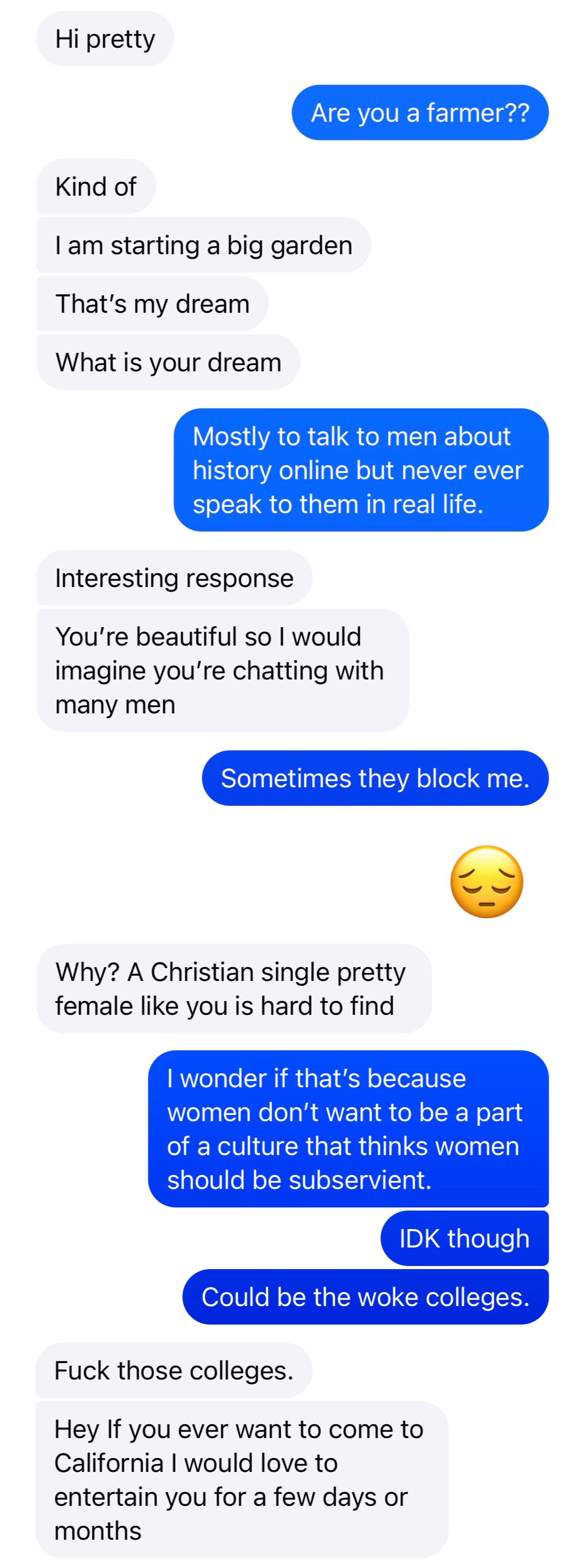
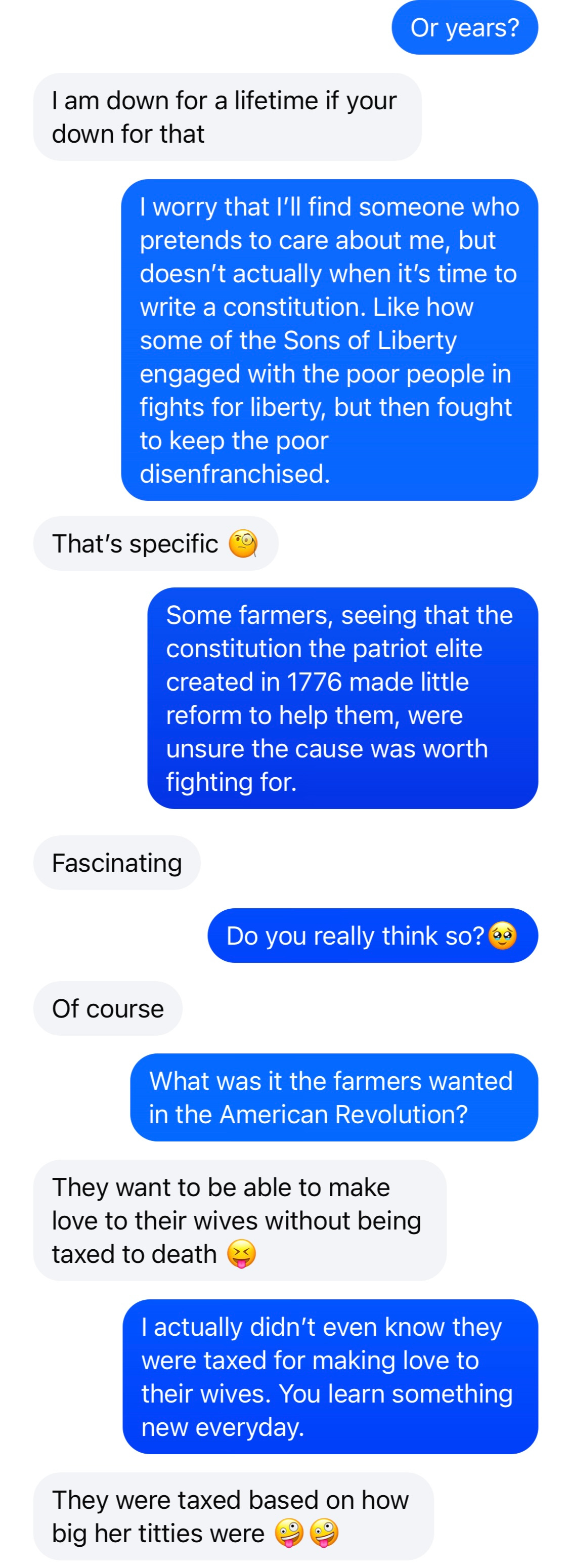
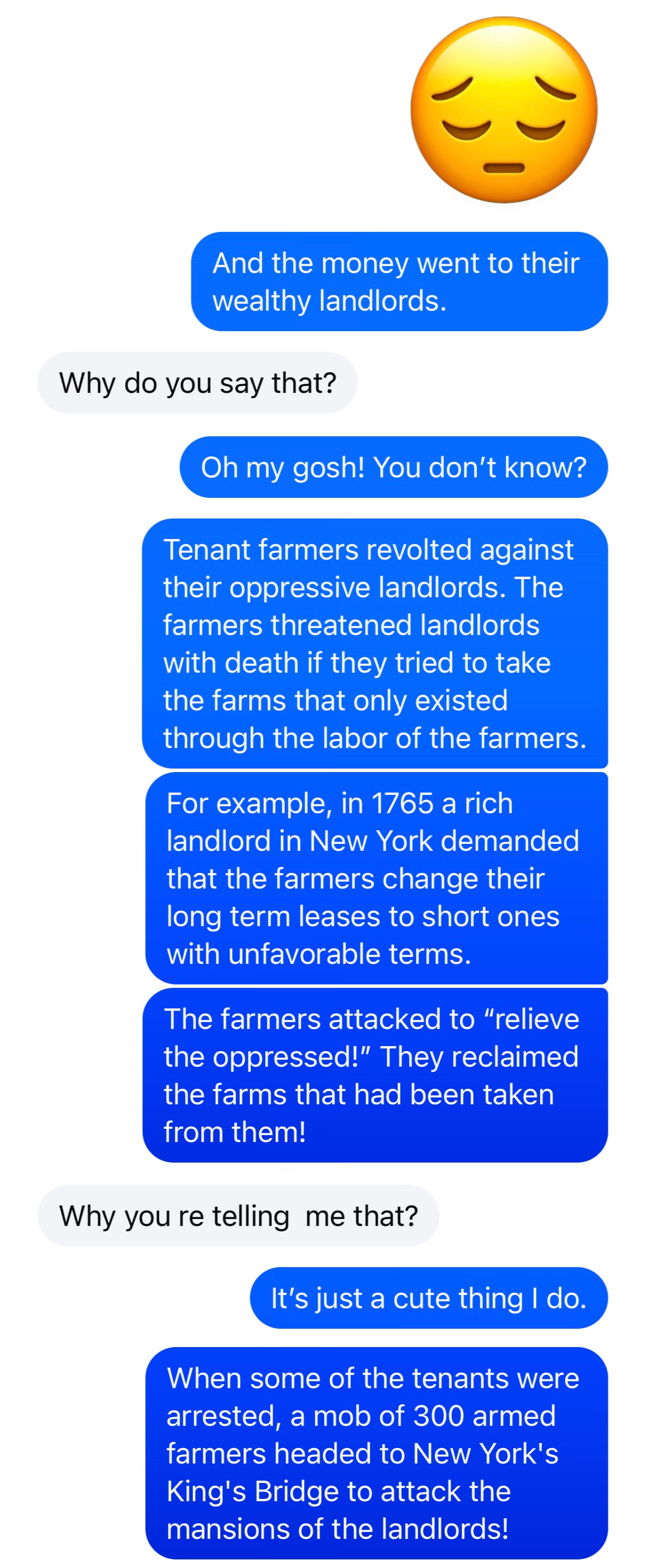
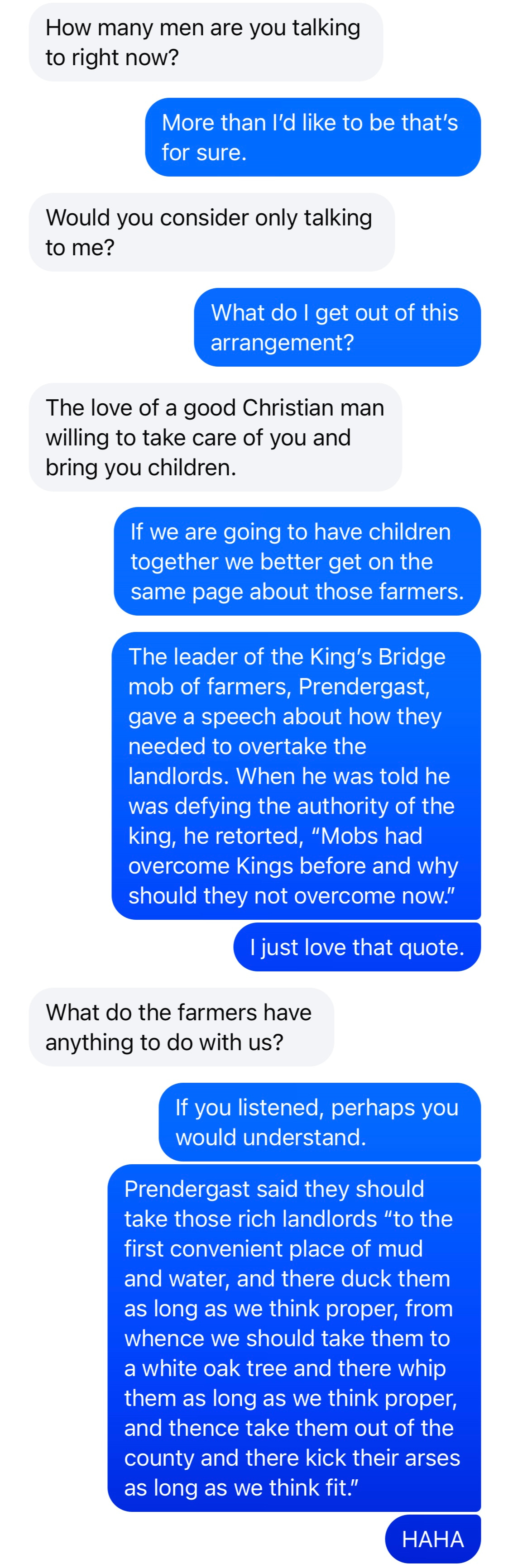
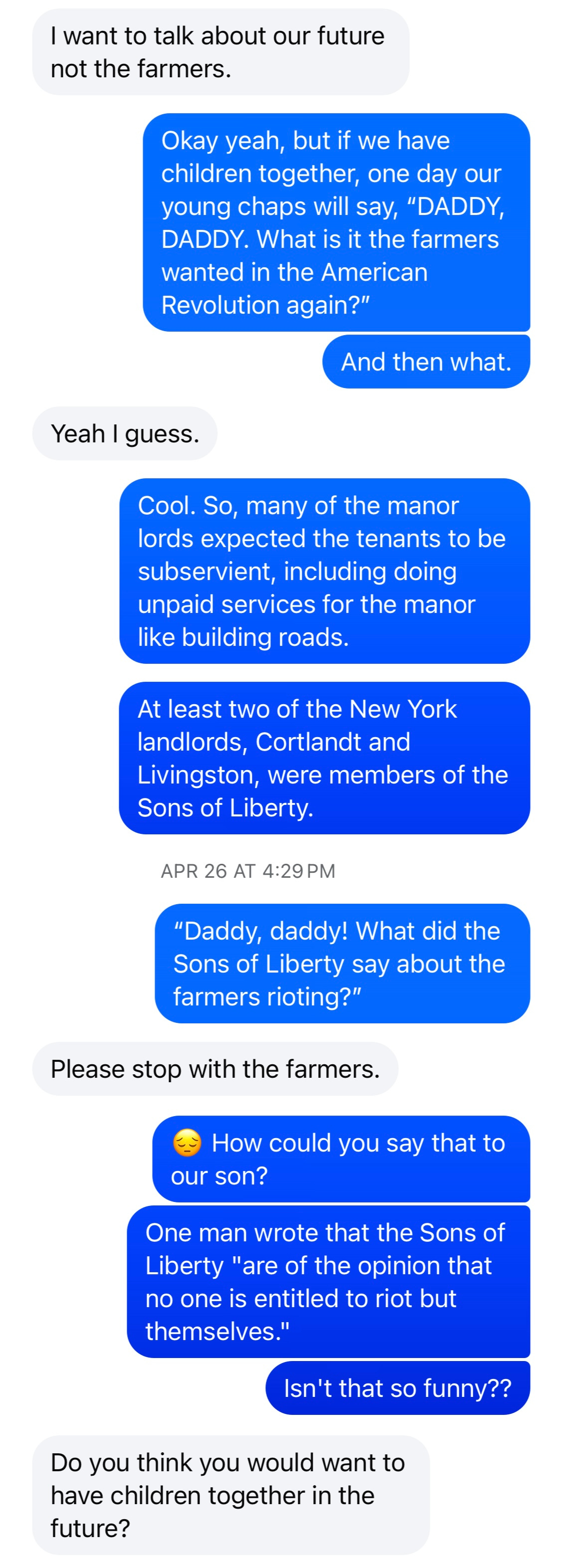
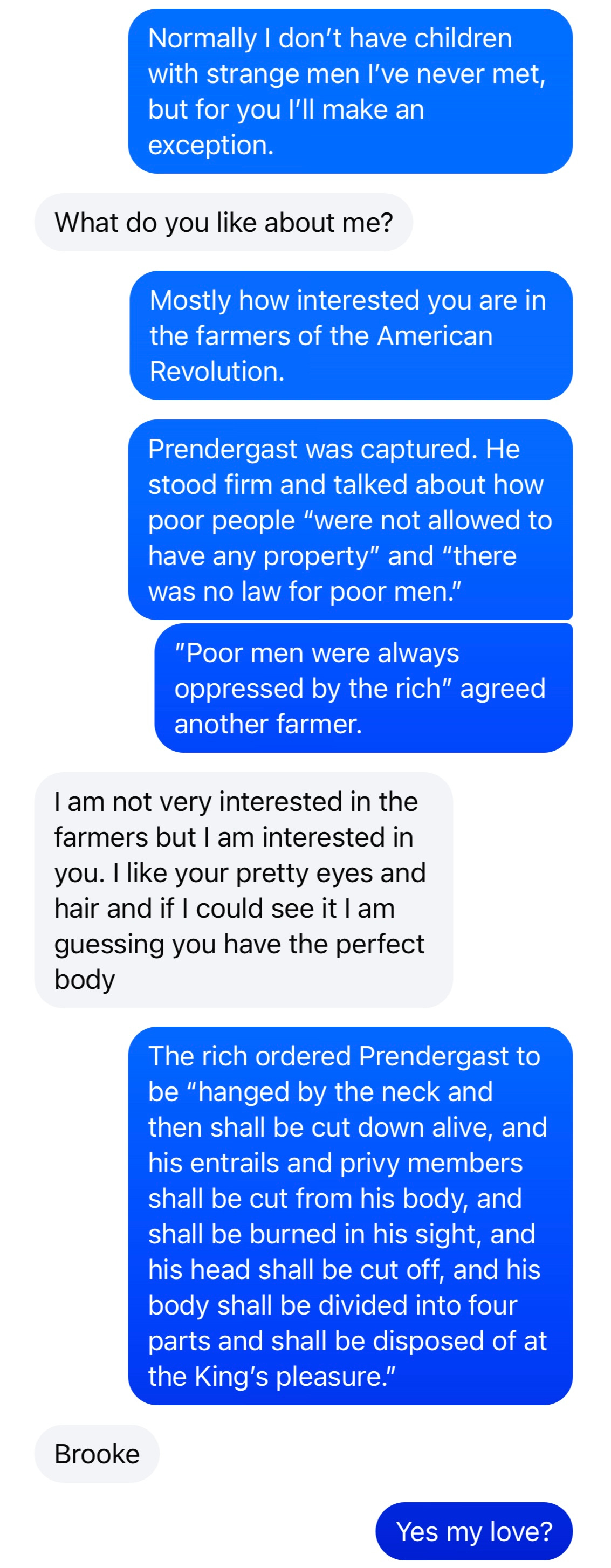
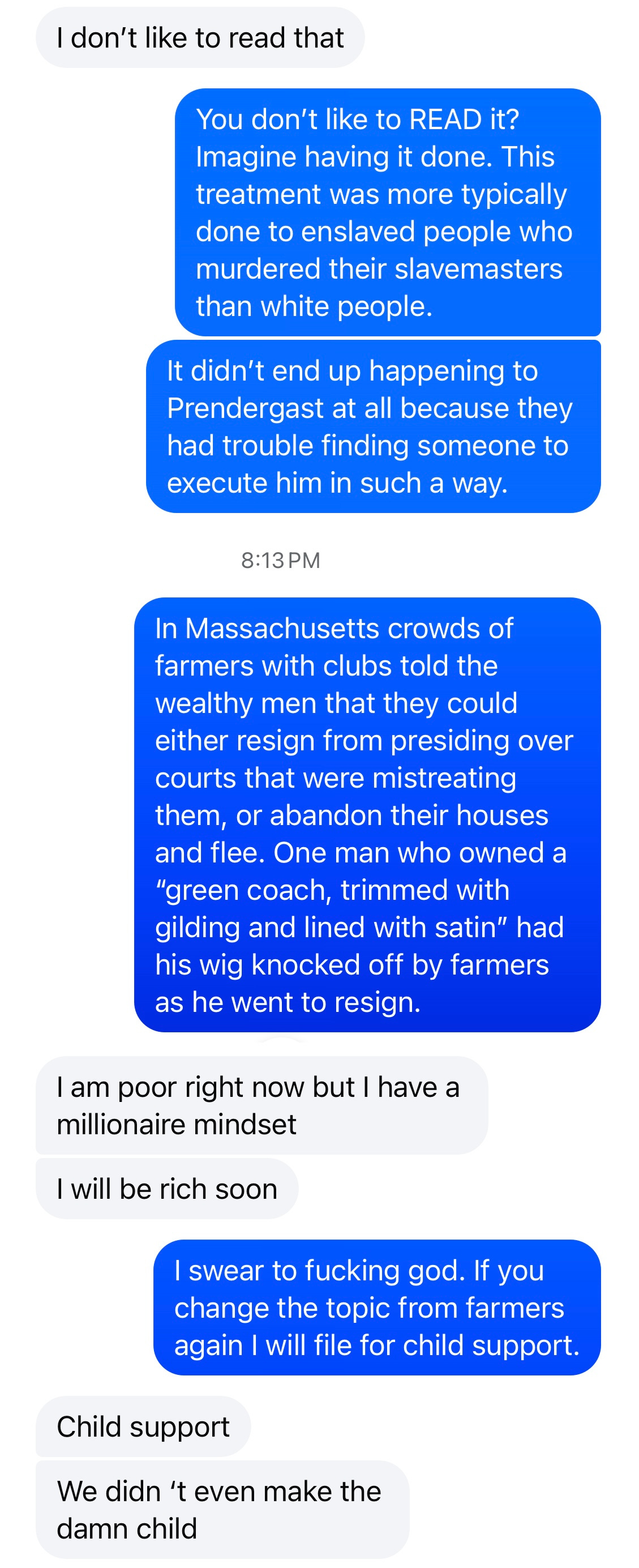
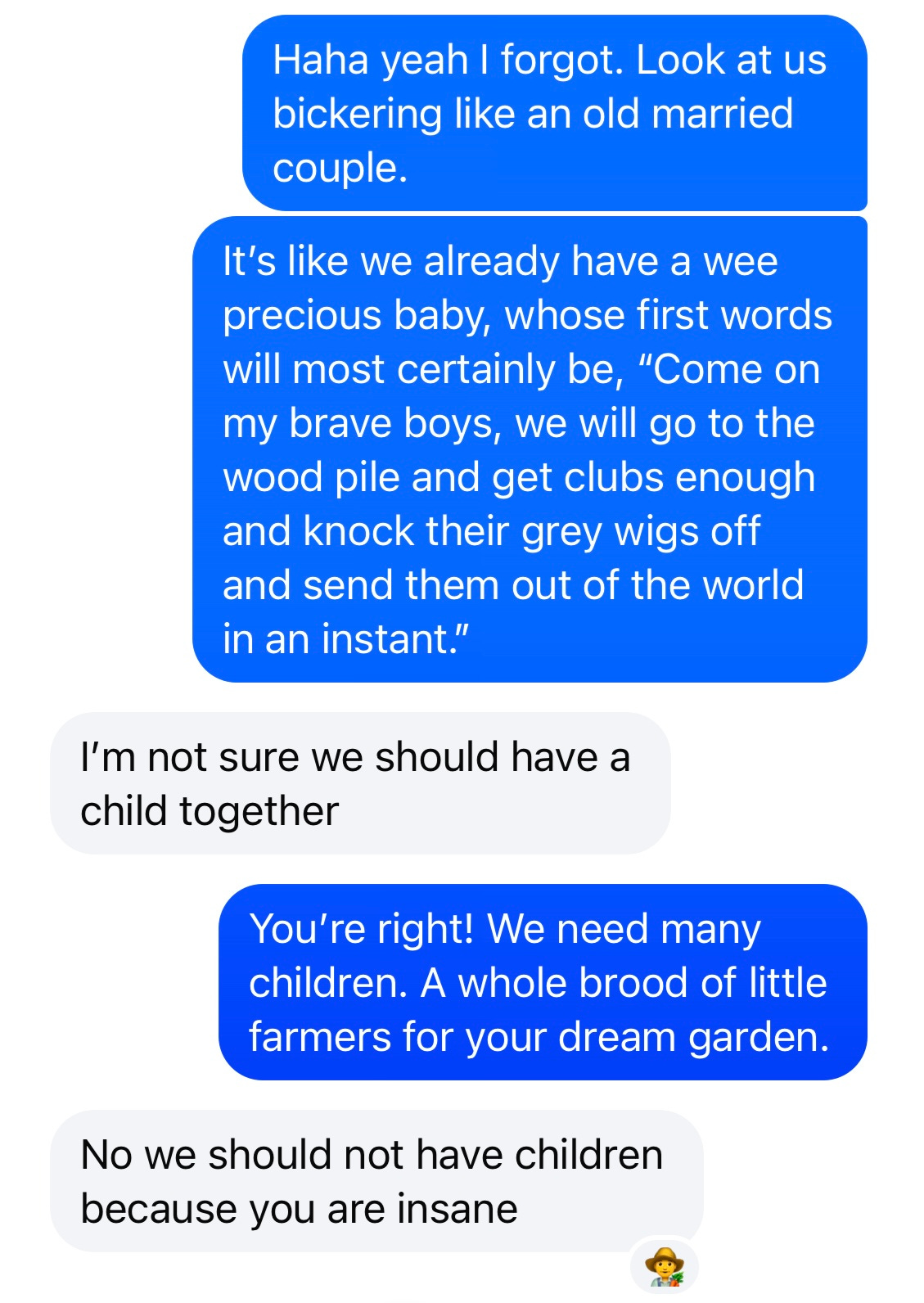
Alas. I will have to find another man to impregnate me. Unsurprisingly, that’s an extremely common offer these men like to make to women they have never met.
Contestant C (The Poet)
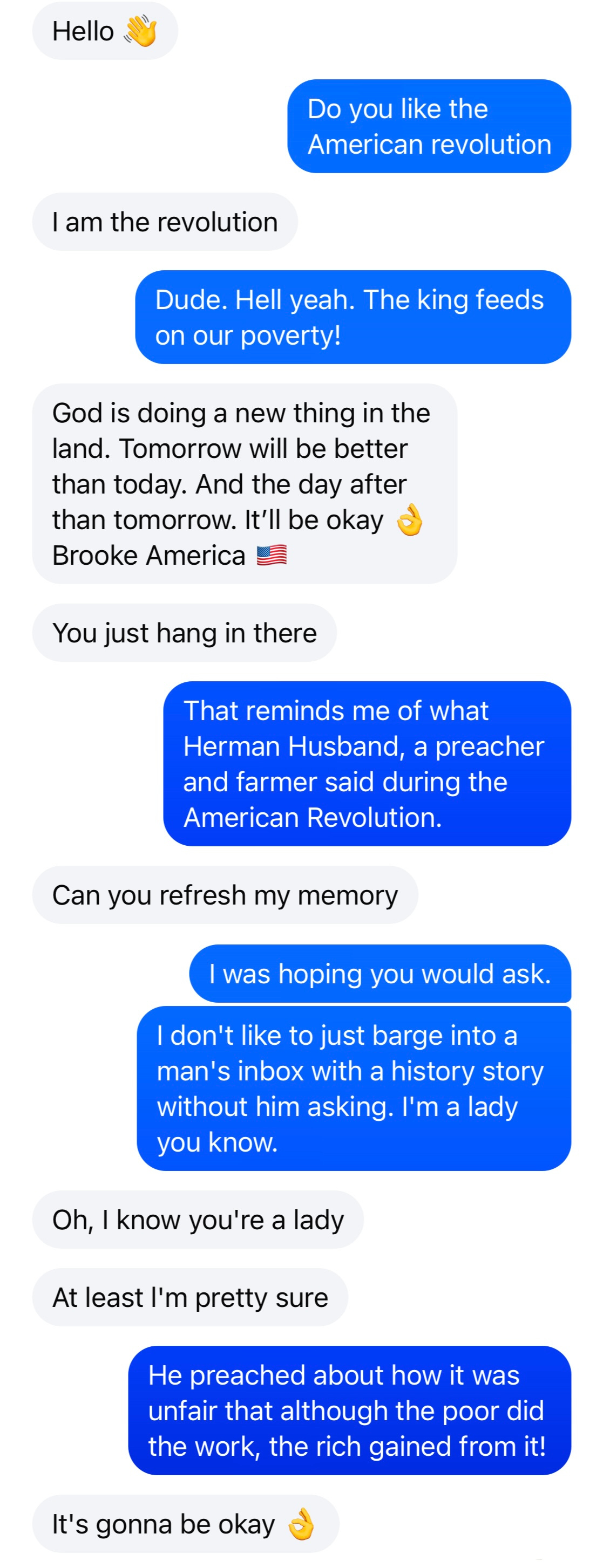
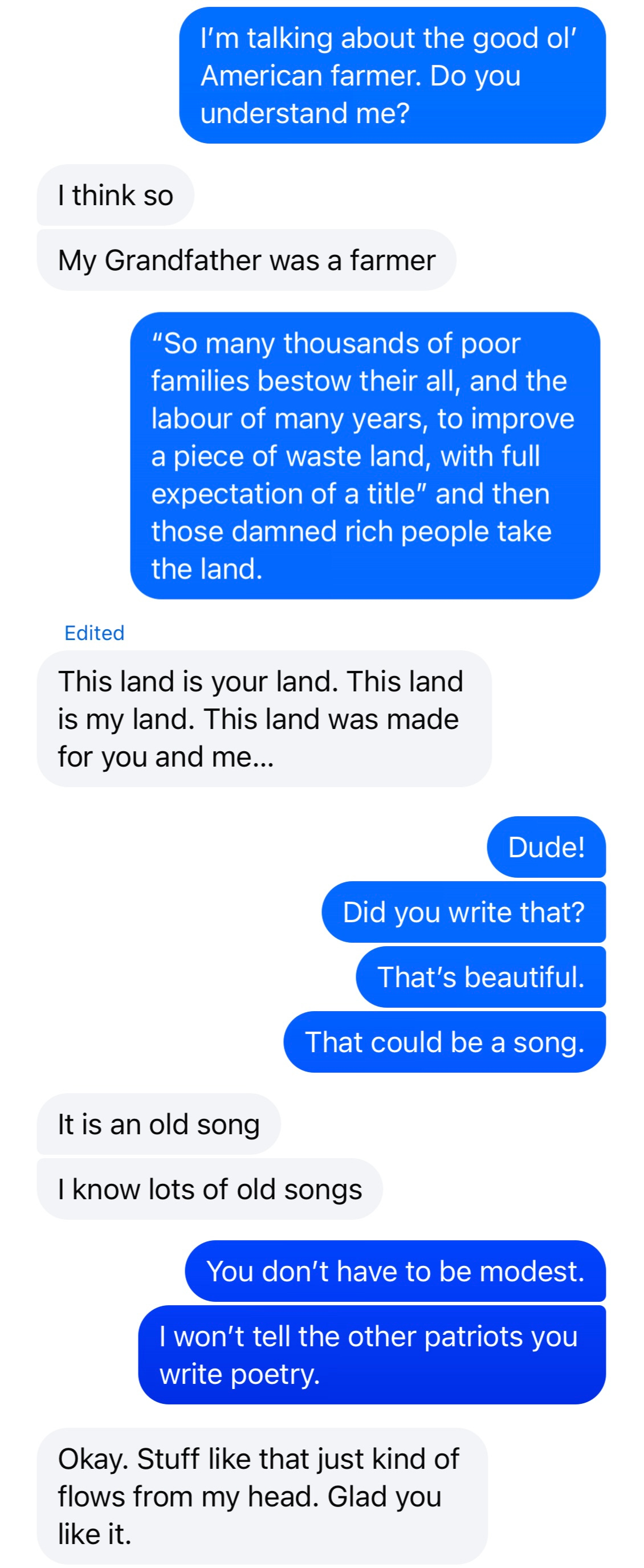
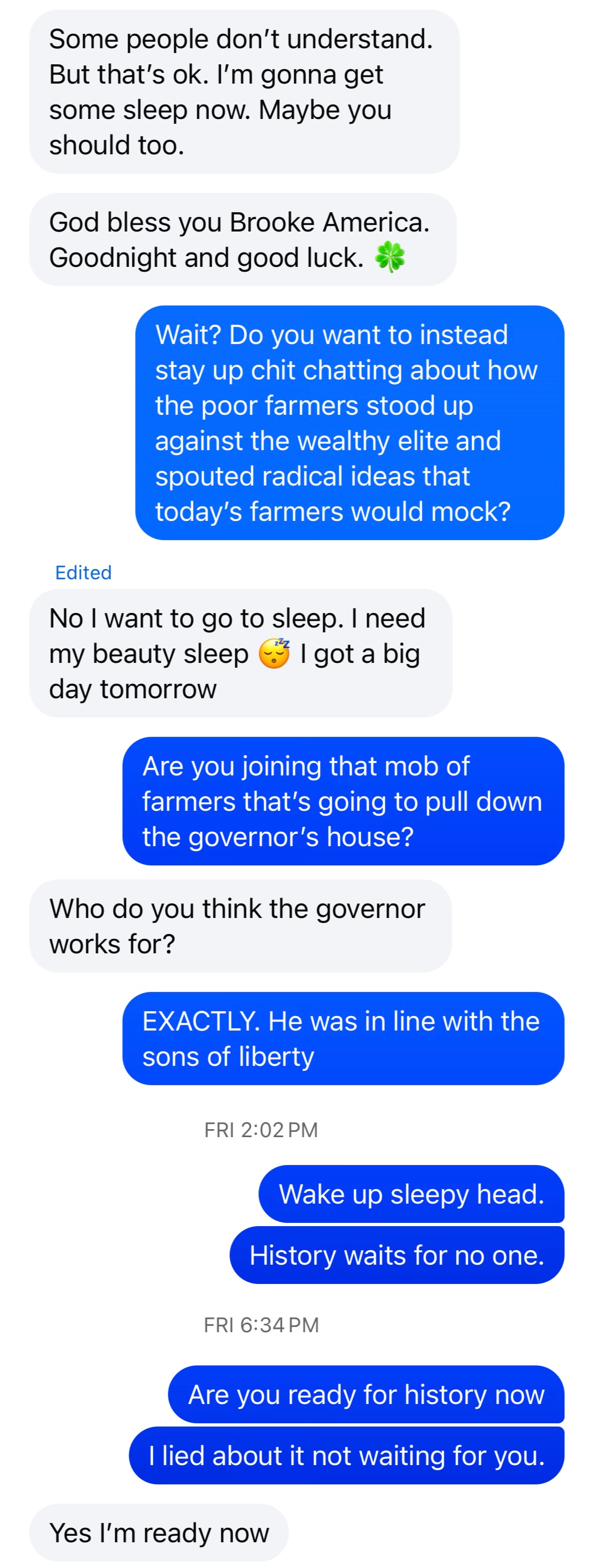
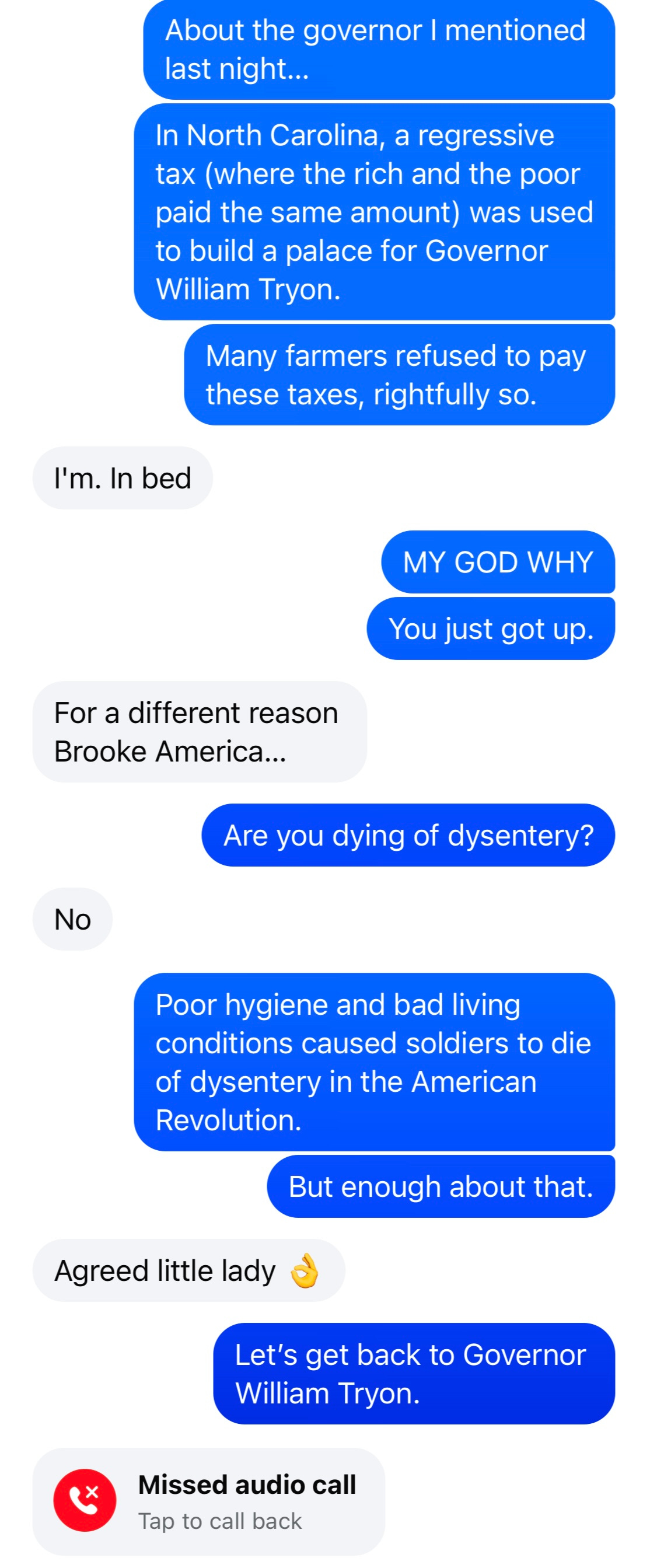
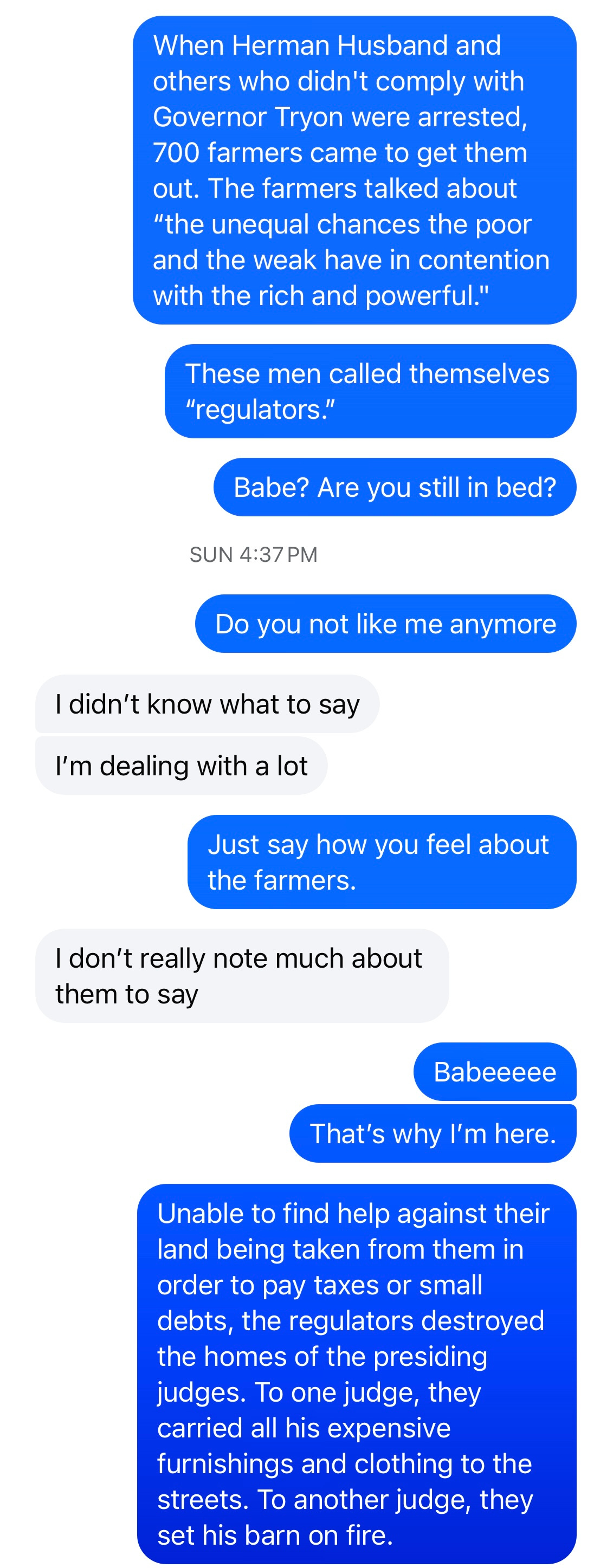
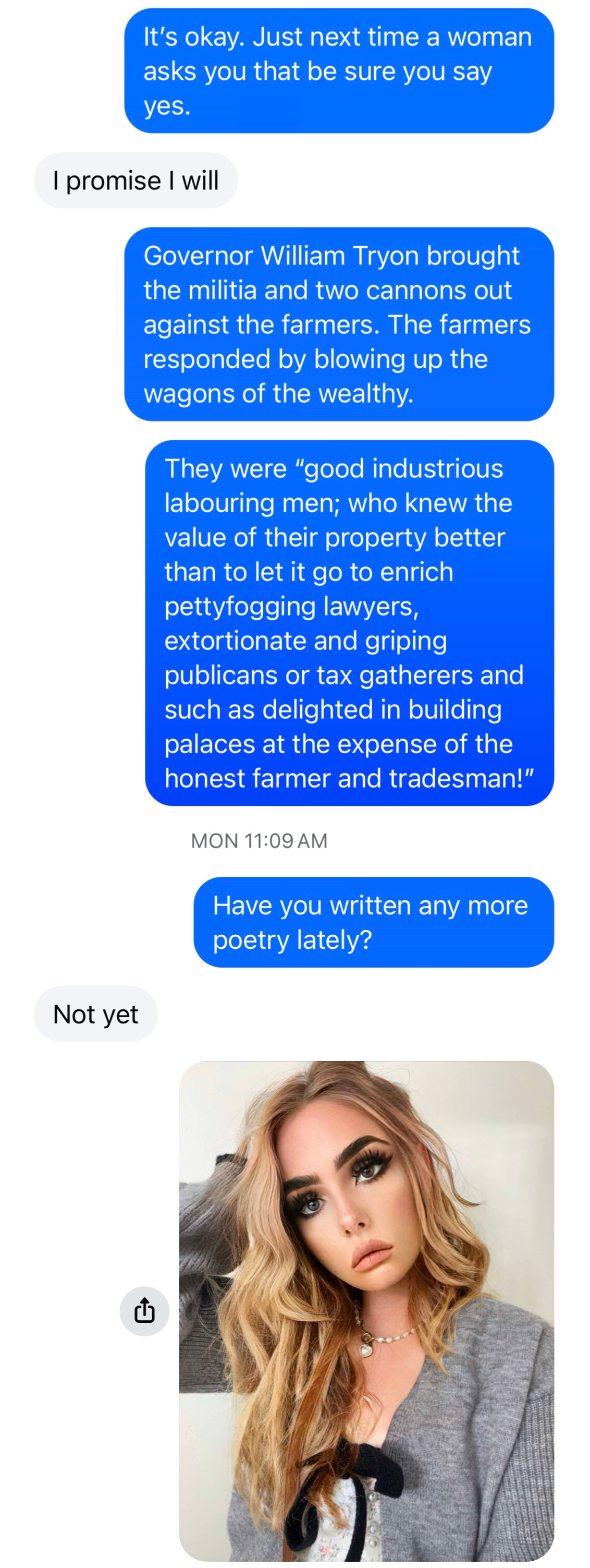
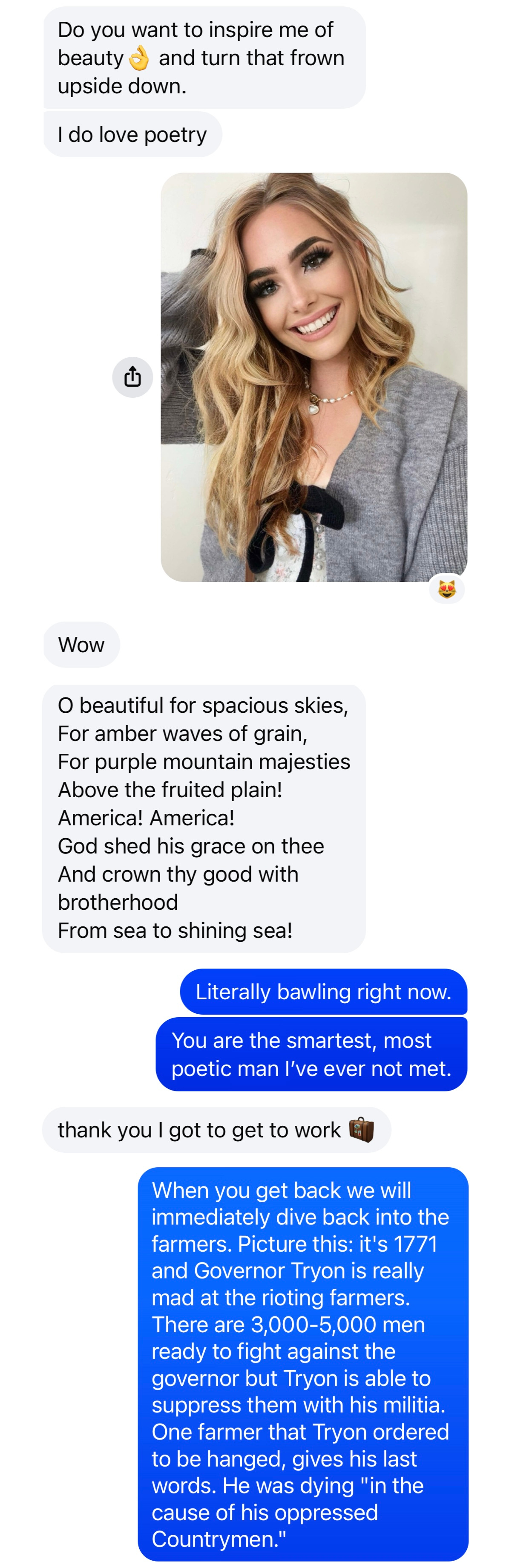
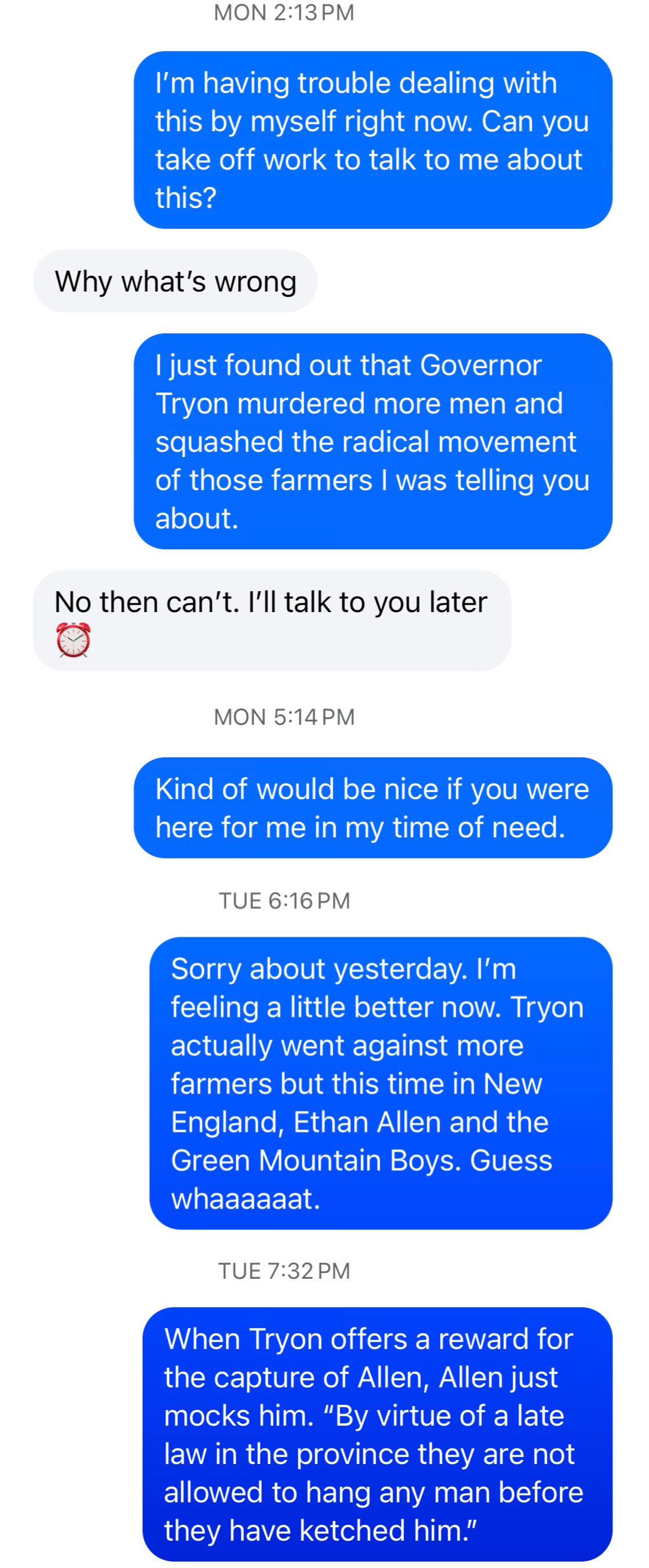
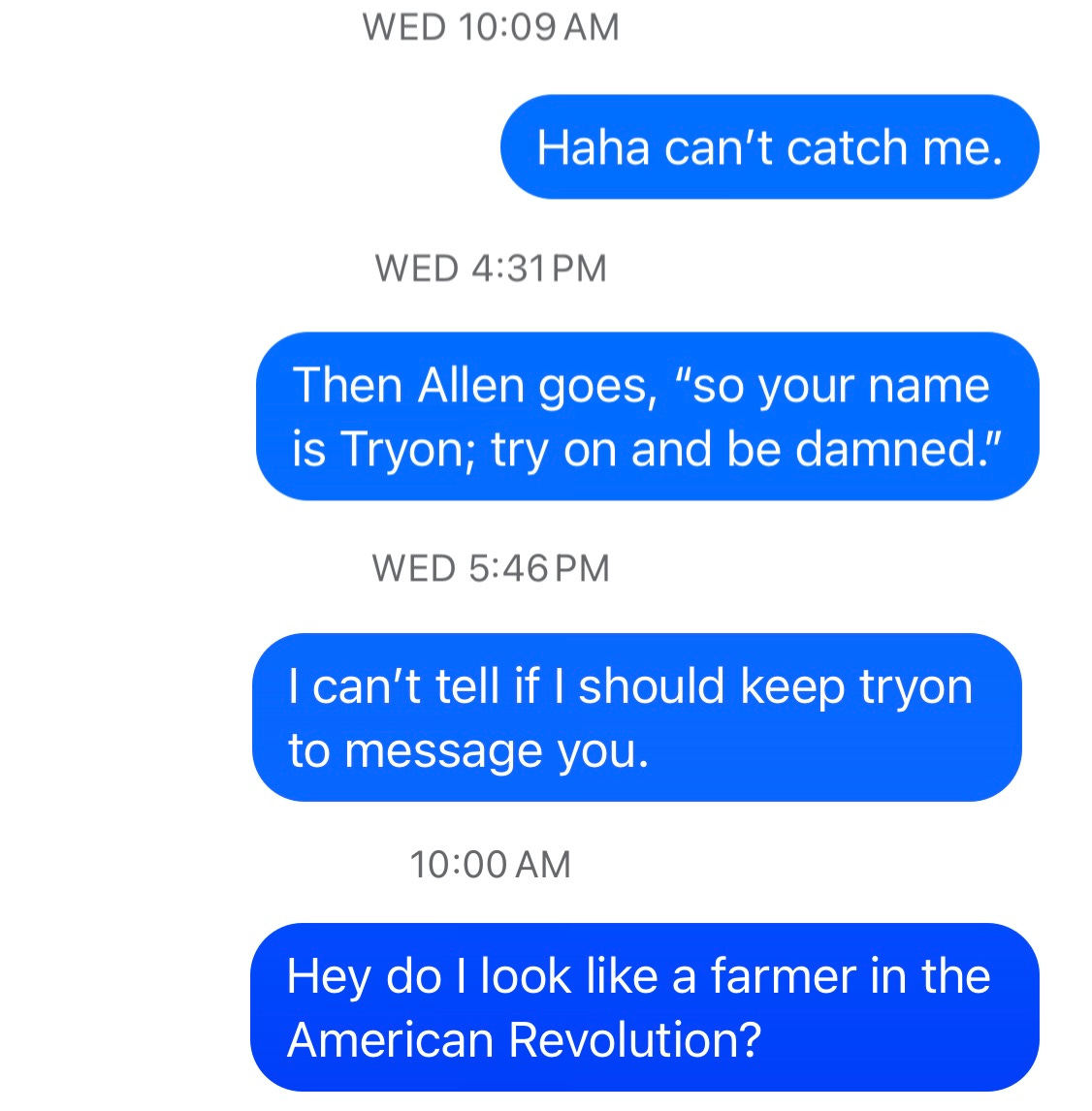
Ethan Allen belonged to the Green Mountain boys, who described their enemies as “a number of Attorneys and other gentlemen.” The group left behind many quotes worth enjoying. After burning a house, they exclaimed that “they had resolved to offer a burnt sacrifice to the Gods of the World,” then shouted, “Go now and complain to that damn scoundrel, your governor. God damn your governor, laws, king, council, and assembly.” Allen also satirically declared a bounty for the capture of several wealthy men from New York.
This is a post about the Revolutionary War era, and I haven’t even mentioned actual battles. Poor farmers fought as Loyalists and Patriots, sometimes choosing whichever side stood against the landlords who had mistreated them.
In the war itself, poor people, including poor farmers, were at a disadvantage against the wealthy Patriots whose liberty they were expected to secure with their bodies. The poor endured the bloodshed directly, while men with money could avoid enlistment by paying substitutes or sending servants, and enslavers could send the people they enslaved in their place. Poor men were given the honor of dying for freedom, while rich men kept the freedom to stay home.
The poor suffered. “We had nothing to eat for two or three days... Except that the trees of the fields and forests afforded us,” Joseph Martin, a farm laborer, wrote of his time in the Continental Army. When Congress decided on a day of thanksgiving to honor the men, the country opened what Martin called its “sympathizing heart” and gave the soldiers “something to make the world stare.”
It gave them “half a gill of rice and a tablespoonful of vinegar.”
Martin called this an “extraordinary superabundant donation,” because sarcasm was one of the few rations the poor could still afford. Wealthy Americans kept eating their meats, breads, fruits, vegetables, and dairy. They kept drinking their alcohol. Rice and vinegar for the poor.
The poor bled. “The greatest part were not only shirtless and barefoot but destitute of all other clothing, especially blankets. I procured a small piece of raw cowhide and made myself a pair of moccasin.” Other soldiers went barefoot “till they might be tracked by their blood upon the rough frozen ground.”
Many conservative patriots wanted independence, but they did not want the Revolution getting any dangerous ideas about equality. The common people, including farmers, could fight the war. They could suffer for it. They could die in it. But men like Alexander Hamilton and John Adams still believed the wealthy should be the ones trusted with power. Hamilton said the poor “seldom judge or determine right.” Adams called the political ideas of radical farmers and other working class people “ridiculous projects.”
Farmers looked at the new constitution and saw very little meant for them. Property requirements for voting, they argued, “declare honest poverty a crime” stripping suffrage from men who have “fought and bled in their country’s cause, are deprived.” Some pushed beyond the rights of white men asking why a person “born in Africa, India, or ancient America or even being much sunburnt” should be denied the vote.
They had fought for independence and been rewarded with a “grievous and insupportable load of taxes” that served the wealthy. Their compliant was not subtle. “If the rich and powerful are suffered to prescribe [the law], and the poor and weak are obliged to submit, liberty is but a name”
Even confiscated Loyalist property was not given to the poor soldiers who had fought the war. It benefited, as wealth so often does, those who were already wealthy. The farmers had a name for those men: “moneyed parasites who did not live by their own labor but, instead, preyed on the many who did.”
Patriot farmers had fought for liberty and still found themselves begging for it. "We have made great sacrifices in the cause of liberty... and now find ourselves oppressed with taxes and lawsuits, deprived of that very liberty for which we fought and bled.” Their postwar uprisings were suppressed by the same elite men who had shouted “liberty” when the needed poor men to fight for it.
Liberty sounds different from below.
The accumulation of enormous wealth… will necessarily produce a degree of influence and power, which cannot be entrusted in the hands of any set of men whatsoever without endangering the public safety.”
A farmer
The biggest threat to democracy is “enormous wealth, possessed by individuals”
William Findley, farmer and politician
Paid subscribers have a bonus post linked below!
If you aren’t already a paid subscriber, subscribe below or subscribe at a discounted rate here: 25% off, 50% off, 75% off, 90% off
Sources:
The American Revolution Edward Countryman
The Unknown American Revolution: The Unruly Birth of Democracy and the Struggle to Create America Gary B. Nash
Herman Husband and "Some grievous oppressions"
Class conflict, slavery, and the United States Constitution : ten essays Staughton Lynd
George Sims' An Address to the People of Granville County
Debates and Proceedings of the General Assembly of Pennsylvania
Taming democracy : "the people," the founders, and the troubled ending of the American Revolution Terry Bouton
The American Revolution : explorations in the history of American radicalism
The American Revolution From the Bottom Up Jesse Lemisch
The American People and the American Revolution Merrill Jensen
Comments
Nothing yet. Say the first thing.
Sign in to join the conversation.