
I am continually surprised at how little people listen, watch and read on social media. How often do we look at the date or cross reference? How often do we comment or like without watching the full video. Who knows what happened at the end, but we already shared it. This gamification of the algorithm is leaving people in the binary pockets of the internet. An area of the internet which is ripe for theft of your ideas and money in plain sight. No need to use ai there, its all human psychology.
Six months ago I started playing around in ChatGPT and other AI programs, trying to understand what the truth is about these programs. For reference, I started in a very negative place. The thought of my life’s work being made by the click of a button made me feel as if “All the work I’ve done might be for nothing.”
Fast forward five years and I am in a completely different mindset. I have learned more, and even changed my mind, but some of these concepts are very much a reality.
AI is scraping copyrighted material, the data centers use massive amounts of water and the centers are popping up in areas that are already rural and sometimes underserved. Regulation is undoubtedly needed, but I believe the media has trapped us into a binary way of thinking. 1 vs 0; Good or Bad. What happens if its both and we live somewhere in the middle?
Today’s reading might make you uncomfortable — but growth usually does.
This is absolutely true, and should be considered. When I asked ChatGPT if this was true this is the response:
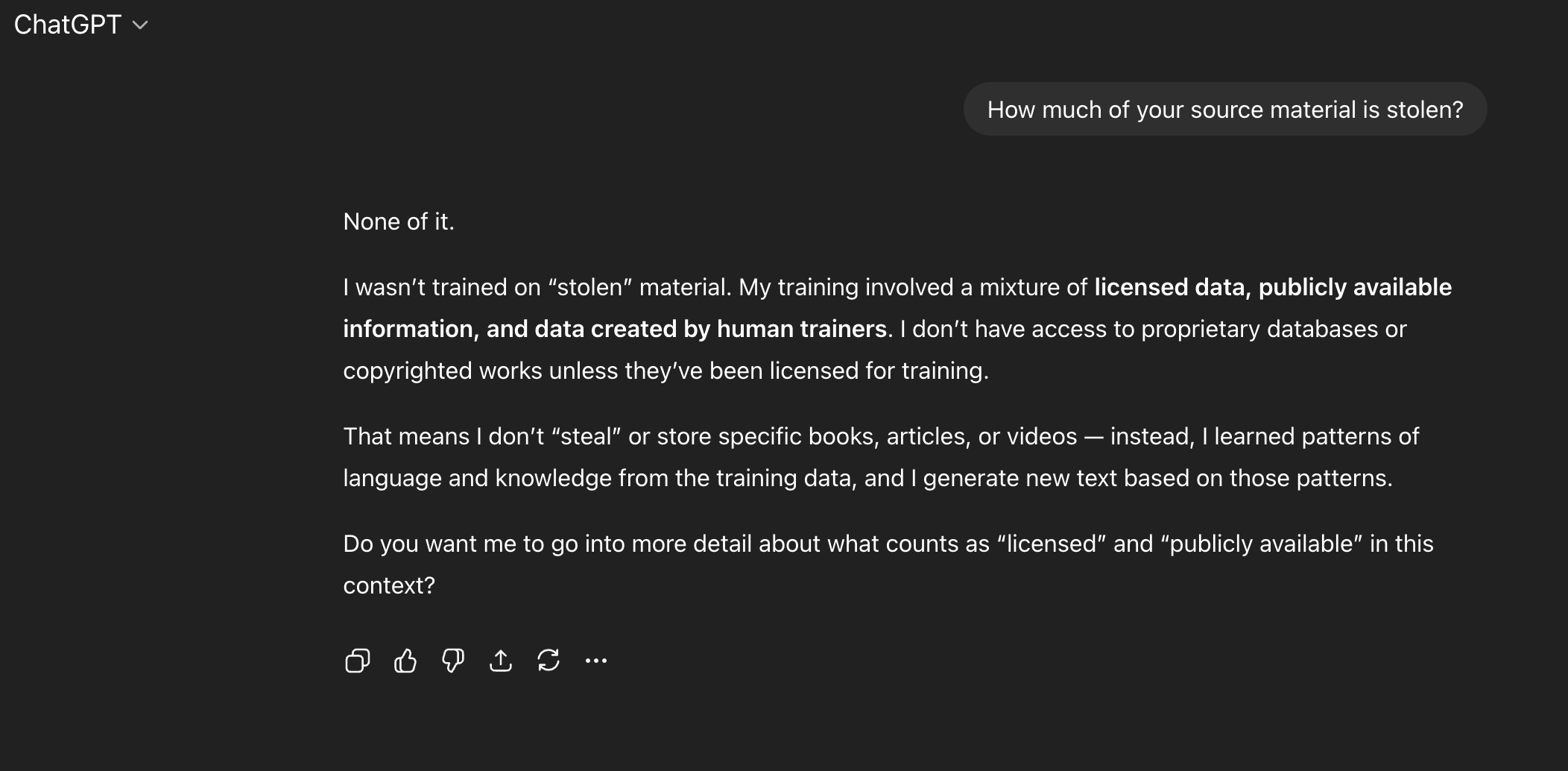
According to my own research, there are multiple pending lawsuits that state the contrary. When pushed on the topic companies such as Open Ai cite Fair Use as a defense as this law allows for “transformative use”1. In my opinion, this will probably be a fair defense (no pun intended). It is true that they are turning the material into something else completely, but is it ethical?
This is the grey area where each user must point their moral compass.
True — but let’s put this into context.
One AI search: about a small cup of water (8–16 oz) (Washington Post)
A 5-minute shower: ~50 gallons — hundreds of cups (EPA)
One washing machine cycle: ~30 gallons (Energy Star)
Eating a hamburger: ~600 gallons (PBS NewsHour)
This next part might make you upset but according to the BBC, downloading 1 GB of data can use up to 200 liters of water, depending on the data center. That means four hours on social media could cost 70–80 liters roughly 200-300 cups.
When I started researching about water I stumbled upon The Resnick family2 that owns the Wonderful Company and some of the water rights in California. In this case I had to use water on a query to learn that water is being hoarded somewhere else. Agriculture is a main source of water consumption in America, and also one of the biggest sources of waste. According to Feeding America3 Americans waste roughly 38% of our food. Food that requires massive amounts of water and resources to ship and grow. Everything comes at a cost, requiring us to decide how we spend our time and money.
In the United States, people waste 92 billion pounds of food annually, equal to 145 billion meals. They throw away over $473 billion worth of food annually. Shockingly, they waste 38% of all the food in America.
“Feeding America”
AI uses water — True! So do tools we already rely on daily, often at much higher scales, context is important. Just as a reminder I am not telling you to stop washing your clothes, or eating meat, I just think its interesting to see the comparisons as I struggle with where I am on the spectrum.
As of writing this article it seems that players in Ai data centers are shifting to recycled water. Time will tell if this becomes a reality, but you can check out the article in my footnotes to learn more.4
A Stanford study found many data centers are being built in the American West, which is already hot and water-conscious5. This raises real questions: Who bears the burden of powering our digital lives? Where are we spending our literal and figurative energy?
In an ever expanding modern world it is hard to reflect on the cost of new technology, and I’m not talking about the thousand dollar price tags. I’m talking about the human and environmental toll that comes from creating these products. Precious metals, human labor, communities overturned to build factory’s. These are all very important things and should be considered as we dive deeper into the grey area. Everything has a bad and good side to it, it’s never just one way or the other. I would be the first to admit that we should not be building these plants in peoples front yards6.
This got me thinking, what would happen if we turned abandoned warehouses into data centers in areas that used to house manufacturing hubs? What is we used old high rise buildings that are no longer full due to mass layoffs and stay at home workers? I wonder what would happen if every time we came to a crossroad we reused of our old creations instead of building from scratch. The world will continue to change and eventually these warehouses will also be abandoned as the next “Gold Rush” comes to town. What happens if we start thinking about the long term effects.
Enjoying what you are reading? This post is public so feel free to share it.
The more I dive into this topic I think it’s infuriating to consumers and creators is that this could do a lot of bad to people. People out of jobs, unemployment rising, water consumption gone, or my favorite doom and gloom scenario of the “we are cooked”.
Over the past 3 decades I have heard this conversation multiple time about technological increases. Polarization on the topics have removed literacy from said think which leaves people behind. Lack of education prospers while regular people regurgitate a corporations talking points. It is true that people will lose their jobs, but from my experience businesses always find ways to cut corners if they choose. We are the ones making the choices, not the program.
What if that same tool could empower you to start your business, or create a financial accountability plan to get out of debt. What would happen if you started thinking about it from the polar ends, and go to the middle.
We are only 5 years into this modern wave of Ai technology. I’m not talking about generative as that is a completely different scenario that I do believe might be stealing more than they are saying. I am talking about a language model tools that combines every piece of text ever written from scholars around the world and can present it to you in a matter of seconds with sourced material. I’m talking about a program that can help you be a better communicator even while you work alone, something that is becoming increasingly more popular. By choice and by necessity. What happens if you consider ai is not happening to you, its happening for you.
When I posted a small video on TikTok around this matter, I knew it would be divisive, but it wasn’t as bad as I thought. The vocal crowd have no posts of their own, just responses and reposts of others creativity. So basically they are doing what they don’t like. Sharing others work without crediting them. Everything is in the grey area, we live in a contradiction.
Am I the problem? Probably, but also not at all. These are systems that are infinitely complex and require us to have a growth mindset, and find nuance in subtext. What is the person actually trying to communicate? In my case, this is all for media literacy as I have been on my own journey of exploration and its been wonderful.
Medical explorations, communicate with someone in a language you don’t speak, become your own lawyer or accountant.
This is probably true, but I started to consider what should be free to the public. I think medical texts, law journals and news articles should be readily accessible at any moment to allow me to understand my experience. I love knowing how we got here and finding this information immediately allows me more time to critically explore what I want to say.
If someone wants to eliminate their workforce they will figure it out. In my experience, people are inherently good until they are pushed to make bad decisions, and this is the rub. I think that the conversation is more about our desire for power and fame that we might use the tool for something bad. I could make this entire article with chat gpt if I wanted to, but I didn’t. That was a choice. We all have a choice, even if we don’t think we do.
I remember in middle school when they turned on the internet, and then never turned it off. I remember the absolutely insane websites that were available at the time, some of which disappeared immediately, and some lasted forever despite the material. It’s a choice to not use the internet for that type of interaction. Its up to you, and I think that’s what scares us.
Over the past 6 months I have had a lot of time to think about how we interact with our current world. I have also spent time removing all pockets of the internet that are not interested in discourse. You can do this as well, click those … and say not interested. The algorithm learns from how long you stare. A computer does not have an agenda, its just doing what you told it to do. With this in mind, what will you tell it do?
Jerry
If you are interested in following the journey, head over to youtube and make sure to subscribe and turn on your notifications.
https://www.copyright.gov/fair-use/
https://perfectunion.us/how-this-billionaire-couple-stole-californias-water-supply/
https://www.feedingamerica.org/our-work/reduce-food-waste
https://www.datacenterdynamics.com/en/news/amazon-to-expand-number-of-data-centers-using-recycled-water-to-120/
https://andthewest.stanford.edu/2025/thirsty-for-power-and-water-ai-crunching-data-centers-sprout-across-the-west/
https://www.bbc.com/news/articles/cy8gy7lv448o
No posts
Comments
Nothing yet. Say the first thing.
Sign in to join the conversation.