
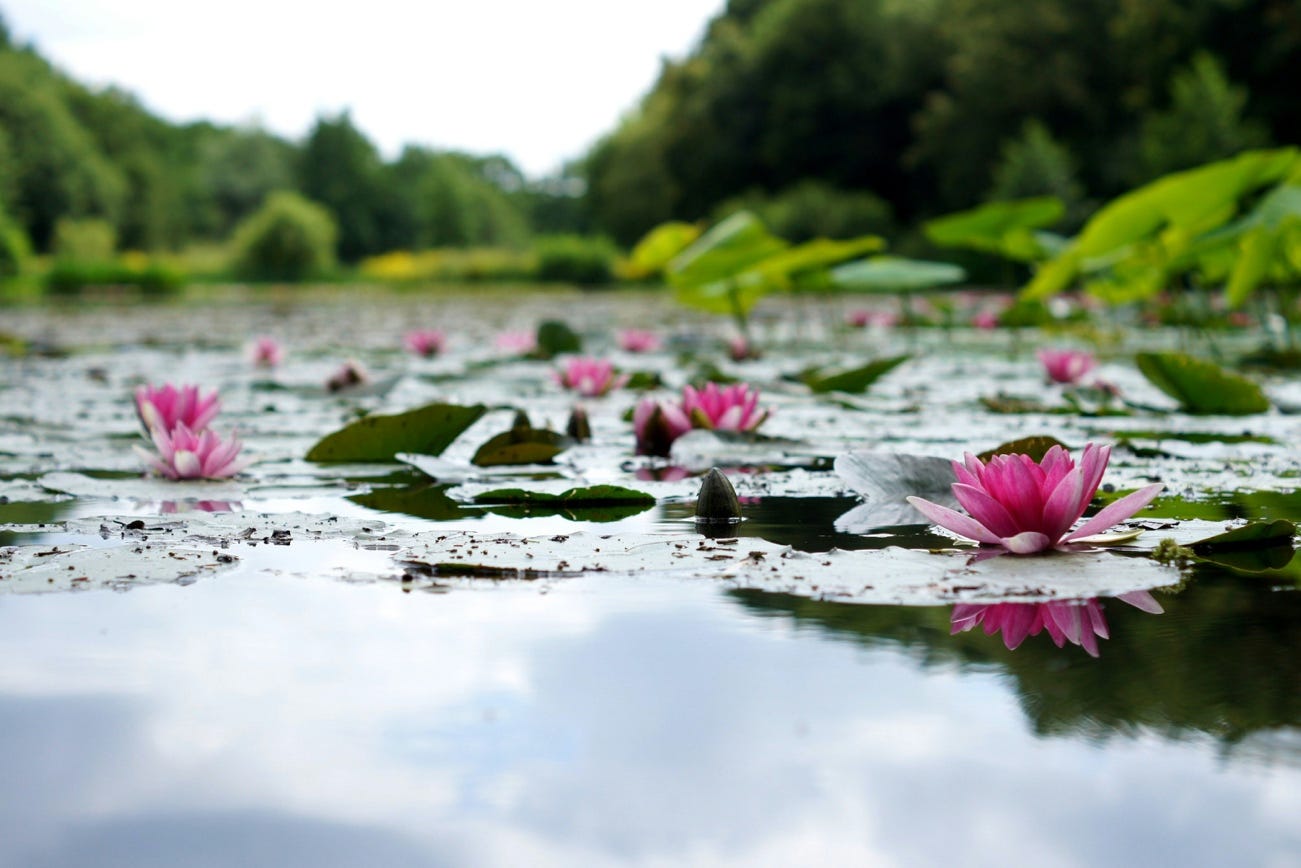
Photo by Hanna Skoromna on Unsplash
· · ·
Bronce and I come at this question from slightly different directions, but we seem to be standing on similar ground. Both of us are interested in how human beings might live more honestly, more deeply, and more consciously in a world that often pulls us away from ourselves.
Bronce’s work speaks strongly to the question of well-being, not as a generic formula, but as something personal, psychological, and deeply rooted in the life of the individual. My own work approaches this from the side of philosophy, especially lived philosophy: the old question of how we should live, not as an abstract idea, but as something we have to wrestle with in the middle of ordinary life.
So rather than write a formal essay, we thought it might be more fitting to enter into a conversation. Because maybe the good life is not something we define once and for all. Maybe it is something we keep returning to, questioning, refining, and living our way into.
ONE
What is a good life?
RODNEY
For me, the question of the good life is one of the oldest and most urgent philosophical questions we can ask. It is easy to assume that the good life means success, happiness, comfort, achievement, or having our needs met. And of course, none of these things are unimportant. I would rather people have food, shelter, friendship, safety, and moments of happiness than not have them.
But I do not think the good life can be reduced to feeling good.
Some of the most meaningful periods of a person’s life may not feel good at all. They may involve grief, uncertainty, loss, failure, illness, or the painful recognition that the life one has built no longer feels true. This is why I think philosophy still matters so much. Philosophy asks us to go deeper than the surface question of whether life is pleasant. It asks whether life is meaningful. Whether it has coherence. Whether we are living with integrity. Whether the way we spend our days reflects what we claim to value.
So when I think about the good life, I think less in terms of a perfect life and more in terms of an honest one. A good life is not necessarily a life free from suffering, but a life in which suffering is not meaningless. It is a life where we are learning how to become more fully human, more awake to our own existence, more connected to others, and more willing to take responsibility for the kind of person we are becoming.
For me, the good life has something to do with wisdom, not cleverness, not productivity, and not constantly improving ourselves into some better future version. But wisdom in the truer sense: learning how to live well with what is real.
BRONCE
Coach, I appreciate us being able to have this conversation, especially now, when so much of modern life trains us to look outward before we have learned how to listen to ourselves inwardly.
I like your point that the good life cannot be reduced to feeling good. At the same time, psychologically, feeling good is often how we decide whether our lives are working for us or not. When we feel good, we take that as evidence that things are going well. When we do not, we may assume something has gone wrong with us or with our lives. But I think it is more complicated than that.
From a psychological perspective, a good life is not necessarily the life that looks successful from the outside, or even the one that produces the most happiness. For me, it has something to do with living in a way that fits who we actually are. And that is not always easy to know what this means or how to figure it out across time.
Many of us learn early how to stay safe, stay connected, avoid conflict, or become the kind of person others needed us to be. Those ways of living may have helped us at one time, but later they can leave us feeling conflicted, distant from ourselves, or unsure why the life we built no longer feels right.
This is where I think so much of our psychological suffering comes into play. Over time, many of us end up living in ways that once helped us feel safe, stay connected, or become the person others needed us to be. Earlier in life, those ways of living may have protected us. But later, they can begin to create real difficulty, especially when the life we have built no longer feels connected to who we understand ourselves to be now.
So when I think about the good life, I do not think about a life without conflict. I think about becoming more able to notice when we are at odds with ourselves, and to take that seriously rather than immediately treating it as a sign that something has gone wrong. Sometimes that conflict is not the problem. Sometimes it is the beginning of understanding what in our lives needs more attention.
And in this sense, I agree with you: the good life is not a formula someone else can hand us. It is something we have to discover across time, with trial and error, and from the inside out. I like to think of the good life as an ongoing experiment in living.
TWO
Why do so many people appear to be doing well, yet still feel that life is thin?
RODNEY
This is one of the central concerns in my own work. I think many people today are not necessarily failing at life. In fact, they may be succeeding at the version of life they were handed. They may have the career, the home, the responsibilities, the routines, the external signs that everything is more or less in place. And yet something still feels absent.
That absence is important.
I do not think we should rush to pathologise it. Sometimes that feeling of thinness is not a symptom of something being wrong with the individual. It may be a signal that something is wrong with the story they have been given about what life is for.
We live in a culture that is very good at teaching people how to function, perform, consume, and optimise. It is much less good at helping people ask deeper questions. Who am I becoming? What is worthy of my attention? What kind of life would I not regret? What have I sacrificed in order to appear successful? What does it mean to belong, not just socially, but existentially?
This is where I think the modern meaning crisis shows up in everyday life. Not always dramatically, often it appears quietly. A sense of restlessness. A low-grade exhaustion, a feeling that, despite doing what one was supposed to do, life still feels strangely hollow.
And this is why I keep returning to philosophy as praxis. Not philosophy as clever debate, but philosophy as a way of coming back into relationship with life. Because the problem is not always that people need to do more. Often, they need to recover a deeper way of seeing.
BRONCE
Coach, I think your point about people doing well within the version of life they inherited is exactly where the psychological side comes in for me. Many people are not struggling in any obvious way from the outside. They may have done what they were supposed to do, met expectations, and learned how to function inside the world they grew up in. And yet, they can still feel strangely disconnected from themselves.
From the outside, their life may look stable and well put together. But psychologically, that stability may have more to do with following old emotional rules than with feeling connected to who they are. A person can do what is expected of them for a long time and still come to feel, later in life, that this is not how they want to be living.
That is why I like your point about not rushing to turn that feeling into a diagnosis. The feeling that something is missing may not mean something is wrong with the person. It may be a signal that something about their life, or the conditions around them, needs to be looked at more closely.
I think this is where many people begin to question themselves. They look around and see that their lives seem to be working well enough. So when they still feel empty or disconnected, they assume the problem must be with them. But sometimes they have spent years doing what made sense for them to do, only to realize that the way they are living is no longer good for them.
That is where our wellbeing becomes more complicated than simply appearing to be doing well. Our wellbeing has to include whether we can recognize our own emotional needs and take our psychological experience seriously. A person can be responsible and outwardly stable, and still have very little room to notice what is happening inside them.
And as you said, the answer is not always to do more. Often the work begins by slowing down and looking more carefully at how we feel, and whether we feel connected to ourselves and to our lives in a fuller, healthier way.
That is where I think psychology and philosophy meet. Philosophy helps us ask what kind of life is actually worth wanting and living. Psychology asks what happens inside a person when the answer they inherited no longer fits who they are, and may never have fit them in the first place. Our wellbeing depends, at least in part, on whether we are willing to listen carefully to that conflict instead of dismissing it too quickly.
THREE
Is wellbeing enough, or do we need something deeper?
RODNEY
I think well-being matters deeply. I would never want to dismiss it. We need practices, relationships, environments, and ways of living that support our psychological and emotional health. But I also think that if well-being is understood too narrowly, it can become another form of self-management.
This is where I sometimes become cautious.
If well-being becomes only about feeling better, functioning better, sleeping better, working better, performing better, then it risks being absorbed into the very culture that is making so many people unwell in the first place. It becomes another optimisation project. Another way of making the self more efficient, more regulated, more productive, more acceptable.
For me, the deeper question is flourishing.
Flourishing includes well-being, but it is not identical to it. A person may be flourishing even while going through difficulty, because they are living in alignment with meaning, courage, truth, love, responsibility, and depth. Likewise, a person may appear well, in the surface sense, but still feel existentially lost.
So I think we need both. We need well-being, but we also need wisdoming. We need emotional health, but also meaning. We need psychological insight, but also philosophical inquiry. We need to ask not only, “How can I feel better?” but also, “What is this discomfort asking me to understand about my life?”
That second question is where philosophy begins to do its work.
BRONCE
Coach, I think I am close to you here, especially in the distinction you are making between wellbeing and flourishing. I may use the language differently, but I share the concern.
If our wellbeing only means feeling better or functioning more effectively, then yes, it becomes too narrow. It can help, but it can also leave out the larger question of whether our lives are actually supporting us.
For me, wellbeing includes health and wellness, but it also asks about the relationship between how we live and how that affects us psychologically, emotionally, and physically. Are our daily lives giving anything back to us? Do we feel connected to ourselves? Are we able to listen to what our emotional life is telling us?
This is where psychology adds something important. It does not only ask whether a person feels better. It asks what their distress may be connected to, and whether it is pointing toward something that needs to be understood more fully. Therapy can be one place where that gets worked out over time. But if the goal is only to help us feel better, we may miss what our suffering is trying to show us.
So I would answer your question this way: our wellbeing is not the whole of flourishing, but it is one of the places flourishing begins. When I speak about wellbeing, I do not mean simply feeling better or functioning more effectively. I mean the deeper question of whether the way we are living is actually supporting us: whether it gives something back to us, helps us stay connected to ourselves, and allows us to feel more alive within ourselves.
FOUR
Can we design a life without turning ourselves into a project?
RODNEY
This is a big one for me, because I think modern culture has made the self into an endless project. We are always supposed to be improving, upgrading, healing, building, branding, becoming. Even well-being can become part of that machinery. Meditation becomes a performance tool. Walking becomes step-counting. Rest becomes recovery for more productivity. Silence becomes a hack.
I am not against growth, but I am suspicious of a version of growth that never allows a person to be enough.
A human life is not a business model. It is not a dashboard. It is not a personal development funnel. There is something deeply tragic about turning every dimension of existence into an improvement strategy.
So the question for me is not, “How do I design the perfect life?” It is more like, “How do I live in a way that feels faithful to what is most human in me?”
That may involve intentional choices, of course. It may mean changing habits, relationships, work patterns, or environments. But the spirit matters. Am I trying to control life, or enter into deeper relationship with it? Am I trying to become impressive, or become more honest? Am I trying to optimise myself, or learn how to inhabit my life more fully?
For me, the danger is that we try to escape ordinary human vulnerability by turning ourselves into projects. But maybe the good life begins when we stop trying to outrun being human in the first place.
BRONCE
I think this is a great question, Coach, because it gets right to the tension in designing our lives. As you indicate, that idea can get distorted when it gets pulled into the culture of self-improvement and optimization.
For me, designing our lives does not mean turning the self into a project. It means looking at how a person’s life is set up, and whether the way they are living gives them enough support to feel healthy and alive, with a stronger connection to themselves.
That is why the spirit a person brings to the idea of design is so important. When that process is driven by the feeling that they need to become more acceptable or impressive, it can become another way of turning against ourselves.
When I think about someone’s personal wellbeing equation, I do not mean something overly prescribed or overly orchestrated. I mean helping people pay closer attention to the factors in their lives that impact their health and wellness, and how those factors become part of our wellbeing. The point is not to tell people what their equation should consist of, or how they are supposed to live their lives, but to help them explore what actually supports a better quality of life for them.
At its best, designing our lives is less about perfecting the self and more about learning, through lived experience, what kind of life helps us feel more alive, more connected, and more at home within ourselves.
FIVE
What role does self-understanding play in living well?
RODNEY
Self-understanding is essential, but I do not think it is only psychological. It is also philosophical.
To understand oneself is not only to understand one’s patterns, wounds, habits, and emotional responses, though all of that matters. It is also to ask: What do I believe life is for? What do I assume about success? What do I fear losing? Whose approval am I still living for? What kind of person do I actually want to become?
These are not merely therapeutic questions. They are existential questions.
I think many people inherit a life before they ever choose one. They inherit ideas about work, success, masculinity, femininity, family, achievement, ageing, status, money, happiness, and what it means to be “doing well.” Then, at some point, those inherited scripts begin to crack. The person may not know exactly what is wrong, only that the old answers no longer hold.
That cracking can be frightening, but it can also be the beginning of wisdom.
For me, self-understanding is not about becoming obsessed with the self. It is about becoming less blindly ruled by the self we inherited, defended, performed, or constructed. It is about creating enough inner space to ask whether the life we are living is truly ours.
BRONCE
I like the way you widen this question beyond psychology, because self-understanding can become too narrow if we treat it only as naming our patterns or figuring out our thoughts.
From my side, self-understanding has to include the physiological, not just the psychological or philosophical. It is not only something we do with our minds; our bodies often register things before we can fully understand what is being registered. A person may understand, intellectually, that they want to live differently, while physiologically they may not feel safe enough to do so. That is why self-understanding also has to include what the body is registering when a person tries to change.
This is why self-understanding is so important to our wellbeing. Without it, a person may keep trying to change things on the surface without understanding why the same dynamics keep repeating, especially when those dynamics are part of what needs to change.
So for me, psychological work is less about becoming obsessed with changing the self and more about making sense of our reactions. When we begin to see why we respond the way we do, those reactions may not automatically disappear, but our relationship to them can change. That kind of recognition often gives us more room to choose how we want to respond, rather than living at the mercy of reactions we do not always understand.
SIX
How do we begin to live differently?
RODNEY
I think we begin very simply, which does not mean easily.
We begin by slowing down enough to notice the life we are actually living. Not the one we present. Not the one we explain. Not the one we hope will eventually arrive. The one we are in.
This is why I place so much emphasis on lived practices. Walking, reflection, dialogue, silence, attention and honest conversation. Returning to the body, returning to nature, returning to the question beneath the noise.
These practices are not about escaping life. They are about becoming more available to it.
To live differently, we do not always need a dramatic reinvention. Sometimes we need to recover the ability to pay attention. To notice what drains us. To notice what brings us quietly back to life. To notice where we are betraying ourselves. To notice where we are still trying to win games we no longer believe in.
For me, this is where philosophy becomes practical. It does not hand us a formula. It teaches us how to question, how to listen, how to discern, how to live with more courage and coherence.
A different life often begins with a different relationship to the questions.
BRONCE
I like to help others do a kind of loose needs assessment of how they are living their lives. I try to focus on what is working for them and what isn’t, and on whether their health and wellbeing are actually being supported day to day.
When we are younger, it is often easier to make big sweeping changes. We can move to a new country, find a different group of friends, try on different versions of ourselves, or take a job completely outside our wheelhouse. As we get older, this kind of change often becomes harder. Our personalities are usually less fluid, and we generally have more responsibilities as we age.
So living differently may need to begin in a more practical way. For me, that often means choosing one or two smaller things I can realistically add to my life. I like to choose something that gives back to me, and something I have enough interest in to keep returning to. For me, that often means being outside, moving my body, eating healthier food, and giving myself enough room to think about how I am living.
The point is not to become rigid or try to change everything at once. It is to pay attention to what happens when I do these things and what happens when I don’t. That is how I begin to get a better sense of what actually supports my wellbeing over time.
SEVEN
What are we both trying to help people recover?
RODNEY
I think, in the end, I am trying to help people recover their humanity.
That may sound simple, but I do not think it is. So much of modern life pulls us away from ourselves. It teaches us to perform before we know who we are. It teaches us to achieve before we know what matters. It teaches us to optimise before we have learned how to be present. It teaches us to function, but not necessarily how to live.
So when I speak about lived philosophy, existential flourishing, or the good life, I am really speaking about a return. A return to meaning. A return to wisdom. A return to the body. A return to honest conversation. A return to the kinds of questions that make us more fully human.
And perhaps that is where Bronce’s work and mine meet. We are both, in different ways, concerned with helping people live less mechanically and more truthfully. Not by giving them a ready-made answer, but by helping them listen more carefully to their own life.
Maybe that is the beginning of the good life. Not certainty, not perfection, not endless improvement, but a more honest participation in being alive.
BRONCE
I think when it is all said and done, I am trying to help people recover a more honest relationship to themselves.
Of course, I would like people to feel happier, healthier, more curious, and more alive. I would like them to have more meaning and purpose in their lives. But life does not always give us all of that, at least not in some clean or complete way. So my work is often more modest than that. I try to help people understand why they are living the way they are, why certain patterns keep repeating, and what they may want to put time and energy into changing, if they can.
Maybe, over time, the hope is that people feel a little better, enjoy more of their daily life, and become more kind and accepting toward themselves. I do not think life is easy for most of us. But I would like people to recover some curiosity, some willingness to explore, and some freedom to make mistakes without turning those mistakes into a final judgment on who they are.
So yes, Coach, I think I am close to what you are saying. In my own way, I am trying to help people recover a bit more of their humanity too. Not as an abstract idea, but in the ordinary experience of being able to spend time with ourselves, figure out who we are apart from the expectations of others, and enjoy more of who we are.
Coach, thank you for this conversation. I appreciate the chance to think alongside you about the good life, and about how we go about having more of it in our actual lives. I found myself thinking more about my own thinking as we went along, and for me, that is often the sign of a worthwhile exchange. So I’m grateful for your questions, your clear thinking, and the spirit you bring to helping yourself and others figure out how to embody the good life. I hope we get a chance to do this again down the road. Maybe a Live next time. That would be fun!
· · ·
ABOUT THE AUTHORS
Dr. Bronce Rice · Psychoanalyst | Psychologist | Health & Wellness Coach helping you understand your Wellbeing Equation beyond generic self-help. Your Wellbeing Equation is like your fingerprint—unique to you. You can read Bronce’s The Wellbeing Equation on Substack HERE.
Dr. Rodney King · Philosopher | Author | Founder of Coaching Philosophia helping you return to a more honest relationship with your own life. Flourishing is a practice, not a purchase, and the good life is something we live our way into. You can read Rodney’s Search for Sophia on Substack HERE.
No posts
Comments
Nothing yet. Say the first thing.
Sign in to join the conversation.