
Strange powers this creature has – making us want to run with them, dance with them, kill them, exterminate them even. Wolves trigger a bizarre careening of human emotions, from worship to camaraderie, fascination to loathing. They are our favoured spirit animal, our big, bad wolf, our wolf in sheep’s clothing – but however we understand them, there they have always been, padding around the edges of our imaginations, stirring old and strong feelings, feeding our loves and our fear/hates. Humans, it seems, are obsessed with wolves.
The re-emergence of right-wing man/boys with their faux wolf pack mentality has gotten me thinking about wolves a fair bit lately, wondering about this tug-of-war over the wolf and its place in our human imaginarium. How to discern truth within these extreme interpretations of wolf behavior - the blood-thirsty, muscular lone-wolf - the inclusive, cooperative wolf pack – which is it?
The wolf has long been trumpeted in right-wing circles. Hitler called one of his military headquarters the Wolf’s Lair, the SS was his wolf pack. The Nazis took a shine to the stylized ‘z’ symbol known as the wolfangel; it appeared in many of their military insignias, including some of the SS. Ironically perhaps, the design was based on the wolfangel, a creepy medieval era tool used for baiting and killing wolves. Some current Aryan Nation types have adopted the symbol as well, as have other far-right groups.
One of the most unsettling aspects of this wolf-fixation came at the end of World War II, as the tides of war turned against the Nazis. Hitler, willing to tap into whatever dark, occult instincts humans might possess, organized two paramilitary/partisan groups known as Werewolves.
“Hitler himself hoped that wartime necessity might eradicate ‘thousands of years of human domestication: Nothing could be more thrilling, the Fuhrer suggested, than ‘to see once more in the eyes of a pitiless youth the gleam of pride and independence of the beast of prey, who, organized in ‘wolf packs, might hunt down and murder Germany’s enemies in the dead of night.” - From Hitler’s Monsters: a supernatural history of the Third Reich
Sounds like unbridled adoration, but it isn’t really that simple. Maybe nothing is when it comes to human beings. Political leanings have often been an indicator of attitudes towards the protection of environment and wildlife. An interesting study in Germany (2022) found that occurrence of wolf attacks on livestock – wolves having been recently re-introduced after having been long exterminated – increase the vote for far-right electoral candidates. The assumption being that only a dominant strongman can protect a citizenry against the blood thirsty wolves.
Icon to demon - the idea of the wolf, but not the wolf itself.
Canada is home to the world’s largest wolf population. The wolf, having been one of the few species to survive the Late Pleistocene extinctions, was able to migrate to North America by a combination of glaciation and lowered sea levels. But even here, after this long, long time of co-existence, wolves were considered a threat to our colonial and nation-building project; as Stephanie Rutherford writes, in our “…early settler interactions with wolves, the animals were victim to the mentality of the purge”. The wolves needed to be removed from the land in order for the land to be tamed. What powerful gris-gris these creatures must carry with them.
In such a tangle of fraught, conflicting notions, it is almost impossible to think clearly about the wolf. How to begin? A good first step is to remember that in our long ago, animals were often understood to be creators, gods, companions and guides, inhabitants of our heavens and our dream worlds.
//
To suppose that animals first entered the human imagination as meat or leather or horn is to project a 19th century attitude backwards across the millennia. Animals first entered the imagination as messengers and promises.
- John Berger, art critic
//
So maybe to re-consider our relationship with animals, to pause and imagine human-animal interactions as not necessarily extractive, whether in terms of material – hide, meat – or the ideological purposes we try and shoehorn them into.
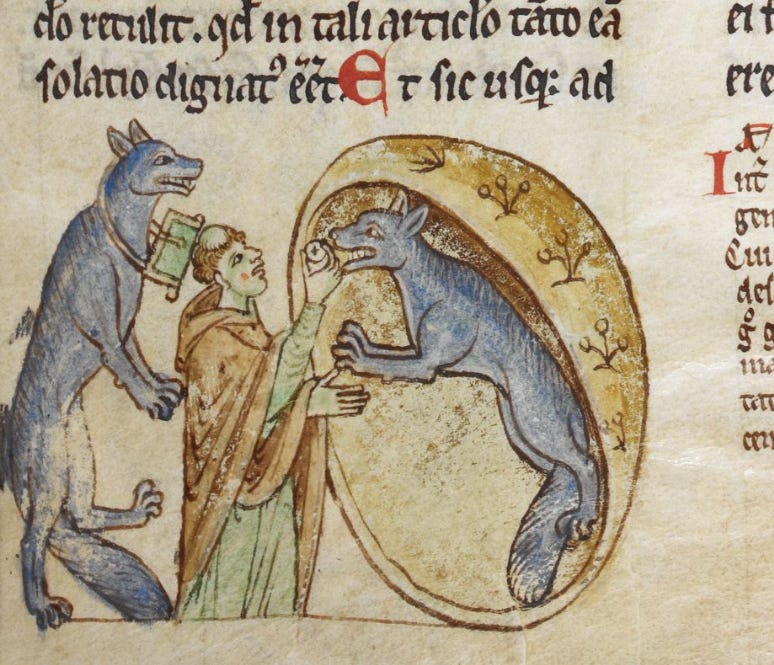
And then there is another kind of werewolf story, not some hyper-masculine fantasy but one that transgresses our ideas of human/animal, other/us. Gerald of Wales, in his 12th century account of travelling Ireland (Topographia Hibernica ), tells of an encounter with an Irish monk. The monk explained that he had been travelling through Ossory, a medieval Irish kingdom, when he encountered a wolf. The wolf spoke to him, beseeching the monk to come and give last rites to his dying partner. Ultimately, it is revealed that inside the she-wolf is an old woman, that both wolves are indeed humans, transformed for seven years into wolves for reasons not completely made clear.
I like this – humans not pulled from some rib of Adam but revealed within a shared skin. And though long ago our relentless persecution likely silenced the talking wolves, sending them deep into the forests with their own legends and lore of Ice Age survival, the story still gives me hope. What was once possible is possible again.
Perhaps for now, best to just let the wolves be their wolf-selves, leave them alone with their howls while we work on becoming better humans - to wait for brother wolf, sister wolf, to come sniffing along what it means to be human, and perhaps at some point we will be different, our scent will be different, and we will be human and they will be wolves and we will remember one another under those hard, bright winter stars.
Sources/further reading:
John Berger’s “Why Look at Animals?”https://web.english.upenn.edu/~cavitch/pdf-library/Berger_LookAnimals.pdf
Wolf attacks predict far-right voting https://www.pnas.org/doi/10.1073/pnas.2202224119
The Nazi Werewolf https://www.smithsonianmag.com/history/nazi-werewolves-who-terrorized-allied-soldiers-end-wwii-180970522/
Hitler’s monsters: a supernatural history of the Third Reich https://archive.org/details/hitlersmonsterss0000kurl_r9q9/page/276/mode/2up?q=wolves
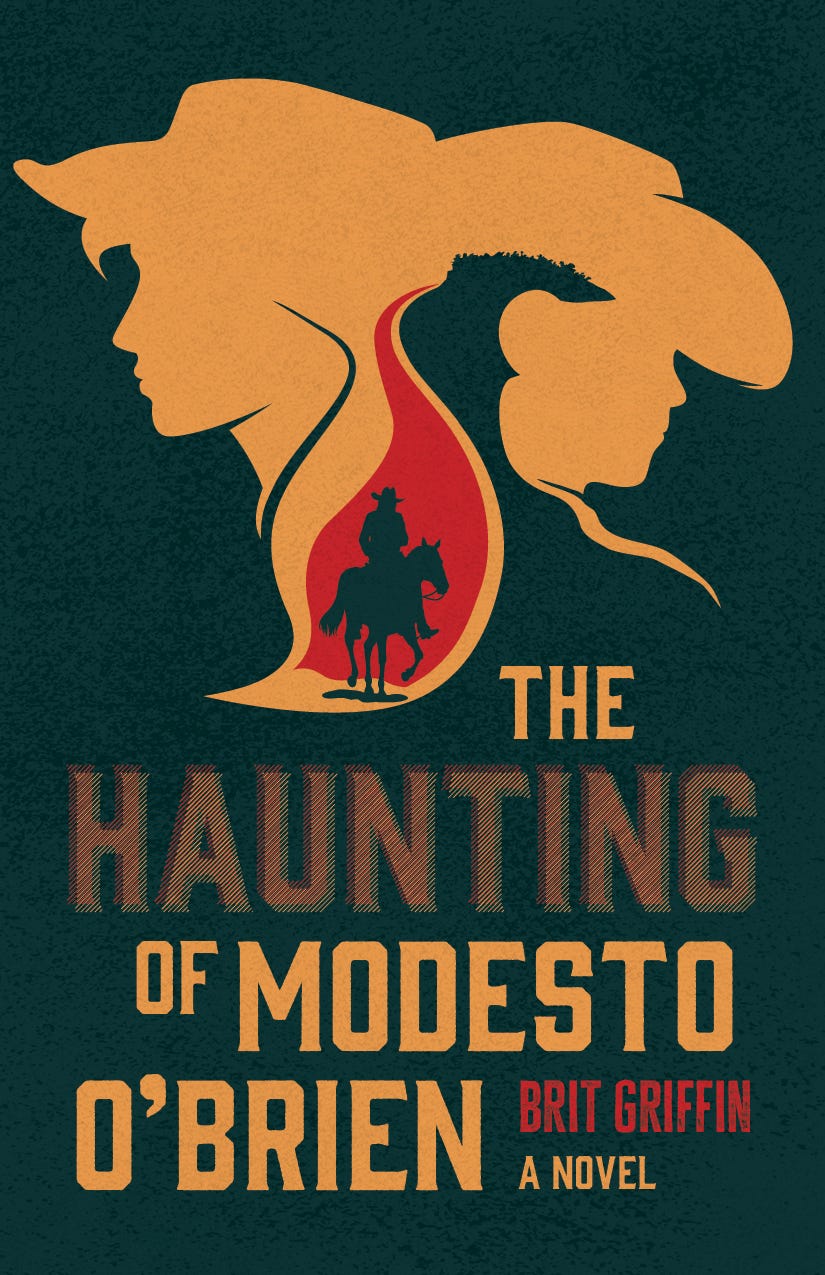
If you like my writing and would like to support it, please pick up or order a copy of my new novel, The Haunting of Modesto O’Brien at your local, independent bookstore or order direct from my publisher, Latitude 46: https://store.latitude46publishing.com/collections/featured-books/products/the-haunting-of-modesto-obrien You might also be interested in my climate change trilogy: The Wintermen, Wintermen II: Into the Deep Dark & Wintermen III: At the End of the World (there’s wolves in this one!, also available for order and from https://store.latitude46publishing.com/collections/fiction/products/the-winter-men
Comments
Nothing yet. Say the first thing.
Sign in to join the conversation.