
I missed the Sturgeon Moon this past August. Wasn’t paying enough attention to the fishies in the sky.
I like to think of the mighty sturgeons as end-of-summer moon fish, imagining these spiny creatures making their way down the Mare Anguis (Serpent Lake) and across Lacus Somniorum (Lake of Dreams), swimming in those waterbodies that are not water bodies at all but imagined moonscapes. I like too thinking of this fish up in the sky and then also way down below, at the bottom of our rivers, lakes and seas, where they naturally dwell. It makes this fish, this giant fish, this fish the has stayed with this planet since before the dinosaurs, it makes this fish some sort of universal being, of sky and water, of silver light and deep darks, an old mystery.
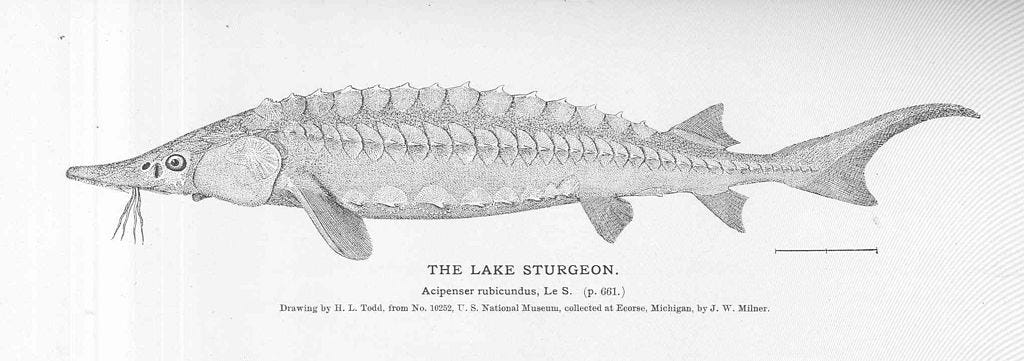
But before North American settlers came to appreciate the commercial potential of caviar, this huge fish, with its barbs and armour and oldness (they can live up to 150 years), was considered trash. It consumed the more desirable fish, tore through fishing nets, and lurked in the briny dark. Vilified, they were hooked and tossed back in the water wounded or thrown up on “… the beach like cordwood and, after they had been lying in the sun long enough for the fat to run, they were set afire and burned”.
Maybe more than just a nuisance though. Taller than a man, weighing hundreds of pounds, lurking in the mysteries of lake bottom, it is quite possible that this magnificent creature unsettled sailors and settlers; the record holding sturgeon was found in 1912 at the mouth of Russia’s Volga River, measuring just over 14 feet and weighing 2,250 pounds. More monster than fish.
The ones in my area would be Lake Sturgeons, not as likely to be record holders but worthy of note nonetheless. One turned up in 1922 at Batchewana Bay, weighing over 300 pounds and measuring almost eight feet. But it’s not just their size that warrants attention but their character too - this tale from 1951:
A man fishing Lake Timiskaming (north-east Ontario) caught and dragged a five-foot sturgeon up from the cold depths, hauled it to his fishing shack and left it there in order to go brag to his companions. When he returned to his ice shack, it was in embers, the fish having used the woodstove to incinerate both the hut and itself. I wonder if in its long fishkin memory it was remembering the piles of burning sturgeon stacked along the beaches – had held on to that sordid fish lore until the end, wondered then how best to use its own death?
In the 1880s, entrepreneurs realized they could make good money selling sturgeon roe (caviar). Needless to say, when commercial fisheries did start to exploit the sturgeon - with the Great Lakes soon producing much of the world’s caviar - it did not take long for their numbers to plummet. In a short span of ten years, from 1885 – 1895, the population in Lake Erie dropped 80%. It was the same story everywhere.
But the saga of the decimated global sturgeon numbers has some strange currents running through it. The Black Sea and the Caspian Sea populations of sturgeon have long been entangled with the gilded history of caviar. They also find themselves center stage in “… one of the most enduring puzzles in ichthyology and evolutionary biology”. The Black and Caspian Seas have been isolated from each other for over 7000 years. This separation should have resulted in genetic diversity among its fish populations, but evidence suggests very low genetic divergence and shared ‘intermixed lineages’ in the two populations of sturgeon. There are many theories on why this might be, but my favourite, suggested by Georgian scholar Gigi Tevzadzeand, involves the ancient fish, royalty and climate catastrophe.
The Black Sea basin endured ecological turmoil in the 6th century which resulted in what is known as the Late Antique Little Ice Age. A string of significant volcanic eruptions – and the resulting release of sulfate aerosols into the atmosphere – caused dramatic cooling, changed water flows, and impacted marine food chains and spawning grounds. Then again in the 9th and 11th centuries, more volcanic-induced cooling that changed precipitation, water levels & temperatures, access to streams and rivers, salinity, and further impacted spawning grounds. All very bad for the slow-growing sturgeon.
In response to the collapsing sturgeon population in the Black Sea, Tevzadzeand suggests that it is plausible that King David the Builder (r.1073–1125) of Georgia had his royal court undertake the transfer of fish from the Caspian Sea to the Black Sea. One piece of his evidence is to be found in this poem by Arsen Ikaltoeli. He was a medieval theologian and his poem is devoted to praising the accomplishments of King David:
“In Nacharmagevi, I hosted the twelve kings with bread,
I expelled Turks, Persians, and Arabs beyond the border,
I transferred fishes from the waters of the East into the waters of the West,
Now on these deeds I lay my hand upon my heart.”
A noble act indeed, the saving of a fish population. These ancient ballads could at times contain historical events derived from folkloric sources, so I will savour the image of the men of the royal court hauling buckets or barrels of larvae or eggs from the spawning grounds over to the Rioni River basin that then flowed into the Black Sea. Not quite 100 kilometers from birthplace to sea. There is something both sad and beautiful about this medieval pilgrimage.
These peculiar travels for the sturgeon continue to this day, but today it is peoples like the St. Croix Chippewa Tribe in northern Wisconsin, hauling five-gallon buckets of tiny, six-month-old lake sturgeon to help restore populations depleted by colonial exploitation. Other communities are also doing their part for the sturgeon, working to restore this creature to its rightful, royal place –king of fishes, ruler of the aquatic and lunar realms.
For sources and more information, please see:
Lake Sturgeon: The History of the Fishery. Ontario Department of Lands and Forests, 1961, by WJK Harkness/JR Dymond.
https://www.afs-oc.org/wp-content/uploads/2017/08/Harkness-Dymond-Lake-Sturgeon.pdf
“Meet the people trying to keep a prehistoric fish alive” by Leah Borts-Kuperman https://thenarwhal.ca/lake-sturgeon-decline-great-lakes/
“Transfer of royal fish and the non-evolutionary history of Black Sea sturgeons” by Gigi Tevzadze. https://www.academia.edu/2837-4010/3/4/10.20935/AcadBiol8024
“Wisconsin tribes helped lake sturgeon recover but climate change stresses its ability to adapt” Dec. 18, 2025 by Stefan Lovgren. https://www.unr.edu/nevada-today/news/2025/lake-sturgeon-recovery
If you like my writing and would like to support it, please pick up or order a copy of my new novel, The Haunting of Modesto O’Brien, at your local, independent bookstore or order direct from my publisher, Latitude 46: https://store.latitude46publishing.com/collections/featured-books/products/the-haunting-of-modesto-obrien

You might also be interested in my climate change trilogy: The Wintermen, Wintermen II: Into the Deep Dark & Wintermen III: At the End of the World, also available for order and from https://store.latitude46publishing.com/collections/fiction/products/the-winter-men
No posts
Comments
Nothing yet. Say the first thing.
Sign in to join the conversation.