
Ancient isn’t quite heavy, or slow, enough of a word. Time immemorial – closer I suppose, but still hard to capture the right words to describe this hard, grey rock underfoot. This Precambrian Shield: a remanent of Old Time, the earth’s oldest geological formations, hundreds of millions of years old, in some places well over a few billion. It is some ground to tread.
Cambrian, the Latin word for Wales, the country in which geologists first identified and named this geological era. So, of course, Pre-cambrian is simply before, older than, Cambrian. The event distinguishing these two eras from one another was the Cambrian Explosion, the appearance and proliferation of exceptional fossil diversity – before that time the earth showed only a meagre fossil record of very small, unicellular critters. This time period was also known as Cryptozoic, as in crypto: hidden, and zoic: life.
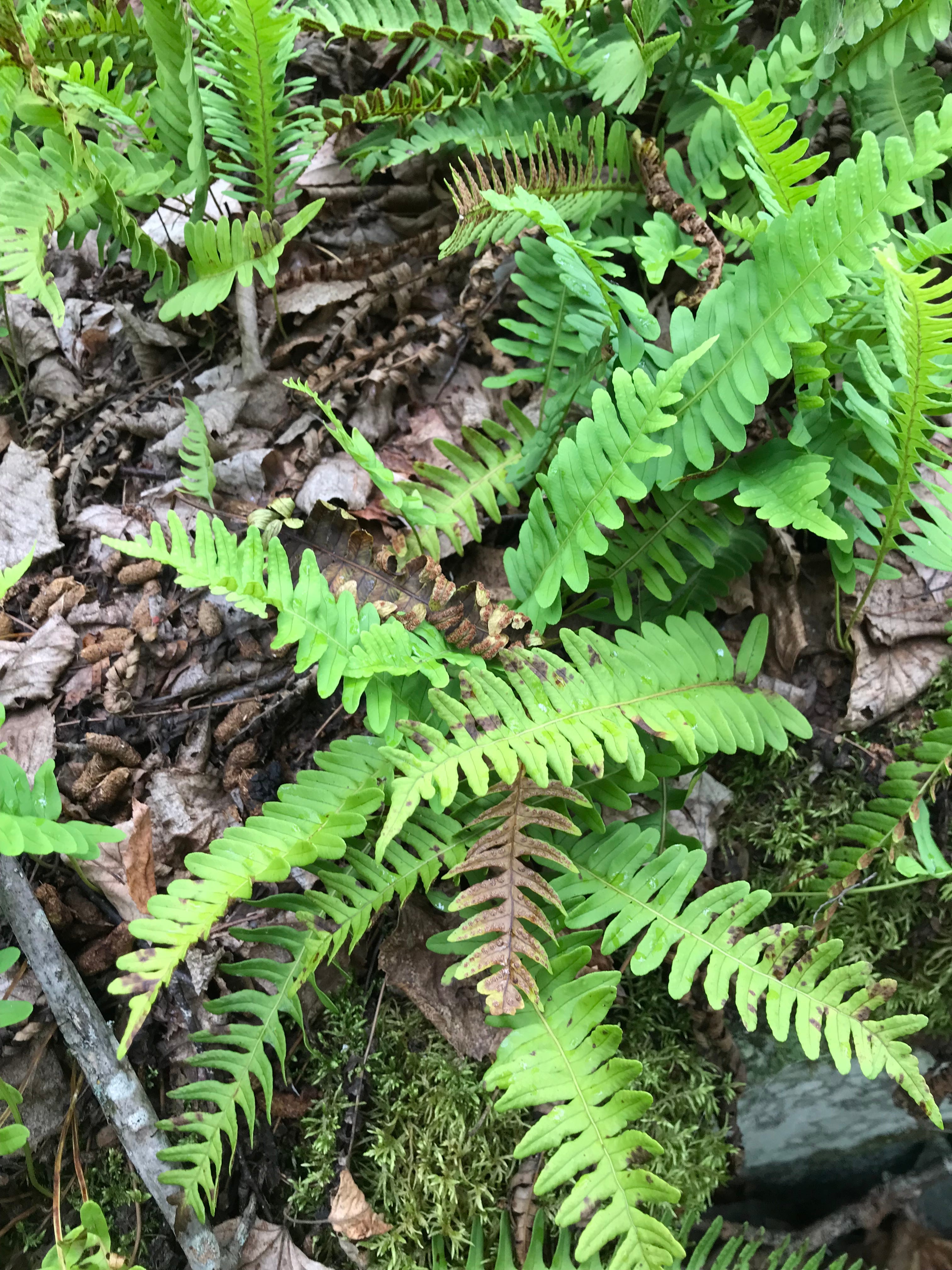
The deep past represents a temporal challenge for the human imagination. So, when out on my rambles it is often not the long, long ago rocks that pull my musings back through the eons, but more recent features, like the ferns growing in the understory of the forest here. They too are able conjure the prehistoric, stir images of browsing dinosaurs and exotic, primordial landscapes. I find them very compelling. Charles Darwin, father of evolution, thought so too, observing them both in Chile and the Galapogas Islands:
// “The forest abounded with beautiful objects, among which the tree ferns, though not large, were, from their bright green foliage, and the elegant curvature of their fonds, most worthy of admiration.” // - from Darwin’s diary, The Voyage of the Beagle
Ferns are one of the earth’s oldest type of plants, resilient and enduring. Their fossil record dates to the Devonian era when many plant types emerged and began to colonize the earth’s surface. The fern’s appearance was sandwiched between two mass extinctions. Unlike the huge beasties who dined on them throughout the Jurassic era, ferns survived the Chicxulub asteroid extinction. 75% of all other plants and animals did not. That asteroid impact also created a hostile post-impact environment: grey, cold and acidic. It is still unclear how ferns were able to survive it, but they were.
Wondering over ferns, the beautiful, primeval array of them, and then an odd coincidence...
The ferns Darwin observed on the Galapagos Islands (1830s) were essentially trees, they grew up high where the fog sat heavy on the land and then, interestingly, provided shade for the tortoises. Tortoises are a type of turtle. Turtles first appeared in the Triassic period, after ferns, but along with dinosaurs. Turtles, like the fern, have survived mass extinctions. So on the day I was pondering old rocks and ferns, for the first time in over thirty years, a very large snapping turtle made himself known in my backyard.
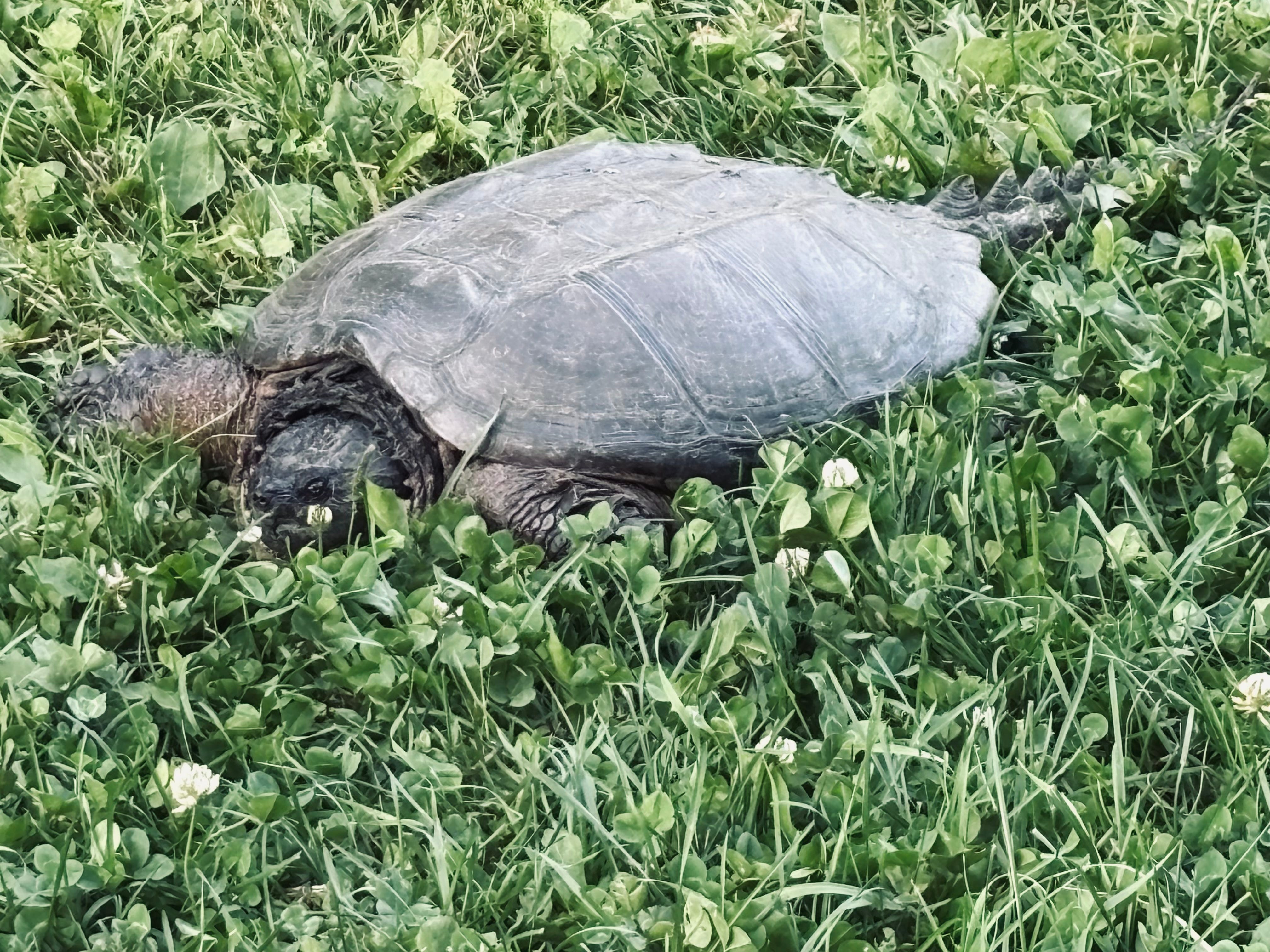
I had never seen one up close. There he was, large, slow, determined, dragging the primeval eons along with him, tail like a stegosaurus, face like Buster Keaton – sad, knowing, heartbroken. Why did this turtle look so sad, with his flippers for feet and his head carrying small black button-eyes?
His slow progress through our yard was determined, purposeful. Was he feeling an end of summer vibe, heading to his favourite over wintering spot? He seemed sure of where he was headed, seemed to know how best to get there too. What a remarkable creature. During the winter, snapping turtles bury themselves in the mud, slow down their metabolic rate, and rest under covers of muck. When they emerge from their mud beds in the spring, sometimes they end up carrying some of the muck along with them on their backs; their shells can also be coated in algae or fungi. Amazing. They bring their world with them.
I take heart in these old, enduring life forms. Having survived other extinctions, I have hope that they too might survive the one we humans are currently so madly seeking. And it is madness, our belligerent refusal to live differently, to evolve.
I think of Darwin’s beloved Galapogas Islands, currently surrounded by an ocean turned torrid by global warming and the El Niño effect - in July the equatorial waters showed sea surface temperature anomalies of +2 degrees C, subsurface temperature anomalies of a worrying +10-degree C. Changes in ocean temperature can be catastrophic for marine life, for the intricate web of life that characterize these diverse ecosystems.
What are the words to describe these islands that taught us all so much about evolution, to describe this turtle and these ferns –words to be collected like prayer cards, strung together with the fairy lights, sent out into the east winds, words like endurance, patience, precision, diversity, adaptation, unwavering. Words that we would be unlikely to use to describe ourselves, but ones that could guide our transformation if we find the fortitude and wisdom to actually try and save our little blue planet.
If we do not, I suppose it is of some comfort to know that this turtle carries his mud with him, the material to make a new world whole, to write his own book of Ends & Beginnings.
Sources & to learn more:
Charles Darwin. The Voyage of the Beagle. https://www.gutenberg.org/files/944/944-h/944-h.htm
Nick Davidson. The Greywacke: How a Priest, a Soldier and a School Teacher Uncovered 300 Million Years of History. Profile Books, 2022. https://profilebooks.com/work/the-greywacke/
Emily Kim et al. “How to Survive a Mass Extinction: Lessons from Fern Gametophytes,” American Fern Journal 116 (2), 109-126, June 5, 2026. https://bioone.org/journals/american-fern-journal/volume-116/issue-2/0002-8444-116.2.109/How-to-Survive-a-Mass-Extinction--Lessons-from-Fern/10.1640/0002-8444-116.2.109.full
Patrick Greenfield. “What can the Galápagos Islands’ animals teach us about the threats of El Niño?” July 24, 2026 https://www.theguardian.com/environment/2026/jul/23/what-can-the-galapagos-islands-animals-teach-us-about-the-threats-of-el-nino
El Niño /Southern Oscillation (ENSO) Diagnostic Discussion, August 13, 2026. National Weather Service: Climate Prediction Centre.
https://www.cpc.ncep.noaa.gov/products/analysis_monitoring/enso_advisory/ensodisc.shtml
Samantha Garrard. “A ‘super’ El Niño has the power to devastate fishing, and leave seals and sea lions starving”, The Conversation, June 17, 2026, https://phys.org/news/2026-06-super-el-nio-power-devastate.html#google_vignette
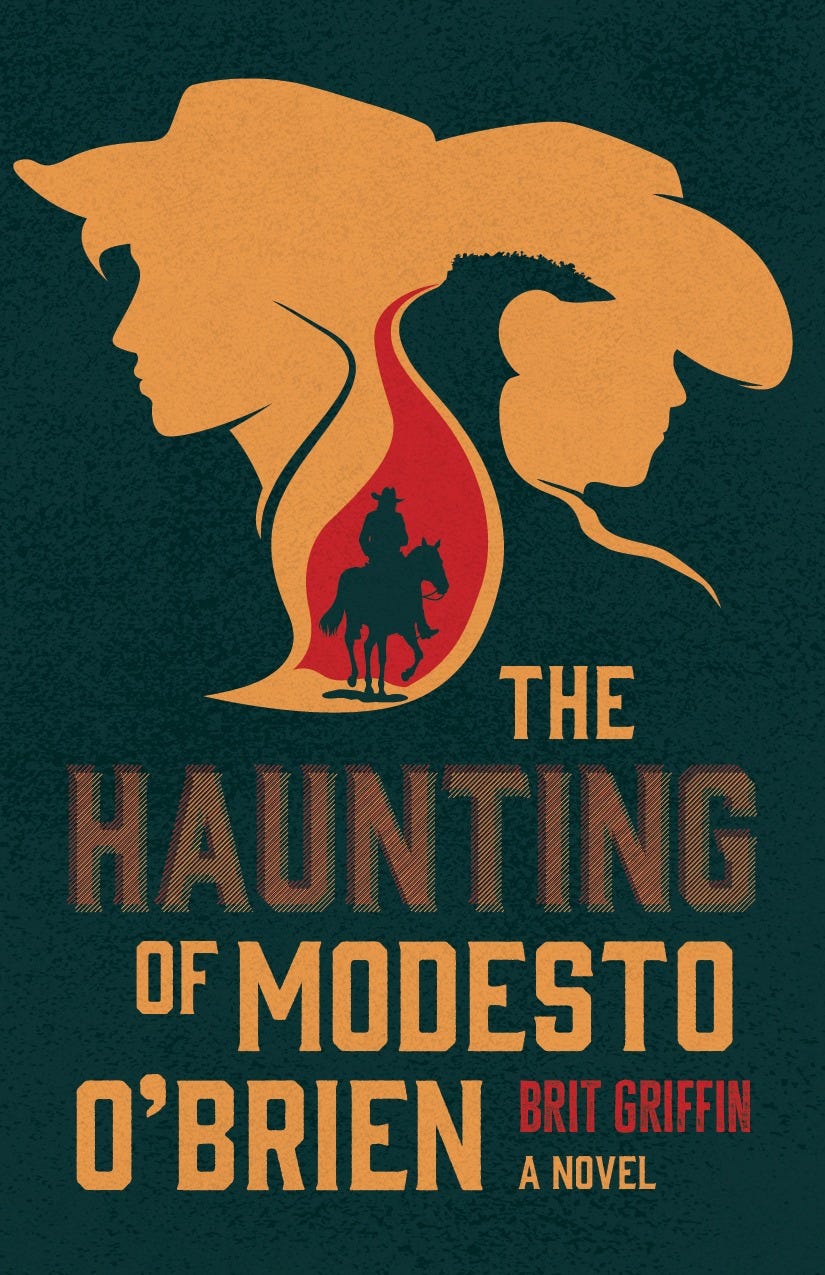
If you like my writing and would like to support it, please pick up or order a copy of my eco-gothic novel, The Haunting of Modesto O’Brien (2025), at your local, independent bookstore or order direct from my publisher, Latitude 46: https://store.latitude46publishing.com/collections/featured-books/products/the-haunting-of-modesto-obrien
You might also be interested in my climate change trilogy The Wintermen, also available for order from: https://store.latitude46publishing.com/collections/fiction/products/the-winter-men
No posts
Comments
Nothing yet. Say the first thing.
Sign in to join the conversation.