
I don't want to dedicate too many column inches to poor polling. The UK psephology scene does that job commendably enough in brief social media posts.
But over the past week some numbers have been doing the rounds that are frankly not on.
Merlin Strategies, one of Britain's newer pollsters, has had some work commissioned by Novara Media on who, between Jeremy Corbyn and Keir Starmer, would be most favourable among voters.
It's a poll of qualities. Who's seen to be more intelligent, more radical, more in-tune with voters. It is interesting stuff. There's nothing wrong with the questions themselves.
Novara's writeup, however, ignored the headline figures and did a drilldown of the subsamples. Because among Reform voters (a weighted sample size of 247), Corbyn bested Starmer handily. It was called a scoop.
The chart here, racking up thousands of likes across various social media channels, details all.
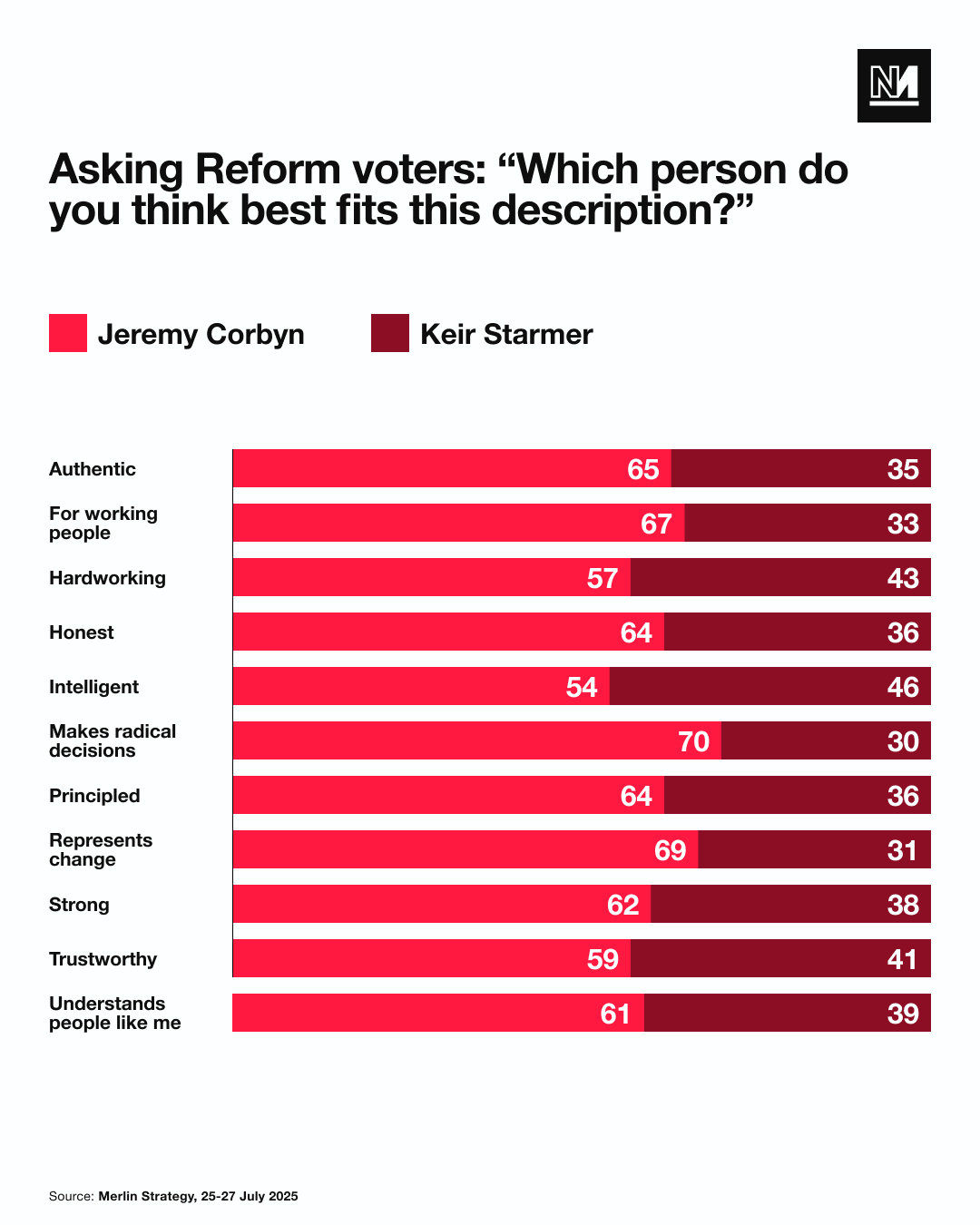
But it's inaccurate stuff.
Two things. Less egregious of the wrongs is the fact this is a subsample. Nothing wrong with covering subsamples, so long as you provide context to it. Slotting it beneath the headline numbers is contextual. This, on its own, is not.
A safe route would have been to emphasise the health warnings from subsamples, in the wider margins of error they incur (in that the actual % for Corbyn/Starmer should be within, say, 6-10pts of the published percentage, as opposed to a typical 3pts).
But most offensive, and I think quite disqualifying, is the binary question put to the respondents.
I checked the tables. You can too. Between Corbyn and Starmer, there is no "I don't know" or "neither" option.
Pollsters and we who cover them have a habit of excluding undecideds where we think relevant, such as for voting intentions or nation-dividing stuff, such as rejoining vs. remaining outside the European Union. My New Statesman colleagues occasionally come to me to check whether they should exclude undecideds when covering this poll or that.
This poll doesn't even offer that option.
And that's the real issue here. It's failing to appreciate a great many voters would prefer to plump for "neither" in this instance.
Neither Corbyn or Starmer are regarded well by Reform voters. According to YouGov, just 1 per cent like Starmer, and 5 per cent like Corbyn.
The levels of disapproval for both are 98 and 89 per cent respectively.
To take that strata of voting society, and ask of the two, which you would prefer, and write that up as remotely telling of anything, is poor poll-reporting.
To send a poll into the field without offering up the option of "neither" or "don't know" to respondents is an open and close case of poor poll-making.
Essentially: a forced choice between two turds tells us what, exactly?
The risk in keeping it binary is that respondents, unable to be represented in the options available, may either choose to skip the question, or abandon completing the poll altogether, thus skewing a "representative" sample of Reform voters.
This Substack is reader-supported. To receive new posts and support my work, consider becoming a free or paid subscriber.
So, what do Reform - and all - voters think really?
I covered More in Common's Seven Segments release over at the New Statesman a few weeks back. My takeaway concerned the surprising breadth of Reform's newfound "base" - not confined to just one of the seven segments, but strong in many. Retired Half Colonels this party's voter-base is not.
Now I've been given sight of the polling following up on these segments (also courtesy of More in Common), asking between Corbyn and Starmer, and Corbyn and Farage, who voters would most prefer as Prime Minister.
Overall, between Corbyn and Starmer, voters would prefer Starmer, 26 per cent to 17 per cent.
Poor for both, and not the most enthusiastic of endorsements for the PM, really.
And between Corbyn and Farage, voters would prefer Farage, 31 per cent to 21 per cent.
Note the fewer undecideds.
Among the segments, meanwhile, the variety is fascinating.
Among established liberals, Starmer’s lead is absolute. Such a shame for him they make up just nine per cent of the country.
Among the one third of the country which make up the more… tail-end extremes of the country (Green-friendly "progressive activists" and Reform-heavy "dissenting disrupters") - Corbyn leads Starmer. Combine the two, reweight them, and you find it's Corbyn 26 per cent to Starmer 15 per cent.
But among more "moderate" Reform-friendly segments, such as "sceptical scrollers" (centrists, I suppose) and "rooted patriots", Starmer has a lead.
But what lead, when 48 to 68 per cent of them aren't keen on either?
This is the valuable context missing elsewhere. Reform voters aren't into either. But of the Reform voters who only just prefer Corbyn to Starmer, they are the more radical, more dissenting, more disruptive of the segments of society most enticed by Farage.
What's important to note is those segments aren't the only Reform voters out there anymore.
Which makes proper poll sampling, and proper poll questions, essential stuff.
I established Britain Elects in 2013 because I wanted more people to understand their neighbours, and why they think the way they think. Leading people up the garden path to believe something so far from the truth is no conducive way to doing that. Let's do better.
This Substack is reader-supported. To receive new posts and support my work, consider becoming a free or paid subscriber.
Comments
Nothing yet. Say the first thing.
Sign in to join the conversation.