
I followed up The Ascent of Man by watching that other great TV show about ideas, Kenneth Clark’s Civilisation. Maybe I’m just getting old, but it’s hard not to think about falling expectations of the television audience when you watch these two programmes. Each came out before I was born, and each was made by a man with deep knowledge, simply explaining ideas and history. No interviews, no re-enactments in costume, just an assumption that the television audience was interested to learn and willing to put in some work to do so.
But I don’t want to turn into one of those accounts which constantly posts about Decline and shares photos of marble statues with a smattering of racism. Instead, I’m going to be more constructive, and pick up on something from Clark’s final episode.
While Civilisation has been criticised for its Eurocentric perspectives, there’s no question that the programme visits some amazing locations. It works its way through over a millennium of history from Skellig Michael in the Dark Ages, via mediaeval cathedrals, Renaissance Florence and Rome, the Dutch Golden Age, the salons and palaces of the Enlightenment, before ending up among the skyscrapers of modern-day New York.
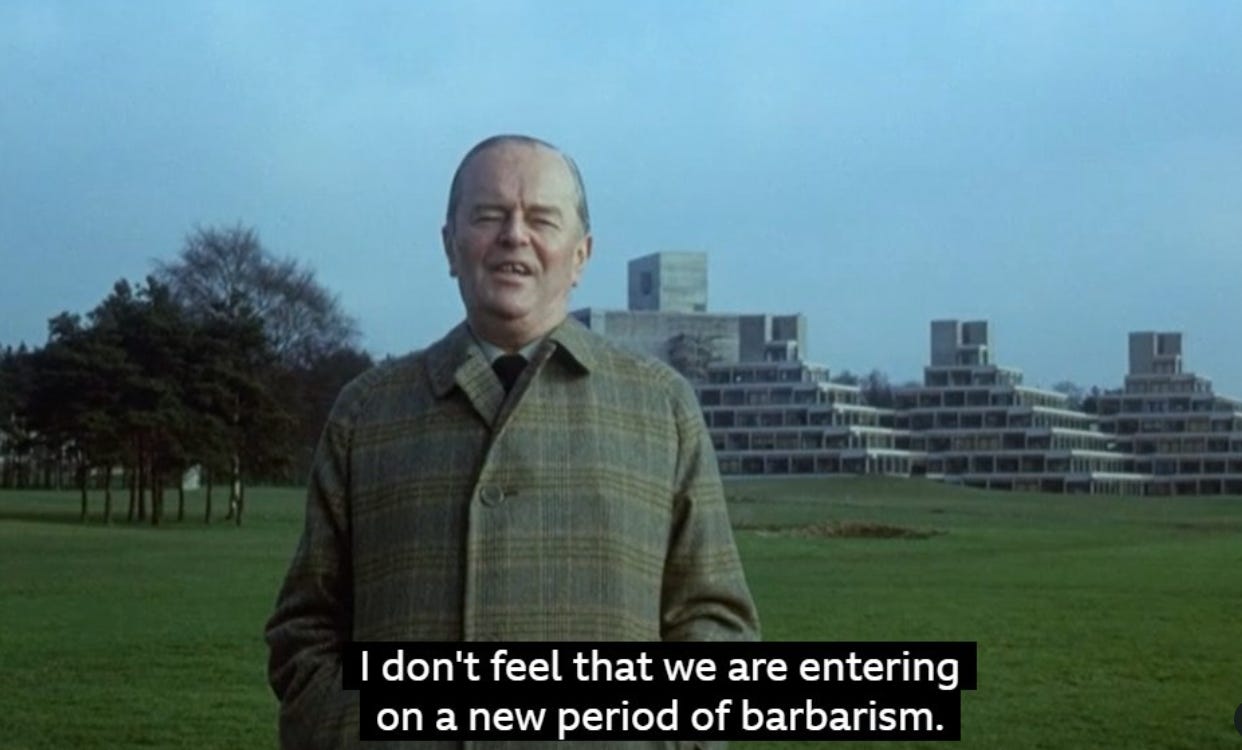
But, for a man who spends so long waxing lyrical about close-up shots of the Sistine Chapel, it’s almost funny that the final episode ends up in the library at the University of East Anglia in Norwich.
He’s there for a reason though. At the beginning of the series, Clark famously explains how Western civilisation survived “By the Skin of Our Teeth”, and that its emergence from the Dark Ages was by no means a historical inevitability. He finishes the show by pondering on whether we might be heading back in the opposite direction (all text taken from this page):
Our other speciality is our urge to destruction. With the help of machines we did our best to destroy ourselves in two wars, and in doing so we released a flood of evil, which intelligent people have tried to justify with praise of violence, ‘theatres of cruelty’ and so forth. Add to this the memory of that shadowy companion who is always with us, like an inverted guardian angel, silent, invisible, almost incredible - and yet unquestionably there and ready to assert itself at the touch of a button; and one must concede that the future of civilisation does not look very bright.
It was far from idle speculation. Clark himself had supervised the protection of the paintings of the National Gallery during the Second World War, so the idea that modern warfare could erase cultural heritage was very relevant to him. And the programme was broadcast seven years after the US and Soviet Union had gone toe-to-toe in the Cuban Missile Crisis, with the potential to destroy humanity itself at a far greater scale than the fall of Rome.
But Clark comes down on the side of optimism, arguing that hope lies in the young people of UEA and millions like them:
I should doubt if so many people have ever been as well-fed, as well-read, as bright-minded, as curious and as critical as the young are today
And a year after the convulsions of 1968 he made the case for moderation and centrism, in a way that remains sadly relevant today:
At this point I reveal myself in my true colours, as a stick-in-the-mud. I hold a number of beliefs that have been repudiated by the liveliest intellects of our time. I believe that order is better than chaos, creation better than destruction. I prefer gentleness to violence, forgiveness to vendetta. On the whole I think that knowledge is preferable to ignorance, and I am sure that human sympathy is more valuable than ideology.
Indeed the final words of the series tentatively float the idea of centrism. After quoting Yeats’s Second Coming, Clark repudiates both extremes, but laments the lack of a solid grounding for anything in between
The trouble is that there is still no centre. The moral and intellectual failure of Marxism has left us with no alternative to heroic materialism, and that isn’t enough. One may be optimistic, but one can’t exactly be joyful at the prospect before us.
This resonated with me, at least in part because I spent a lot of the pandemic advocating a position of “COVID centrism” which almost became a self-parody:
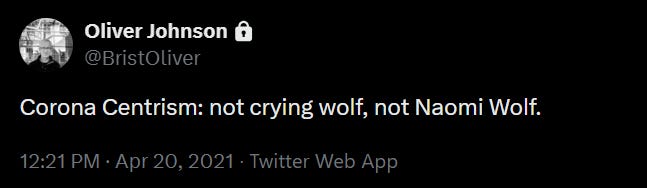
That’s not to say that there weren’t times when it was right to be concerned. But as a general principle, advocating for some kind of nuance and moderation has generally aged better than those who insisted that every single variant heralded a return to doom, or that the whole thing was a silly overblown fuss. While the Feigl-Dings of this world were right to sound the alarm in March 2020, to be still doing it three or more years later (as well as sounding the alarm about apparently imminent monkeypox and bird flu pandemics) might imply someone is just a natural alarmist. And the less said about the intellectual contortions required to keep up the “PCR machines are fake, vaccines kill more people than the disease, it’s just rebadged flu” grift the better.
But actually, I think that the principles which worked for COVID work in other contexts as well. I’m not arguing for some kind of wishy-washy LibDem political position. I’m also not saying that you should reflexively triangulate on all issues - for example I’m happy to say that vaccines and nuclear power are very good things, whatever the “balanced” position might be. But in general, if you start off with the prior belief that things are unlikely to be as good as the most optimistic 10% of people say, or as bad as the most pessimistic 10%, then you might not end up so far wrong.
Take AI. I think the jury is genuinely out on how useful it might be. But I think we can safely discount Sam Altman’s hyperbolic suggestion that “We have to be ready for a world where global GDP goes up 50 percent a year for a couple of decades” just on grounds of simple algebra. That would represent a 3,325-fold growth of the economy (not just 3,325%!), and I’m not sure that it even make sense to write those numbers down. Equally, I think it’s clear from all the proofs of concept so far that everyone who dismissed AI as "spicy autocomplete” with no real value was underselling these ideas as well.
Of course, that still leaves a wide range of possibilities - just as with COVID, the nature of estimating exponential growth rates sees to that. But perhaps if we fumble towards imagining a world where AI systems can transform drudge work in specific sandboxed settings (fixing potholes, handling planning applications and so on) while not proving the Riemann hypothesis, where AI companies have overinvested in data centres but value remains after a bubble bursts, where the technology puts stress on power grids but doesn’t destroy the planet, then maybe we won’t be a million miles wrong?
Indeed, many of the themes of Logging the World can be thought of through a similar lens. Bird flu probably wouldn’t kill 50% of the people it infects (though sustained human-to-human transmission wouldn’t be a walk in the park either). COVID vaccination policies which target the old and vulnerable can be almost as effective (and much cheaper) than trying to keep boosting everyone. Climate change is a problem, but it’s not one that the UK can solve immediately with current energy storage technology. Indeed, Bill Gates’s recent comments that
Although climate change will have serious consequences—particularly for people in the poorest countries—it will not lead to humanity’s demise. People will be able to live and thrive in most places on Earth for the foreseeable future. Emissions projections have gone down, and with the right policies and investments, innovation will allow us to drive emissions down much further
are pretty much textbook centrism of the kind that I would advocate.
But if many issues are best viewed through this sort of centrist lens where nuance and moderation can be valuable, but there are occasions when that’s not the case, it still leaves the question of how we decide. Of course it is a matter of judgement, but I think there are certain tools which can help: as I wrote here, it can be valuable to spot a bandwagon and to reject simple solutions predicated on problems having a single cause.
Most of all, I think that if a problem can be quantified then it can be understood better. We can all do a better job by asking “is that a big number?”, by kicking the tyres on estimates of growth rates, by understanding that reported numbers are uncertain and trying to reason within that framework of uncertainty.
Even situations which can’t be directly quantified can be considered in the same way by remembering ideas like recency bias and regression to the mean. On a wider historical perspective, how likely is it really that the genuine undisputed Greatest Of All Time is playing your favourite sport right now? If we imagine that a graph of quality looks something a bell curve, then it stands to reason that most films, books, TV shows, albums and restaurants will be “basically fine” and that five-star and zero-star reviews should be rare exceptions, whatever the publicity industry will tell you.
None of this exactly feels like rocket science, and perhaps this reliance on hard numbers and mathematical principles is the antithesis of what Kenneth Clark might have wanted. But if you want to link arts and sciences, you can always put Clark’s comments alongside Richard Feynman’s famous bridge story:
But, fortunately, it’s been useless for almost forty years now, hasn’t it? So I’ve been wrong about it being useless making bridges and I’m glad those other people had the sense to go ahead
and remember that Feynman’s forty years are now eighty. So maybe the idea that the world is full of terrible things, but that it could also be a lot worse, isn’t a bad place to start 2026 - Happy New Year!
No posts
Comments
Nothing yet. Say the first thing.
Sign in to join the conversation.