
What would you do with a time machine? Maybe you’d go back and buy Apple or Microsoft stock at the right time in the 1970s. Maybe you’d be like Doctor Who, visiting interesting events in history around the galaxy. Or maybe you’d try to prevent terrible events from happening, as the meme says
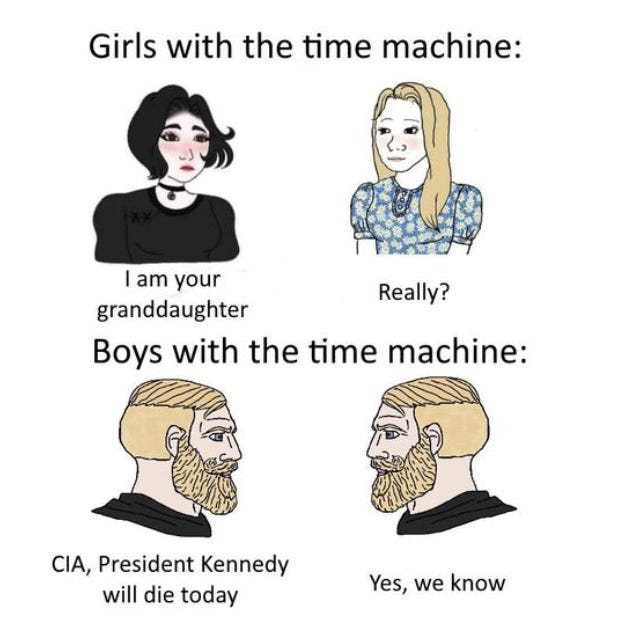
But if you are of a scientific bent, the obvious answer is that you would go back in time with your current knowledge, and scoop other people’s scientific discoveries. And that’s fine in theory, but in a lot of cases it’s harder than it might sound because of the nature of science itself.
Take relativity. If I used my time machine to turn up at the inaugural meeting of the Royal Society in 1660 and shout “I’ve got it, E equals m-c-squared”, I wouldn’t instantly be acclaimed as the greatest genius of all time. Without context, it’s literally just meaningless letters.
And actually, if you read the history of this equation, you can see that it was the culmination of two centuries or so of people groping their way towards Einstein’s famous formula, and that its truth and implications took a long time to be teased out.
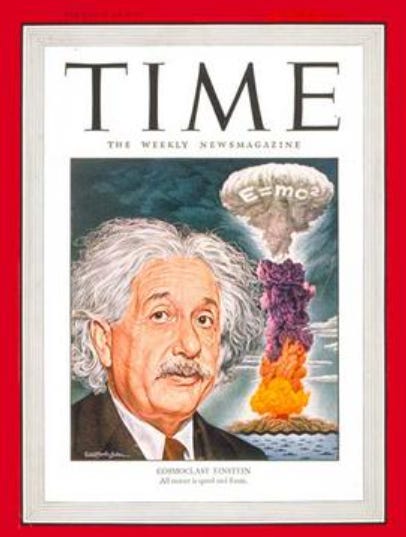
In the same way, Einstein’s theory of general relativity couldn’t have just been thought of by Newton, or by Pythagoras. Specifically, the mathematical framework of his equations relied on the algebraic description of the geometry of curved space developed by Riemann in the 1850s. So if I want to scoop Einstein by setting my time machine somewhere between 1854 and 1916, I’m first going to have to get to grips with some pretty serious mathematics if I’m going to convince people that my theory has any value.
But deep down, I think all these questions about time machines aren’t questions about the past at all, they are questions about the present. I think they tell us more about the nature of anachronism and how we think about history than anything else.
If I watch a hypothetical TV drama about Hitler in 2026, where he says “gentlemen, we need to Make Germany Great Again”, that gives me no new insights into him, but it tells me almost everything about the politics of the modern writer. Tarantino’s Once Upon a Time in Hollywood and Inglourious Basterds, where the Manson Murders are averted and Hitler is killed, tell me nothing about the horrific truth, but plenty about edgy riffs on past events.
I’ve been thinking about this because of the death of Tom Stoppard. Via a letter to The Times, he seems to have been elevated to the status of a secular saint, who cured cancer through his writing:
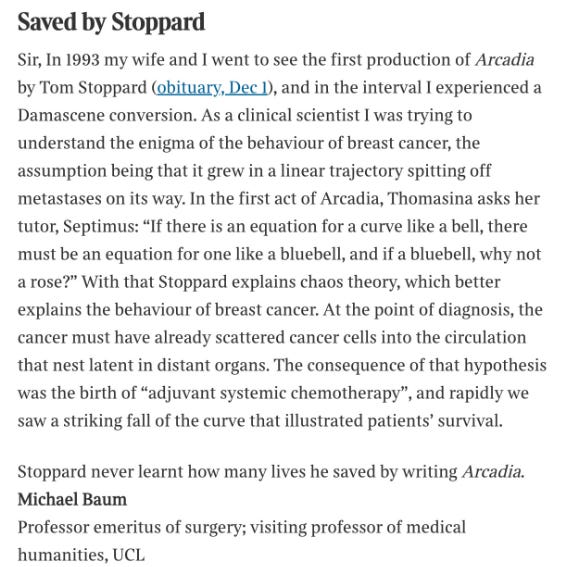
And that’s fine, as far as it goes. Maybe I’m a Philistine, but I’d happily have put Stoppard in the Order of Merit just for his work on Indiana Jones. However, following his death I decided to read Arcadia. I think we have to be careful with some of the claims about science which are implicit there, because some of it plays with the same kind of time machine tropes that I already talked about.
Because Arcadia jumps back and forward in time, it asks us to consider 1809 through a 1993 lens. When it asks the question “could a teenage Ada Lovelace1 have discovered chaos theory?”, it’s not really telling us about Ada Lovelace, it’s telling us that chaos was the hot topic of the 1980s and 90s when Stoppard was writing his play. (I’m also not sure that any tutor at any point in history would have ever asked a teenager to prove Fermat’s Last Theorem, even as a distraction).
But actually, Stoppard answers the question himself. In Scene 4, part of the modern-day part of the play, the characters discuss why chaos theory wasn’t possible in the 1800s. The reason is not quite the same kind of “standing on the shoulders of giants” that applied earlier, but rather the lack of technology.
In order to generate fractals and chaos, you really need a computer. It would have been more or less plausible for Lovelace to think “what happens if we plug the output of an equation into itself”, because authors like Julia and Fatou were doing that in 1910s, but it wasn’t until Lorenz, Mandelbrot and others had access to computers that the true beauty of these kinds of structures could be revealed.
And to his credit, Stoppard more or less says this
HANNAH: What I don’t understand is … why nobody did this feedback thing before - it’s not like relativity, you don’t have to be Einstein
VALENTINE: You couldn’t see to look before. The electronic calculator was what the telescope was for Galileo.
HANNAH: Calculator?
VALENTINE: There wasn’t enough time before. There weren’t enough pencils!
In that sense, it might be best not to think of scientific discovery as something that happens because of a solitary genius who can be scooped with a time machine. It’s almost always the case that discoveries emerge from a long chain of work, and can only happen when the technology is ready.
In 1948, Claude Shannon showed how you could generate random text which looked plausible over a short stretch of words:
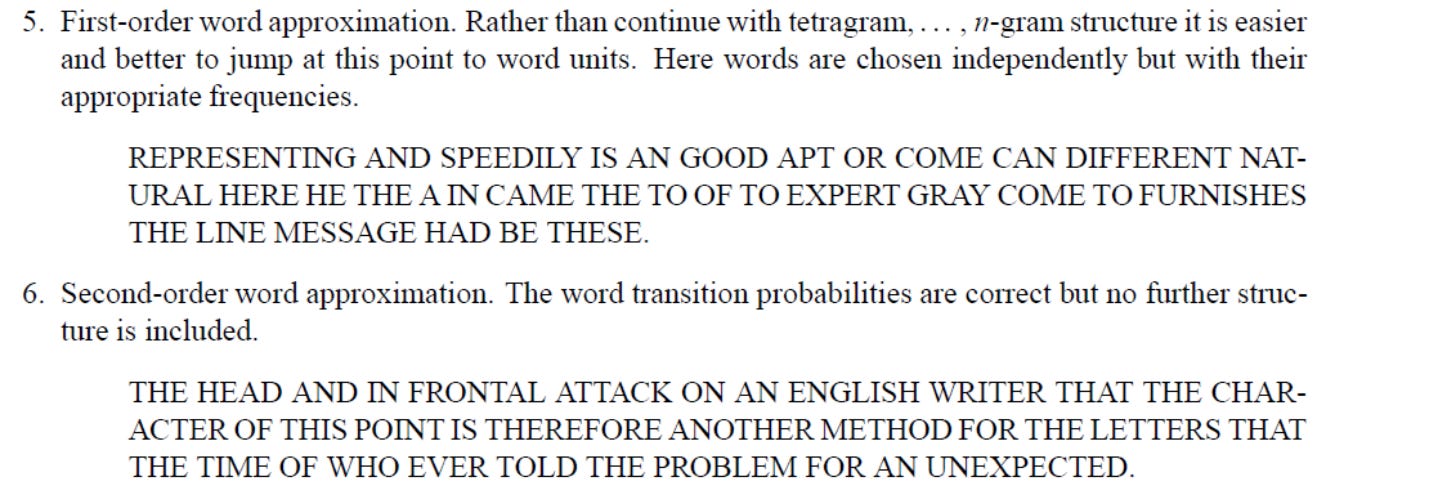
He did this by taking the word “Head” (for example), opening a book at random, and moving forward until he found it, and then writing down the word which followed it:

As Shannon said, the issue wasn’t the idea itself, but the amount of work that it took to generate this text. If we travelled back in time and showed ChatGPT to Shannon, although he’d be impressed with the engineering and computational power, there’s a sense in which he could feel like he’d already got there 75 years earlier.
And in the same way, I think we have to be careful when looking back and forwards in time to make sure that we do it through an honest lens, and to make sure we’re not just telling the stories which sound good in retrospect.
Anyway, that’s probably my last Logging the World post of 2025. It’s been quite the year on any number of fronts, but I’ve enjoyed writing here, and I hope you’ve enjoyed reading. Have a Happy Christmas everyone!
No posts
Comments
Nothing yet. Say the first thing.
Sign in to join the conversation.