
When I was about twelve years old, I sang as a choirboy in the Protestant cathedral in the ecclesiastical city of Armagh. We rehearsed twice a week, sang at the Sunday service, and often at other services as well. Every time we gathered, we recited the Nicene Creed, beginning with the words, “I believe in God the Father almighty.”
At the time, those words carried little meaning for me. They were simply words that everyone knew by heart. Today they carry an entirely different significance because they have become a question rather than a declaration. What does it mean when someone says, “I believe in God”?
Christianity Without Fear is a reader-supported publication. To receive new posts and support my work, consider becoming a free or paid subscriber.
In writing Christianity without Fear, I return again and again to this question. It is not simply a question for those who call themselves Christians, or for those who belong to another religion. It is a question for every human being, because belief is not confined to the doctrines we profess. It is revealed in the way we experience ourselves and the world.
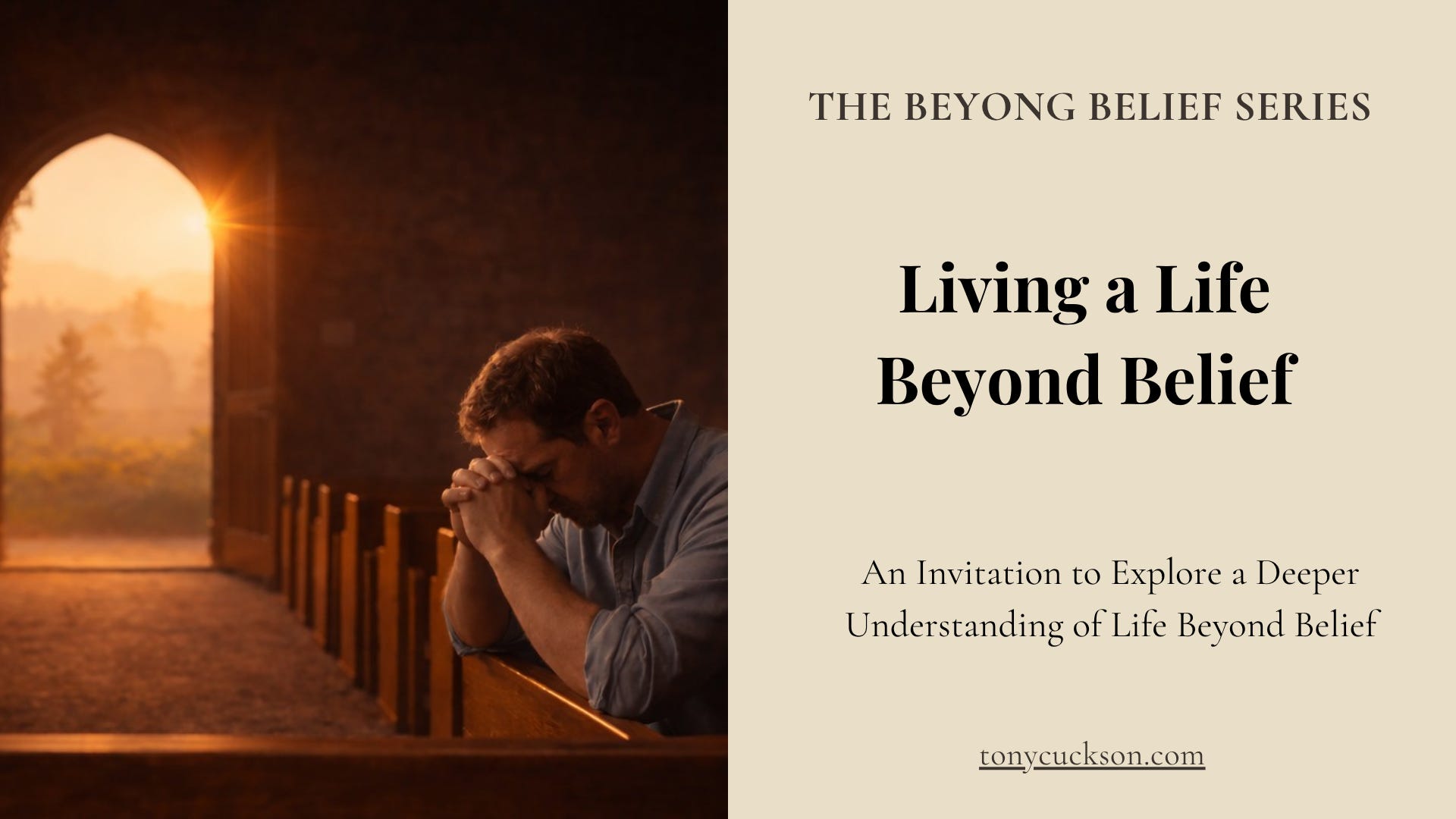
The deepest belief is not, “I believe in God the Father almighty.” The deepest belief is the belief in separation. It is the unquestioned conviction that I exist as a separate self, distinct from everyone else and separate from the reality to which the word God points. This belief is rarely spoken, yet it shapes the whole of our experience. No matter how often the words of the creed are repeated, they do not in themselves dissolve this deeper conviction. Whether someone believes in God or rejects the very idea of God, the underlying experience is often the same. God is “over there,” and I am “over here.” God is one thing; I am another. Separation is taken to be reality itself.
For that reason, whenever I hear someone say, “I believe in God,” my first response is not to agree or disagree. It is to ask, “What do you mean by that?” Until that question is explored with honesty, the words remain a formula that can easily conceal more than they reveal.
The Nicene Creed begins with a single, easily overlooked word: I.
“I believe in God the Father almighty.”
That “I” appears entirely natural because it expresses our ordinary experience of ourselves as separate individuals. Yet it is precisely this unquestioned identification with the separate personal self that forms the veil between ourselves and the reality to which the word God points. The repeated affirmation of belief can therefore strengthen the very identity that obscures direct knowing.
God, whose boundless love and joy
Are present everywhere;
He cannot come to visit you
Unless you are not there.
— Angelus Silesius
Angelus Silesius is not inviting us to deny God. He is inviting us to discover that there is something to be relinquished before God can be known. What must disappear is not God but the separate self that stands apart claiming, “I am the believer.”
The invitation is not to become an unbeliever. It is an invitation to move beyond belief into KNOWING. Belief belongs to thought. KNOWING belongs to direct experience. As long as there is someone standing apart saying, “I believe in God,” there remains a subtle division between the believer and God. When that division falls away, belief gives way to knowing.
This sounds like an invitation to lose ourselves, but it is nothing of the sort. It is an invitation to discover that what is lost is only the false identity we have mistaken for ourselves. This is the paradox to which Angelus Silesius points when he writes, “Unless you are not there.” It is the same paradox expressed by Jesus when he says, “Whoever wants to save his life will lose it.” The separate self is always seeking security. It can seek security through wealth, status, success, relationships, or even through being “a believer.” The identity itself becomes something to protect. Yet the gospel points beyond every identity, even the religious one, towards the direct knowledge of our oneness with the Father.
The invitation of Christianity without Fear is to explore what lies beyond belief. It is an invitation to the quest for knowing, for revelation, for realization—the unveiling of what has always been true. When something is known directly, belief has fulfilled its purpose. There is no need to believe that the sun is shining while standing in its light. Direct experience replaces assumption. The question, then, is both simple and unsettling:
Would you be willing to let go of your belief in God in order to discover the reality to which the word God points?
This is not an invitation to unbelief. It is an invitation to authentic faith. Faith, in this sense, is the courage to move beyond inherited ideas, doctrines, and second-hand certainty into direct encounter. The journey begins with an act of profound humility: acknowledging that you do not know. Not that you know nothing, but that you do not yet know directly the reality to which the word God points. That acknowledgement is the doorway to the unknown.
Throughout Scripture, this movement into the unknown is portrayed as the wilderness. Israel leaves the familiarity of Egypt and enters the desert before reaching the Promised Land. The wilderness is not a punishment but a transformation. It is the place where old identities die and a new way of seeing is born. The Promised Land is not ultimately a geographical destination. It is a state of awareness in which separation has come to an end. It is the realization that you have never been separate from the Divine and never could be.
Seen in this light, Egypt becomes a metaphor for every identity to which we remain enslaved, including the identity that says, “I am a believer.” The wilderness is the willingness to surrender every certainty that stands between ourselves and direct knowing. The Promised Land is the discovery that what we have been seeking has always been present.
Along the journey that has been my life, I have met many believers. What has often struck me is that many are uncomfortable when their beliefs are questioned. Whether Christian, belonging to another religion, or committed to some other worldview, questioning can provoke defensiveness and, at times, even anger. That response raises an important question. If belief is true, why should it fear enquiry?
Is belief, then, of any value?
I believe it is.
Belief is like a signpost. A signpost has great value because it points beyond itself towards a destination. Its purpose is not to be admired or defended but to be followed. The problem begins when we mistake the signpost for the destination itself. One contemporary mystic described this as becoming a “signpost clinger.”
Every authentic spiritual tradition points beyond words, doctrines, and beliefs towards direct realization. The Christian path is no exception. The invitation of Jesus is not simply to believe certain propositions about God but to follow him. To follow is to take up the cross of the separate self, to allow the illusion of separation to die, and to awaken to union with the Divine as our true identity.
This is the meaning of dying into eternal life. Eternal life is not something that begins after physical death; it is the discovery of a life that has always existed beyond the limitations of the separate self.
Belief can be the beginning of that journey. It can awaken the possibility that such a transformation is real. But belief is never the destination. The destination is realization. The destination is knowing. The destination is awakening to the truth that what we have sought has never been absent. When belief gives way to KNOWING, there is nothing left to defend.
How do you defend the Infinite?
The need to argue, persuade, or convince quietly falls away because what has been revealed no longer depends upon opinion. The separate self, with its need to be right, loses its grip. What remains is Presence.
It is this Presence that people encounter. Some are drawn to it, while others turn away. Neither response matters very much because there is no longer a desire to make anyone believe. Belief cannot be imposed. Revelation cannot be argued into existence.
The gospel is therefore not first and foremost something we speak. It is something we become. Words may point the way, but they are only signposts. What transforms another person is the silent communication of a life lived in communion with the Divine reality to which those words point.
In that communion, you discover that there is very little to do. The separate self no longer strives to accomplish God’s work. Instead, it allows the Divine Presence to live and move through it, just as it always has. Authority no longer rests upon borrowed ideas, inherited doctrines, or the approval of others. It arises from direct participation in the Divine. It is the quiet authority of experience rather than the loud authority of opinion.
There is nothing to prove because there is nothing to protect. Conviction born of belief seeks agreement. Conviction born of revelation seeks only to be faithful to what has been seen. The first argues; the second radiates. The journey that begins with the words, “I believe in God the Father almighty,” reaches its fulfilment when even the one who says, “I believe,” disappears into the One who simply IS.
Tony Cuckson, Cordressogagh, Ireland
Christianity Without Fear is a reader-supported publication. To receive new posts and support my work, consider becoming a free or paid subscriber.
Comments
Nothing yet. Say the first thing.
Sign in to join the conversation.