
What I love about writing Christianity without Fear is that it allows me to explore the questions that genuinely excite me. I have reached a stage in life where I no longer feel the need to seek permission for such explorations or worry about whether others agree with my conclusions. I am not trying to convince anyone that I am right. I am simply sharing what has become clear to me through experience. When a question captures my attention, I stay with it until something deeper reveals itself. That process has become one of the greatest joys of this journey.
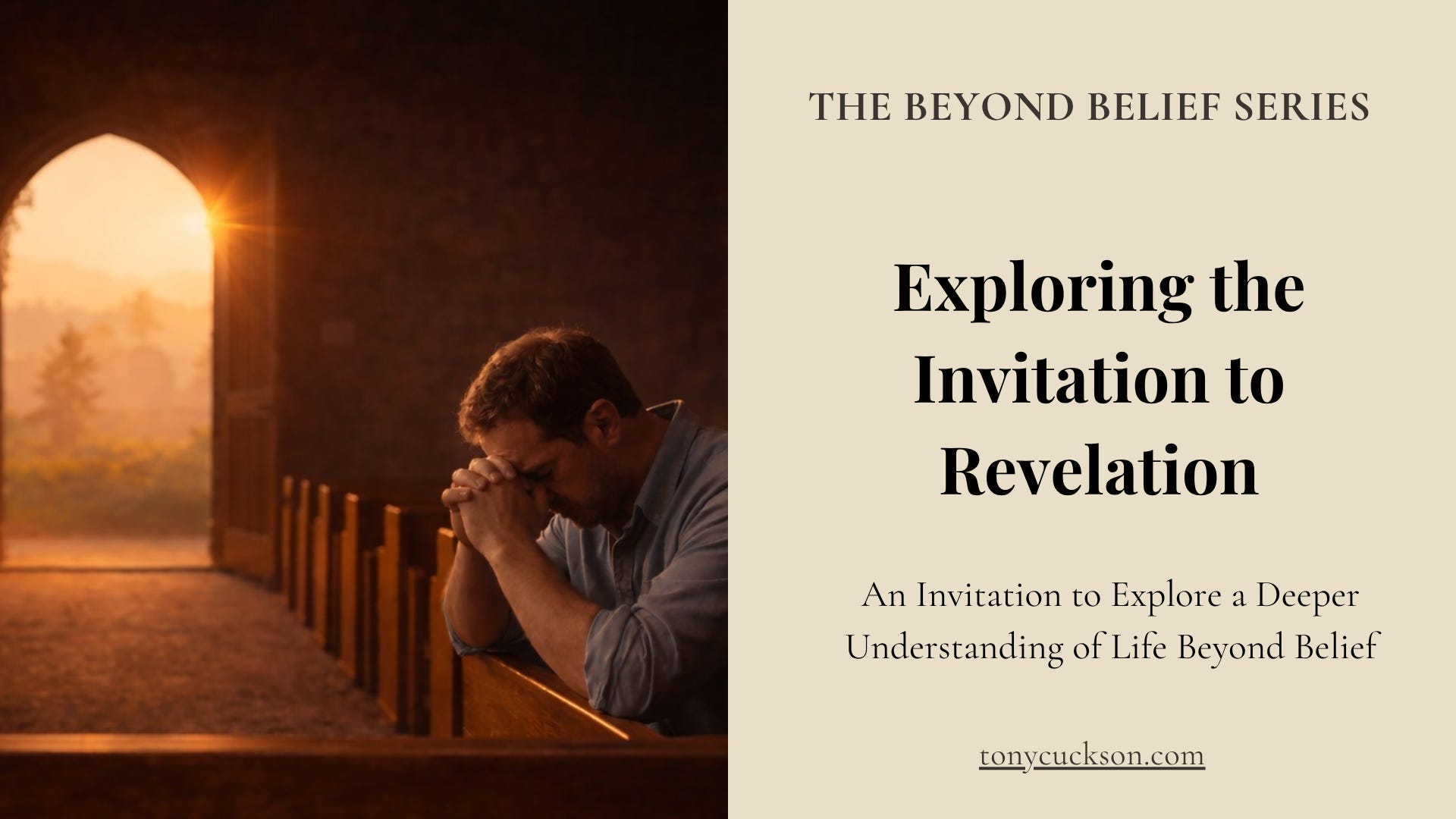
I do not begin by looking for answers from pastors, priests, theologians or gurus. They all have their place, but they cannot reveal to me what can only be known directly. Instead, I return to the silence within. It is there that revelation happens. It is there that what is hidden becomes visible. It is there that I encounter what I can only call the true Revelator. This is why the words of the Psalmist continue to resonate so deeply with me: “Be still and know that I am God.” I no longer hear this as an invitation to believe something about God. I hear it as an invitation to know directly. The emphasis is on the word know. The invitation is to experience for myself the reality to which the word “I” points. That direct knowing is revelation.
Christianity Without Fear is a reader-supported publication. To receive new posts and support my work, consider becoming a free or paid subscriber.
For the last week one question has remained with me wherever I go. It is a remarkably simple question: What is revelation? I have discovered that the way we answer this question shapes the whole of our spiritual life. If revelation is understood as information handed down from an external authority, then our task becomes one of believing and defending ideas. If revelation is understood as direct seeing, then everything changes. Spiritual life becomes an awakening. It becomes the unveiling of what has always been present but unnoticed.
This understanding stands in sharp contrast to the way the word revelation is commonly heard within Christianity. For many people it immediately evokes images of the end of the world, divine judgement, catastrophe and fear. The final book of the New Testament has come to dominate our understanding of the word itself. Mention revelation and most minds move immediately towards predictions about future events rather than towards an awakening of consciousness.
Yet the word revelation simply means an unveiling. It is the removal of a veil. Nothing new is created. Nothing is added. What has always been true is finally seen. That understanding has become increasingly important to me because it shifts the focus from trying to discover what will happen one day to seeing what is true now. Revelation is not primarily about history. It is about Reality.
As I have explored this subject I have also become fascinated by the history of revelation within the early Christian movement. The Book of Revelation is only one of several early Christian apocalyptic writings. Other texts also claimed to unveil spiritual truth, although they were not included in the New Testament canon. Their existence reminds us that the early Church wrestled with different understandings of what revelation meant. That historical journey is interesting, but it is not where I find the deepest meaning of revelation.
For me, revelation is neither the possession of secret knowledge nor the prediction of future events. Revelation is the direct recognition of what has always been true. It happens when the mind becomes quiet enough for reality to disclose itself. It happens when the separate self relaxes its grip and a deeper knowing emerges. It happens in silence. It happens now. That is the revelation I want to explore in this article.
As I have lived with this question, I keep returning to another one. Is revelation the same as prophecy? My own experience tells me that they are not the same thing, although they are often treated as though they are. When most Christians think of the Book of Revelation they immediately think of prophecy. Their attention turns towards future events, the Four Horsemen of the Apocalypse, the return of Jesus, the Day of Judgement and the end of the world. For many Christians this is not simply a belief; it is a longing. Their eyes are fixed on a future that will finally bring this world to an end. I find myself asking what it means when our spiritual attention is directed more towards death than towards Life. My own journey has taken me in the opposite direction.
The Hebrew prophets spoke in visions, dreams and powerful symbolic language. The writer of the Book of Revelation does the same. Symbols have their place, but symbols always require interpretation. They point beyond themselves. One person sees one meaning while another sees something entirely different. This is the nature of prophecy. It speaks through images that awaken the imagination and invite reflection.
Revelation is of an entirely different order. Revelation is not symbolic. It is not imagination. It is not belief. It is not something that has to be interpreted. Revelation is KNOWING. When revelation occurs there is no need for argument because there is no separation between the knower and what is known. The veil falls away and what remains is direct experience. This knowing does not arise through thinking. It is given in silence. It carries its own certainty because it is self-authenticating.
Within that knowing there is no anxiety about the future because revelation does not belong to time. It belongs to the Timeless. This is why I find myself saying that revelation is not about the end of the world. It is about the end of Time. It is the ending of psychological time, the ending of the mind’s endless movement between past and future. In that ending there is the direct knowing of eternal Life. Eternal Life is not endless duration. It is the experience of the Eternal Now.
This is not a future event waiting to happen to humanity. It is an awakening available in this moment. It is deeply personal, profoundly transformative and completely transcendent. It changes the way we see ourselves, the way we see God and the way we see the world.
This also explains why an obsession with prophecy can become a veil that hides revelation. The mind becomes absorbed in trying to decode future events instead of awakening to what is present now. Attention is drawn away from direct knowing and towards endless interpretation. The future becomes more fascinating than Reality itself.
Revelation calls us in the opposite direction. It calls us out of time, out of imagination, out of fear and into direct knowing. It is here, and only here, that the veil is removed and Life reveals itself as it has always been.
To my mind, one can spend an entire lifetime exploring the symbols of prophecy without ever arriving at revelation. History is filled with people who have confidently proclaimed the end of the world. They have pointed to wars, eclipses, earthquakes, political events and countless other signs as proof that the final days were at hand. They announced dates with absolute certainty. Every one of those dates passed. The fascination with signs remained, but revelation did not.
Every great spiritual tradition begins with someone whose life has been transformed by direct revelation. Yet very few of those revelators set out to create a religion. What follows is usually something very different. The living experience gradually becomes a system of beliefs. The revelation becomes a doctrine. The words of the teacher become more important than the experience from which those words arose. Generation after generation learns to repeat the words while only a few discover for themselves the reality to which those words point. Those few have traditionally been called mystics, not because they possess secret knowledge, but because they have been graced with direct communion with the Reality we call God.
When I see people endlessly searching for signs of the end of the age, I do not see revelation at work. I see the mind looking everywhere except where revelation is found. Such searching can easily become a form of spiritual narcissism. The attention remains fixed upon my interpretation, my certainty, my prediction, my special knowledge of what is about to happen. Ironically, the very search for signs becomes the veil that hides what is always present.
Jesus addressed this directly. When the Pharisees asked Him when the Kingdom of God would come, He answered, “The kingdom of God is not coming with signs to be observed... for the kingdom of God is in your midst.” His response redirected attention away from the future and back to the immediacy of the present. He invited people to stop looking “here” or “there” for the Kingdom and to awaken to the Reality already present.
This is why I see revelation and the search for signs moving in opposite directions. One takes the mind into the future, where it endlessly interprets symbols and imagines events that have not yet happened. The other dissolves time altogether. It brings us into the Eternal Now where nothing needs to be predicted because Reality is already revealing itself. Revelation is never found in speculation about tomorrow. It is found in the direct knowing of what is present now.
Revelation is an inner experience given by grace. It cannot be manufactured through effort, acquired through study or possessed through belief. It is received. When it comes, it unveils what has always been present but hidden beneath the activity of the thinking mind.
At the heart of that unveiling is the direct knowing of the words, “I AM.” I do not mean the separate personal self that continually declares, “I am this,” or “I am that.” The personal self is always identifying itself with thought, memory, history and experience. The “I AM” of revelation is prior to all of these. It is pure Being. It is the living Presence to which every great spiritual tradition points and which Jesus expressed so simply when He said, “Before Abraham was, I AM.”
When revelation is given there is certainty. Yet this certainty does not belong to a person. There is no separate individual standing apart saying, “Now I know.” The division between the knower and the known has dissolved. There is only KNOWING. That is why revelation carries an authority that no argument can either establish or destroy. It is self-authenticating because it is direct.
The intellect cannot grasp this. It can describe it, analyse it, debate it and build entire theological systems around it, but it cannot produce the experience itself. One can spend an entire lifetime studying the Book of Revelation and remain fascinated by its symbols without ever entering the revelation to which the word itself points. The map is not the territory. The words are not the experience. The symbol is not the Reality.
Only when the veil falls away through grace does the meaning of revelation become clear. What is unveiled is the truth of non-separation. Time and space no longer define experience. The separate self is seen for what it is, and eternal Life is no longer an article of belief but a living reality. Nothing new has been added. What has changed is that what was hidden has become visible.
This is why revelation always transcends words. Words can point towards it, just as a finger points towards the moon, but words cannot contain it. In fact, words can become the veil when they are mistaken for the Reality itself. This is why an endless preoccupation with the end of the physical world can obscure the deeper invitation. Revelation is not pointing towards the end of the world. It is unveiling the end of psychological time. In that ending, the Eternal Now is no longer an idea. It is directly known.
Tony Cuckson Cordressagogh Ireland
Christianity Without Fear is a reader-supported publication. To receive new posts and support my work, consider becoming a free or paid subscriber.
Comments
Nothing yet. Say the first thing.
Sign in to join the conversation.