
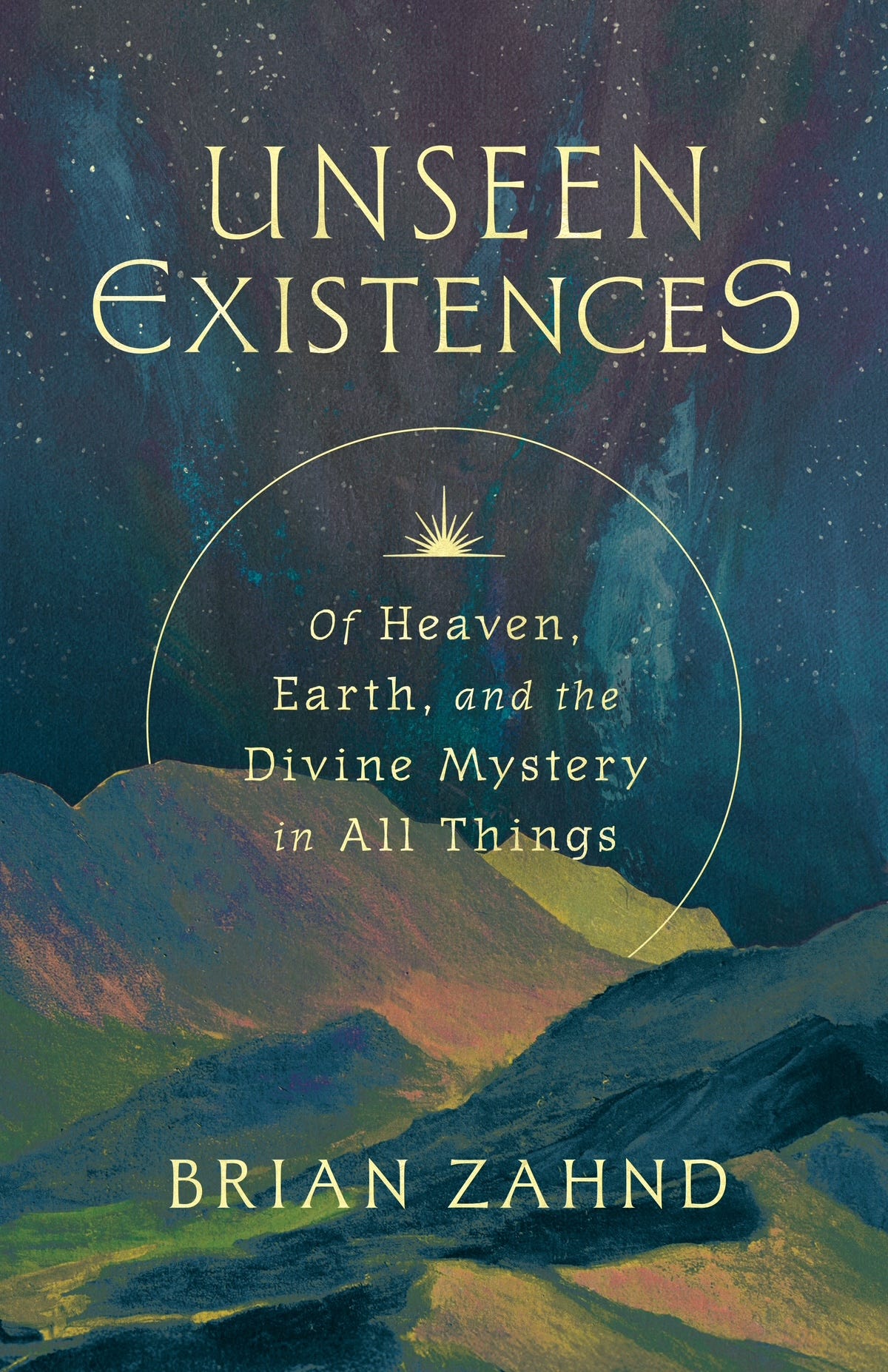
Five weeks from today (May 19) is the release date for my latest book, Unseen Existences: Of Heaven, Earth, and the Divine Mystery in All Things. I thought I might pique your interest and give you an idea of what this book is about by sharing the Prelude. Also, shortly after the release date, I’ll share what at this point I’ll call a “bonus track”—the original final chapter that didn’t survive the editing process. But for now have a gander at the Prelude.
BZ
PRELUDE
Paths of Unseen Existences
You paths worn in the irregular hollows by the roadsides!
I believe you are latent with unseen existences, you are so dear to me.
—Walt Whitman, “Song of the Open Road”
In his “Song of the Open Road,” the great American poet Walt Whitman spoke of beloved paths that somehow touch on unseen existences. Poets and prophets are prone to use that kind of language—unseen existences. To the modern materialist mind, unseen existences are casually dismissed as a fallacy of the imagination. But, as Nick Cave astutely observes, “We must take our subtle spiritual intuitions seriously and view them as the quintessence that underlies the ordinary world. The rejection of the sacred is the fundamental reason for our existential discontent.” Our modern “existential discontent” will not be healed unless we remember what our ancestors knew: A spiritual world underlies what we think of as the ordinary world.
This other world, this unseen world, this spiritual world is commonly called heaven—not merely as the domain of the afterlife but as the spiritual world enfolded into the material world all around us. All premodern societies presumed the existence of this unseen world and tried in their own ways to interact with it properly through ritual and religion, shamanism and sacrifice. The ancient Hebrews, through revelation, eventually came to understand this unseen world as the domain of the one true God and a host of attendant spiritual beings called angels. The Greek philosophers, through what they described as reason, intuited that a spiritual world of eternal Forms sustaining the temporal material world must necessarily exist. And within Christianity the belief in a heavenly world is so basic, so assumed, so essential that without such a belief Christian theology would be incoherent.
And yet under the pressure of modernity and its subservience to empiricism, heaven seems to have gone missing in much of Christian theology. In the field of academic theology, there is a tacit embarrassment to speak too seriously about heaven lest one be dismissed as a fundamentalist rube by Christianity’s cultured despisers. I shrug off any such condescension and insist that if Christianity is to have a compelling message in the twenty-first century, it must once again speak confidently, if humbly, about the reality of unseen existences.
Once we acknowledge the reality of a spiritual world, we can understand life as a pilgrimage of the soul toward our true telos—our true aim, our true goal, our true end: union with God. Before contemporary Christianity was taken over by modern pragmatism and deteriorated into a bland religious form of self-improvement programs, the robust spirituality of earlier ages placed a primary emphasis on spiritual formation. For us to become the people God created us to be, we must embark on a journey toward spiritual maturity—a pilgrimage of the soul, if you will. This pilgrimage toward a properly developed soul is a lifelong project, and quite possibly a project that continues into the life to come. None of this is a new idea. In attempting to do my tiny bit to help Christianity have a flourishing presence as it enters its third millennium, I am largely drawing on the ideas and praxis of an earlier time—a time before heaven and the soul were sidelined for what are considered more pragmatic concerns.
Gregory of Nazianzus (329–390), sometimes known as Gregory the Theologian, in an Easter sermon spoke of the human being as the nexus between the two worlds—the visible and invisible. In thrilling and robust theological language—so characteristic of the early church fathers and mothers, and so appallingly absent in modern sermon craft—the Theologian said this:
The great Architect of the universe conceived and produced a being endowed with both natures, visible and invisible. . . . He created a being at once earthly and heavenly, insecure and immortal, visible and invisible, halfway between greatness and nothingness, flesh and spirit at the same time . . . an animal en route to another native land, and, most mysterious of all, made to resemble God by simple submission to the divine will.
Pope Benedict XVI said something similar when he observed that, “Human persons are beings en route, beings characterized by transition. They are not yet themselves; they must ultimately become themselves.” We human pilgrims are en route to becoming ourselves, and we’re on a journey to another native land—we’re on a pilgrimage of the soul toward our true home in heaven. Pilgrimage is an enduring metaphor—yet this is more than a metaphor. Pilgrimage may be the most accurate description regarding the proper relation of the soul to heaven while in this present world. At least the Bible thinks so. What are we in this life? We are pilgrims trying to find our way to the heavenly home of union with God—the home where we belong but have not yet been.
Yet we should not assume that a life lived any way we choose will automatically lead us home—we must submit to the divine will. As Jesus warned, there are roads that lead to ruin. And here I concur with C. S. Lewis when he remarked, “I do not think that all who choose wrong roads perish; but their rescue consists of being put back on the right road.” Though to many a modern reader the idea of life consisting of roads that lead either to home or ruination may seem little more than the quaint superstition of a bygone epoch, this is precisely how our venerable forebears thought of their lives in this transient world.
~ ~ ~ ~ ~ ~ ~
You can preorder Unseen Existences here.
Comments
Nothing yet. Say the first thing.
Sign in to join the conversation.