
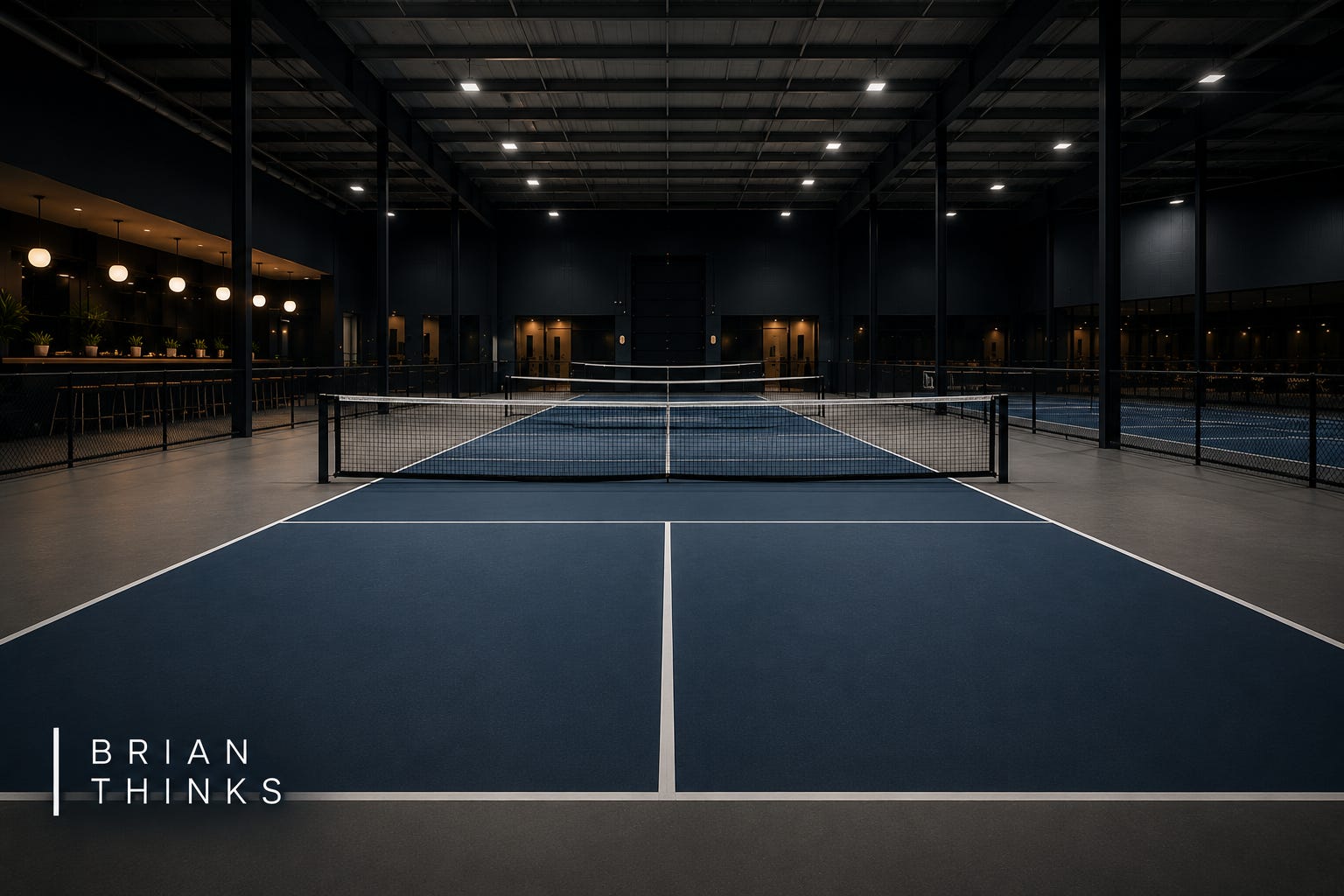
Three new pickleball clubs are opening within a few miles of each other.
Every pickleball club is successful on opening day.
The courts are finished.
The easy part is over.
The grand opening will be packed.
The memberships will come in.
The photos will look great on social media.
Everyone will feel optimistic.
That’s the easy part.
The real competition starts on Tuesday night.
That’s when members decide whether to come back.
That’s when operators discover what business they’re actually in.
Most think they’re in the pickleball business.
Some think they’re in the court business.
Others think they’re in the membership business.
A few think they’re in the technology business.
They’re all asking the same question.
How do we fill the courts?
They’re asking the wrong question.
The question isn’t how to fill the courts.
The question is how to keep filling them.
Week after week.
Month after month.
Year after year.
Courts are purchased. Demand is earned.
Most operators don’t realize this until it’s expensive.
Because courts are visible.
Demand is invisible.
The court shows up on a balance sheet.
The relationship doesn’t.
The trust doesn’t.
The anticipation doesn’t.
The habit doesn’t.
Yet those are often the assets doing the heavy lifting.
When members stop showing up, operators usually blame the market.
The weather.
The economy.
The competition.
Almost anything except the real problem.
They misunderstood what business they were in.
The courts were never the business.
The business was demand creation.
The business was giving people a reason to return.
You can finance courts. You can’t finance demand.
Demand has to be created.
Then recreated.
Again.
And again.
And again.
This is where many operators get into trouble.
They build the facility.
Launch the memberships.
Open the doors.
Then they start looking for places to save money.
The conversation inevitably lands on payroll.
A little less salary.
A little less experience.
A little less investment in staff.
The spreadsheet improved. The business didn’t.
The mistake is understandable.
A court looks like an asset.
Payroll looks like an expense.
One appreciates.
The other depreciates.
At least that’s what the spreadsheet says.
But pickleball clubs aren’t built on spreadsheets.
They’re built on behavior.
They’re built on relationships.
They’re built on the reasons people choose one club over another when they have options.
That’s where the best operators think differently.
They don’t see great staff as payroll.
They see great staff as demand creation.
A great pro isn’t payroll. A great pro is demand creation.
A great pro is marketing.
A great pro is retention.
A great pro is onboarding.
A great pro is customer success.
A great pro creates reasons for people to return.
The operator sees an expense.
The member experiences a reason to stay.
Those are not the same thing.
The clubs that survive understand this.
The ones that struggle usually don’t.
Not because their courts are worse.
Not because their technology is outdated.
Not because their memberships are priced incorrectly.
Because they misunderstood what business they were in.
The operator sees an expense. The member experiences a reason to stay.
Three clubs can open in the same market.
All can have beautiful courts.
All can have memberships.
All can have software.
All can have grand openings planned.
The question isn’t who built the nicest facility.
The question is who built a demand engine.
Because once the novelty wears off, the game changes.
Now members have choices.
Now the market gets efficient.
Now operators discover whether they built a facility or an engine.
You can scale courts. You can’t scale empty courts.
The next few years will tell us.
Some operators built facilities.
Others built demand engines.
Only one of those scales.
The easiest thing to build is a pickleball club.
The hard part is building one people miss when they’re not there.
No posts
Comments
Nothing yet. Say the first thing.
Sign in to join the conversation.