
Sports fans have never been smarter.
They understand statistics.
They understand tactics.
They understand roster construction, matchups, trades, leverage, and momentum.
And they can smell recycled analysis from a mile away.
That’s why so much modern sports content feels unsatisfying.
The audience already knows the score.
They already saw the highlights.
They already know who won.
What they’re looking for is the thing everyone else missed.
Insight.
The kind that makes you stop and think:
I hadn’t thought about it that way.
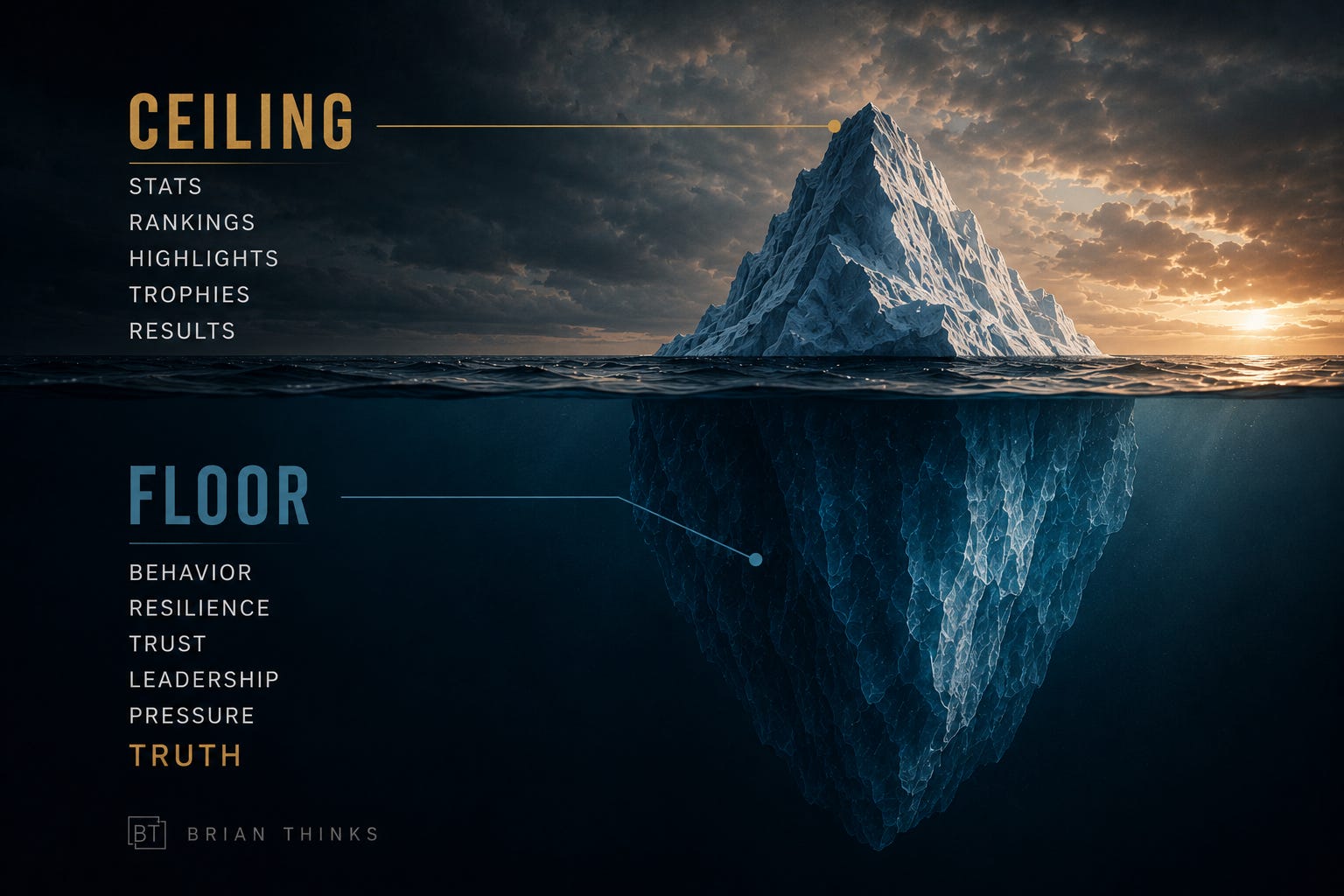
The sports world is obsessed with ceilings.
Ceilings are fun.
Ceilings sell tickets.
Ceilings get players drafted.
Ceilings fill podcasts.
Ceilings dominate social media.
A ceiling is possibility.
A glimpse of what someone could become.
But ceilings don’t show up when you need them most.
Pressure doesn’t care about potential.
Pressure doesn’t care about rankings.
Pressure doesn’t care about highlight reels.
Pressure asks a different question.
What happens when the plan breaks?
Pressure doesn’t reveal potential.
It reveals behavior.
The best athletes I’ve ever watched weren’t always the most talented.
They were the hardest to break.
I’ve been thinking about that a lot lately while watching Major League Pickleball.
Not the shots.
Not the score.
The people.
Tyson McGuffin is a good example.
When things start going sideways, Tyson gets bigger.
Not physically.
Behaviorally.
He communicates more.
Connects more.
Competes harder.
He raises the floor of the people around him.
The same thing shows up in different forms.
Rachel Rohrabacher touches the ball and entire rallies begin bending around her decisions.
Christian Alshon quietly stabilizes chaos.
The best players don’t just make plays.
They make mistakes survivable.
Great players don’t just raise the ceiling.
They raise the floor.
And that’s when something clicked for me.
Maybe we’ve been evaluating athletes backwards.
We start with results.
Then statistics.
Then performance.
Then narrative.
But the story often begins much earlier.
With behavior.
How does someone respond after three straight misses?
How do they treat a struggling partner?
What happens when opponents find the pressure valve?
What happens when certainty disappears?
Those moments rarely appear in the box score.
Yet they often determine the box score.
The invisible layer of sports isn’t talent.
Talent is easy to see.
The invisible layer is behavior.
That’s where trust lives.
That’s where leadership lives.
That’s where pressure lives.
That’s where truth lives.
The ceiling is what a player can become.
The floor is who they are when everything starts falling apart.
Everybody wants a higher ceiling.
Owners want it.
Coaches want it.
Players want it.
Fans want it.
I get it.
Ceilings are exciting.
But championships are often won by something else.
A floor that refuses to collapse.
A partnership that survives adversity.
A player who doesn’t fracture when momentum shifts.
A team that remains itself when the plan dies.
Great players raise the ceiling.
The rare ones raise the floor.
And the more sports I watch, the more convinced I become that we’re looking at the wrong thing.
Not because the visible layer doesn’t matter.
Because it’s the invisible layer that explains it.
The ceiling is potential.
The floor is truth.
No posts
Comments
Nothing yet. Say the first thing.
Sign in to join the conversation.