
Tennis people do not need another essay telling them pickleball is growing.
They already know.
They hear it through the fence. They see the converted courts. They feel it in the schedule, the budget, the court sheet, the member complaint, and the strange plastic crack now following every racquet facility in South Florida.
The mistake is thinking this is still an argument about tennis versus pickleball.
It is not.
Tennis has history, technique, prestige, lineage, and the names on the wall.
Pickleball has noise, compression, velocity, group texts, deep rosters, and new players who started six months ago and now speak like they discovered geometry.
Fine.
Everyone can keep their religion.
I am less interested in changing anyone’s mind about the sport.
I am more interested in the machine around it.
Because the more I looked at the league numbers in Southern Palm Beach County, the less this looked like a sports story.
It looked like a distribution story.
Then it looked like something stranger.
Maybe pickleball did not build the machine from scratch.
Maybe South Florida already had the machine sitting there.
Pickleball just found the switch.
These are working estimates, not a perfect census.
Pickleball does not have one clean USTA-style database. Players overlap. Rosters are inflated. Some people play multiple leagues. Some are listed but barely play.
Still, the shape of the market matters:
55+ South County pickleball leagues: roughly 6,900 rostered players
All-age / DUPR-style pickleball leagues: roughly 1,200–1,500 players
Estimated South County pickleball footprint: 8,000+ roster spots
South County USTA tennis: roughly 2,500–3,500 players
Tennis becomes much more competitive when independent women’s leagues, senior leagues, flex leagues, and club circuits are added back in
The point is not the exact count.
The point is the structure.
Pickleball did something very specific.
It concentrated.
It organized.
It turned neighborhoods into teams, courts into obligations, residents into captains, and captains into operators.
That is not just growth.
That is infrastructure.
Tennis is still everywhere, but tennis is spread out. USTA. Women’s leagues. Senior tennis. Private clubs. Public parks. Country clubs. Flex leagues. Old captains. Long memories. Systems built over decades.
Pickleball found a tighter path.
Boca. Delray. Boynton.
The gated community corridor.
The active adult neighborhood.
The place where the ingredients were already sitting there: courts, calendars, captains, email lists, WhatsApp threads, free mornings, seasonal urgency, status anxiety, and the need to belong.
Pickleball did not need to invent a culture.
It plugged into one.
That is the part tennis people often miss. They see the easier sport, the smaller court, the shorter swing, the lower barrier, the newer player who has not spent twenty years learning topspin, footwork, serve mechanics, point construction, and how to lose a tiebreak without blaming the sun.
And they are not wrong.
Tennis is deeper. Tennis has the higher technical ceiling. Tennis takes longer to learn, longer to master, and longer to fake.
But depth is not activation.
Mastery is not participation.
Prestige is not showing up.
Modern clubs do not survive on prestige alone. They survive on utilization. Calendars. Bodies through the gate. Cars in the lot. Players staying after the match. Lunch orders. Practice groups. Group texts. Members feeling like the club is part of their life.
Pickleball found that vein.
Or maybe South Florida had the vein waiting.
Smaller courts. More players per square foot. Shorter points. Faster entry. More rallies. Less punishment. More people believing they can matter sooner.
Same footprint. More courts. More bodies. More rotation. More noise. More belonging.
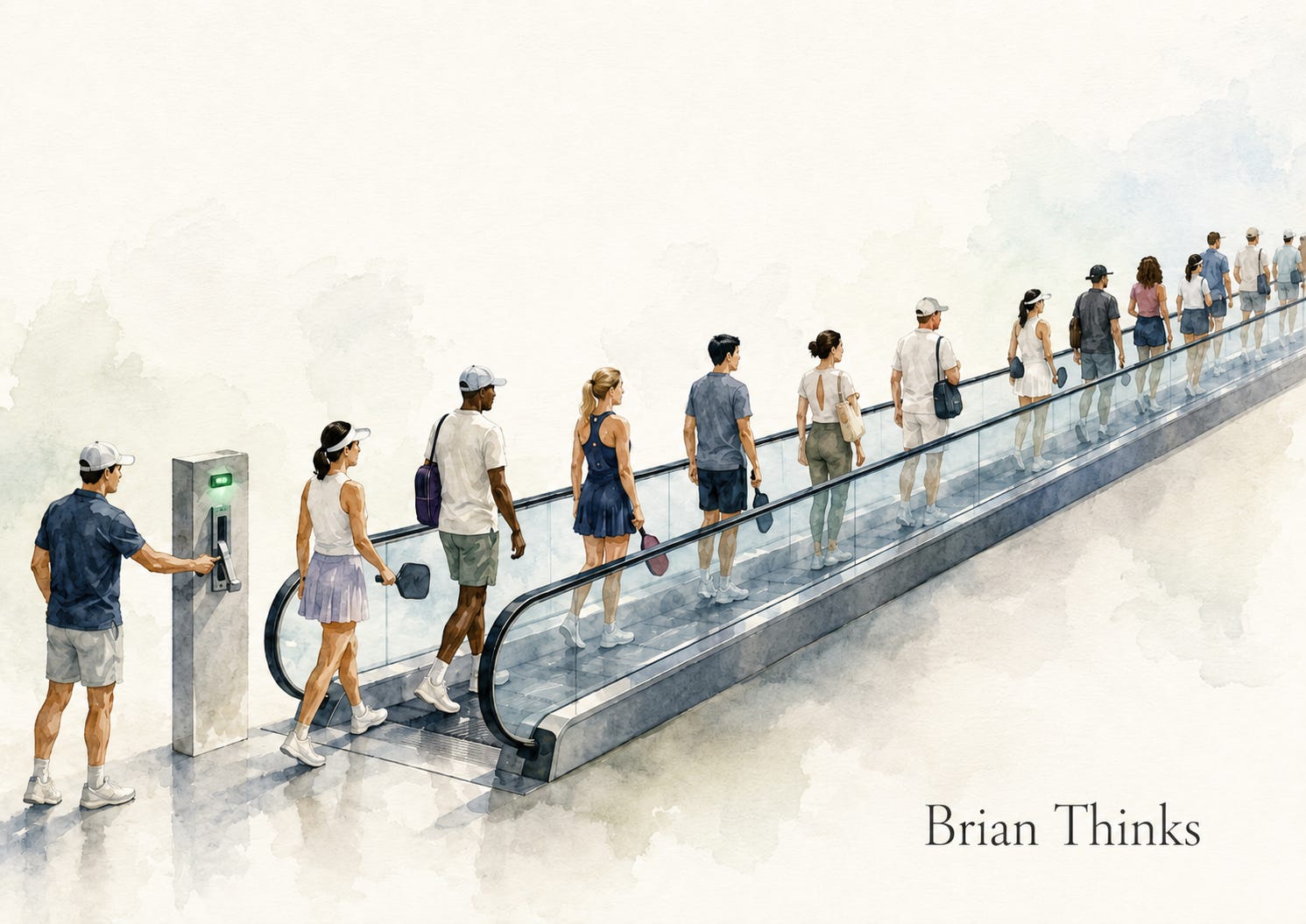
That is the machine.
Not a machine in the cold industrial sense.
A social machine.
One neighbor asks another to play. One foursome becomes two. One clinic becomes a chat thread. One chat thread becomes a team. One team becomes a league. One league becomes a weekly identity.
Can you stay for one more?
That may be the addict’s creed of pickleball.
Not because the sport is perfect.
Because the loop is perfect.
Entry. Rally. Belonging. Invitation. Repeat.
The league might be the product.
Not the lesson. Not the clinic. Not even the court.
The league.
The league creates identity, urgency, repetition, stakes, and a reason to care about a Tuesday morning in February.
It turns a resident into a teammate. A reservation into a calendar event. An amenity into a social operating system.
That is why the pickleball league explosion matters.
It is not just a participation story.
It is a structure story.
Tennis built players.
Pickleball built participation loops.
That line may bother people.
Good.
It should.
Tennis still owns the idea of mastery. Pickleball may own the habit of showing up.
And if you run a club, build a department, sell programming, manage court demand, or try to understand where racquet sports are going, the habit of showing up is not a small thing.
It is the business.
The future of racquet sports will not be decided only by which sport is harder, better, purer, deeper, or more deserving of respect.
It will be decided by rhythm. By the calendar. By the role. By the roster. By the thing that makes people feel needed. By the sport that turns courts into culture.
That is where pickleball has been underestimated.
Not as a sport.
As a machine.
It found the calendar. It found the group text. It found the captain. It found the retired resident looking for a reason to be needed on Tuesday morning.
It found the community that did not just want courts.
It wanted belonging.
That is the machine.
And once a sport becomes the machine, the argument over which game is better starts to matter less.
Because clubs do not run on opinions.
They run on people showing up.
The future of racquet sports may not belong to the sport people respect the most. It may belong to the sport that gets the most people to show up.
Brian Thinks explains the pattern.
Dinkmasterly helps you recognize it in yourself.
Hint: To try it out log into chatGPT and then click here.
No posts
Comments
Nothing yet. Say the first thing.
Sign in to join the conversation.