
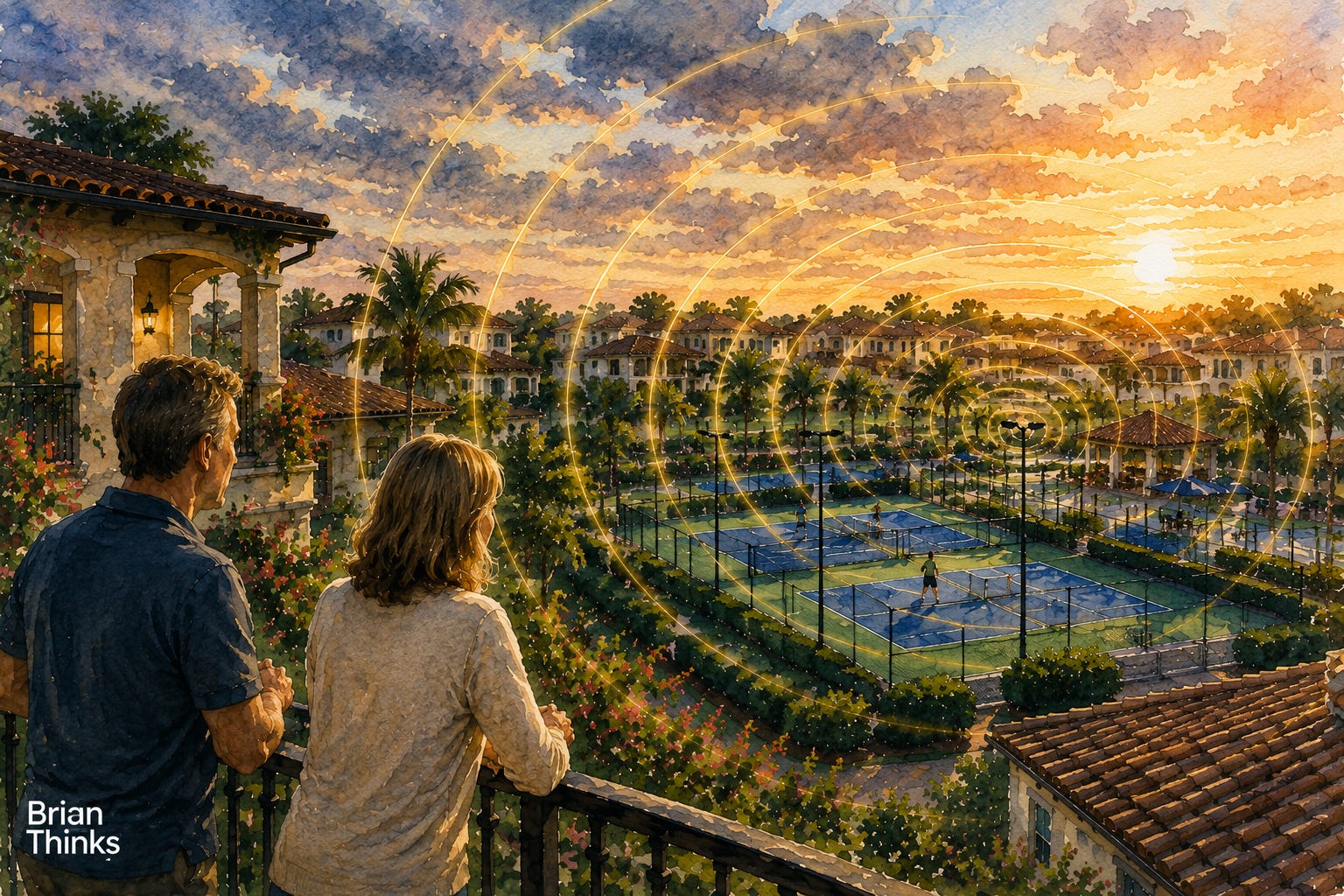
They’re fighting each other.
They should be fighting physics.
At first glance, this looks like another story about pickleball noise.
It isn’t.
It’s a story about what happens when intelligent people spend years trying to solve the wrong problem.
Across the country, homeowners are filing lawsuits.
Boards are facing recalls.
Neighbors who once enjoyed living beside one another have stopped speaking.
Every community has its own explanation.
Players blame the neighbors.
Neighbors blame the board.
Boards blame developers.
Developers blame demand.
None of those explanations fully answer one simple question.
Why does the same conflict keep appearing in community after community?
Whenever different people keep producing the same outcome, it’s worth asking a different question.
What if the problem isn’t the people?
What if it’s something underneath them?
That question led me to three South Florida communities.
According to reporting by The Palm Beach Post, Parkside at Boca Trail, Polo Trace, and Crescent Lakes have each become flashpoints in the growing debate over pickleball noise.
The details are different.
The pattern isn’t.
At Parkside, residents filed suit after saying the sound from nearby courts invaded their homes. One homeowner described it as feeling “like they’re playing in my kitchen.”
At Polo Trace, homeowners challenged courts built close to homes and plans for additional expansion.
At Crescent Lakes, converting tennis courts into pickleball courts helped spark a recall effort against the board.
Three communities.
Three different stories.
One remarkably familiar ending.
That’s when I realized I had been asking the same question everyone else was asking.
Who is responsible?
It turns out...
...that was the wrong question.
Because this story stops looking like a neighborhood dispute.
It stops looking like a legal dispute.
It even stops looking like a pickleball dispute.
It starts looking like an engineering problem.
We measured how loud pickleball is.
We may have forgotten to measure why it bothers us.
A decibel meter can tell us how much sound reaches a home.
It cannot tell us what that sound feels like once it gets there.
That distinction matters.
People don’t experience noise as a spreadsheet.
They experience it as interruption.
Think about fingernails scraping across a chalkboard.
Now think about the door of a well-built luxury car closing.
Neither sound is silent.
Most people would gladly hear one a hundred times before hearing the other ten.
Why?
Because our ears don’t simply measure volume.
They experience character.
Traditional pickleball paddles often produce a sharp, high-frequency crack.
Not once.
Hundreds of times.
Sometimes thousands over the course of a busy day.
To the player, it becomes part of the rhythm of the game.
To the neighbor sitting on a patio, it can become the rhythm of the afternoon.
That may explain why conversations focused exclusively on decibels have struggled to resolve the conflict.
This isn’t just about making pickleball quieter.
It’s about making it easier to live beside.
That’s a different question.
And different questions usually produce different solutions.
By now you may be thinking:
“That’s great for the next community.”
“What about the ones already living with this?”
That’s the right question.
Because the goal isn’t to win an argument.
The goal is to restore peace.
Fortunately, physics doesn’t care whether a court was built yesterday or ten years ago.
It follows the same rules either way.
Which means the same science that can prevent tomorrow’s conflict can also reduce today’s.
No, there isn’t a magic solution.
There is something better.
A series of practical ones.
Each removes a little friction.
Each lowers the temperature.
Each moves a community one step closer to peace.
The first place to look isn’t the paddle.
It’s the path.
Sound travels.
If you interrupt that journey before it reaches the nearest patio or bedroom window, you’ve already changed the conversation.
That’s why properly designed acoustic barriers remain the most effective outdoor tool available.
Not because they eliminate noise.
Because they interrupt geometry.
Sound travels best with a clear line of sight.
Break that line with enough height, mass, and continuous coverage, and the amount of sound reaching nearby homes drops substantially.
Well-designed outdoor systems have demonstrated meaningful reductions, often in the range of roughly 8 to 16 decibels depending on site conditions.
That won’t eliminate every complaint.
It doesn’t have to.
The goal isn’t perfection.
It’s meaningful improvement.
But barriers solve the problem only after the sound has already been created.
That raises a better question.
What if we could improve the sound before it ever left the paddle?
For years, nearly every conversation about pickleball innovation sounded the same.
More power.
More spin.
More pop.
Today, another conversation is beginning to emerge.
How can the sport become a better neighbor?
Newer foam-based paddle constructions often produce a deeper, softer impact than many earlier paddle designs.
Think less chalkboard.
More muted thump.
That distinction matters.
Not because it eliminates the need for barriers.
Not because it solves every neighborhood conflict.
Because engineering rarely succeeds through one miracle.
It succeeds through accumulation.
A quieter paddle.
A better sound wall.
Smarter court orientation.
Thoughtful landscaping.
Reasonable hours of play.
Each improvement may seem modest on its own.
Together, they begin changing what neighbors experience.
Complex problems are usually solved exactly this way.
Not with one giant leap.
With a series of intelligent decisions all pointing in the same direction.
One of the most overlooked tools may also be the least visible.
An acoustic study.
Most people think of it as another report.
Another consultant.
Another expense.
I see something different.
An acoustic study isn’t a permit.
It’s a glimpse into the future.
It lets a community hear tomorrow before it pours concrete today.
A proper study can model distance, orientation, elevation, court activity, and the way sound reflects through a neighborhood.
It doesn’t eliminate disagreement.
It eliminates unnecessary surprise.
And surprise is often where conflict begins.
A board approves a conversion expecting recreation.
A homeowner opens a window and hears something entirely different.
The courts become wildly successful.
The success exposes a problem nobody anticipated.
By then, the concrete is down.
The players are invested.
The neighbors are frustrated.
Every solution has become more expensive.
Communities rarely fail because they ask too many questions.
They fail because they ask them too late.
Good planning is the art of discovering problems while they’re still inexpensive.
By now, the lawsuits make more sense.
So do the recalls.
So do the angry meetings.
They were never really fighting over a game.
They were fighting over a shared environment.
For years, everyone searched for someone to blame.
The players.
The neighbors.
The board.
The developer.
Reality never picked a side.
Reality just kept operating.
Physics doesn’t care who won the vote.
It doesn’t care who filed the lawsuit.
It simply follows the same rules every single day.
Once you understand that, the conversation changes.
Communities stop asking,
“Whose fault is this?”
They begin asking,
“What can we change?”
That question is remarkably hopeful.
Because physics can be measured.
It can be modeled.
It can be interrupted.
It can be respected.
And when it is...
Players don’t have to lose.
Neighbors don’t have to lose.
Boards don’t have to lose.
The best solutions rarely produce winners and losers.
They reduce conflict for everyone.
The goal isn’t silence.
It’s peace.
Peace begins the moment we stop arguing with each other...
...and start listening to reality.
Reporting for the opening case studies was informed by Mike Diamond’s coverage of pickleball noise disputes in The Palm Beach Post, including the July 29, 2026 article examining conflicts in Parkside at Boca Trail, Polo Trace, and Crescent Lakes. The analysis, interpretations, and conclusions in this essay are my own.
My Paddle of Choice
One of the ideas explored in this essay is that sound isn’t just about volume.
It’s about character.
The difference between a sharp crack...
...and a refined thump.
I’ve been playing with RPM Pickleball’s Q2 because I enjoy its solid, premium feel and its more muted, luxury-style sound at impact.
No paddle solves the noise conversation by itself.
But I believe better engineering—whether it’s equipment, court design, or sound mitigation—is part of helping the sport become a better neighbor.
If you’d like to learn more about RPM or try the Q2 for yourself, use my affiliate code LUTZ15 for a discount at checkout.
Your support helps fund my research, writing, and future essays.
Affiliate Code: LUTZ15
No posts
Comments
Nothing yet. Say the first thing.
Sign in to join the conversation.