
A pro leaves.
No announcement.
No explanation.
Just a new name on the board next week.
Members ask quietly:
“What happened to him?”
No one really answers.
The schedule shifts.
Programs adjust.
Something feels… off.
We call it turnover.
But it’s not random.
The System Is Working. Just Not the Way We Think
Clubs love utilization.
And they should.
Full courts mean demand is there.
The game is growing.
The system is active.
On paper, everything looks healthy.
But utilization only answers one question:
Are we busy?
It doesn’t answer the one that matters:
Is this a profession people can build a life in?
The Model Behind the Movement
The labor model in racquet sports is old, normalized, and rarely questioned.
Pros are classified loosely.
Compensation is inconsistent.
Admin work spills into off-hours.
Weekends blur into weekdays.
The job expands but the structure doesn’t.
So pros adapt.
They grind.
They stay quiet.
They make it work.
Until they don’t.
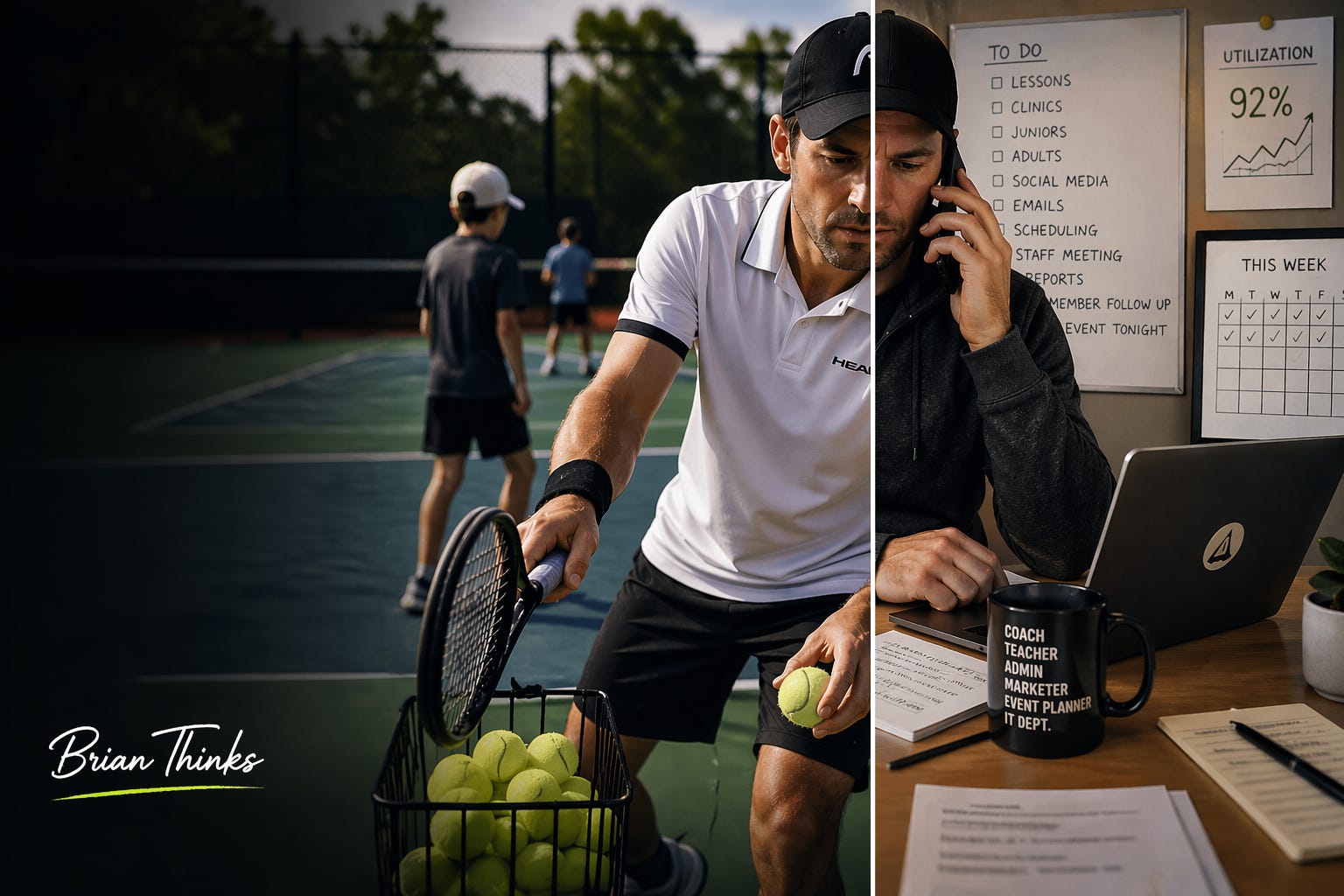
Turnover Is Structural
Look at any club long enough and you’ll see the pattern:
New pros arrive.
Old pros disappear.
Continuity breaks.
Programs reset.
This isn’t bad luck.
It’s the predictable outcome of a system built on:
inconsistent income
limited stability
unclear growth paths
high physical and emotional demands
Pros don’t leave randomly.
They leave when the system stops working for them.
The Gap
There’s a gap in this system.
The gap between what a pro does
and what they get for doing it.
When that gap gets too wide:
effort drops
initiative fades
risk disappears
Because the signal becomes clear:
Do more, get the same.
So pros adjust.
They stay busy.
They stay safe.
They protect their time.
Not because they don’t care
but because the system teaches them how to behave.
Utilization Fills Courts. It Doesn’t Build a Profession.
High utilization is a sign of demand.
But demand alone doesn’t create stability.
It doesn’t create ownership.
It doesn’t create long-term careers.
It creates activity.
And activity, without alignment, leads to one outcome:
Turnover.
The Conversation We’re Having—And the One We’re Avoiding
The industry talks about access.
About inclusion.
About growing the game.
And that matters.
But access without alignment doesn’t last.
Because if the underlying model doesn’t work,
more people entering the system doesn’t fix it.
It accelerates the same result:
Turnover.
The spotlight is on who gets in the door.
But the real question is:
Can they afford to stay?
You Can’t Build a Profession on Survival Behavior
Right now, many pros are operating in survival mode:
Protect your schedule.
Avoid unnecessary effort.
Don’t overextend.
That’s not a growth mindset.
That’s adaptation.
And you can’t build a professional class on adaptation alone.
What Actually Fixes It
The answer isn’t abandoning utilization.
It’s building around it.
A modern compensation structure has three parts:
1. Stable Base
Predictable income.
Reduced financial pressure.
2. Performance Incentives
Clear upside for:
program growth
retention
value creation
3. Ownership Layer
Even small:
revenue share
bonuses
leadership roles
Alignment Changes Behavior
Security creates stability.
Incentives create performance.
And when effort connects to reward, something shifts:
Pros stop surviving.
They start building.
They take initiative.
They invest in programs.
They think long-term.
Not because they’re told to
but because it finally makes sense to.
The Opportunity
Turnover isn’t the crisis.
It’s the signal.
The signal that the current model is out of alignment.
And the clubs that recognize this first
and act on it
will have a massive advantage in:
talent
retention
culture
member experience
long-term growth
The Shift
Utilization shows demand.
But compensation design determines whether the profession survives.
The Close
A pro leaves.
Another one takes their place.
The board updates.
The system keeps moving.
But the signal remains.
And at some point, every club will have to decide:
Are we just staying busy?
Or are we actually building something that lasts?
Turnover is the signal.
But it points to something deeper:
The job itself has changed
and no one has redefined it.
Narci — a courtside chat on your phone
You don’t lose pickleball matches because you lack information.
You lose them because you miss the moment.
Pop-up. Speed-up. Middle ball. Now what?
Describe the point.
Get your next move.
Thanks for reading Brian Thinks! Subscribe for free to receive new posts and support my work.
Comments
Nothing yet. Say the first thing.
Sign in to join the conversation.