
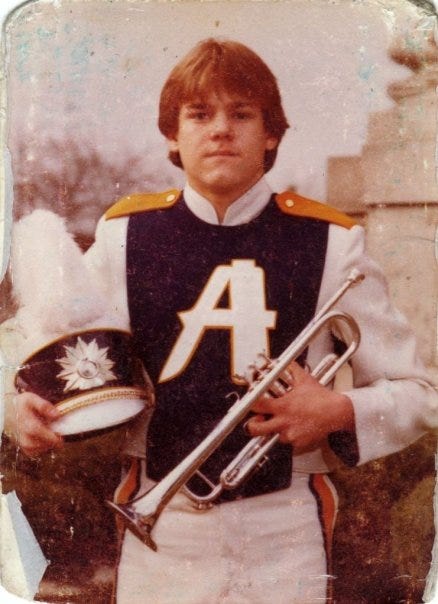
I started playing the trumpet in the late 1970s. By the mid-80s, Wynton Marsalis wasn’t just a musician; he was a god. He was winning Grammys in both jazz and classical music simultaneously, effectively rewriting the rules for what a trumpet player could be.
As a teenager, I was obsessed.
My household wasn’t exactly a jazz mecca. My father was a trumpet player for the Air Force, so our record collection was strictly big band and classical. My dad actually thought Miles Davis and Chet Baker had “funny” sounds—the closest we got to jazz was Blood, Sweat & Tears. When I first heard Wynton’s recordings of the Haydn and Hummel concertos, it shattered my world. I listened to them until the grooves wore out, memorizing every phrase and teaching myself the nuances.
The night of my high school graduation in 1986, my dad bought me tickets to see Wynton’s quartet at the Great American Music Hall in San Francisco. My girlfriend and I drove up, hyped to see the man in person, but my exposure to his jazz playing at the time was limited to just two albums: a live Art Blakey recording and a copy of Hot House Flowers. Because of that, I had no real idea what Wynton was actually going to play that night. I was expecting the polished orchestral sounds or the hard-bop fire of the Jazz Messengers.
When we arrived at the club, the doorman delivered the crushing news: the tickets were for the previous night.
We were dejected, standing on the sidewalk feeling like the world had ended. But the doorman took pity on us, mentioned there was standing room available for the second show, and told us to wait outside. Five minutes before the set, a car pulled up and parked directly in front of the club. Wynton stepped out, alone, and walked right toward us. I asked for an autograph, and he signed the ticket envelope right there on the sidewalk.
Inside, the music was transformative. It was a killer quartet featuring Marcus Roberts on piano and Jeff “Tain” Watts on drums. I watched as Wynton graciously led Marcus to the bench, and then they proceeded to play with a level of brilliance I didn’t know was humanly possible.
A year later, I saw him again at the Fairmont Hotel. I was sitting so close and watching him so intensely that I could swear he noticed me. At one point, he actually motioned with his hand for me to stop staring at him and pay attention to the saxophone player, Don Braden, who was soloing. I was so young and impressionable; I was trying to soak up his essence, but Wynton was already trying to teach me about the ensemble.
Eventually, I moved to Los Angeles to attend Cal State Northridge. That’s where I met a brilliant young pianist named Eric Reed. Eric knew all of Wynton’s arrangements by heart, and later that year, he got the call to join Wynton on the road. Around 1990, I went to the Coach House in San Juan Capistrano to hear Wynton’s sextet with Eric playing piano.
Eric tried to get me into the green room, but security wasn’t having it. So, he asked Wynton to come down to the hallway. Wynton walked out, handed me his famous, ten-pound Monette trumpet to hold, and listened as I thanked him for his influence. He heard the dead-earnestness in my voice. He looked at me and asked, “Do you have a trumpet with you?”
I said no.
“Well,” he said, “the next time you come and hear me play, you bring a trumpet with you, ‘cause I want to hear you play.”
I spent the next year practicing with a new kind of terror and purpose.
The “next time” came about a year later at a small venue in Westwood Village. I brought my horn, but I left it in the trunk of my car—I didn’t want to seem arrogant or delusional by carrying a trumpet case into a show headlined by the greatest player in the world. After the show, I stood in a line of about thirty people. When I got to the front, I reminded him of his invitation.
He didn’t blink. “Yeah,” he said. “Go get your horn.”
I ran to the car, my heart hammering against my ribs, and retrieved the trumpet. When I got back, Wynton didn’t ask for a concerto or a complex bebop head. He just started scat-singing a blues bass line. Right there, in front of the remaining crowd, I played along with him.
Afterward, he was incredibly generous. He told me to sit down next to him while he finished signing autographs. I was desperate for technical feedback—I wanted him to tell me about my embouchure or my fingering. Instead, he looked at me and said, “Hey. You don’t need to do that. Whatever you look like, it’s what you look like. You don’t have to look like me when I play. You are going to look like you.”
At the time, it felt like a brush-off. I wanted “The Secret,” and I felt like he gave me a platitude. It felt like a bit of a letdown to receive a lesson on self-acceptance when I was looking for a lesson on virtuosic technique.
But he wasn’t wrong. He was giving me the most profound advice a young artist can receive. He saw that I was so busy trying to be a carbon copy of my hero that I was disappearing. He was telling me that the music doesn’t come from the posture or the brand of the horn; it comes from the person.
That was the last time I spoke with him, but his kindness shaped how I teach today. I always tell my students to go see him and speak to him after the show. Time and again, they come back and tell me he was just as generous with them as he was with that nervous kid in Westwood.
Wynton Marsalis is a giant of the stage, but to me, his greatest legacy is those five-minute masterclasses he gives to every kid with a horn and the guts to show up.
Thanks for reading Brian Swartz Music! This post is public so feel free to share it.
My upcoming shows:
Decades later, I'm still trying to 'look like me' on the bandstand. Hope to see you at one of these upcoming shows.
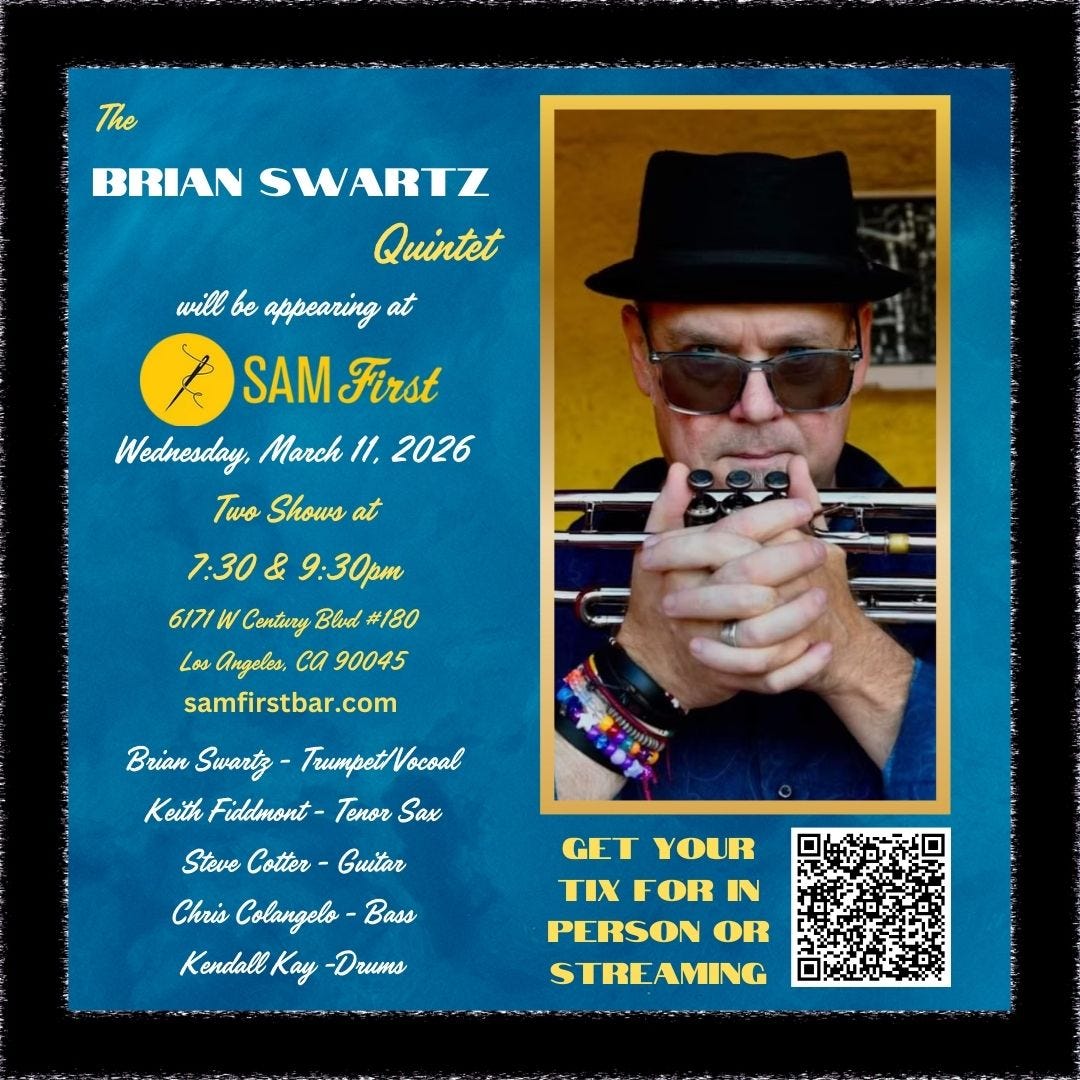
Mar 11 - The Brian Swartz Quintet - Sam First, Los Angeles, CA
Mar 13 - Oingo Boingo Former Members - House of Blues, Anaheim, CA
Mar 14 - Oingo Boingo Former Members - Stage Red, Fontana, CA
No posts
Comments
Nothing yet. Say the first thing.
Sign in to join the conversation.