
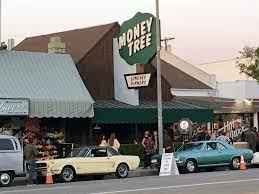
“Drop everything. We’re going to meet a living legend.”
Back in 2001, I had a regular Monday night gig leading my trio at The Money Tree. It was one of those classic, intimate, dimly lit joints—the kind of place where legends like Jack Sheldon and Ross Tompkins used to play. Our band was just trumpet, guitar, and bass—no drums—which really suited the cozy, booth-filled room.
We’d play until midnight or 1:00 AM, and one particular Monday, after the gig was over, my guitarist Marcel Camargo, my bassist Pablo Motta, and I were coiling cables and packing up our gear.
Then, a woman approached our small stage. “Mr. Fayard Nicholas would like to meet you,” she announced. “We’re celebrating our one-year wedding anniversary, and he’s right over here.”
Now, Marcel and Pablo were pretty young at the time, maybe ten or fifteen years my junior. They were great musicians, but they might not have known who Fayard Nicholas was. But when she said his name, my internal alarm bells went off. I looked at Marcel and Pablo, who were still fiddling with their cables, and in a voice that left no room for debate, I told them, “Drop what you’re doing right now! We are going to go talk to this man!”
I knew we were about to meet one half of the legendary Nicholas Brothers, those tap-dancing titans whose athleticism and artistry redefined what was possible on a stage. We were about to meet a living legend.
So, we immediately walked over to his table. And there he was, Fayard Nicholas, about 85 years old, celebrating his one-year wedding anniversary with his beautiful wife, Katherine Hopkins. They were both absolutely beaming. They graciously invited us to sit down, and for the next hour and a half, until the very moment the club lights signaled closing time, Fayard Nicholas held court.
He began by telling us how much he enjoyed our performance, which, coming from him, was a profound honor. My mind raced, trying to formulate every possible question about his life and career. I asked him about tap dancing, of course, but also what it was really like at the legendary Cotton Club. What was Duke Ellington really like? Or Count Basie? Or Cab Calloway? Because this man had not only shared stages with them, he knew them.
At one point, emboldened, I even suggested that his revolutionary style of tap dancing might have directly influenced the complex rhythms of Bebop. He smiled, a knowing, erudite smile, and said, “Absolutely, but it was kind of everybody influencing each other. Not just dancing influencing the music; the music was also influencing the dancing.” He was so humble in his genius.
He was a truly stately gentleman. As he talked, he had this beautiful, elegant cane, and he held it upright in front of him, both his hands resting clasped on its top, almost like a scepter. He couldn’t have been more gracious, more kind. He truly was the sweetest man. I felt so incredibly lucky to have had that opportunity – for him to call us over, to invite us to sit down, and to share those priceless stories. It was an audience with a true titan, and a night I’ll never forget.
🎺 See You at Sam First!
Being a part of the L.A. jazz scene means you never know who is sitting in the booth behind you. It’s about being present in the room when the music is happening. L.A. jazz venues come and go—don’t miss the ones we have now!
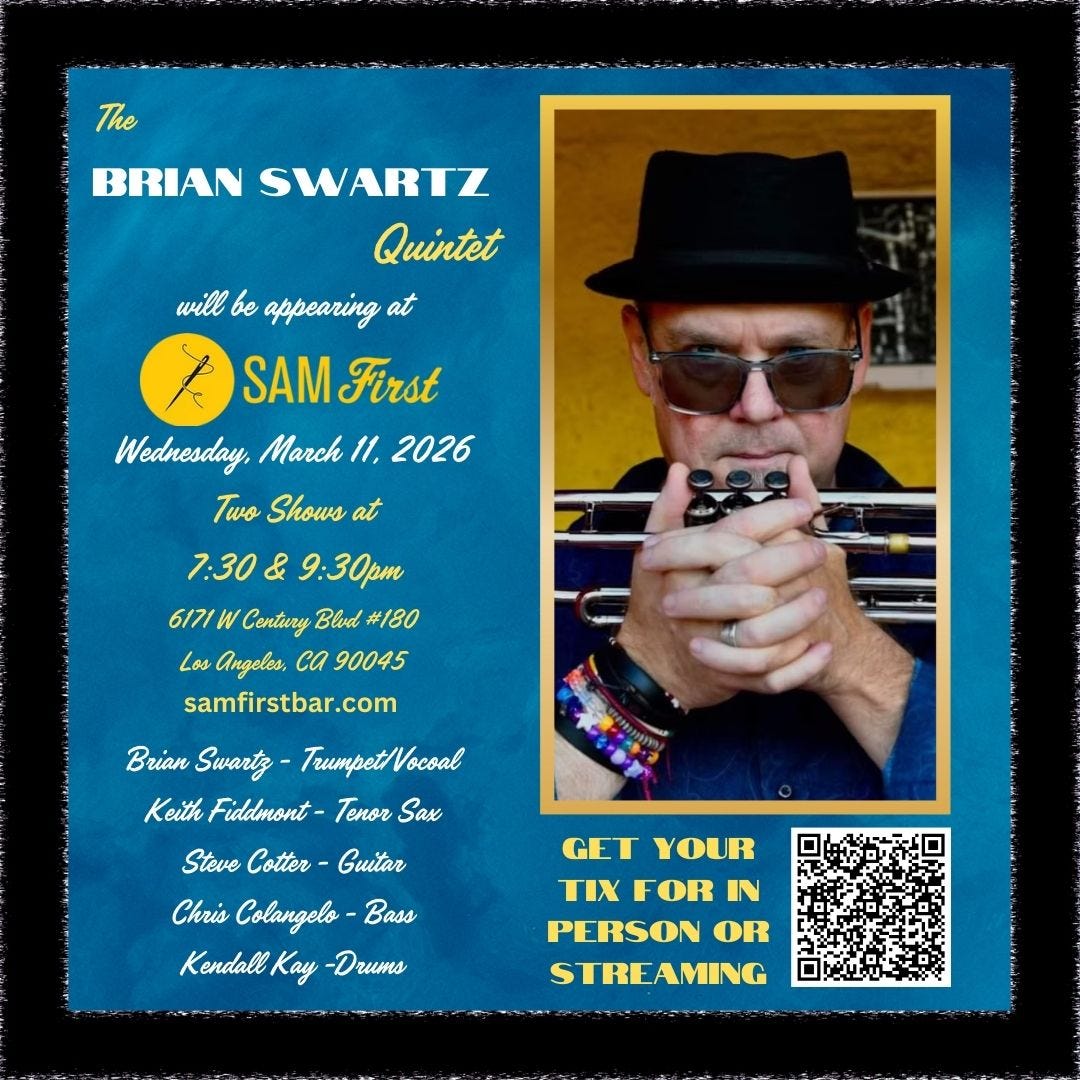
I’d love to see you at Sam First on March 11th. No promises on meeting a legend at the table, but the Quintet will be burning.
When: Wednesday, March 11, 2026
Where: Sam First, Los Angeles (Near LAX)
No posts
Comments
Nothing yet. Say the first thing.
Sign in to join the conversation.