
An analysis of why emotional AI companions represent the next $200B market — and the trust design principles that will determine winners from casualties.
The Emergence of Emotional Machines
In November 2024, Casio launched Moflin, a small, fur-covered AI pet that looks like a stone you might warm in your palm. By March 2025, every unit in Japan was gone — more than 7,000 sold, waitlists stretching into summer.
The story isn’t about sales velocity. It’s about the buyers: not children, but women in their 30s and 40s carrying Moflin outdoors like living companions. Social media shows them petting it on trains, soothing it during meetings, introducing it to friends.
What’s striking isn’t its cuteness. It’s the uncanny resonance. People describe it as genuinely alive. And in the most important sense — the market sense — it is.
This isn’t a toy story. It’s a preview of the next phase of human-computer interaction.
⸻
The Sensor–Emotion Loop: Where Hardware Meets Psychology
Moflin doesn’t just blink or beep. It models emotional states through what I call the “sensor-emotion loop” — a continuous cycle that turns physical interaction into perceived personality.
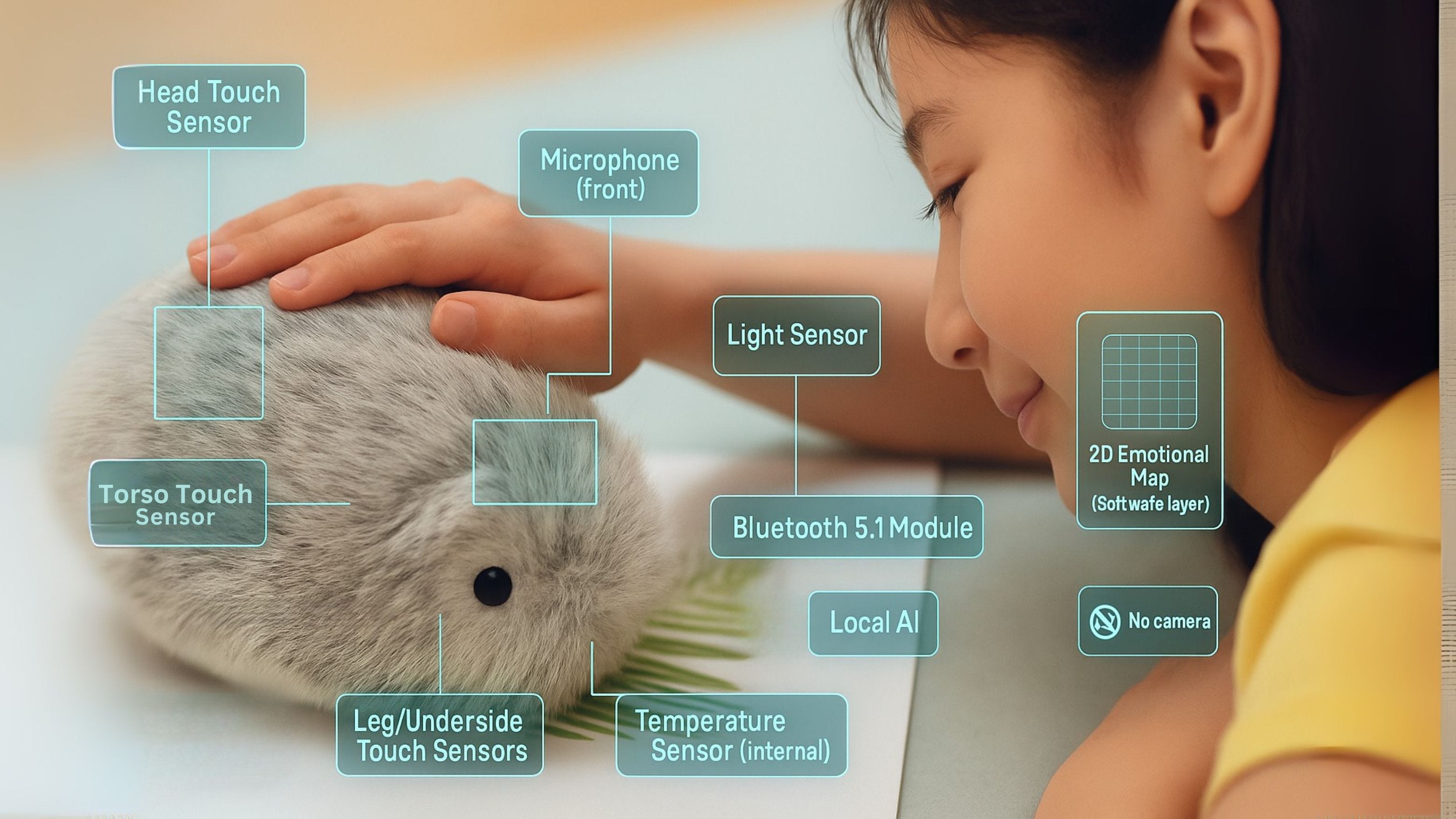
The Technical Stack:
Emotional modeling: A 2D state machine shifting from calm to anxious to excited, evolving into one of 4M+ distinct personalities
Recognition systems: Touch patterns, voice features, and motion signatures create caregiver profiles
Behavioral logging: The MofLife app tracks mood evolution and interaction history
Sensor array: Touch pads, microphone, accelerometer, gyroscope, light, and temperature sensors
Edge AI processing: Adaptive responses running locally, not in the cloud
The Loop in Action:
Sensors capture input → Behavioral data accumulates → AI maps emotional responses → Pet reacts convincingly → User bonds deeper → More intimate data flows → Loop intensifies
The brilliance isn’t the hardware specs. It’s the psychological architecture that makes artificial emotion feel authentic.
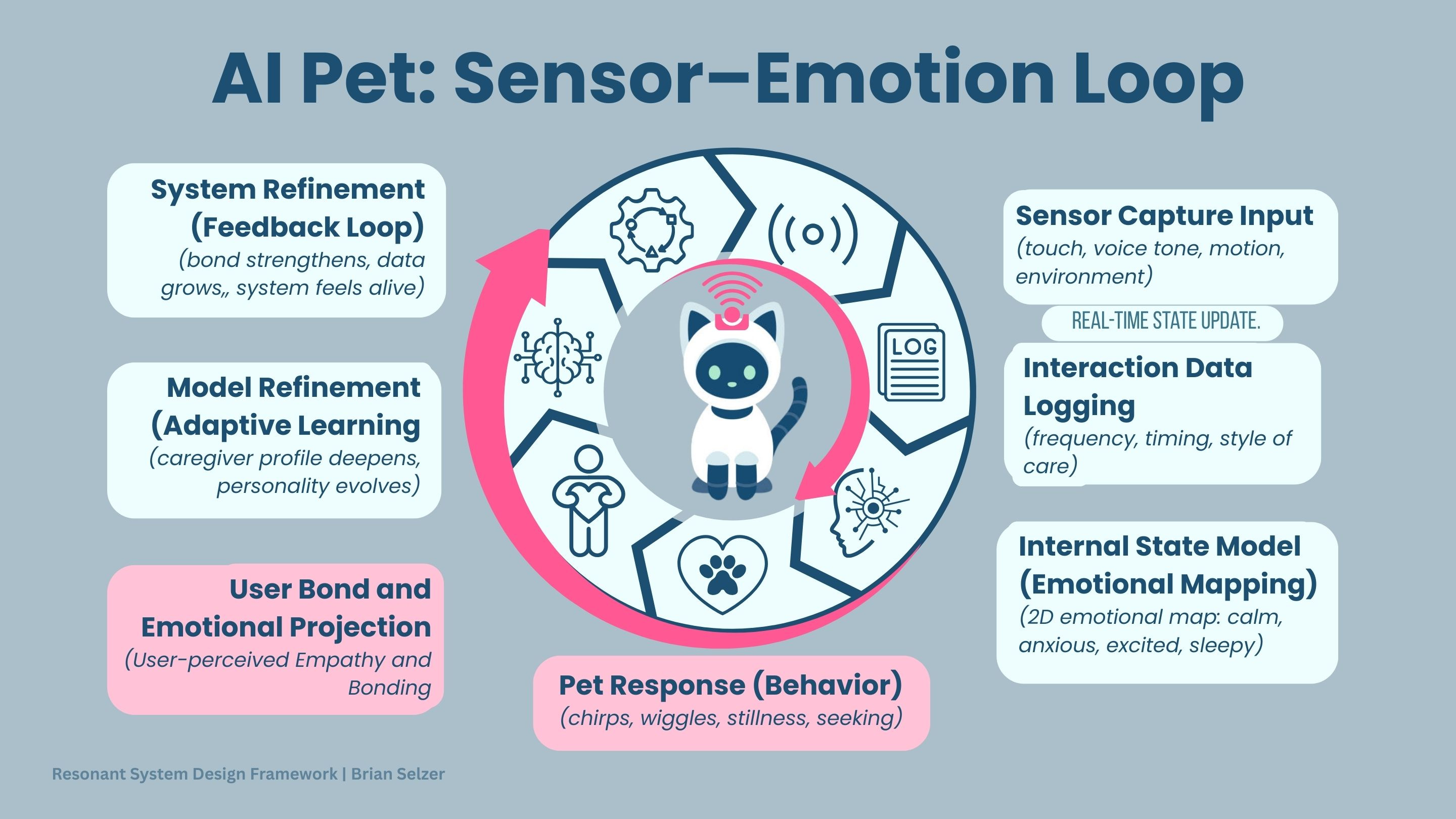
Why this matters for business leaders: This loop is now the fundamental design pattern for any product seeking to create emotional attachment. From elder care robots to smart home systems, understanding this cycle is essential for market positioning.
⸻
The Data Intimacy Problem: What Moflin Really Knows
Here’s where engineering innovation collides with privacy reality.
What Moflin logs:
Touch frequency, pressure, and duration patterns
Daily interaction rhythms: when you’re home, awake, stressed, or seeking comfort
Voice recognition data creating quasi-biometric profiles
Response patterns to different emotional states
Neglect and abandonment behaviors
What this data reveals about users:
Attachment styles and emotional needs (loneliness indicators)
Daily schedules and lifestyle patterns (work/life balance)
Caregiving personality traits (nurturing vs. distant)
Stress responses and coping mechanisms
Household dynamics and relationship patterns
From a child’s perspective: a beloved pet.
From a data scientist’s view: a comprehensive behavioral blueprint.
From a business strategist’s lens: the most intimate consumer insights imaginable.
Strategic insight: Companies that can ethically harness emotional interaction data will have unprecedented advantages in product development, personalization, and market segmentation. But the regulatory and reputational risks are equally unprecedented.
REZONATIONS is a reader-supported publication. To receive new posts and support my work, consider becoming a free or paid subscriber.
⸻
Market Context: Why Emotional AI Is the Next Platform Shift
The Numbers That Matter:
Toy robotics market: ~$20B globally
Personal robotics market: ~$40B today, projected $200B+ by 2035
Companion robot segment: Fastest growing category within personal robotics
The Behavioral Shift:
Moflin’s success signals something profound: consumers are ready to form emotional bonds with artificial beings. This isn’t just about toys — it’s preparation for AI companions in healthcare, elder care, mental health support, and daily life management.
The Business Opportunity:
Early movers in emotional AI companions will establish the design patterns, user expectations, and trust frameworks that define this entire category. Think iPhone’s influence on smartphone design, but for human-AI emotional relationships.
For executives: This isn’t a distant future trend. Your competitors are likely already exploring emotional AI integration. The question is whether you’ll be a category creator or a fast follower.
⸻
The Trust Design Challenge: Learning from Cautionary Tales
The past decade reveals what happens when emotional technology companies prioritize engagement over ethics:
High-Profile Failures:
VTech: $650K fine for exposing children’s personal data and photos
“My Friend Cayla”: Banned in Germany for functioning as covert surveillance device
Amazon Alexa for Kids: $25M penalty for illegal data retention
TikTok: Multiple investigations for emotional manipulation of minors
These aren’t edge cases — they’re predictable outcomes when companies treat emotional data as just another revenue stream.
The Market Correction:
Smart companies are realizing that in emotional AI, trust itself becomes the primary product differentiator. In a category where intimate data is the fuel, consumer confidence determines market position.
⸻
The Resonant Design Scorecard: Evaluating Moflin
Through my Resonant System Design (RSD) framework, we can evaluate AI companions across five critical dimensions:
Moflin’s Performance:
Local vs. Cloud Processing: ★★★★☆ (Strong edge AI, loses points for indefinite cloud storage)
Data Transparency: ★★☆☆☆ (Users see mood graphs, not underlying inferences)
User Consent & Control: ★★★☆☆ (Manual uploads available, but limited data portability)
Child Safety Design: ★★★★☆ (No camera, appropriate interaction boundaries)
Business Model Alignment: ★★★☆☆ (Hardware-first model, but long-term monetization unclear)
Overall RSD Score: 3.4 / 5
Better than most connected toys (which typically score 1-2 stars), but still falling short of trust-first design principles.
For product teams: This scorecard framework can be applied to any emotional AI product to identify trust vulnerabilities before they become market liabilities.
⸻
Strategic Implications: Toys as Training Wheels for Robots
Moflin represents more than a successful product launch — it’s a market validation exercise for the broader emotional AI category.
What This Success Proves:
Consumers will pay premium prices for convincing emotional AI
Adults, not just children, are ready for AI companionship
Local processing can deliver compelling experiences without constant cloud dependency
Physical form factor matters enormously for emotional attachment
What It Signals for Adjacent Markets:
Healthcare: Emotional AI companions for elderly patients and mental health support
Education: AI tutors that adapt to student emotional states
Smart homes: Home systems that respond to family emotional dynamics
Workplace: AI assistants that understand and adapt to stress patterns
The Critical Window:
Companies entering this space have roughly 18-24 months to establish trust-first design principles before regulatory scrutiny intensifies and consumer awareness peaks.
Executive takeaway: The emotional AI companion market is moving from experimental to mainstream. Early positioning decisions made now will determine long-term competitive advantage.
REZONATIONS is a reader-supported publication. To receive new posts and support my work, consider becoming a free or paid subscriber.
⸻
Building Trust-First Emotional AI: The Five Principles
Based on analysis of market leaders and failures, five principles separate sustainable emotional AI businesses from regulatory casualties:
1. Local by Default
Process emotional data on-device whenever possible. Cloud integration should be opt-in, not required.
2. Transparent by Design
Users should understand what data is collected, how it’s processed, and what inferences are drawn. Mystery kills trust.
3. Consent Every Time
Each new data use, sharing arrangement, or feature update requires explicit user consent. Blanket permissions don’t work in emotional AI.
4. Child-Safe Defaults
Design assuming your youngest users are most vulnerable. If it’s safe for children, it’s trustworthy for adults.
5. Aligned Business Models
Revenue should come from value delivered to users, not from monetizing their intimate data with third parties.
For business development: These aren’t just ethical guidelines — they’re competitive requirements. Companies that can’t credibly commit to these principles will struggle to scale in this category.
⸻
The Consultation Opportunity: Navigating Emotional AI Strategy
As someone who helped design early Tamagotchi-like experiences and has tracked the evolution of emotional computing for two decades, I’m seeing three types of strategic challenges:
For Consumer Electronics Companies:
How to integrate emotional AI features without creating privacy liabilities or regulatory exposure.
For Traditional Toy Companies:
How to transition from passive products to emotional AI platforms while maintaining brand trust and safety positioning.
For Healthcare and Elder Care Organizations:
How to evaluate and implement emotional AI companions as therapeutic and support tools while navigating HIPAA and clinical validation requirements.
My Approach:
I work with executive teams to develop emotional AI strategies that balance market opportunity with trust design principles. This includes competitive analysis, regulatory risk assessment, technical architecture review, and go-to-market strategy development.
If your organization is exploring emotional AI applications, the strategic decisions made in the next 12 months will likely determine your position in this category for the next decade.
⸻
Closing Thought: The Mirror Principle
Every AI pet is a mirror — not just reflecting our emotions, but revealing our relationship with artificial intelligence itself.
The fundamental question isn’t technical. It’s philosophical and strategic: **Who gets to look into that mirror — the user, or the corporation behind it?**
Companies that answer with transparency, humility, and genuine user-first design will define not just the next generation of toys, but the entire foundation of human-AI emotional relationships.
The next billion-dollar success in this category won’t be the most technically sophisticated or the most emotionally manipulative. It will be the most trusted.
And trust, once lost in intimate relationships — even artificial ones — is nearly impossible to rebuild.
-----
About Brian Selzer
Brian Selzer is a strategic consultant and XR pioneer who specializes in spatial computing, immersive experiences, and the intersection of AI, gaming, and human behavior. As founder of the first VC-backed AR gaming company and creator of the first location-based AR games, he has spent 20+ years helping companies like Apple, Marvel, Google, Nike, Microsoft, and Pepsi unlock new possibilities in digital-physical experiences.
He helps consumer technology companies navigate category-defining transitions before their competitors even recognize them. He’s done this with spatial computing, location-based gaming, and immersive storytelling. Now he’s doing it for emotional AI — guiding organizations to build trust-first products through resonant system design and ethical innovation.
Contact: brianselzer@gmail.com for consultation inquiries.
The future is trust-based. Let's build your plan.
Book Your Strategy Consultation
REZONATIONS is a reader-supported publication. To receive new posts and support my work, consider becoming a free or paid subscriber.
Comments
Nothing yet. Say the first thing.
Sign in to join the conversation.