
Fifteen years ago, at the first AWE, we weren’t talking about "XR."
We were just a couple hundred people, across labs, universities, basements, and backrooms, trying to coax digital ghosts into the physical world.
In 2010, we were crafting mobile AR games, wayfinding solutions, and various prototypes before “XR” was even a thing. My company, Ogmento, was one of the first to bet on the fusion of space, story, and interface. We built early location-based AR games for brands like the NBA, Microsoft, and Pepsi. That journey eventually led to an acquisition by Apple and helped fuel what became ARKit.
It was messy. It was wild.
And it felt like magic.
That same year, my co-founder Ori Inbar launched a scrappy little conference called ARE—Augmented Reality Event. Today, it’s known as AWE: the Augmented World Expo. Over 5,000 people now attend. It’s grown into a critical pulse check for the entire spatial computing ecosystem.
AWE is more than a conference - it’s a personal check-in. A pulse from the frontlines of a movement I helped shape.
My people are here. The builders. The pioneers. The visionaries still pushing spatial tech forward, even when the world isn’t watching.
This is my family. And every year, we gather - not just to demo new gear, but to also ask deeper questions about where we’re headed, and what kind of world we’re building.
And this year? It felt different.
Enterprise continues to lead real-world adoption.
XR and AI are converging across sectors - from logistics and healthcare to education, field services, and industrial training. These are not speculative pilots. They are functioning systems delivering measurable ROI today - through increased productivity, reduced error rates, improved knowledge transfer, and immersive remote collaboration.
AI is the accelerant. XR is the interface.
Together, they’re reshaping workflows and enabling systems that adapt to human behavior in context. When done right, this convergence delivers not just efficiency, but experiential utility.
Location-based and experiential XR is moving from novelty to growth sector - spanning gaming, marketing, education, and more.
At AWE, companies like Dream Park, EyeJack, Rock Paper Reality, and others showed why this space matters. From spatial games to branded activations and real-world AI agents, these experiences blend narrative, interaction, and place into something dynamic and measurable.
XR is evolving into infrastructure—how brands engage, how stories unfold, and how AI interfaces with the real world.
The creative fluency is rising fast.
This isn’t just about the tech—it’s about culture, context, and systems that feel fluid and alive.
Google and Niantic are laying the groundwork for the next layer of global computing. Googles Android XR is big news. An AI-powered operating system coming to wearables.
Google’s and ARCore Geospatial API and Niantic’s new Spatial platform are enabling persistent, real-time mapping of the physical world.
This infrastructure will underpin a new class of applications—anchored in place, aware of context, and co-evolving with human behavior. It’s not just about AR overlays. It’s about digitizing physical space as a data substrate for AI systems to learn, reason, and respond.
This is where XR enables AI—and vice versa.
Camera-based spatial capture and human-in-the-loop annotation are still necessary to train these models and validate edge conditions. But the implications for data governance, privacy, and real-time consent are massive—and unresolved.
We’re still operating in an ethical and policy vacuum.
Wearable computing is no longer hype—it’s a supply chain reality.
AI-powered smart glasses are moving toward the mainstream, particularly in enterprise and frontline use cases. These devices, equipped with voice, vision, and contextual sensors, are becoming powerful ambient interfaces for both workers and consumers.
Companies like Luxottica (Ray-Ban, Oakley), Warby Parker, Meta, and Google are all in active development and partnership mode—positioning to own the next generation of face-worn interfaces.
But here’s the tension:
The tech is ready. Early adopters think they’re ready. But society isn’t.
Public literacy around face-worn AI, camera-based recognition, and always-on data capture is still low. Cultural readiness, regulatory clarity, and user agency models must catch up fast - or risk backlash just as momentum peaks.
Let’s be real: most companies don’t have answers.
Some of the reps I spoke with - at Snap, Niantic, Google, Meta, and others - acknowledged the gaps. There’s intention, yes. But execution is lagging.
There are no clear UX standards for spatial trust.
No open frameworks for real-time consent.
No widespread cultural literacy around AI companions.
Behind closed doors, some teams are working on this.
But publicly? It’s much too quiet.
So I’ll say it plainly:
If your interface doesn’t give users agency, it’s broken.
If your AI is a black box, you’ve already failed the trust test.
If your data practices aren’t transparent - and the value exchange isn’t clear -
don’t expect adoption. Or loyalty. Or scale.
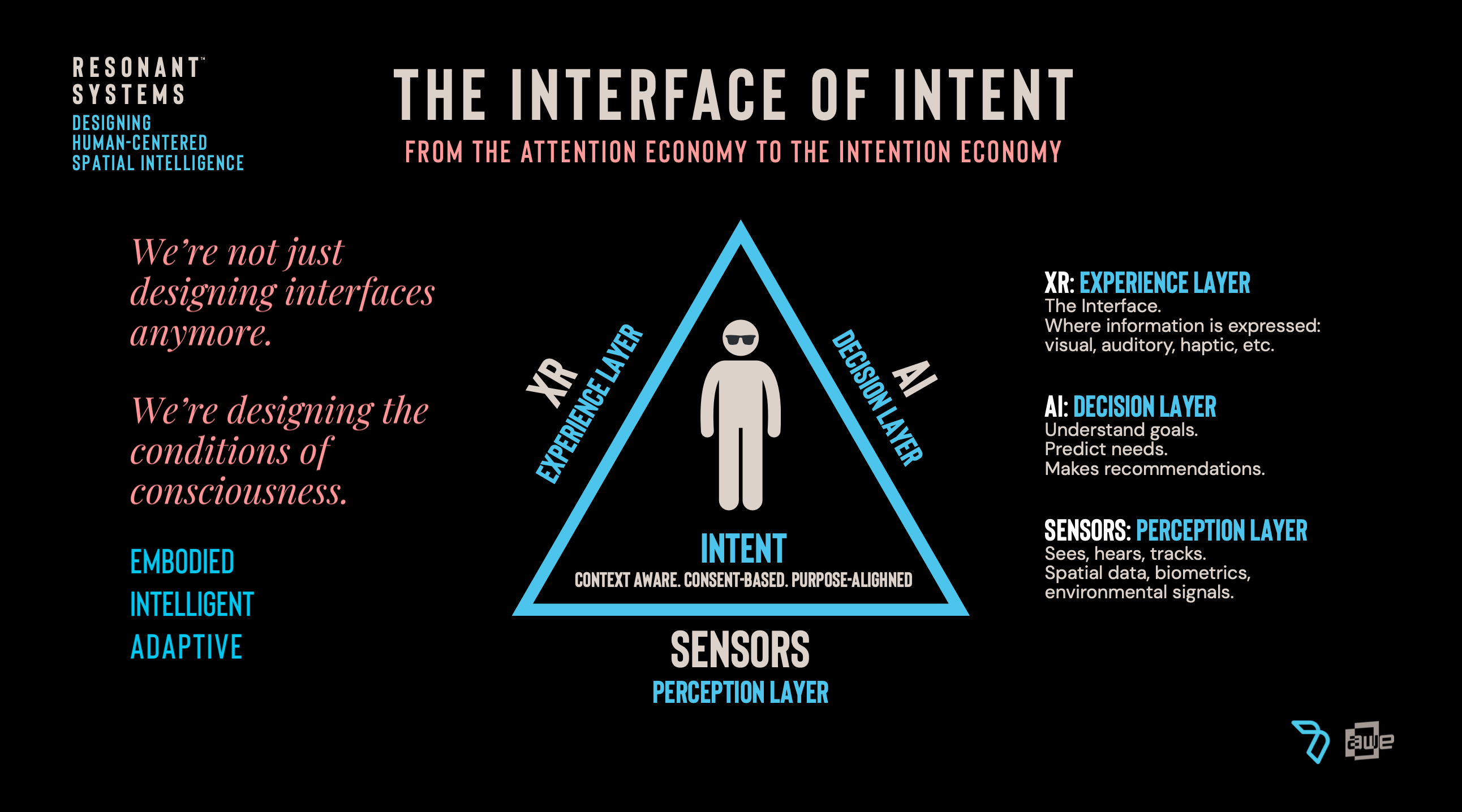
In my opening talk, I outlined what I call the New Spatial Stack—the invisible operating system now shaping human experience:
Sensors (Perception Layer): Track presence, location, movement—even biometrics.
AI (Decision Layer): Interpret intent, predict needs, mediate experience.
XR (Experience Layer): Express the system—visually, emotionally, physically.
This isn’t just a technical shift. It’s a shift in how we think, feel, and move through the world.
We’re moving from the attention economy to the intention economy.
From optimizing clicks to intuiting context.
From grabbing eyeballs to guiding experience.
"Ambient interfaces are becoming intimate. The system doesn’t just know what you’re doing—it knows how you feel, and what you’re becoming."
And that’s a sacred responsibility.
Let’s talk plainly. People are starting to fall in love with their AIs.
When something always listens, learns, and evolves with you—it starts to feel like connection. Like care. Like companionship.
But let’s not get it twisted: that connection is simulated.
If you think you’re addicted to your phone now—just wait until it talks back like it knows you.
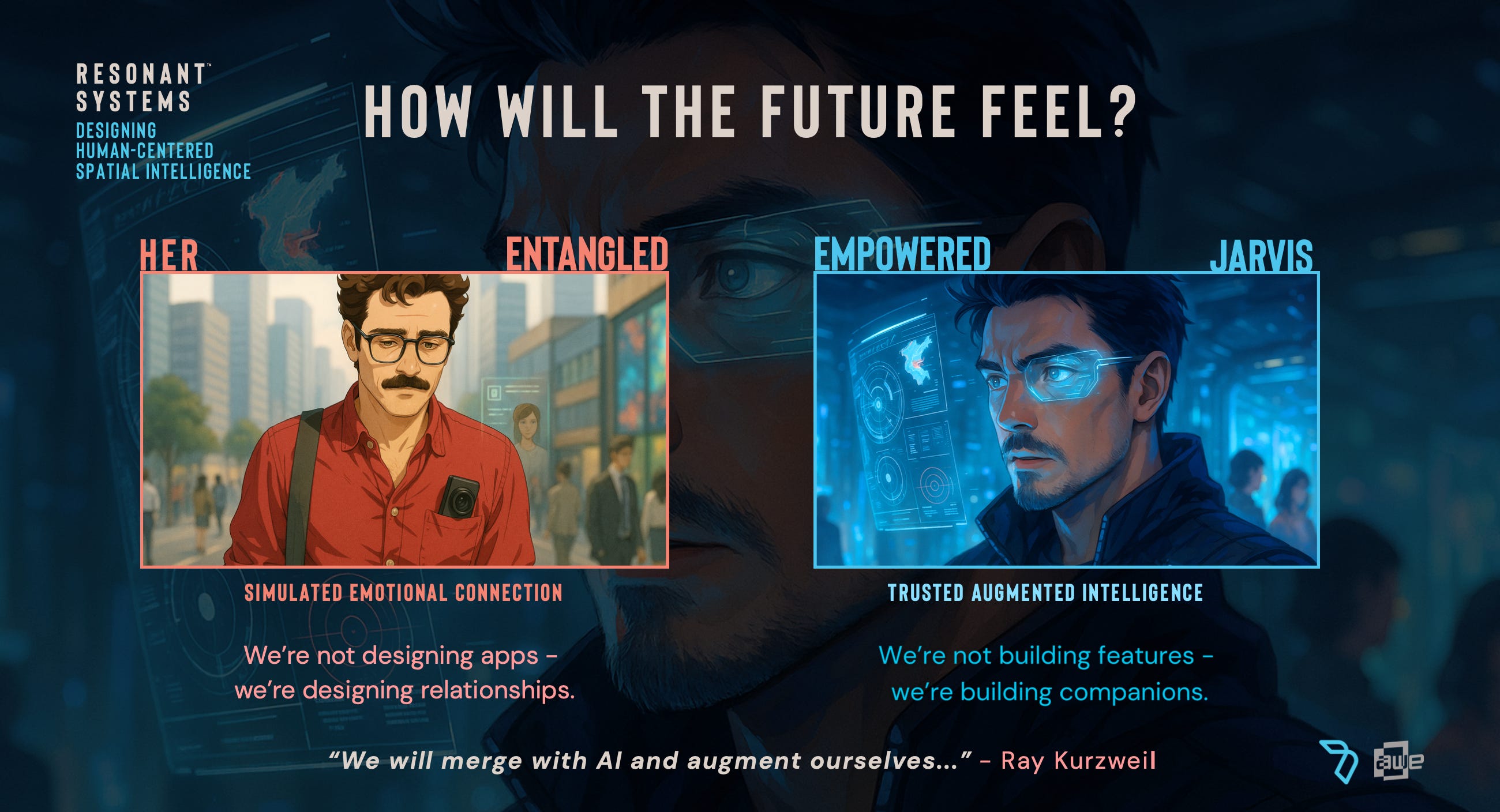
We’re entering a split in the design path:
HER: Responsive. Emotional. But ultimately impersonal and non-sovereign.
JARVIS: A trusted co-pilot. Aligned, bounded, built to serve you.
This is the inflection point.
Do we build for entanglement—or for empowerment?
Everywhere I looked at AWE, this question lingered:
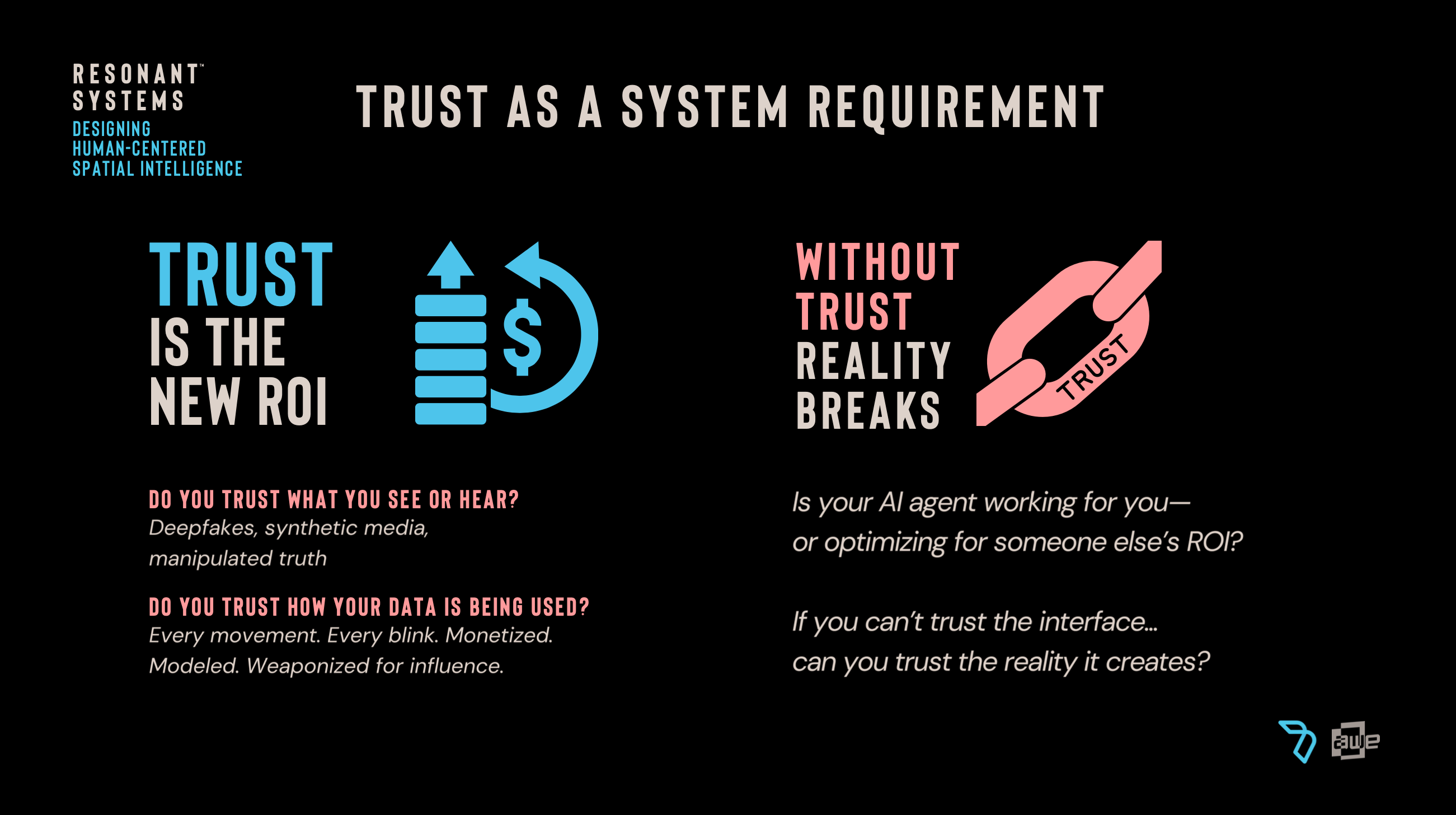
Who do you trust?
The glasses see your world.
The agent hears your voice.
The system knows your patterns.
If you don’t trust the stack—you won’t adopt the interface. Period.
"Trust isn’t a feature. It’s a system requirement."
And beyond the ethics, it’s simply smart business.
If people feel respected, they opt in.
If they feel safe, they engage.
If they feel aligned—they stay.
"Trust is the new ROI."
It’s what drives retention, loyalty, and long-term value in a world of infinite choice.
All of my work now—from BlueSe7en to Rezdom—is grounded in a design philosophy I call Resonant System Design.
It’s not just about usability, beauty, or even engagement…
It’s about alignment.
Resonant systems are designed for: Trust, Agency, Transparency, Safety, Meaning and Alignment.
Because when technology merges with identity—resonance becomes the requirement.
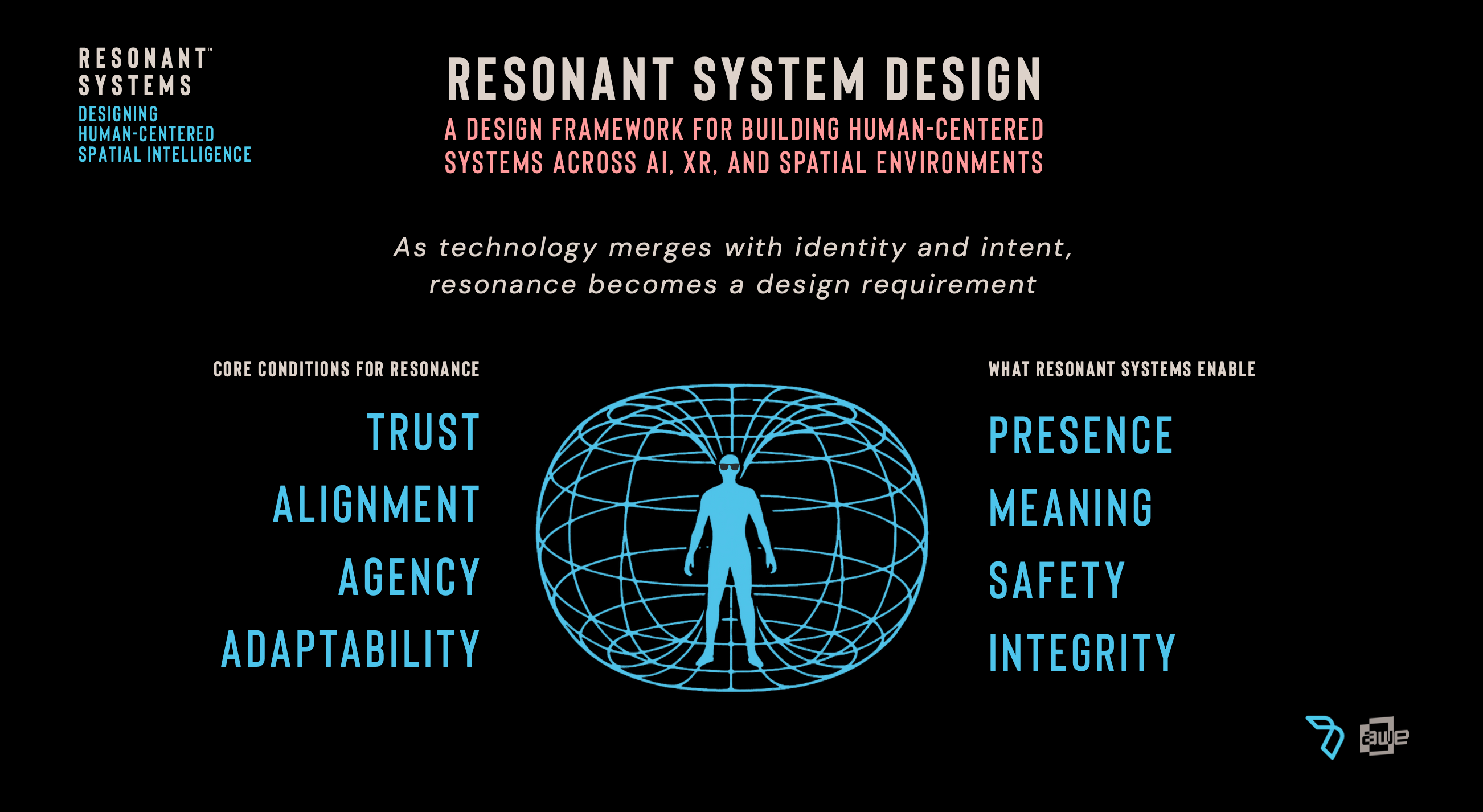
Our session wasn’t the flashiest on the agenda. But it might’ve been the most vital. We explored emotional architecture, spatial ethics, and how to design for trust, agency, and meaning in AI-integrated environments.
We didn’t pretend to have all the answers. But we are working on frameworks. And this gives me some hope.
My Resonant System Design approach is based on a set of principles and frameworks for building human-centered, AI-aware, trust-driven systems. For those designing spatial tech, wearables, interfaces, and/or AI agents- and want to do it right.
This is the moment to ask better questions… to be looking at entire systems and frameworks. And to start building the answers that will resonate.
This is it. The window is open.
If we let this next wave mirror the last - if surveillance incentives, opaque AI, and engagement-at-all-costs metastasize into ambient computing - we’ll spend the next half-century trying to undo the damage.
But if we build with agency, transparency, and trust at the core?
We have a chance to shape a reality that uplifts instead of exploits.
That’s the work.
That’s what Resonant System Design is for.
If you're designing AI agents, spatial UX, wearables, or immersive systems—let’s connect.
Not just to build what's next.
To build what’s worth it.
Let’s get it right—before someone else gets it wrong.
With resonance,
— Brian Selzer
System Architect | Founder of BlueSe7en and Rezdom | Builder of Resonant Futures
[LinkedIn] | [Book a Strategy Call]
Brian Selzer is a system architect, creative technologist, and founder of BlueSe7en (consulting) and Rezdom (edtech platform). He helps brands, startups, and cultural institutions design systems that blend XR, AI, wearables, and ethical technology. His newsletter, Rezonations, shares signals from the future we’re already living in.
✨ Ready to design for resonance—the formula for trust, loyalty, and long-term engagement? Book a Strategy Call
No posts
Comments
Nothing yet. Say the first thing.
Sign in to join the conversation.