

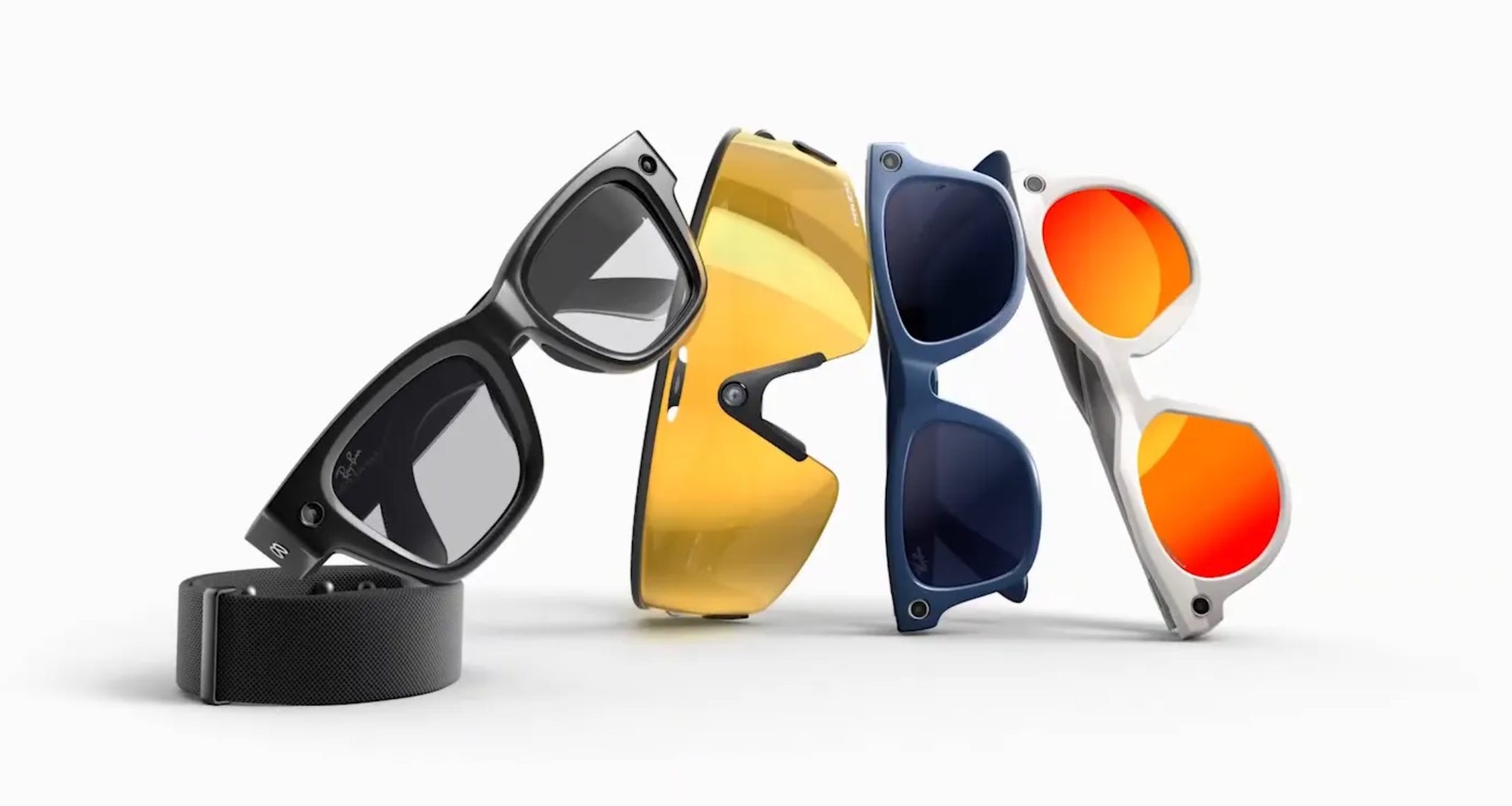
Meta didn't just tease another wearable this week. Based on a now-removed Meta promo video and corroborating reports, Ray-Ban–branded glasses with a built-in display and an EMG wristband are expected on stage tomorrow at Meta Connect (Sept 17). The specs will dominate headlines. The real story is architectural: we're witnessing the largest shift in human-computer interaction since the iPhone. Apps, screens, and clicks are giving way to sensors, agents, and invisible systems. The new UX is ambient.
And most brands have no idea what's coming.
For the past 15 years, we've optimized for engagement—keeping users locked to screens, clicking through interfaces, feeding attention into algorithmic loops. The entire digital economy was built on capturing and monetizing human focus.
That model is ending.
The New Paradigm:
Instead of apps you open → Agents that act continuously
Instead of screens you stare at → Sensors that understand context
Instead of interfaces you navigate → Systems that anticipate needs
Instead of commands you give → Conversations that flow naturally
Meta's wearables aren't just another device category. They're the first mainstream attempt at disappearing the computer while making it omnipresent. The interface doesn't vanish—it becomes invisible, woven into the fabric of daily life.
Display-in-lens (monocular HUD) on Ray-Ban–branded glasses
sEMG wristband for hands-free input
Oakley model also spotted in the clip
Pricing/ship dates still unconfirmed; keynote is Wed 5 PM PT
Here's the uncomfortable truth: In an ambient world, trust is the interface.
When there's no screen to show you what's happening, no buttons to press for control, no clear boundary between "on" and "off" - trust becomes the entire user experience. If users don't trust the system, they won't adopt it. Period.
The Trust Design Stack:
Agency - Users must feel in control even when they're not actively controlling
Transparency - Systems must communicate their actions and intentions clearly
Reciprocity - Value exchange must be obvious and fair
Boundaries - Clear limits on what systems can and cannot do
Reversibility - Easy ways to undo, opt out, or change course
This isn't just about privacy policies or data collection notices. It's about fundamental system design that puts human agency at the center, not as an afterthought.
Example: The Starbucks Test Imagine an ambient system that learns you always get coffee at 9 AM and starts brewing your usual order when it detects you're two blocks away. Magical? Maybe. Creepy? Definitely, if you don't understand how it works, can't turn it off, or feel like it's manipulating your behavior for Starbucks' benefit rather than your convenience. The same technology feels helpful or invasive depending entirely on how well it implements the Trust Design Stack.
Horizon 1: Immediate (0-12 months)
Audit your current interfaces for "ambient readiness"
Identify touchpoints that could benefit from contextual intelligence
Start building voice/conversational capabilities
Develop clear data usage principles that customers can understand
Horizon 2: Strategic (1-3 years)
Design for continuous, background value delivery
Build systems that learn and adapt without explicit training
Create "ambient brand experiences" that feel helpful, not intrusive
Develop new metrics beyond engagement (satisfaction, trust, life improvement)
Horizon 3: Transformational (3+ years)
Reimagine your entire customer relationship as ongoing partnership
Build ambient intelligence that makes customers' lives genuinely better
Create new business models based on life enhancement, not attention capture
Establish your brand as a trusted ambient layer in customers' lives
As the click economy fades, we enter the Intention Economy: winning systems detect intent and deliver value with minimal attention cost.
I've spent 20+ years building systems that bridge technology and humanity. I've seen this pattern before: every major interface shift creates massive opportunity for those who understand the human implications, not just the technical capabilities.
The pattern is always the same: The companies that win platform shifts don't adapt their old thinking to new hardware—they fundamentally rethink the user relationship. When the iPhone launched, Instagram didn't shrink Flickr's interface; they reimagined photo-sharing for touch, immediacy, and social context. When voice assistants emerged, Spotify didn't just add voice commands to their app; they created entirely new interaction models around intent and context.
The same pattern is emerging now. The ambient winners won't be companies that shrink their mobile apps onto glasses—they'll be the ones who design for continuous, contextual value delivery without requiring constant attention.
The companies that will win in the ambient era aren't necessarily the ones with the best AI or the most sensors. They're the ones who understand that design for ambient systems is fundamentally design for trust.
The New Design Principles:
Invisible by default, visible on demand - Systems should work quietly until users need to see what's happening
Progressive revelation - Show complexity only when needed, simplicity otherwise
Emotional resonance - Technology should feel warm and human, not cold and mechanical
Contextual intelligence - Systems should understand situation and mood, not just data and preferences
Graceful degradation - When systems fail (they will), failure should be human and helpful
Case Study: Rethinking Navigation Consider how Google Maps would work in an ambient world. Today's mobile version demands your visual attention—you stare at a screen, following turn-by-turn directions. An ambient version might use spatial audio cues, subtle wrist vibrations at decision points, and only surface visual information when you're genuinely lost or need to see complex intersections. The interface disappears, but the guidance becomes more contextually intelligent. This isn't just "hands-free GPS"—it's a fundamental rethinking of how humans and navigation systems collaborate.
The ambient revolution is happening whether we design for it intentionally or not. If the leaks are confirmed, Meta's announcement is the starter pistol for ambient systems. Apple, Google, and countless startups are building similar capabilities. The question isn't whether ambient computing will arrive—it's whether it will serve human flourishing or merely extract more value from human attention.
For brands, the choice is clear:
Design for human agency, build trusted relationships, create genuine value
OR get left behind as ambient systems route around your friction-heavy interfaces
For builders and policymakers: The decisions made in the next 24 months will shape the next 20 years of human-computer interaction. We can build ambient systems that enhance human capability and preserve human agency—or we can build more sophisticated attention-extraction mechanisms.
The interface is disappearing. What we build in its place will define the future of human experience with technology.
Map your friction points - Where do customers have to work too hard to get value from you?
Identify ambient opportunities - What could happen automatically, contextually, helpfully?
Design your trust framework - How will you demonstrate agency, transparency, and reciprocity?
Start small, think big - Pick one interaction to make more ambient, then scale the lessons
Measure differently - Track trust, satisfaction, and life improvement, not just engagement
The ambient future isn't coming—it's here. The only question is whether you'll help design it, or be designed out of it.
If you're building products, leading a team, or steering strategy in this shifting landscape, you don't have to navigate it alone. I've spent two decades at the intersection of human-centered design and emerging technology — from the early web through mobile and into AI — and I'm seeing the same patterns that created billion-dollar opportunities in past platform shifts.
The leap from mobile to ambient wearables requires fundamentally different thinking. The companies that will dominate ambient computing are building mobile experiences today that evolve seamlessly into wearable contexts. The design decisions that will define trust, adoption, and market position are happening in boardrooms and product meetings this quarter.
I'm offering a limited number of free 30-minute strategy calls for leaders serious about getting this right. Together, we'll assess where you are, map your mobile-to-ambient evolution path, and sketch a roadmap for trust-first experiences that work across both platforms.
Book your free strategy call here
With Meta Connect kicking off this week, now is the moment to think differently about what comes after apps and screens.
What's your take on the ambient shift? How is your organization preparing for interface-less interactions? Share your thoughts in the comments — I read every one.
Subscribe to Resonant Signal for weekly insights on designing technology that serves human flourishing. Join 2,500+ founders, designers, and strategists building the future we want to live in.
No posts
Comments
Nothing yet. Say the first thing.
Sign in to join the conversation.