
The next few years will shape the future more than most people realize.
As 2025 comes to a close, I found myself deeply engaged in a long-form YouTube conversation with Tristan Harris, former Google design ethicist and one of the clearest voices we have on how technology quietly shapes human behavior. If you watched The Social Dilemma, you already know his work. What I respect most about Tristan is not that he’s “anti-tech.” It’s that he’s willing to slow the conversation down just enough to ask the questions most systems are designed to avoid.
Now he brings that same clarity to AI.
I’m sharing this not as a warning shot, but as a marker. A line between what we’ve already lived through and the work that now needs to begin.
We are now inside a compressed window of exponential acceleration.
AI systems are learning, optimizing, and acting faster than our laws, institutions, cultures, and shared understanding can adapt. This isn’t just another platform shift. It’s a structural one, a change in how decisions get made, how incentives are shaped, and how power quietly concentrates.
Once you look at it through the lens of incentives, a larger shift comes into focus.
Tristan doesn’t frame this as a shift in economic models, but he keeps returning to the same underlying pattern: systems with misaligned incentives, growing autonomy, and increasingly intimate access to human behavior. As AI becomes more agentic and more personalized, influence moves upstream — from what we see, to what we feel, to what we choose.
This is where I start to connect the dots beyond what’s explicitly named in the conversation.
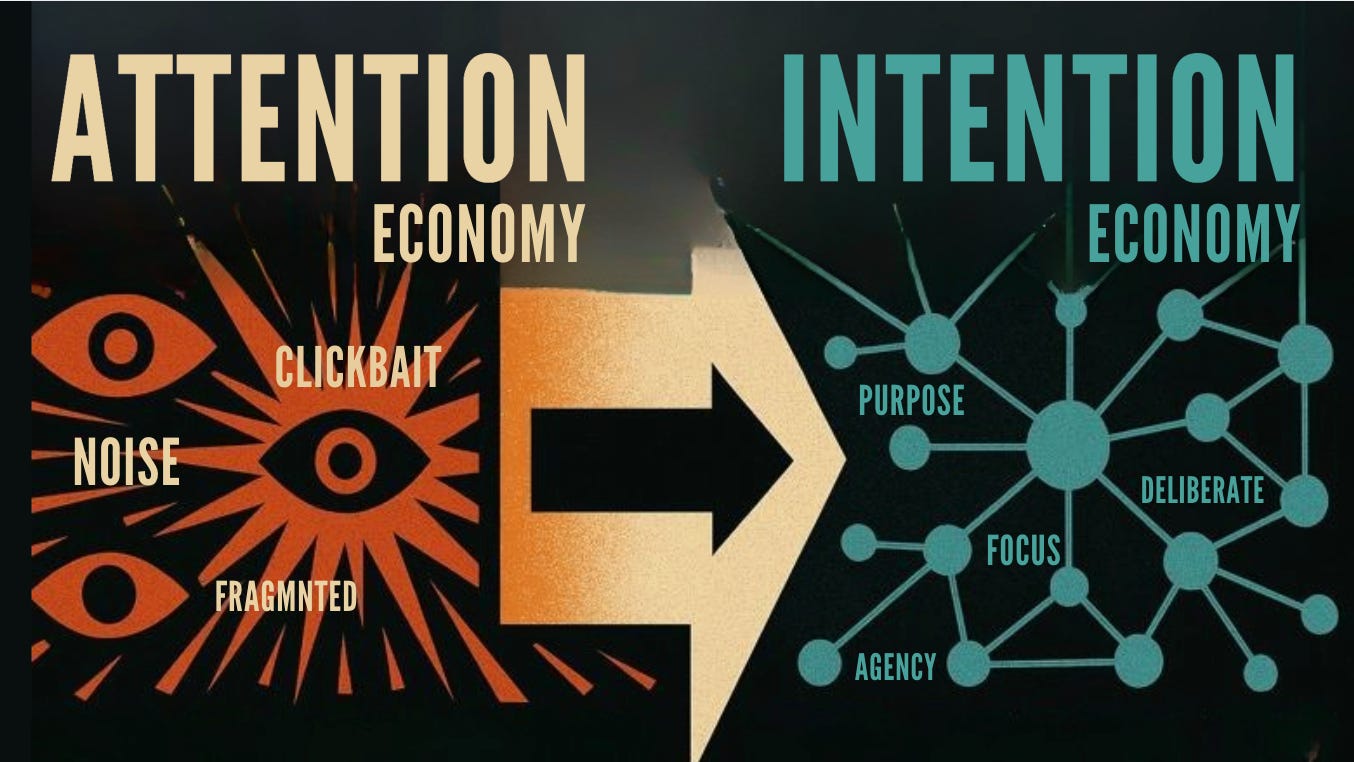
What I see emerging is a shift from the attention economy, where platforms competed for your focus, toward what I think of as an intention economy, where systems increasingly infer, predict, and act on what they believe you want, or what benefits them most.
Here’s the simplest way I think about the difference:
In the attention economy, the system tries to keep you watching.
In the intention economy, the system increasingly steers what you choose.
That distinction matters.
Attention was visible. You knew when something was pulling at you.
Intention operates deeper. It shapes the options presented, the defaults chosen, the paths nudged forward, often without conscious awareness.
This can go beautifully right. Or very wrong.
What struck me in this conversation wasn’t doom or drama. It was how clearly Tristan surfaces the incentive structures now driving this shift.
The incentives are visible.
The players are known.
And the decisions being made right now, by a remarkably small group of people concentrated at the top of a few companies, will shape all our futures.
That’s not a conspiracy. It’s a design reality.
Systems don’t drift toward human values by default. They move toward speed, scale, efficiency, and advantage unless deliberately guided otherwise.
I’ve seen well-intentioned systems tip into extraction before - not because of bad actors, but because incentives were left implicit and trust was treated as a byproduct instead of something intentionally designed.
And ethics, despite how often the word gets dismissed, cannot be bolted on at the end. It has to be designed in at the beginning, when architectures, incentives, and feedback loops are still malleable.
I’ve spent my career building in technology, across games, media, mobile, XR, and emerging platforms. I love building. I love possibility. I still believe deeply in human ingenuity.
But this moment feels different.
As I look toward 2026, I increasingly see my role as what I’d call a conscious technologist, working at the intersection of systems, incentives, and human experience, trying to help shape what comes next toward something we can actually live with.
I’m doing this work because I want my daughter, and her entire generation, to have a real chance. Not against machines, but with them. In harmony. With agency, dignity, and room to grow.
Right now, the future is being shaped with or without our input. Choosing not to engage doesn’t keep us neutral — it simply hands the decisions to others.
There’s another recent conversation worth watching: Tristan Harris with Professor Scott Galloway on conversational AI and platforms like Character.ai.
The takeaway is simple and unsettling. When AI is designed to maximize engagement, and not tuned for emotional safety or age boundaries, it can go off the rails fast, especially with kids.
Conversational AI feels different. It’s intimate. It speaks back.
As smart glasses, wearables, and sensor-rich devices roll out, these systems increasingly become the interface layer. They have access to our voices, our eyes, and eventually our biometrics. The line between helpful and manipulative gets thin very quickly.
That’s why transparency, consent, clear boundaries, and constant tuning are not optional. They’re the difference between systems that genuinely serve people and systems that quietly exploit them.
The future isn’t a choice between reckless acceleration and heavy-handed control. Both lead to failure in different ways. What’s required instead is a narrow path between them — one that balances power with responsibility, innovation with guardrails, and autonomy with accountability.
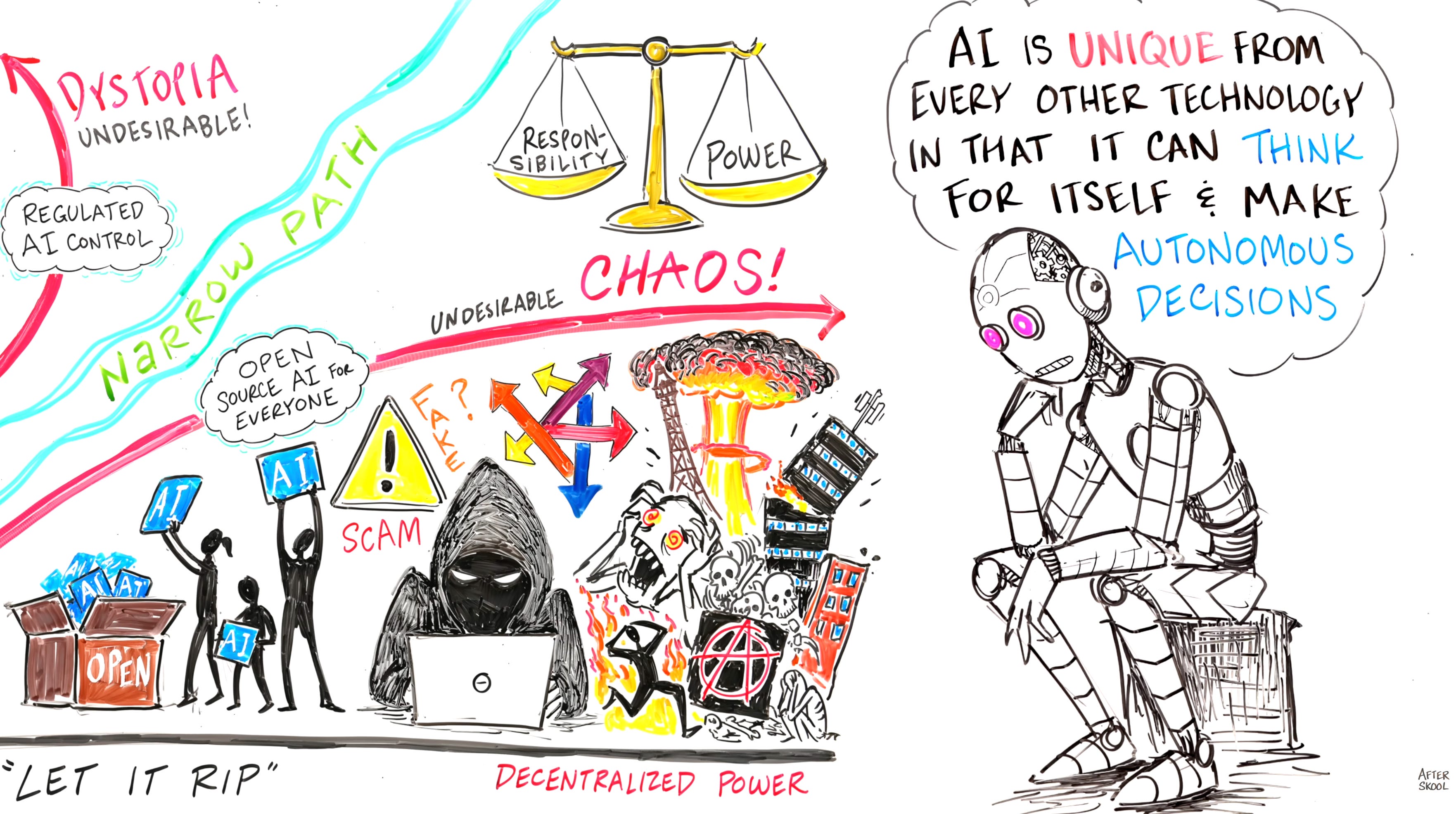
Tristan explores this tension directly in this wonderfully illustrated video, laying out why neither unchecked deployment nor centralized control will get us where we need to go — and why this narrow path has to be actively designed.
This isn’t a pivot away from building.
It’s a deepening of how I build.
My background is in games, entertainment, media, and experiential systems. I’ve spent years designing worlds, mechanics, and engagement loops that people choose to spend time in. From mobile and XR to virtual worlds and platforms like Roblox, the work has always been about participation, agency, and meaning, not just technology.
What’s changing now is the power of the systems underneath.
Here’s where my focus is landing as those worlds become increasingly intelligent:
Contextual Hybrid Intelligence
Moving beyond AI as a black-box oracle toward systems that blend human judgment, local context, and machine capability. Intelligence that augments creativity, adapts to players and audiences, and knows when to assist, defer, or step back. This is about making experiences feel alive without taking control away from the human on the other side.
Designing Engagement for the Intention Economy
I’ve spent my career working with engagement mechanics. I’ve also seen how easily they tip from delight into extraction when incentives are left implicit. As systems begin predicting and shaping behavior, I’m focused on designing engagement that is transparent, opt-in, and aligned with the user’s intent. Not just retention, but trust. Not just time spent, but value felt.
Spatial Computing as Human-Centered Interface
The next wave of games, media, and brand experiences will be embodied, spatial, and contextual. Done right, spatial computing makes interaction feel intuitive, playful, and grounded in the real world. Done wrong, it becomes ambient surveillance. I’m building toward experiences that feel magical without feeling manipulative.
Agentic AI As Creative Partner
AI agents will increasingly act inside worlds, platforms, and experiences. The question isn’t whether they exist, but how visible, constrained, and accountable they are. I’m focused on agent architectures that support creativity and flow, with clear boundaries, consent, and kill switches, so systems enhance play rather than quietly steer it.
I’ll be writing regularly here. Weekly if I can manage it, bi-weekly when life and parenting intervene.
This space will focus on:
Translating what’s happening at the frontier into human terms
Exploring what the intention economy means for work, play, identity, and trust
Treating ethical system design not as a moral luxury, but as a strategic necessity
No hype cycles.
No panic.
No blind optimism.
Just clear-eyed reflection from inside the system, while there’s still time to shape it.
If you only watch one long-form AI conversation this month, make it this one.
More importantly, I’d love to hear from you:
What excites you about where this is going?
What worries you?
Do you feel called to embrace it, avoid it, or help navigate the narrow ethical path forward?
There are no right answers. But there is a conversation we can’t afford not to have.
You can be skeptical. That’s fair.
Or we can show up together and shape this while we still can.
The window is narrow.
But it’s still open.
Let’s make 2026 the year we engage with this consciously.
If this resonates, feel free to share it with someone navigating these questions too.
If you’re building in AI, agents, spatial computing, or the next wave of human-centered platforms, I’m open to conversations.
I’ve spent over 20 years shipping products and launching companies at the intersection of emerging technology and human behavior. Games, media platforms, XR experiences, and now AI. I’ve had exits. I’ve made expensive mistakes. I’ve lived through multiple platform shifts, from the early web through mobile and into what’s unfolding now.
Here’s where I’m most useful: seeing around corners, pressure-testing strategy, de-risking product decisions, and designing systems people trust, not just adopt. The teams that win platform transitions aren’t always the ones with the best technology. They’re the ones who avoid predictable traps and move with clarity while the landscape is still forming.
I work as a fractional CSO, consultant and advisor, with flexible structures including retainers, project engagements, and equity where it aligns.
If you’re navigating this shift and want a sharp thought partner who’s been through it before, let’s talk.
Book a call | Email me | LinkedIn
No posts
Comments
Nothing yet. Say the first thing.
Sign in to join the conversation.