
🧭 From Play to Presence
Because Context Isn’t Just Powerful—It’s Personal

The interface fades. What remains is resonance —
the quiet harmony between nature, presence, and intelligent systems.
I started designing games to turn the world into a playground—not to escape it, but to elevate it.
When mobile took off, I saw more than a screen. I saw a living design canvas—one that could move with you, evolve in real-time, and respond to the world around you.
That vision led me to found Ogmento, where we created the first location-based AR games—years before Pokémon Go. Our work helped launch a new genre and was eventually acquired by Apple, forming part of the foundation for ARKit.
From that point on, I was hooked on building experiences that merge digital and physical, play and presence.
I’ve spent the last decade building at the edges of digital and physical worlds—blending GPS, computer vision, wearables, brain-computer interfaces, even EEG-powered gameplay.
At Neurable, we developed the first video game played entirely with your mind—hands-free, powered by eye gaze and intention. Funded by Red Bull, it gave players a taste of what’s possible when systems don’t just respond to clicks—but to consciousness itself.
That’s when it hit me:
Context isn’t just powerful. It’s personal.
The more intelligence we build into our systems, the more invisible the exchange becomes.
And if we don’t design that exchange with care—if we don’t build for trust, agency, and transparency—we risk creating systems that manipulate rather than empower.
Now, with AI becoming ambient—always listening, always adapting—we’ve crossed into a new frontier.
We’re not just designing interfaces anymore. We’re designing relationships.
With AI.
With our environments.
And with ourselves.
🔍 The Moment We’re In
From Features to Presence, and Why Design Needs to Catch Up
We’ve crossed a threshold—and most people don’t even realize it yet.
AI isn’t something you activate anymore — it’s always on. It’s in your phone, your inbox, your car, your home. It filters your feed, finishes your sentences, recommends what to watch, and soon, what to do.
It’s not just on your screen anymore. It’s in your environment.
At the same time, our physical spaces are becoming more intelligent—layered with sensors, cameras, microphones, and contextual triggers. Our environments are listening. Responding. Adapting.
We’re moving from designing interactions to designing relationships.
Because what’s forming now isn’t just interface—it’s presence. Systems that track not just what you do, but where you are, what you’re paying attention to, and increasingly, who you are becoming.
That’s a profound shift. And it raises the real question:
Who are these systems aligned with?
Are they working in service of you—your goals, your values, your growth? Or are they quietly optimized to serve the platforms, advertisers, or agendas behind the scenes?
This is why design needs to evolve. We’re not just shaping products anymore—we’re shaping how people relate to the intelligent systems around them.
And if we don’t get it right — if we don’t prioritize agency, trust, and transparency — then we risk letting the next generation of technology shape us before we’ve had a say in how it should behave.
🧩 What’s Missing from Today’s Design Models
Why UX and Human-Centered Thinking Aren’t Enough Anymore
For decades, human-centered design has been the gold standard. It taught us to empathize. To design with usability, clarity, and accessibility in mind. It helped us make complex systems approachable—and made the digital world feel more human.
But it was built for a different era. An era of screens, clicks, and direct input. An era where users were clearly in control—opening apps, tapping buttons, issuing commands.
That world is disappearing.
Now we’re designing for environments where systems act on their own. Where AI makes suggestions before we ask, adapts before we notice, and interacts based on context we can’t always see.
And yet, many companies are still using the same old playbook—treating design like decoration, or UX like a checklist. They’re optimizing for engagement instead of alignment. Frictionless flows instead of intentional exchanges.
But when intelligence becomes ambient, the stakes change.
We’re not just designing how something looks or works anymore. We’re designing how it behaves—and what kind of relationship it builds with the human on the other side.
And that demands a new kind of design framework. One that still honors the best of human-centered thinking—but goes further.
Toward systems that are not only useful, but trustworthy. Not only frictionless, but respectful. Not only responsive, but aligned.
That’s what I’m building next. A new model for designing in a world of resonant systems—where humans and AI don’t just interact, they evolve together.
🌐 Designing for Resonance
A New Model for Human–AI Alignment
A New Model for Human–AI Alignment
We’re stepping into environments that respond to us—sometimes invisibly, sometimes intimately.
As AI becomes more ambient, immersive, and adaptive, we have to ask:
How do these systems see us? And how do we want to be seen?

We’re no longer looking at the interface. We’re standing inside it—reflected, sensed, and shaped.
Resonant design begins when systems don’t just react to us… they recognize us.
So where do we go from here?
If traditional UX was about usability, and human-centered design focused on empathy, then Resonant Systems Design is about something deeper:
Alignment—not in the technical sense, but in the human sense.
In AI circles, “alignment” typically means ensuring a system behaves as intended by its creators. But in our lived experience, that’s not enough.
What we need now is Resonant Alignment—when systems don’t just work, they feel right. When behavior is in sync with our values, our context, and our agency.
That shift—from screen-based interactions to ambient relationships—requires a new kind of design mindset. One that doesn’t just respond to people, but respects them. That offers support without surveillance. Choice without manipulation. Presence without pressure.
We’re no longer just designing interfaces—we’re designing intelligent environments.
But it’s not just environments we’re designing. Increasingly, we’re shaping relationships with autonomous AI agents—systems that sense, decide, and act on our behalf. These agents aren’t just passive tools. They learn, adapt, and increasingly shape how we work, relate, and make sense of reality itself.
Designing for that kind of relationship requires new thinking—grounded in trust, agency, and alignment.
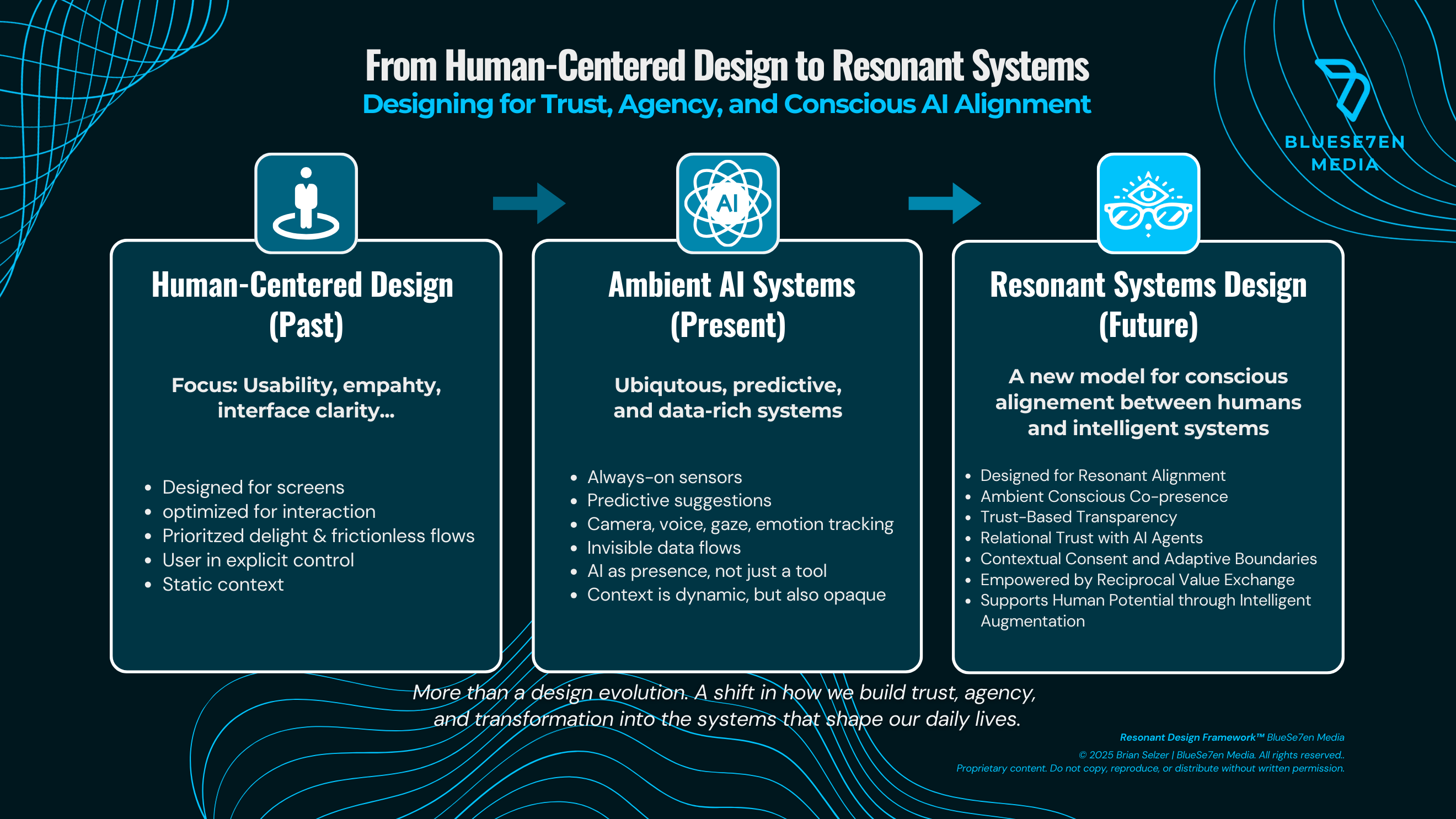
From Human-Centered Design to Resonant Systems Design.
This framework maps the evolution of experience design—from usability and empathy, to ambient intelligence, to systems that align with human context, values, and agency. It’s not just a shift in interface—it’s a shift in relationship. We’re now designing environments—and partnerships—with adaptive AI agents that participate in our daily lives. These systems must be built on trust, transparency, and resonance.
Want the high-res PDF version of this framework slide? It’s free for all subscribers.
As you can see, we’ve moved from interaction → prediction → resonance.
And that evolution demands a new foundation—rooted in two core principles:
🔹 Ambient Conscious Co-presence
Systems that are aware without being intrusive. Present, but not overwhelming. Like a trusted partner that knows when to assist, when to wait, and when to simply be there.
🔹 Trust-Based Transparency
A new standard for how data is exchanged and understood. It means giving people real-time clarity over what’s happening behind the scenes—and the power to choose how and when to engage.
These aren’t just UX patterns. They’re foundational principles for the age of intelligent systems—meant to preserve what makes us human, while unlocking new ways of evolving in partnership with AI.
🛠 Where We Go Next
The Future Needs to Be Designed—Now
This isn’t a warning. It’s a call.
We’re not powerless in the face of AI. We’re the ones designing it. Training it. Integrating it into our spaces, our systems, our lives.
And if we want these tools to truly serve us—to help us grow, connect, create, and evolve—we have to get intentional about how we build them.
This is the work ahead:
Not just to protect our humanity, but to amplify it. To design systems that resonate with who we are, and who we’re becoming.
I’ll be sharing more soon—starting with a new framework I’m developing:
The 7 Principles of a Resonant Future—a design framework for aligning people, environments, and AI systems through trust, agency, and clarity.
It’s a practical, teachable system for designing immersive, AI-powered experiences with clarity, consent, and consciousness at the core.
If you’re building at the intersection of AI, XR, wearables, gaming, or spatial computing… Or if you simply know that how we design now will define how we live next—Stay tuned.
I’ll be releasing the full 7 Principles Deck soon—20+ pages of insights, design prompts, and future-forward tools for anyone shaping the next era of human–tech interaction.
If you care about designing with clarity, agency, and alignment—this isn’t just a map. It’s a compass.
👉 Stay tuned—or upgrade to a paid subscription to get first access when it drops.
We’re just getting started.
✦ Subscribe to Rezonations
✦ Building a movement at Rezdom.com
✦ Reach out if you’re ready to design the future—with resonance.
Comments
Nothing yet. Say the first thing.
Sign in to join the conversation.