
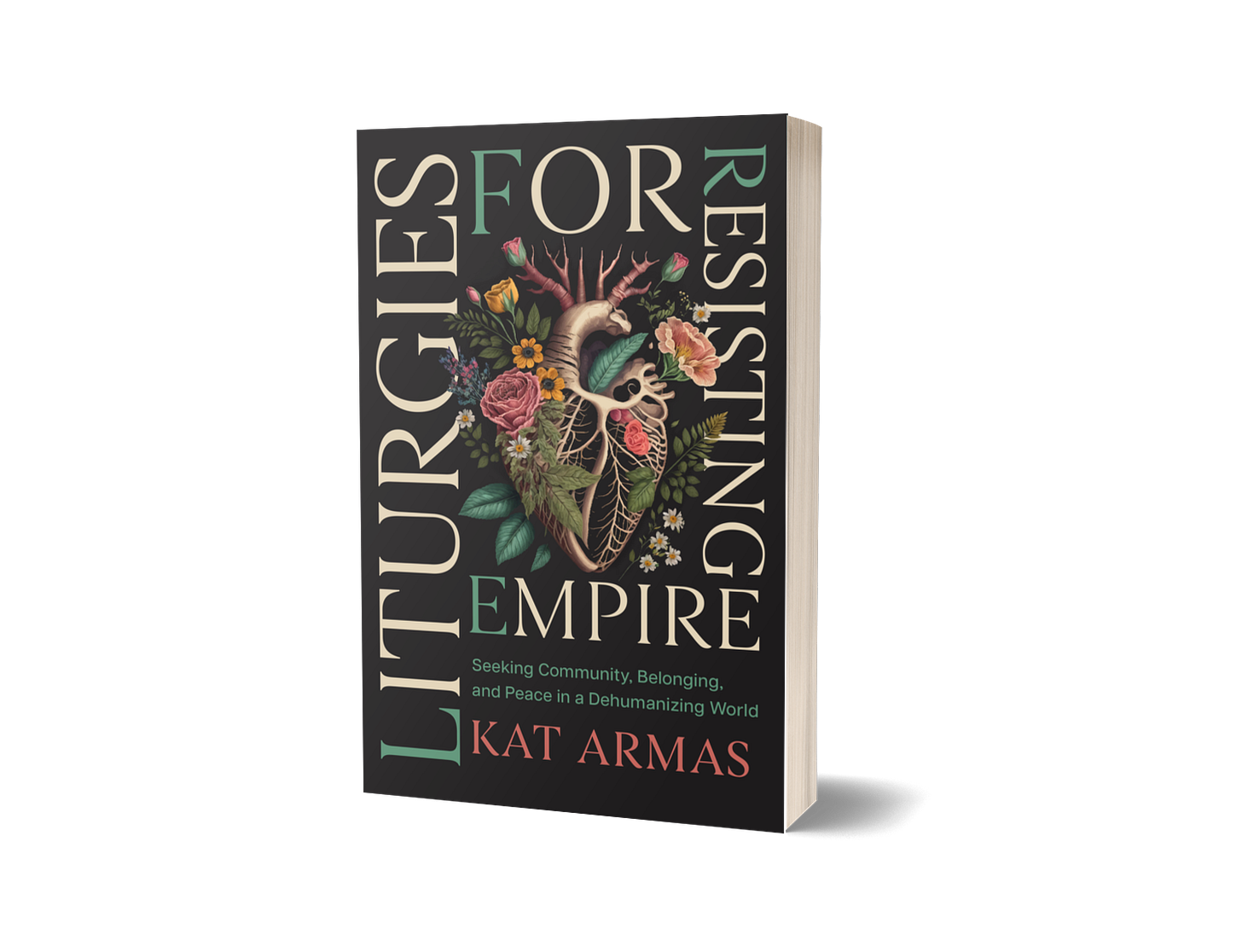
This week I’ve been digging into Kat Armas’ gorgeous new book, Liturgies For Resisting Empire.
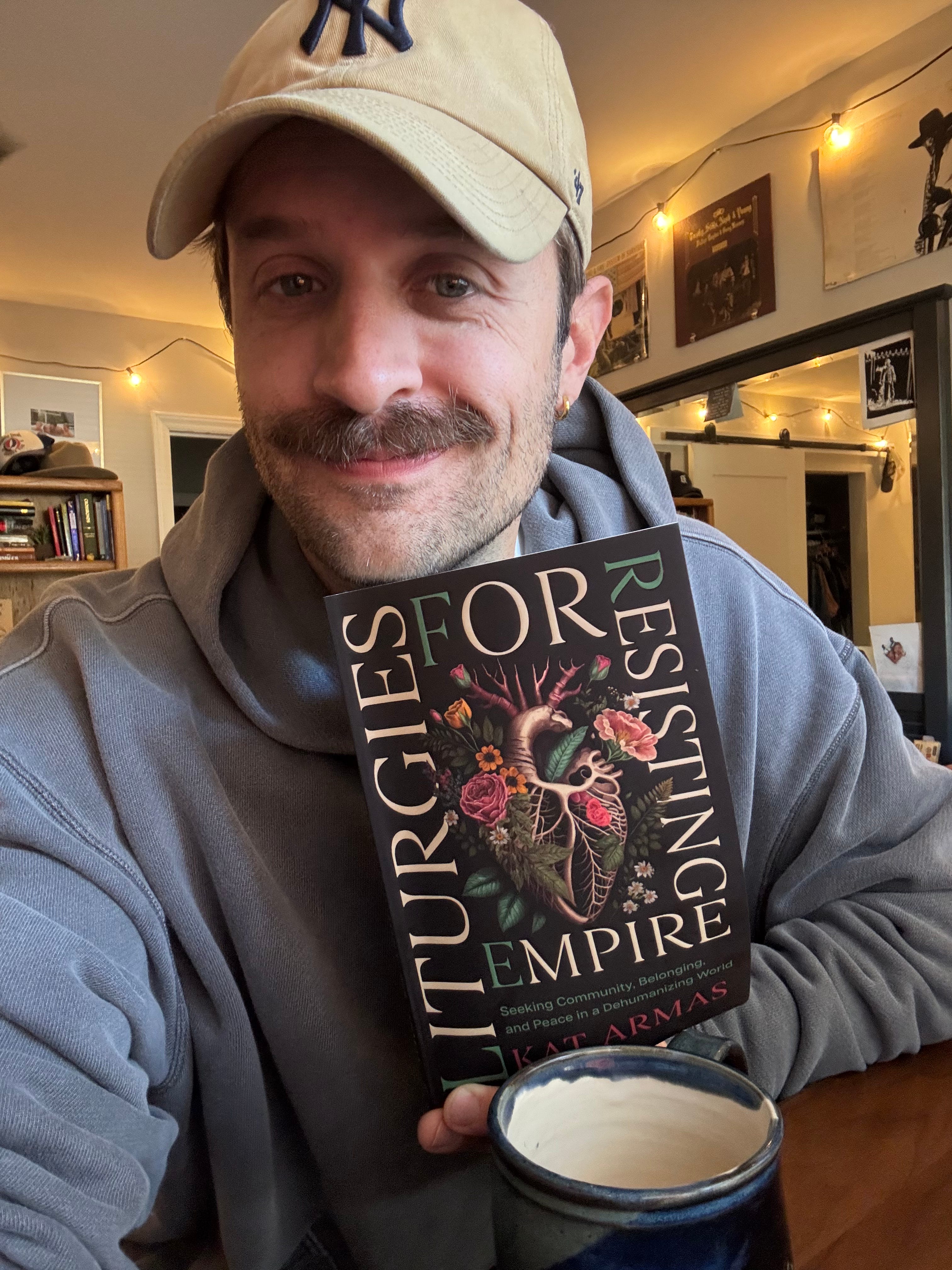
It comes out TODAY, and I can’t recommend it enough for our moment in history when these oppressive forces have become so explicit, brazen, and culturally dominant. For many of us, Christian spirituality actually formed us to be willing participants in empire, rather than counter-cultural resistors. Our “Christian” mission was little more than a spiritual disguise for colonialism and supremacy. This book will help us reclaim our place on the underside, where Jesus stands with the oppressed and the silenced. It will also help us reclaim our humanness.
In addition to reflections like the one below, the book contains prayers, poems, invocations, and benedictions—tools for forming strong hearts that stand against empire.
I am proud to share this brief excerpt, but I highly encourage you to grab the book, and give her Substack a follow: Some Things Abuelita.
beloved, with Brian Recker is a reader-supported publication. To receive new posts and support my work, consider becoming a free or paid subscriber.

LITURGIES FOR RESISTING EMPIRE
by
Kat Armas
Letting Our Light Shine?
I remember the way we used to sing “This Little Light of Mine” in Sunday School. We’d hold our index fingers up high like tiny flames, and declare with everything in us, “Hide it under a bushel? No!” And with even more passion, “Don’t let Satan blow it out! I’m gonna let it shine!” For us, the message was clear as day: God is not present in the darkness.
For so much of my early faith, that’s what salvation meant. Once lost in the dark, I had become a child of light. And no words shaped that understanding more than the beginning of the Gospel of John:
What came into being
through the Word was life,
and the life was the light for all people.The light shines in the darkness,
and the darkness doesn’t extinguish the light. (1:3–5)
The poetry of John has stirred hearts for centuries, and I was no exception. I was captivated by this image of Jesus—the Word, the light—piercing through the dark. I’ve always loved language, the way a single word can hold a universe. But looking back, I see how these words in all their poetic beauty might have contributed to a way of seeing the world I am now trying to dismantle.
It’s clearer to me now, the subtle way dualism—one of empire’s oldest and most seductive lies—was quietly woven into the faith of my youth. How by raising our index fingers high, we were learning something deeper than a melody: we were being formed to see the world in binaries, a stark division between believers and nonbelievers, saved and lost. What seemed innocent enough in childhood wasn’t harmless at all. It was formation—an early initiation into empire’s way of seeing, a lesson in separation that would take years to unlearn.
I was taught to see darkness only as absence. As something empty, something to fear. No one ever told me that darkness is where seeds are buried before they bloom. That it is the womb of creation. That before God said, Let there be light, the Spirit was already there, hovering over the deep. What if we have spent so much time trying to escape the dark that we have missed the God who dwells within it?
The problem isn’t necessarily John’s understanding of salvation, nor the poetry or language in the Gospel itself. The fracture runs deeper—into the way Greek philosophy has shaped our imagination, training us to divide what was never meant to be split. We learned to read dualism into the Bible, missing its paradox and mystery, and taming what was wild and relational in the Word. This lens doesn’t just shape doctrine; it shapes our very encounter with the divine, conditioning us to seek God in the abstract instead of in the soil, the body, and the breath between us.
Out of this binary imagination grew a theology that justified colonial and missionary efforts to bring the “light of the gospel” to the so- called “heathen” in the non-Western world. The “darkness” wasn’t just metaphorical anymore—it now represented a people, a geography, a skin. The Word became flesh, but in the hands of empire, the message became something that fractured us instead of knitting us together.
Empire’s logic leaves no room of multiplicity. Its dualistic framework strips away the richness of the human experience, reducing whole people to symbols, stereotypes, or monoliths. Frantz Fanon reminds us that the erasure of our complexity is empire’s greatest theft. He speaks of how colonialism erodes identity, reducing People of Color to roles that serve its narrative—always “the native,” always “the oppressed,” as if our existence is static, singular. But we are not one thing. We carry worlds within us, histories and futures colliding in every breath. To resist empire is to reclaim our right to nuance—to reject the binaries that seek to flatten and contain us.
Reducing people to a single story is an act of violence. It severs the sacred chaos of who we are from our bodies and our histories. We are complexity incarnate—uncontainable, defiant in our wholeness, unyielding in our joy, grief, and contradictions. To know ourselves truly, we must surrender the myth of simplicity and sit with the beauty of our depths. We must remember that we are spirit and we are flesh.
This way of seeing echoes an ancient truth in the Hebrew scriptures—a vision of humanity not as a soul trapped in a body, but as a living, breathing whole. Though Jewish thought is diverse, much of the tradition speaks of the human being as an integrated whole—flesh and spirit interwoven, inseparable.
So when John writes that the Word became flesh (1:14), it isn’t just theological; it is radical. It declares that the body is not incidental to faith but central to it. Jesus’s incarnation is not God’s concession to our frailty; it is God’s affirmation that our very flesh is sacred.
And the resurrection? It isn’t just the triumph of a soul; it was the return and restoration of a body, scarred and breathing. This stands in defiance of the Greek idea that death was a release from the material world. Instead, it proclaims that the body—this very skin, this very breath—holds meaning beyond the grave. The early Christian story resisted the hierarchical dualism that pits body against soul, that names one eternal and the other disposable. Instead, it entwined word and flesh, spirit and sinew, light and dark.
beloved, with Brian Recker is a reader-supported publication. To receive new posts and support my work, consider becoming a free or paid subscriber.
Comments
Nothing yet. Say the first thing.
Sign in to join the conversation.