
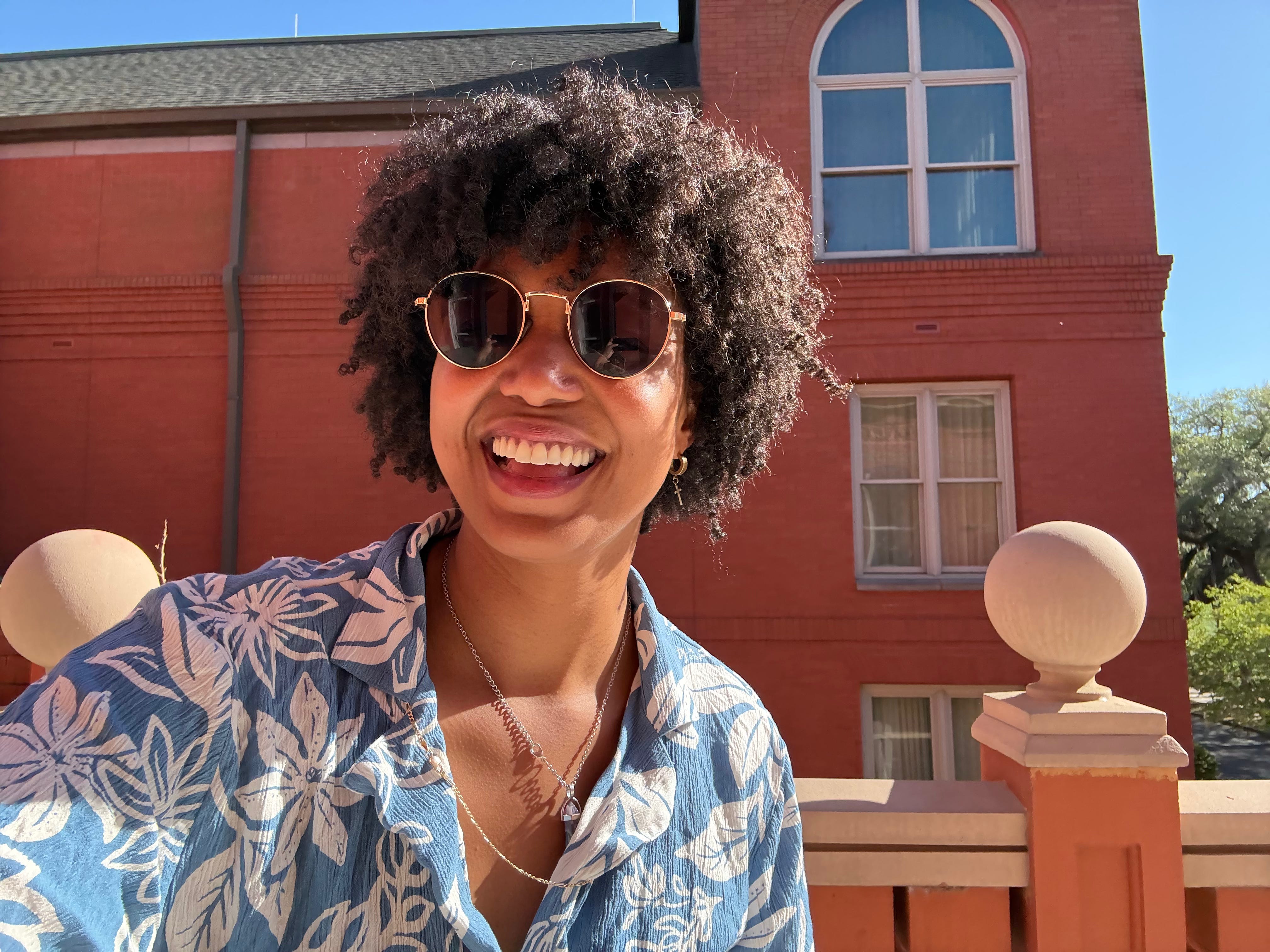
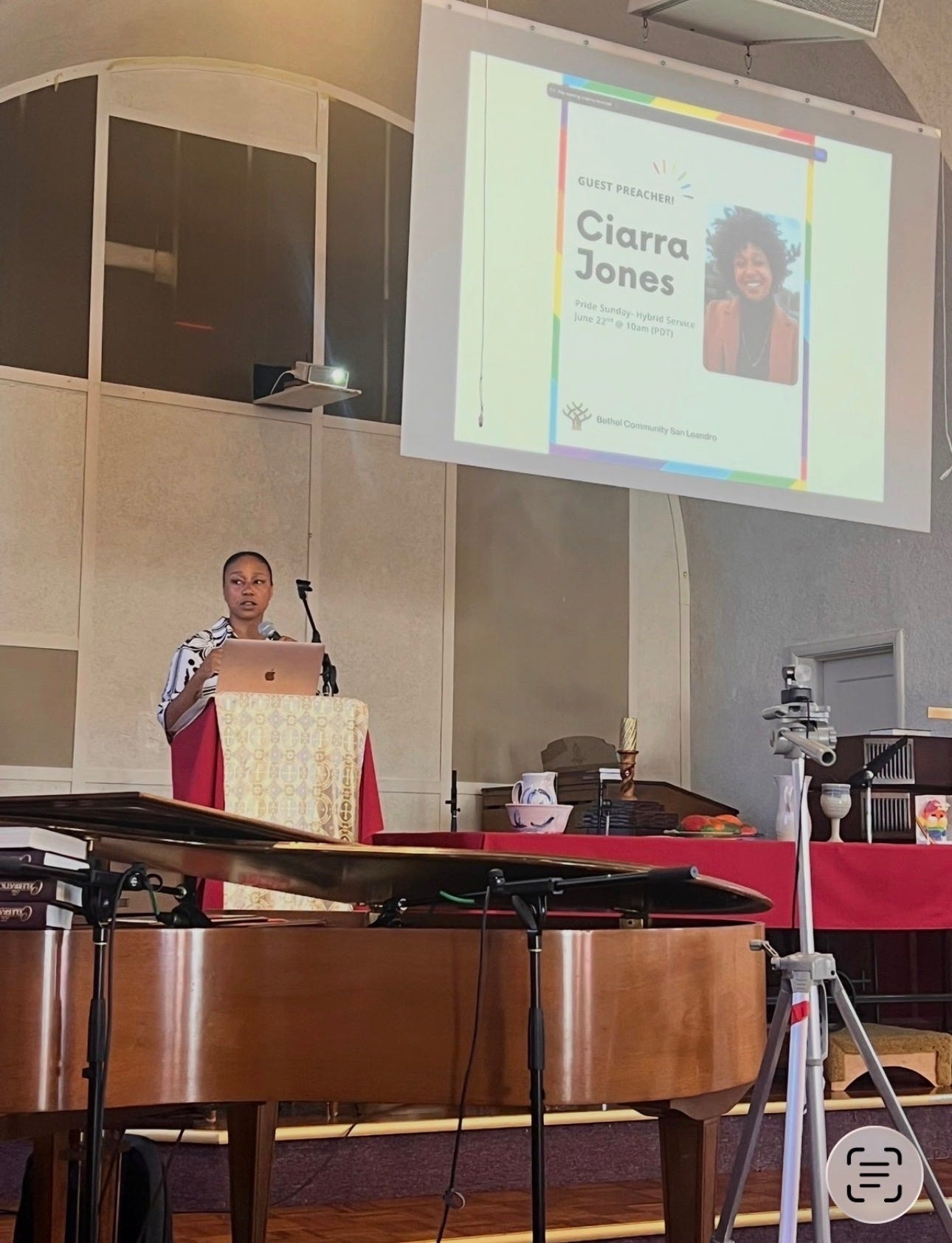
For Pride month, I’m featuring guest essays from queer writers. My friend Ciarra Jones aka the gardening theologian has a powerful voice and story worth hearing. In her journey to find God, she had to ditch a bad one to find a good one.
Follow her on IG and subscribe to her Substack.
As a Black Queer Theologian, I think the God of Fundamentalist Christianity is just plain bad.
Many Christians are taught it’s heretical to name any part of God as Bad but leaving Bad Theology and a Bad God saved my life.
In her seminal text, Our Lives Matter: A Queer Womanist Theology, Reverend Dr. Pamela Lightsey says, “Black Lesbians must worship a God that they are told hates them categorically.” As a child of the Assemblies of God Pentecostal Church (if you know, you know), I spent years praying away parts of myself, including my Queerness, at the altar of the God who hates me, at the altar of a God that I was told sees ME as bad.
To get free from white-homophobic-patriarchal God, I had to learn to see my Queerness as divine, and that meant embracing the truth that certain parts of my theological upbringing were bad. Hating gay people in the name of a God that upholds heterosexual supremacy is bad. Hating immigrants in the name of a God that “protects borders” is bad. Hating pregnant women and denying their rights in the name of a God that only cares about unborn children is bad.
Fundamentalist theology explains away so much violence through its theological paradigms. In the name of trying to make sure the Fundamentalist Christian God is good, and we are bad, our churches do a lot of mental gymnastics to explain away harmful theology as good.
“If we could just see that our original sin and ‘fleshy desires’ are what make us reject patriarchal God,” our churches tell us, “then we could see that even God’s rigid rules are good for us.”
Churches teach us to refine and renew ourselves; they teach us to mangle ourselves for bad theology instead of asking, encouraging us to ask the question: do I want to follow this construction or idea of God?
My Assemblies of God church believed that men were the head of the household, it believed Queerness was bad, and it also believed parts of Black culture, like hip hop, were inherently sinful. My church essentially hated my intersectional identity as a Black Queer Person. To love my church and the God my church believed in meant I was required to reject myself.
As a Black Queer Theologian, I reject the narrative that our only hope is to contort ourselves into shitty theology. As a theologian who finds God most clearly in gardening, I think our job as believers is to prune the parts of God that are hurting us. Like killing a weed that impacts a garden’s ability to thrive, we must be brave enough to name the parts of our theologies that are simply functioning to crush people and maintain hierarchy.
This pruning is not new; it is a practice with deep roots in Black religious history. During enslavement, many enslaved Black people simply did not read books by Paul. Do you know why? Because Paul’s theology, to many Black folks, is bad and harmful. Paul’s words were used to justify slavery and dehumanization. Black Theology has always embraced the idea that certain ideas from the dominant church simply need to GO so that the church body can be well.
As Rev. Dr. Lightsey says, “It is because we have experienced and know God as love, that Black queer womanists must dismiss as heretical any theology…that gives us up to the powers of evil, and leaves us to fend for ourselves.”
This is an essay about leaving a bad God to find a better one; this is an essay about getting bolder about naming theological toxicity and braver about claiming spiritual freedom. Leaving Bad God isn’t heretical; upholding power in the name of Bad God just might be.
The first time I heard of the book Gay Girl, Good God, I was in my second year of my Master’s of Theological Studies degree at Harvard University. A conservative Christian club at Harvard actually invited the author, Jackie Hill Perry, to speak at Harvard. She left ample trauma in her wake, and I ran the trauma-informed program that the University created after she left — the Religion, Gender, and Sexuality Program.
This program was interfaith and fully affirming. I worked with students across all faiths who were asking the question: Does God see my Queerness as GOOD? Can God hold all of me? Running this program was life-changing, and it left me with a deeper understanding of not just the belief that God affirms Queerness, but that Queerness has something to say about God. When we deny the divinity of Queerness, we miss a way to collectively know God more deeply.
The second time I saw the book Gay Girl, Good God, I was a year out of graduate school. I walked into a friend’s house to pregame before a party, and I saw the book lying on her dining room table.
“Please do not read this,” I pleaded with her. “I have a whole list of queer-affirming authors for you to read.”
I hate the title of that book. I hate that it essentializes Queerness as Bad and God as Good. I hate that it makes these two claims diametrically opposed. I hate the idea that a Good God can’t accept Queerness.
I have a personal beef with Jackie Hill Perry and ex-gay theologians. My personal beef comes from living in the corrosive impact of ex-gay theology. My personal beef comes from seeing how ex-gay theology harms the queer people I love. My personal beef comes from seeing parents of loved ones in Jackie Hill Perry’s comments begging to know how to save their child from Queerness instead of wondering how they can love their own child more just as they are.
I know what it is to hate a part of yourself into repression and silence so God will love you. And I have consistently worked with those who exist in the aftermath of shitty ex-gay theology.
Spiritual violence is violence. When we despiritualize Queer people, we tell them that accepting themselves means a life without divinity, spirituality, or universal love. What violence we have done to Queer people by telling them their love is devoid of God.
When I first called my sister during my freshman year at UC Berkeley to tell her I was gay and that I also planned to pray the gay away, she said, “You can do that, or you can find a bigger God.” Her words stayed with me, and over the years, I took them seriously. Slowly but surely, I picked all of the parts of white supremacist patriarchal God out of my theological beliefs. I left behind the prosperity gospel, “love the sin, hate the sinner” theology, original sin theology, and more. But I didn’t just deconstruct God; I’m reconstructing God, too.
Octavia Butler says, “God is Change.” I love the idea that God is changing because it means that God is not stagnant, but grows and evolves with us. Many Christians are taught to reject any idea that God can change, yet we accept those changes all of the time. There are thousands upon thousands of translations of the Bible text, and there are thousands upon thousands of Christian denominations, all comprised of various competing ideas of who God is.
The rainbow itself in the Biblical text is a sign of change. After releasing genocidal anger on the world because of humanity’s “sin,” God saves only Noah’s family and a small percentage of the animal and plant life on Earth. After releasing a violent flood on the world, God places a rainbow in the sky as a sign that God will never flood the Earth again.
As a Black Queer Theologian, I always read this moment as a sign of deep contrition, as God’s recognition that humanity has value even if humanity deviates from God’s idea of perfect or Good. The rainbow is the sign I see as an acknowledgement by God that the limitations God placed on humanity were too rigid to survive. Like the rainbow today, the Biblical rainbow too represents God’s ability and our ability to transform and change. It also represents how all people have inherent value and dignity.
The theologies that separate us are the worst parts of God, and we are allowed to reimagine them. This is not heretical, it’s necessary. As Father Gregory Boyle says in Tattoos on the Heart, “Soon we imagine, with God, this circle of compassion. Then we imagine no one standing outside of that circle, moving ourselves closer to the margins so that the margins themselves will be erased. We stand there with those whose dignity has been denied. We locate ourselves with the poor and the powerless and the voiceless. At the edges, we join the easily despised and the readily left out. We stand with the demonized so that the demonizing will stop. We situate ourselves right next to the disposable so that the day will come when we stop throwing people away.”
I threw away Bad God so I could love myself, and I found a Gentle Mother God in my garden. Ecotheology is the place where nature and divinity meet. I love being a Black Queer ecotheologian because it gives me a paradigm for death and rebirth.
In gardens, all things die so something else can bloom in their place. I let patriarchal fundamentalist God die. But in my garden, something else rose: a God that calls me to love others, including nature, as myself. A God that calls me to tend to others. A God that calls me to be compassionate when I fail. A God that still blooms even when I am still learning and imperfect in my cultivation. A God that can sit with me in my grief and change—a God that changes too!
God is not stagnant. God shifts, changes, and evolves with us.
Leaving Bad God did not leave me with nothing; it left me with room to grow something better. The God I prayed away was never the only God available to me, and naming that God as bad was the first act of tending my own life back toward bloom.
To prune God is not to destroy faith but to protect it, to clear space for a theology that can hold all of who I am. All of who we are.
I am still in the garden, still learning, still reaching toward a God who reaches back. And that God, the one who changes alongside me, is good.
No posts
Comments
Nothing yet. Say the first thing.
Sign in to join the conversation.