
Coaches stress practice efficiency. We use shooting machines to increase repetitions, negating the need for anyone to chase a ball or even work with a partner. We demand players arrive 10-15 minutes before the start of practice to begin the daily vitamins. We schedule drills to the second and time water breaks. Efficiency, not wasting a second of time, is considered a characteristic of good coaching.
I prefer effectiveness. I do not not schedule every second, but have a loose time frame in mind. I do not demand players arrive before practice starts as long as they are dressed and ready at the designated starting time. I hate shooting machines. We are not producing simple toys on an assembly line. There are many more important things than efficiency when working with people: Effectiveness is one.
Small-sided games are an example of an activity increasing effectiveness and efficiency because it incorporates many skills. Players shooting with a machine practice one skill; they maximize repetitions, but only shooting repetitions. Small-sided games practice many skills. Comparing shooting repetitions on a shooting machine to shooting repetitions in a small-sided game ignores the time spent on other drills to practice passing, dribbling, defense, and more. Only comparing shooting repetitions oversells the machine’s efficiency. A small-sided game provides fewer shooting repetitions than the machine, but the repetitions are more representative, and the game includes all of the skills, which outweighs any issues of efficiency.
Decision-making is not an add-on, but an integral aspect of skill execution. Shooting is not just the physical action, but the decision to shoot. Small-sided games better represent game shots because they are game shots; the decreased number of players reduces the potential interactions, thus lessening the complexity, but the primary constraints are present. Players decide whether or not to shoot and determine the distance to a defender needed to feel open. They read the speed and angle of closeouts. The defense’s presence and proximity increase the speed of the shot execution. Players evaluate whether a teammate has a bigger advantage if they turn down the shot to move the ball. Players shoot differently on the first shot than at game point.
Players and coaches trust in game slippage, accepting their shooting percentages will be halved during games. They strive to increase their undefended shooting percentages, creating a greater skill reserve for when their skill depreciates rather than embracing and practicing with the constraints that affect shooting percentages. The drastic percentage difference between practices and games demonstrates players practice something other than what occurs in the game. The whole point of practice is to improve game performance; the practice did not transfer when percentages are halved. Players should change their shooting practice, not aim for a greater skill reserve.
“Complexity transfers to simplicity, but not vice versa,” said movement expert Rafe Kelley. Every player who shoots 35% from the three-point line during games can shoot 70% in a gym by themselves, but not every player who shoots 70% by themselves will shoot 35% during games. The 70% practice shooting does not cause 35% game shooting; they are correlated because great game shooters will shoot well in practices as well. We trick ourselves into believing correlation is causation by looking at the best shooters, but many great practice shooters are not great game shooters.
Coaches and players hesitate to move away from traditional repetitions. Almost everything we believe about shooting, skill, and success is predicated on repetitions. Naturally the best shooters have attempted the most shots, but there is also survivor’s bias: Every time we highlight the practice routines of Stephen Curry or Kobe Bryant, and the volume of repetitions, we ignore other players who also shot hundreds of thousands of shots and never played in the NBA or developed into great shooters.
The ten-thousand hour rule warped our minds, making us believe anyone could develop into experts with sufficient practice, but many players develop with fewer repetitions, while others fail to develop despite many more. I coached a player who she she had never thought of herself as a shooter, but proceeded to shoot 50% from the three-point line, essentially leading the nation in three-point shooting percentage, while practicing less than anyone on the team.
I recruited a player who shot 35% from the three-point line during her last high-school season. She shot 35% and 40% in her two seasons playing for me and set the school record for three-point field goals made. She transferred and shot 21% in her next season. She transferred again for her final season, which became two because of the pandemic, and shot 35% and 37%. She averaged roughly 37% from the three-point line across six seasons. The outlier was the 21% season, not the 40% season. What happened?
There are various factors involved: New coach, teammates, environment, league, offensive sets, role, injuries, etc. Shooting is not one thing, but many things. However she sent a text after reading Evolution of 180 Shooter:
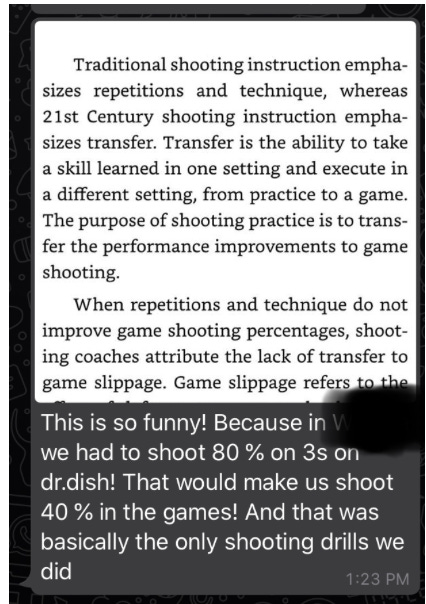
One coach in six seasons demanded 80% practice shooting to attempt game three-pointers. She led or was near the lead during those Dr. Dish workouts, shooting around 80%, but she shot only 21% during games. The issue was not just her. Her team did not shoot over 30% from the three-point line, whereas her previous team shot 37% and was top five nationally in three-point field goals made and three-point field-goal percentage; her final team led the country in three-point field-goals made, I believe.
She played for three coaches and three programs. Two were among the nation’s leaders in three-point field goals and percentage, whereas the other program believed in practice efficiency, shooting machines to decide who could shoot in games, and game slippage. The game slippage theory did not work, at least in her case, as she shot far below her practice percentages.
Why? Skill development, shooting, and performance are multifactorial. Correlation is not causation. I would not attribute success or failure to a single factor. However, she suggested her two biggest factors were confidence and practice design.
She switched from a team encouraging her to shoot to one questioning her shots. Consequently, her playing time decreased, reducing her shot attempts, creating a negative reinforcement loop: Less confidence = worse shooting = less playing time = fewer shots = less confidence… This started with the coach who had players run on treadmills next to the court for practice mistakes and created arbitrary rules about who can and cannot shoot based on practice percentages on a shooting machine.
The second change was practice design. As she texted:
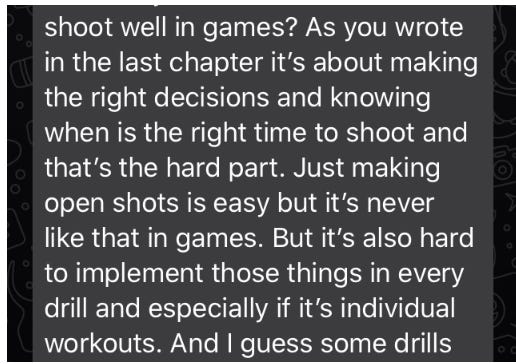
She never practiced her shooting against defenders during the outlier season. They shot primarily on the Dr. Dish. She lost a sense of timing and rhythm without the consistent game-like practice. She struggled with anticipating the speed of defenders, especially playing in a new conference against new opponents, then playing fewer minutes and attempting fewer shots. She no longer engaged in the same type of practice that helped her improve from 35% to 40%. The lack of game-like practice likely affected her confidence, compounding the problem.
She was not alone. Almost without exception, her teammates shot lower percentages before and after their two junior-college seasons. This is a within-subjects design: We can compare the results from the same players who encountered two or more different training environments. Of course, it is far from objective, as too many variables affect shooting performance. However, these players changed their shooting practice for two years during junior college, engaging in more contested shooting and decision-making shooting through small-sided games and modified shooting drills than before or after. Many never practiced in this manner again. Some teams used only isolated, block shooting drills; others relied on shooting machines on the players’ own time. Many coaches view our shooting practice as scrimmaging and not true skill development.
The players endured many changes when transferring, and one cannot ignore the differences in situations, systems, styles of play, shot selection, playing time, opponents, and more. However, every player shot better when practicing with more variable, defended, and decision-making shooting drills and small-sided games than when they no longer engaged in this practice. Of course, this does not confirm the typical coaching bias, so coaches ignore these results and attribute the differences to higher levels of competition (debatable with the talent we faced) or lack of effort.
Is game slippage real? Sure, it is a euphemism for a lack of transfer, evidence that the skills practiced by players differ from those performed during games. We should design better practices rather than increase our skill reserve, and include as many game constraints as possible. The purpose of practice is to improve game performance; what are we really practicing when game performance is so far removed from practice performance?
Efficiency is great, but effectiveness is better. Fortunately, small-sided games provide both. Players mix multiple skills, improving efficiency compared to block practice, and attempt more representative shots, this improving the effectiveness, and transfer, of the practice.
Thanks for reading Hard2Guard Player Development Newsletter! Subscribe for free to receive new posts and support my work.
Comments
Nothing yet. Say the first thing.
Sign in to join the conversation.