
The Will Wade era arrived at NC State with a clear offensive identity. While there have been some bumps in the road during the first half of the 2025-26 season, the early returns are positive. Wade’s hiring set the tone, but the foundation of the Wolfpack’s offensive redesign was established with a series of staff additions last offseason, including general manager Andrew Slater, assistant general manager Patrick Stacy and assistant coach Adam Howard. Each plays a distinct role: Slater with player acquisition and roster construction, Stacy focuses on basketball strategy and scouting, and Howard — drawing on his experience working with Fred Hoiberg at Nebraska — has been particularly influential in shaping both how and why this offense works.
Howard arrived from Lincoln after helping architect one of the Big Ten’s most modern and efficient attacks. Nebraska’s offense under Hoiberg thrives on pace, spacing, off-ball movement and quick decision-making. As the ball pops around the floor, the Cornhuskers operate with 4-around 1 and 5-out alignments, stretching the court and forcing defenses to guard multiple actions within the same possession. The results are tangible: Nebraska finished the 2023–24 season Top 35 nationally in adjusted offensive efficiency, played at a go-go tempo (16.3 seconds per possession, No. 44 nationally) and over 44 percent of its shots from 3-point range (No. 33).
Some of those same concepts are now evident in Raleigh, too, and the numbers back it up. Pace remains a core tenant of the offense: NC State averages just 16.0 seconds per possession (No. 58 nationally), while 45 percent of its field goal attempts come from beyond the arc. Through the first 17 games, NC State owns the No. 23 offense in the country (five spots ahead of 17-0 Nebraska), according to KenPom’s adjusted efficiency rating, ranking among the national elite in several key metrics. The Pack sit No. 5 in 3-point percentage (40.5 3P%), No. 19 in effective field goal percentage (57.5 eFG%) and No. 22 in turnover rate (14.1 TOV%), a combination that underscores both shot quality and offensive principles.
After struggles against Wake Forest and Virginia, scoring under 1.0 points per possession in back-to-back games for the first time all season, NC State’s offense rediscovered its groove, punctuated by a 1.3 points-per-possession performance in a road win at Boston College and a historic shooting display at Florida State. Against FSU, the Pack drained a program-record 19 3-pointers and scored 1.45 points per possession — the most efficient offensive outing by any ACC team in league play this season.
While NC State is unlikely to replicate those bonkers shooting numbers on a night-to-night basis, the offense must continue clicking for the Pack to meet their high preseason expectations. With Selection Sunday less than two months away, the next eight weeks will fly by. This deep dive breaks down NC State’s most efficient and high-priority play types, explains how each set is designed to create opportunities and provides exclusive statistical context that demonstrates why this offense ranks among the nation’s best.
Let’s dive in.
NC State’s 3-point shots aren’t created by accident. Quite the opposite, in fact. If it were easy to generate open looks from 3-point range, every team would do it. But to consistently generate high-quality looks from deep, an offense must operate with purpose, structure, flow and…also have good players. While the Wolfpack run a variety of actions designed to free shooters like Paul McNeil Jr. for clean catch-and-shoot opportunities, the offense ultimately revolves around a central principle: getting downhill and the paint. By forcing penetration and collapsing the defense, NC State creates the conditions to spray the ball out to the perimeter, producing in-rhythm spot-up 3s.
The Wolfpack want to live in the paint and finish at the rim, where they’re shooting 76 percent this season — good for No. 2 nationally, per CBB Analytics. The primary catalysts for this effort are point guard Quadir Copeland and center Ven-Allen Lubin, who leads the team with 7.1 field goals attempts at the rim per 40 minutes.
Copeland: 4.6 rim FGA per 40 minutes (85th percentile), 71.2 FG% at rim (81st percentile)
Lubin: 7.1 rim FGA per 40 minutes (87th percentile), 86.3 FG% at rim (85th percentile)
Moreover, only nine percent of NC State’s field goal attempts this season have been 2-point attempts from outside the lane, according to CBB Analytics. For the Pack, those shots are the province of really only one player: Darrion Williams, who attempts 2.9 2-pointers per 40 minutes from outside the paint (98th percentile). Matthew Able and Tre Holloman are the only other players on the roster averaging more than one 2-point attempt per 40 minutes from the range: 1.5 and 1.2, respectively.
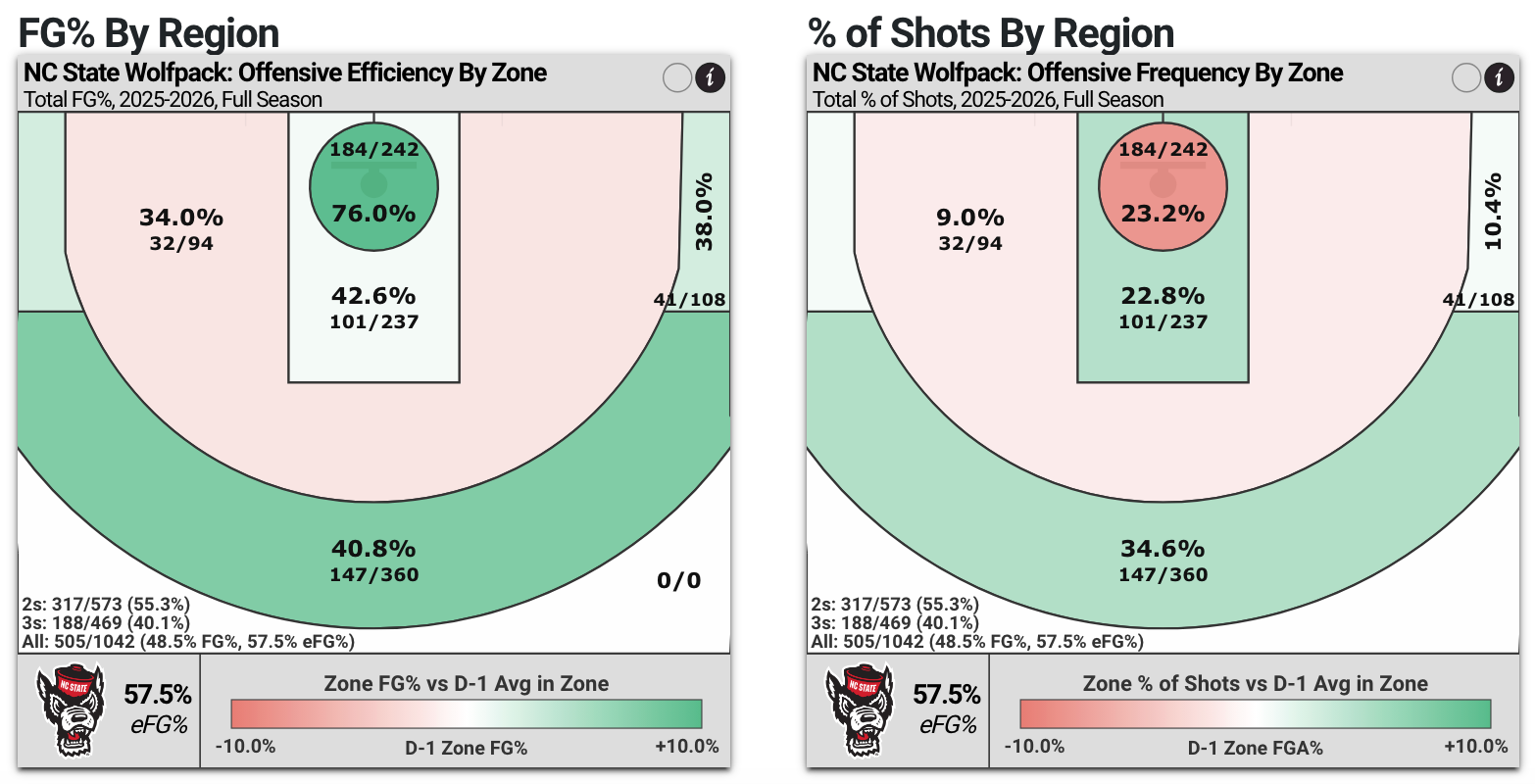
[Shot chart via CBB Analytics]
In his return to the ACC this season, Copeland — the former Syracuse and McNeese State guard — has emerged as an invaluable piece. He leads the team in both usage rate (27.1 percent) and assist rate (40.9 percent). That expanded role has coincided with a significant jump in efficiency: after entering the season with a career true shooting percentage of 53.4, Copeland now ranks inside the national top 50 at 66.5 percent.
Whether attacking 1-on-1 in the open floor or operating out of the pick-and-roll, Copeland has shown real pop as a driver. He leads NC State with 4.7 unassisted 2-pointers per 40 minutes (95th percentile) and draws 3.3 shooting fouls on 2-point attempts per 40 minutes (97th percentile).
As a consistent source of rim pressure, Copeland has also continued to evolve as one of the nation’s top playmakers, ranking Top 10 nationally in assist rate. Given NC State’s shot distribution, it’s no surprise that the majority of his assists come from the two most valuable areas on the floor: at the rim and beyond the arc. Copeland has assisted on 5.7 made 3s per 40 minutes this season, and according to CBB Analytics, 88.3 percent of his assists have resulted in either rim finishes or 3-pointers.
This was a part of NC State’s plan heading into the season, but Copeland’s usage has also allowed other guards — such as Tre Holloman, Matthew Able, Alyn Breed and McNeil — to slide into more efficient off-ball roles. After posting a 22.7 percent usage rate last season at Michigan State while shooting just 32.9 percent from deep (45.2 eFG%), Holloman has fit nicely alongside Copeland. His usage has dropped to 19.2 percent, while his shooting efficiency has climbed dramatically to 43.5 percent from three (58.6 eFG%). With both players on the floor, NC State is +84 in 216 minutes, scoring 1.27 points per possession, per CBB Analytics.
McNeil’s shooting splits also shift dramatically when Copeland is on the floor. In 315 minutes alongside Copeland, McNeil is shooting 57.1 percent on 2-point attempts and 45.5 percent from 3. Those figures drop to 37.5 percent and 33.3 percent, respectively, in 139 minutes without him.
And the Wolfpack don’t wait to get downhill. NC State’s early offense is built on the same principles: speed, rim pressure and rapid paint-to-perimeter reads that stress defenses before they can get set. Let’s examine further how NC State has empowered Copeland to get into quick-hitting offense.
With Williams at the 4, NC State frequently has four players on the floor capable of grabbing and going — either pushing the ball themselves or delivering hit-ahead passes. The Wolfpack are opportunistic in transition and look to run with crisp spacing: two shooters in the corners, a rim runner and a trailing big, whether off makes or misses. It’s low-hanging fruit to grab, but that approach has paid off.
NC State is scoring 0.99 points per chance following a defensive rebound on a missed field goal attempt (88th percentile) and an elite 1.39 points per chance following a defensive rebound on a missed free throw (99th percentile). In those situations, the Wolfpack are shooting 70 percent on two-point attempts and 50 percent from three (12-of-24), per CBB Analytics.
Beyond grab-and-go opportunities and hit-ahead passes, NC State also pushes pace and flows into early offense through drag ball-screen actions. These are ball screens set in transition or secondary situations, typically with the trailing big sprinting into the action. The objective is simple: allow the point guard to turn the corner while the five rolls hard to the rim, forcing downhill pressure against a scrambling defense.
For example, against VCU, Lubin sprints into a step-up drag screen for Copeland near the midcourt logo with 24 seconds left on the shot clock, catching the Rams before they are fully set defensively.
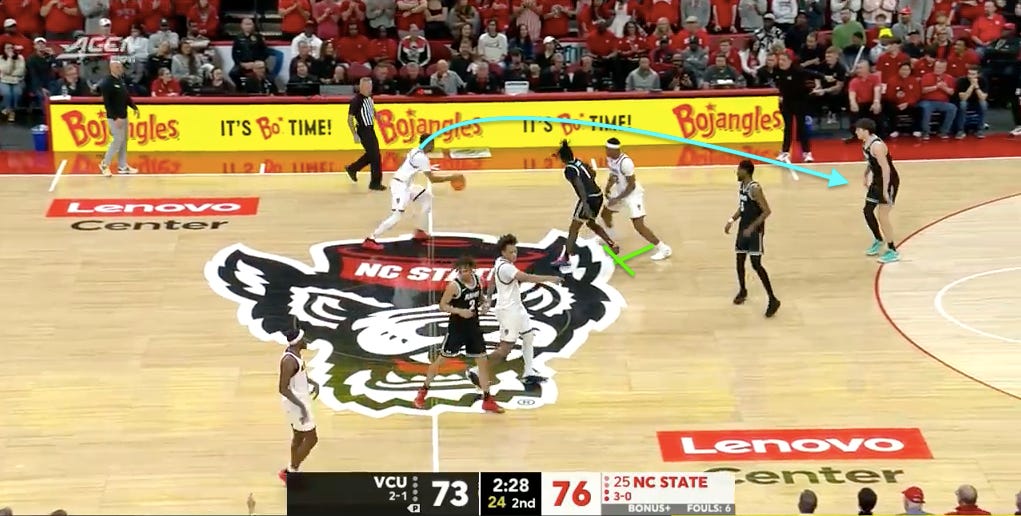
As Copeland attacks off the drag screen, he uses a protective dribble shield off swipes at the ball and drive into the paint, drawing two defenders before finding Lubin on the roll. Lubin misses his first attempt but quickly elevates on the second jump, finishing over the defense for a put-back 2.
At 6-foot-6 and 220 pounds, Copeland has the size, stride length and speed to bulldoze through drag actions. He can use his strength to attack the rim, but his height also lets him scan the defense and deliver a variety of creative passes. In this sequence, Lubin is well-covered as he slips the drag screen; however, as Asheville center Myles Mayfield (5) turns his back to the ball, Copeland finds a small window, threading a beautiful pass that hits VAL in stride for a layup.
According to CBB Analytics, NC State’s offense scores 1.15 points per chance on opportunities completed in under 10 seconds, including 61.8 percent shooting on 2-point attempts. This includes drag actions like the one at Auburn with Williams in control. Copeland can also be an impactful off-ball cutter and connector, finding ways to bridge plays and finish alongside Williams in these uptempo scenarios.
Another staple of NC State’s offense is what’s commonly known across basketball as “Wide” action. This 5-out concept features a down screen in the middle third of the floor, near the top of the key, for a player cutting from the opposite wing or slot toward the ball. In this example, Musa Sagnia sets the down screen for Williams, who cuts right and receives a pass from Holloman.
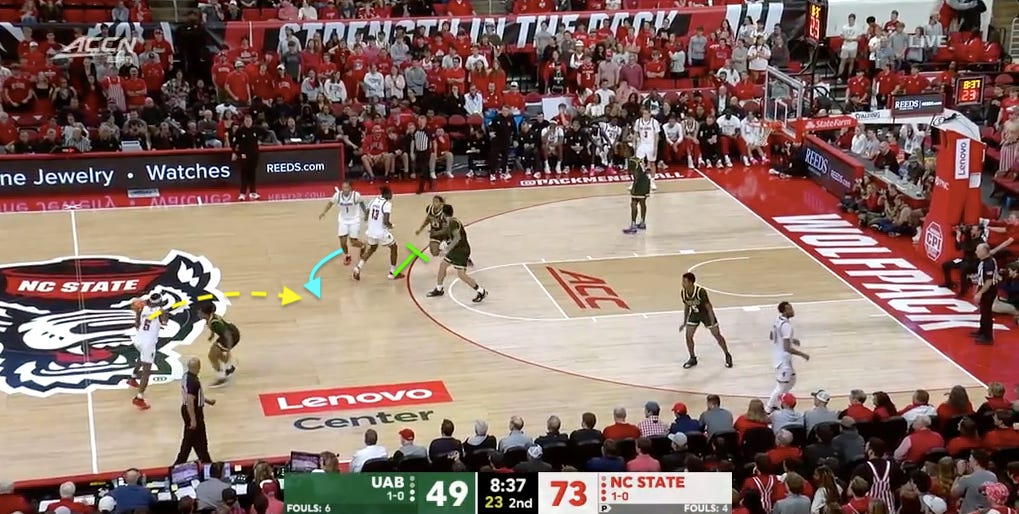
After the initial down-screen action, the Pack can flow into a variety of looks. For example, Williams fakes a handoff back to Holloman, keeps the ball, and flows into a 4-5 screen-roll with Sagnia. UAB puts two defenders on the ball and fails to tag the rolling big, allowing Williams to find an open Sagnia and deliver a threaded pass for an easy layup.
On this possession against Virginia, Williams curls the down screen from Lubin and gets to the elbow for a jumper against UVA’s standard drop coverage.
One of the things Wade and Howard like to do out of the Wide series is have the off-ball guard reject the screen and flow into a 5-out set, with the 5 initiating from the middle of the floor. On this play against Texas Southern, the off-ball guard — Copeland — takes a few steps toward the Wide screen before cutting away toward the lane.
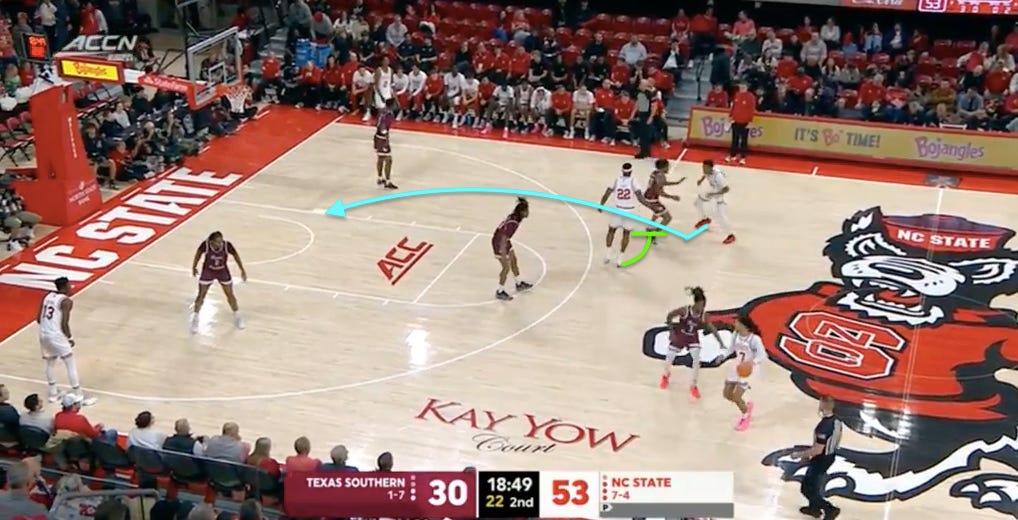
The 5 — Lubin in this case — pivots to face the ball and receives a pass from the 1. After Breed feeds VAL at the top of the key, he cuts down toward the left elbow, moving in Copeland’s direction. NC State is now set for the next progression of the play: “Zoom” action.
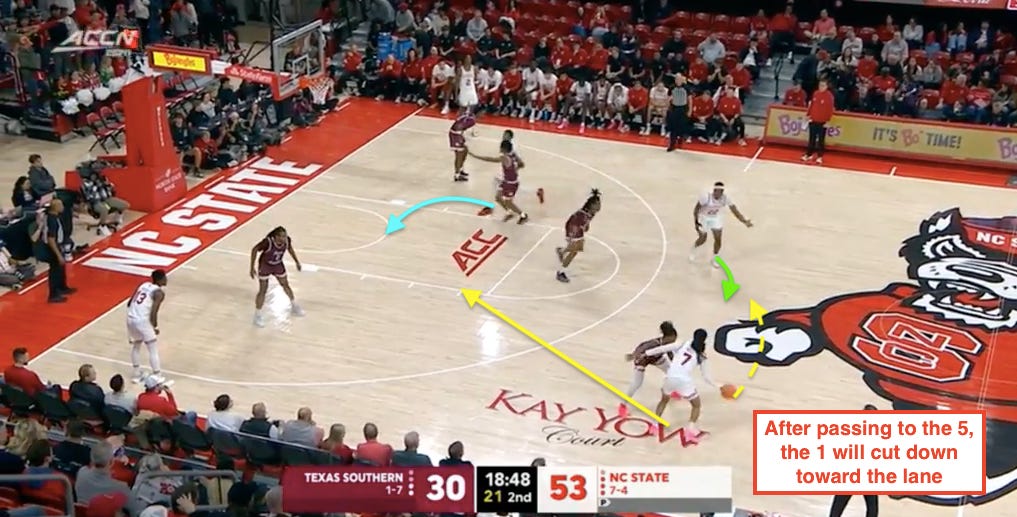
Zoom is a three-person action featuring a down screen for a player who will exit and sprint directly into a dribble handoff (DHO). In this case, Breed sets the pindown, and Copeland uses it to flow into a DHO with Lubin.
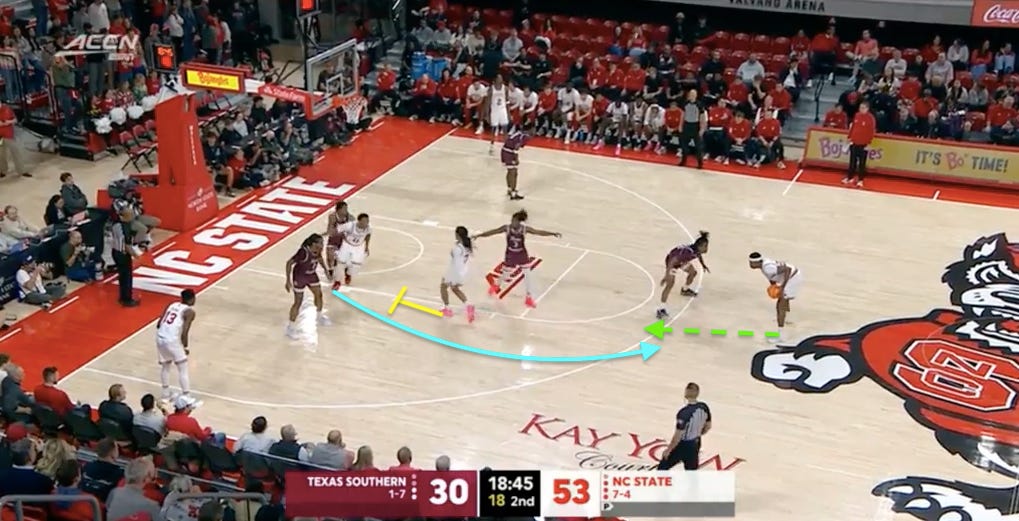
In this scenario, Copeland’s defender is forced to navigate multiple screens, putting him at a disadvantage. As Copeland curls off Lubin’s DHO, he creates space and draws the defensive 5 toward him. Lubin rolls hard to the rim with minimal weak-side resistance, and Copeland delivers a pass for an easy layup.
This is what I refer to as NC State’s Wide Gut Zoom action. “Wide” is the series, “Gut” refers to the location on the floor — taking place in the middle third — and “Zoom” is the down screen into DHO concept. Many around basketball, however, call it “Spanoulis,” in honor of Greek legend Vassilis Spanoulis, who popularized it in Europe. Regardless of the name, it’s highly effective.
In the November matchup with UNC Greensboro, the same Wide Gut Zoom concept is on display — this time with Sagnia as the 5-out hub in the middle. Copeland keeps the ball and attacks downhill for an easy layup.
Copeland isn’t the only player who gets to attack in these middle-third actions out of NC State’s Wide series, though. This has been good action for Able and Holloman this season, too.
On their home floor against Kansas, the Pack run Wide Gut Zoom for Able. The Jayhawks switch to bottle up Able’s drive, but the defense ends up a bit scrambled. Bill Self has frequently used center Flory Bidunga (40) to switch 1-5 this season, but it’s a tall task to check Copeland in space — even for a 6-foot-10 big with soccer-inspired footwork. With only Holloman spaced out on the right side, Copeland has a double gap to attack and an excellent spot-up shooter (Holloman: 43.5 3P% this season) to kick to if Jamari McDowell (11) helps off the strong-side corner.
It’s been fun digging through my archives, reviewing Nebraska film from the past few seasons and seeing how it aligns with NC State’s current offense. Unsurprisingly, there are some clear similarities. In fact, here’s Nebraska running the same action in the 2024-25 season, though it ends in a turnover against Indiana on an illegal screen by center Andrew Morgan (23).
Another variation of this play is what I call Wide Gut Razor. It starts similarly: the off-ball guard rejects the Wide screen and cuts toward the bottom of the lane, while the 5 wheels back to the middle of the floor to receive a pass from the primary initiator. This setup resembles the Zoom concept, but with one key difference: instead of the 1 setting a down screen for the 2, NC State flips it — the 2 sets a back screen for the 1.
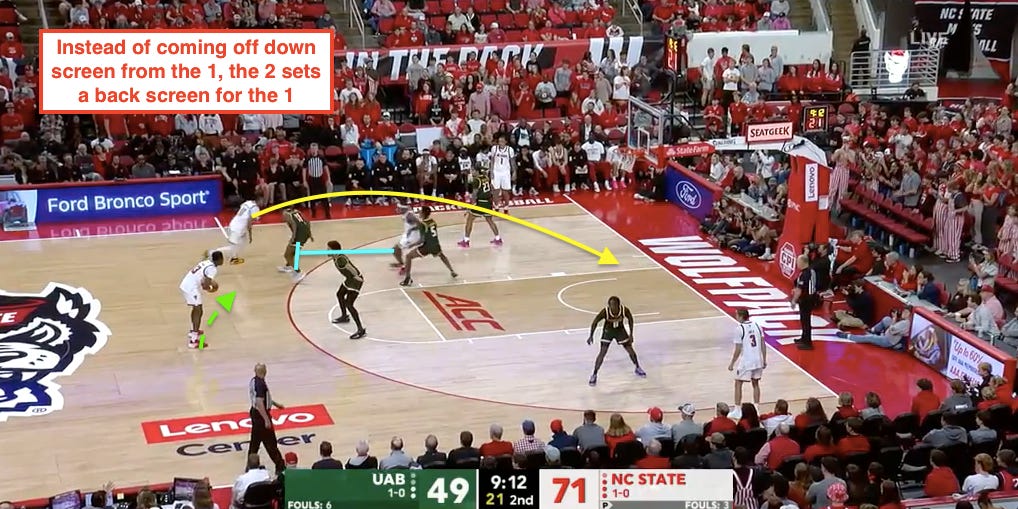
As the 1 (Copeland) cuts down to the post off the back screen, the 2 (Holloman) sprints into a DHO with the 5. Holloman’s back screen for Copeland triggers a switch, causing the defense to pause briefly to communicate and ensure neither player breaks free. That split-second hesitation needed to navigate the switch is all Holloman needs; he drives toward Sagnia, receives the handoff and uses the advantage to attack downhill for a layup.
A few weeks later against UNC Asheville, NC State runs the same Wide Gut Razor action — this time for Able. The Bulldogs struggle to communicate the switch while one defender jams Holloman. Able abandons his screen and flows into the handoff with Lubin, turns the corner against the defensive 5 and attacks downhill for a layup.
(The back screen into a DHO is referred to by some as “Peja” action, named for former NBA player Peja Stojaković, who ran it frequently under Rick Adelman in Sacramento and Rick Carlisle in Dallas. I’ve come to call this action Razor, so that’s the name I’ll stick with.)
NC State’s Wide series has been one of the team’s most efficient play types this season. According to my charting data, it scores 1.17 points per chance, with the team shooting 65.2 percent on 2 and 38.9 percent on 3.
One of the reasons I was so bullish on NC State’s offense heading into the season was the presence of Williams and Copeland: two veteran ball handlers with size, strength, and excellent passing vision. Both are built to be mismatch pieces at the college level, capable of scoring through contact at multiple levels of the floor and punishing smaller defenders switched onto them in inverted-screen actions. In theory, the Wolfpack’s offense has a sturdy floor with Williams and Copeland at the controls; if nothing else works, they can simply run pick-and-roll and create.
There is some natural usage overlap between the two, and at times it has been tricky to strike the ideal playmaking balance. Williams, in particular, is too good, and too central to the offense, to drift for long stretches as an off-ball floor spacer. The key is finding the right blend and using them in complementary ways, making sure that they interact and not just take turns initiating action.
According to CBB Analytics, Williams is more active on the ball in minutes without Copeland; his usage jumps from 23.8 percent to 27.2 percent, while his assist rate climbs from 18.2 percent to 24.7 percent. However, his efficiency slips: 46.3 percent true shooting (down from 62.3 percent in minutes with Copeland), 34.3 percent on 2-point attempts (down from 52.7 2P%) and 35.5 percent on 3-point attempts (down from 46.9 3P%). It’ll be interesting to see how those numbers stabilize over the course of the season, but these offer a few data points that highlight the importance of these two as a duo.
With Copeland and Williams steering things, the Pack have shown they can be both intricate and egalitarian offensively, while still allowing those two to drive usage. If anything, NC State could lean even further into bully-ball sets featuring Williams. With that in mind, let’s examine the possession types the Pack use to isolate him in the mid-post.
Pistol 4
During his two years at Texas Tech, Williams was a focal point in head coach Grant McCasland’s offense, frequently operating as a point-forward ball handler in “Pistol” action. I wrote about it last offseason for Pack Pride and referenced it ahead of NC State’s matchup with TTU in the 2024 NCAA Tournament, but those early-offense sets — featuring a guard setting a ball screen for Williams — are so effective because of the pressure they place on the defense.
If the defense switches a smaller guard onto him, Williams can initiate in “Barkley” fashion, chiseling downhill with his back to the basket. If the defense switches and sends a double team to prevent him from attacking a mismatch, he’s a very good passer who can kick out to an open shooter or cutter. And if opponents hedge and recover aggressively, Williams can move the ball quickly to create open 3-pointers or force 4-on-3 advantages.
A perfect example came on the game-winning basket against Arkansas in last year’s Sweet 16. Christian Anderson sets a screen for Williams on the right wing, forcing Karter Knox (11) to switch out and leaving 6-foot-10 shot blocker Trevon Brazile (23) on Anderson, who spaces to the top of the key and pulls Brazile away from the paint. Williams then uses his power and footwork to get downhill against Knox, spinning his way to an incredible finish.
I referred to this as Texas Tech’s “Pistol 4” action last season, and I’ve carried over the same terminology at NC State, where the Wolfpack run an identical set with Williams.
The action begins with Williams in the slot, another guard — Holloman in this possession against UNC Greensboro — on the ball and the third guard, Copeland, stationed in the corner. Holloman dribbles toward Williams and flips him a handoff. As that happens, Copeland lifts from the corner to set an inverted ball screen for Williams, completing the Pistol action.
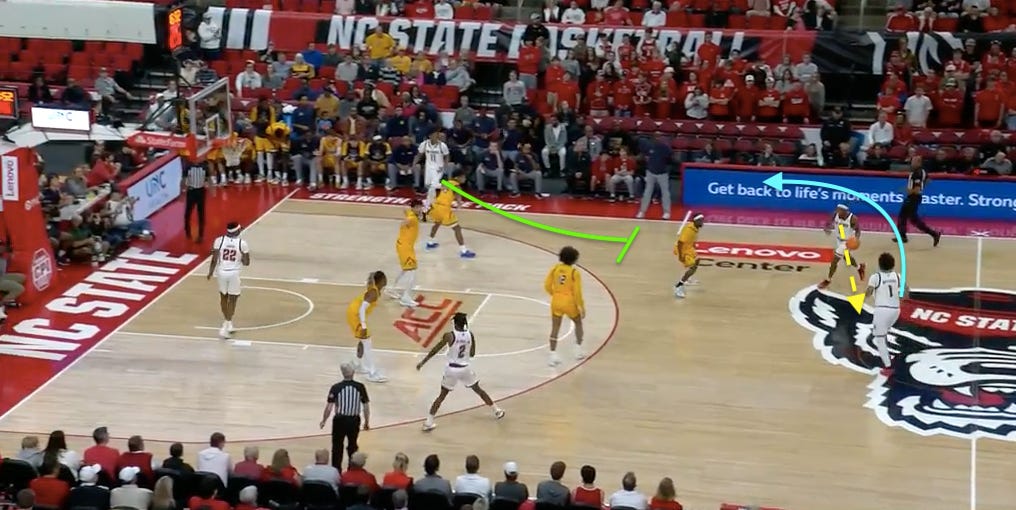
The Spartans elect not to switch, but Copeland’s defender doesn’t even attempt to show on the ball, which is a big problem. Williams turns the corner into space and gets north-south for a layup.
According to my charting data, NC State has scored 1.05 points per chance on Pistol sets this season, shooting 63.6 percent on 2-point attempts, including this possession against VCU. It’s the same action, but this time to the left side of the floor and with the ever-dangerous McNeil setting the screen. Williams attacks the switch and spins downhill for yet another layup.
Post Splits
NC State is undefeated (3-0) when Williams posts a usage rate of 30 percent or higher. In contrast, in three of the Pack’s five losses this season — Seton Hall, Texas and Virginia — Williams recorded a sub-19 percent usage rate. The only game this season in which Williams topped a 25 percent usage rate and NC State still lost was the overtime defeat to Kansas—a contest that was essentially a coin flip. It’s imperative that a healthy share of possessions flow through the senior forward, including deliberate post touches that allow the offense to play off his interior gravity. This is what I refer to as NC State’s Post Split action with Williams.
On this possession against Boston College, Able enters the ball to Williams on the block and then runs off a flare screen from Lubin, while Copeland drifts in from the opposite wing. From there, Williams is perfectly positioned to facilitate the offense: he operates from the post with shooters spaced around him and cutters moving off the ball.
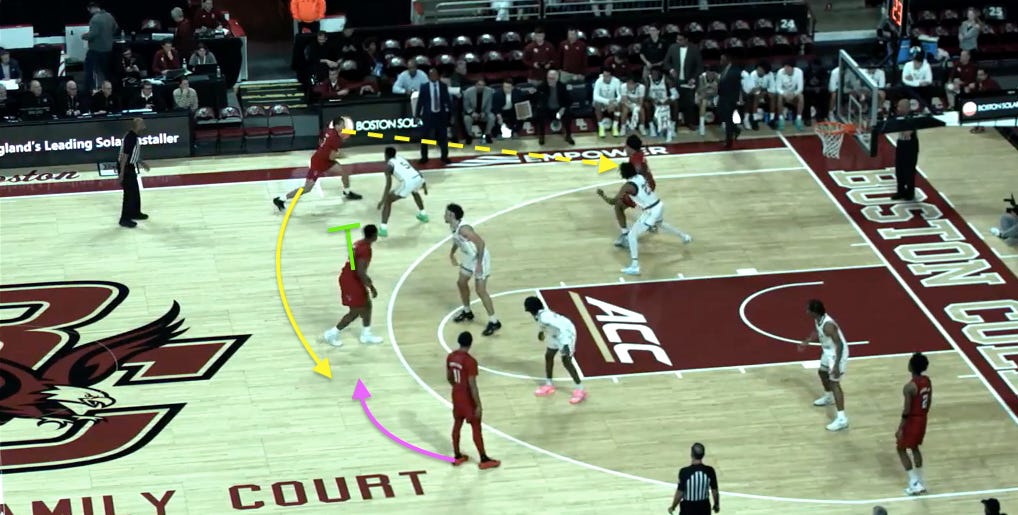
It initially appears that Able and Lubin are set to form staggered screens for Copeland to curl toward Williams on the left side of the floor. Instead, Copeland and Able execute a split cut: Copeland darting to the rim as a potential cutter for Williams, while Able cuts back to the left wing off a “Wiper” re-screen from Lubin. After setting the re-screen, Lubin rolls to the rim.
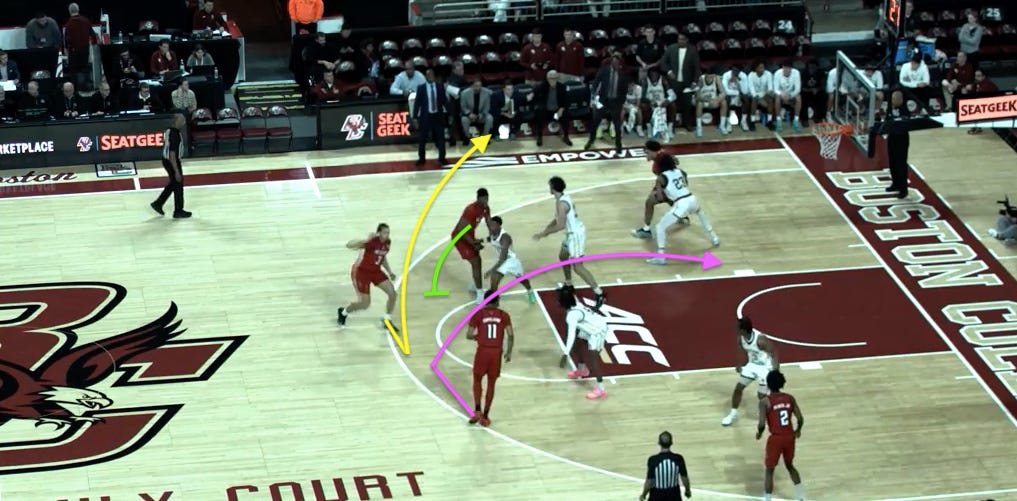
Williams has multiple passing options available on this after-timeout set, but the double team never comes. Boston College elects to guard him 1-on-1, and Williams opts to keep the ball and power his way to the front of the rim for a layup.
Next trip down the floor, NC State runs the same action, but this time Copeland uses the staggered screens from Able and Lubin. The Eagles defend it well and stick with single coverage on Williams. Boston College forces a miss, but it’s still a solid attempt for Williams.
Here’s a similar look against Florida State. Terrance Arceneaux throws the entry pass and cuts off a screen from Lubin. Williams attacks quickly, and FSU sends a double team. He drives deeper into the paint, collapses the weak-side defense, and delivers a ridiculous skip pass while falling out of bounds to a wide-open Able for 3.
An important component of NC State’s half-court pick-and-roll offense is the use of screen-the-screener action. This occurs when an off-ball guard sets a down screen for the 5, who sprints up to set a run-out ball screen for the 1. There are many names for this type of pick-and-roll concept, including “Wedge” and “Bump”, but I use the lingo “Ram” to describe it.
Ram Leak
While much of NC State’s offense appears to be built on Howard’s designs, some of Wade’s signature sets and concepts have made the trip from McNeese State to Raleigh. One of the team’s most popular pick-and-roll sets is what I call “Ram Leak,” which arrived in North Carolina this summer via Louisiana.
Copeland had significant success running this set last season at McNeese State, and that success has carried over to his time with the Wolfpack.
Matched up with Texas in Maui, McNeil sets a down screen for Lubin, who sprints up to set a ball screen for Copeland.
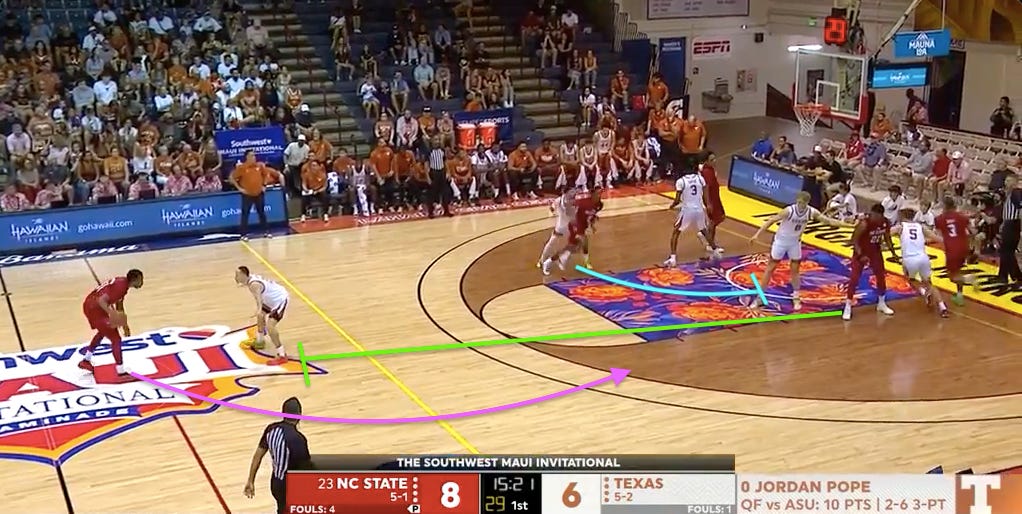
As Copeland drives into a double gap against Texas in drop coverage — with McNeil intentionally spaced in the strong-side corner — Williams leaks back up the floor while Lubin rolls, creating roll-replace action and drawing a potential help defender away from the lane.
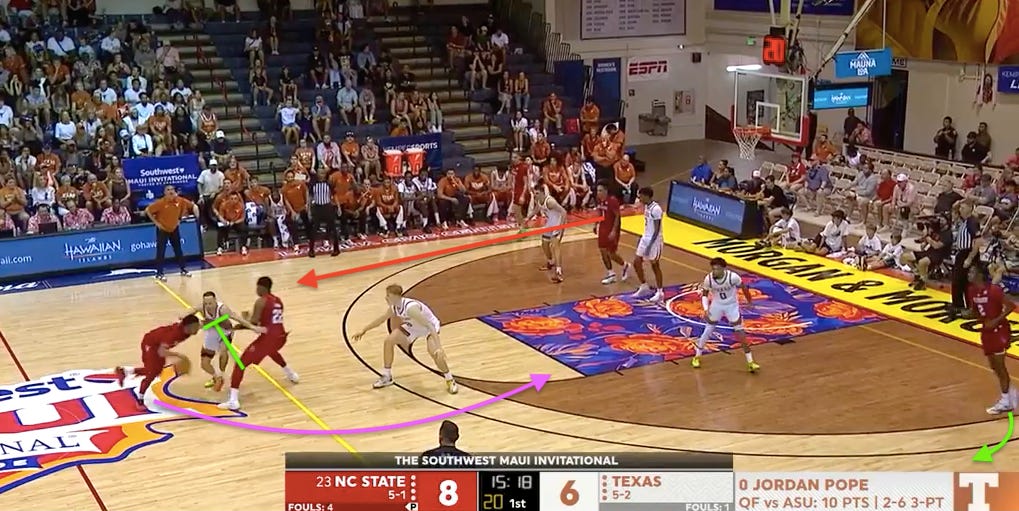
Copeland excels at timing his strides while absorbing contact. As he comes blazing off the ball screen into space, with Jordan Pope (0) in the gap but reluctant to help off McNeil in the corner, Copeland drives straight at Texas center Matas Vokietaitis (8) and finishes over him.
In the second half against Ole Miss, it’s the same combination for “Ram Leak.” McNeil sets a screen for Lubin and spaces out to the strong-side corner. Lubin then sets a ball screen for Copeland and rolls to the rim. As Lubin dives, Williams leaks up to the left slot. Mississippi tries to switch every part of the action, but Lubin rolls hard, establishes good position and Copeland delivers a precise pass for a layup.
And finally, here’s the same action against Wake Forest, this time with Holloman and Sagnia replacing McNeil and Lubin. As usual, Wake Forest puts two on the ball, with Tre’Von Spillers (25) hedging out on Copeland. That forces wing Jaylen Cross (23) to sag into the paint briefly to tag Sagnia as Williams leaks up the floor. The rotation leaves Williams momentarily open on the wing and Copeland delivers a pass that Williams converts for a catch-and-shoot three.
Ram Exit
This isn’t the only type of Ram action NC State runs. The team also runs “Ram Exit,” a screen-the-screener pick-and-roll set that shifts the pieces around the floor while leveraging the off-ball gravity of McNeil and Holloman.
In this play, the 4 (Williams) sets a ball screen for the 1 (Copeland), while the 5 (Lubin) spaces out to the right corner. The 2 (Holloman) sets a down screen for Williams, who then runs out for the ball screen with Copeland, creating the Ram action.
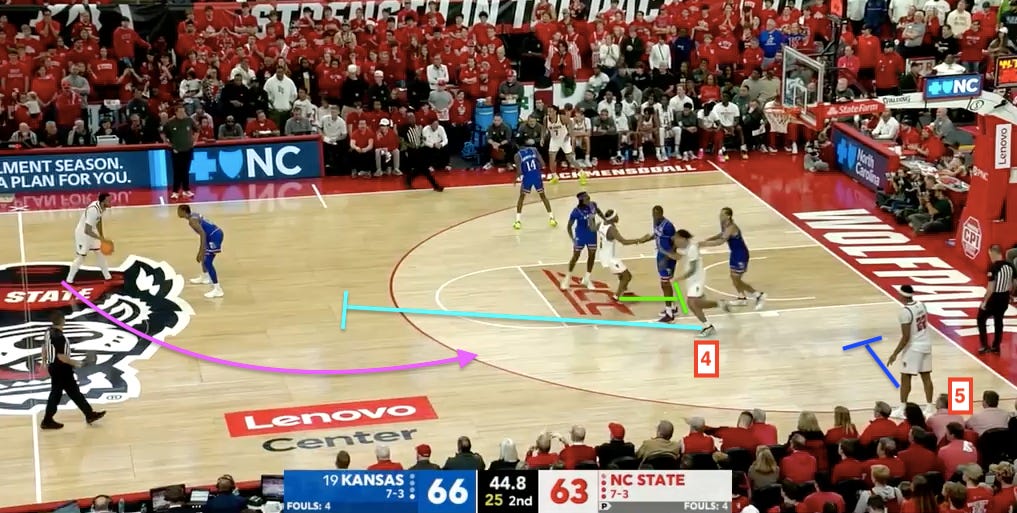
Instead of rolling, Williams pops out to the left wing. After screening for Williams, Holloman cuts to the right corner off an “Exit” (or “Smack”) screen from Lubin. This baseline Exit screen is a key way to use a non-shooter — like Lubin — to create spacing. Copeland can look to kick out to Holloman coming off the screen for a corner 3, or the action can serve as a dummy concept to occupy the defense and tie up back-line help, pulling the 5 away from the rim and opening a driving lane.
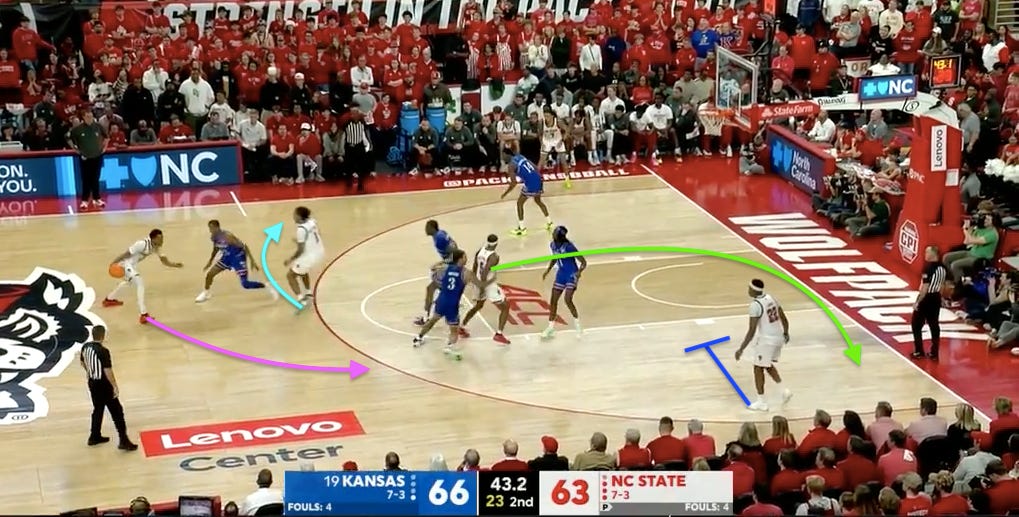
After a timeout, NC State runs Ram Exit down three with less than a minute remaining against Kansas. The Jayhawks are scrambled defensively trying to navigate the action. Copeland drives into the lane, leaving Williams open on the wing for a kick-out 3 that ties the game.
In overtime, NC State returns to the same set with the same players. Kansas defends it more effectively this time, but Bidunga ends up on Holloman, who pulls Self’s top shot-blocker away from the hoop. That creates just enough space for Copeland to finish inside.
NC State runs the same set against Ole Miss. Holloman’s cut to the corner off the Exit screen pulls the defensive 5 away from the hoop, and Copeland once again takes full advantage.
Similar to Duke and Jon Scheyer, NC State’s play-callers do a good job sequencing actions. This means NC State will run the same set—or actions that look similar—multiple times, taking advantage of defenders who begin to anticipate rotations or overcorrect based on the initial action. It’s a good way to build a rhythm and get to certain counters.
Later in the first half, with McNeil as the screener, NC State returned to the same look. This time, Copeland rejects the screen, and after the defense had stuck with Holloman on the earlier Ram Exit set, they collapse on him. With the defense in rotation, Copeland then skips the ball to McNeil in the corner for a 3, running off Sagnia’s screen.
This same Ram Exit set is identical to one of the plays Kevin Keatts ran at times for McNeil last season and DJ Horne the year prior.
In my view, NC State most closely resembles Nebraska’s offense when it comes to 5-out initiation — with the center positioned in the middle of the floor, flanked by shooters, cutters and potential handoff partners. Lubin has thrived as the middle hub in these sets. He’s not the type to dissect a defense with passes from the elbow or high post, but he’s comfortable handling the ball, extremely mobile for a 5 and a tireless worker when rolling to the rim or crashing the glass. He can be a playmaker for NC State’s offense.
In terms of more traditional center metrics, Lubin still checks plenty of important boxes. He’s shooting 80 percent on cut attempts this season and 73.3 percent on 2-point attempts in the half-court. He also leads NC State with 25 dunks. That’s 15 more than the next closest player, Copeland, who has 10.
When NC State enters the ball to Lubin or Sagnia atop the key in 5-out “Delay” action, the first thing to watch is what the wing players do. They can either set a down screen for the corner player, who then cuts into a DHO with the 5 to create Zoom action, or they’ll cut through the lane at a 45-degree angle, opening up a gap on that side and clearing space for a two-man action.
Here, against Texas Southern, NC State runs Zoom action: Copeland sets a screen for McNeil, who receives the DHO.
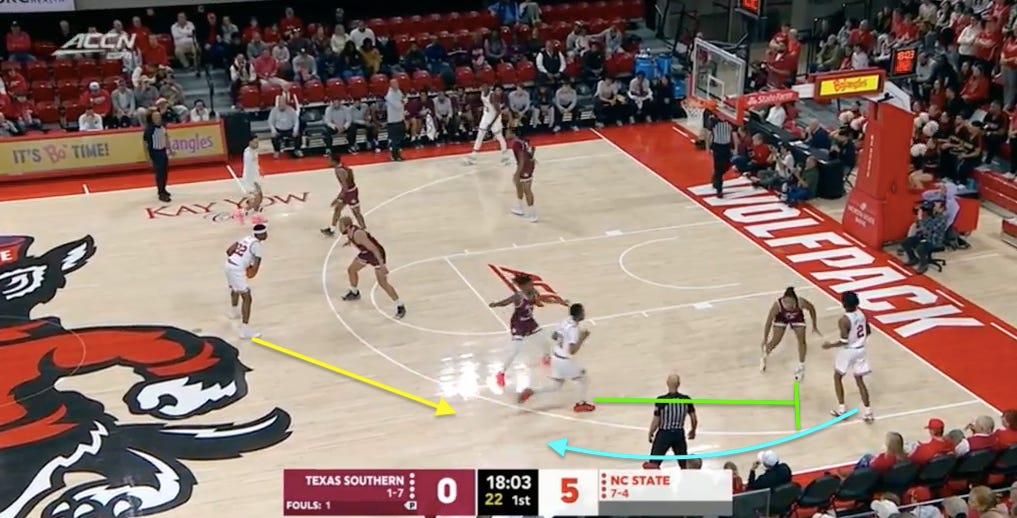
As Lubin rolls toward the restricted area, Copeland drifts back up the floor. McNeil draws two defenders to the ball, and Lubin attracts weak-side help, leaving Copeland open. McNeil and Copeland then snap into an impromptu give-and-go, with McNeil kicking out and relocating for a spot-up 3 in the left slot.
This is pretty standard 5-out basketball, but it’s a great way to open the floor up for drives, basket cuts and rim runs. NC State can do a lot of different creative stuff out of 5-out, but this is the foundation: space the floor and let the players make reads and get into flow.
Down in Tallahassee, NC State flows into more 5-out Zoom action with Lubin and McNeil. Once again, McNeil draws two defenders to the ball and finds Lubin on the roll for an easy finish.
Here’s 5-out Zoom action from last season’s Cornhuskers, with Connor Essegian (0) — Nebraska’s closest facsimile to McNeil last season — coming off the DHO and finding Morgan on the roll for a layup.
NC State can flow into 5-out Zoom from a variety of looks, too, including a rejected Wide down screen. Holloman rejects Lubin’s down screen, Copeland passes to Lubin atop the key and then screens down for Williams — creating the Zoom action and forcing a switch for Williams to attack.
On this possession against Kansas, it’s more of the 5-out setup around Lubin. However, Breed doesn’t set the down screen for the Zoom action; instead, he slices through the lane on a 45 Cut, which clears the area for a two-man game between Williams and Lubin.
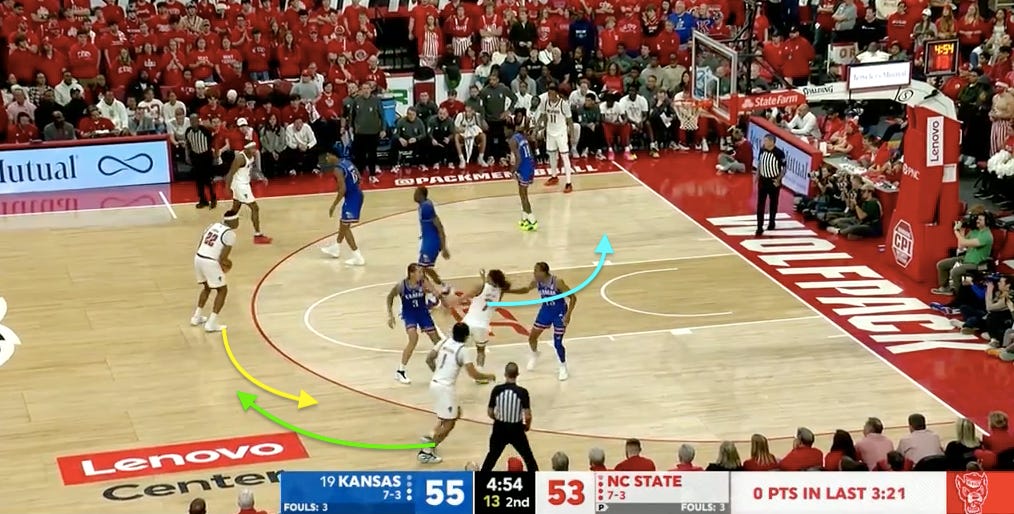
The Jayhawks have already gone through multiple switches, so when Lubin sets a screen for Williams, he ends up matched with shooting guard Elmarko Jackson (13) in the post. Williams feeds Lubin, and Kansas sends an extra defender, allowing Lubin to find Breed for a cutting finish in the lane.
Angle
One of NC State’s primary pick-and-roll actions in the half-court offense is a spread pick-and-roll concept often called “Angle.” This play features a step-up ball screen in one slot, with shooters spaced in both corners (Williams and Breed) and an off-ball player (McNeil) positioned in the opposite slot or wing.
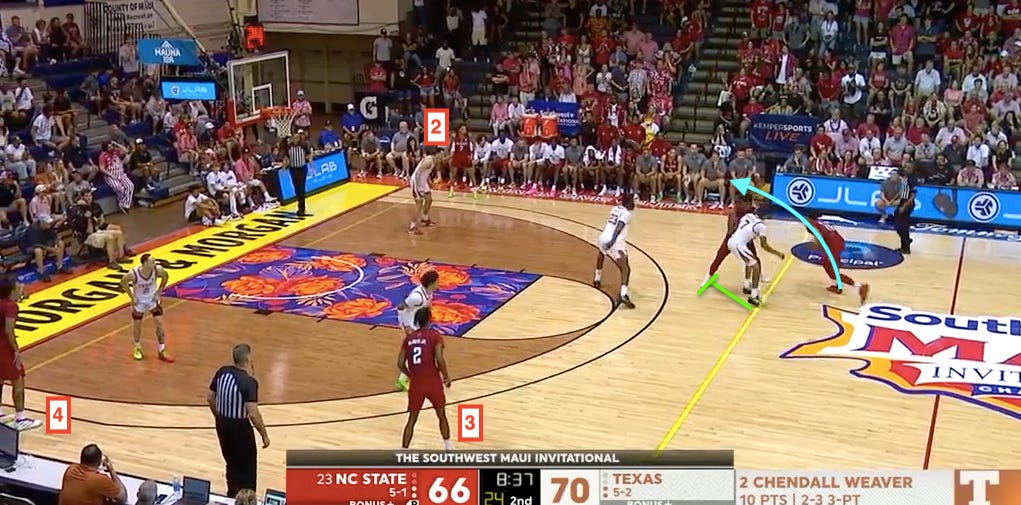
Texas defends Copeland’s ball screen with drop coverage, having the on-ball defender go under the screen — a strategy increasingly seen in recent weeks from ACC opponents like Virginia. One effective counter is to beat the on-ball defender to the spot and then have the 5-man re-screen further down the floor, allowing the ball handler to get closer to the rim. Copeland changes direction, drives left into the paint and uses Lubin to shield his defender. McNeil adds the finishing touch to the half-court pick-and-roll action with an excellent relocation, cutting from the left slot to the left wing.
This heady bit of movement creates an easy kick-out pass for Copeland as Pope scrambles to recover to McNeil.
Angle Pop Zoom
The Angle pick-and-roll is a key component of State’s half-court offense, in part because of what it can create: more 5-out Zoom action. This variation is what I refer to as NC State’s “Angle Pop Zoom” set.
The 1-5 screening action occurs in the same spot — the right slot — with two players spaced on the weak side, Able and Williams. Instead of rolling to the rim, though, Lubin pops out toward the middle of the floor.
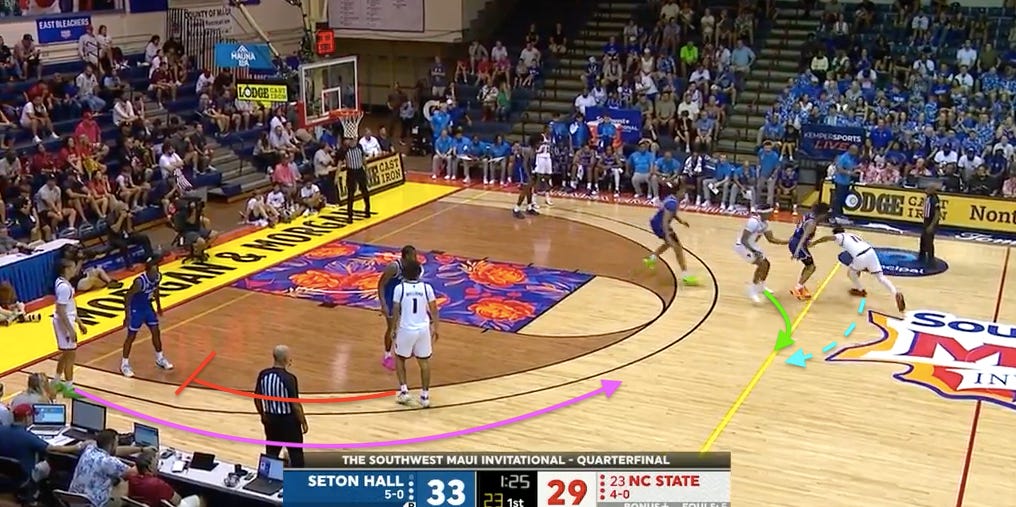
If you freeze the film after the 1 passes the ball back to the 5 on the pop, NC State is in a familiar formation: 5-out spacing with the center positioned in the middle of the floor, ready to initiate back-side Zoom action for the player coming out of the left corner.
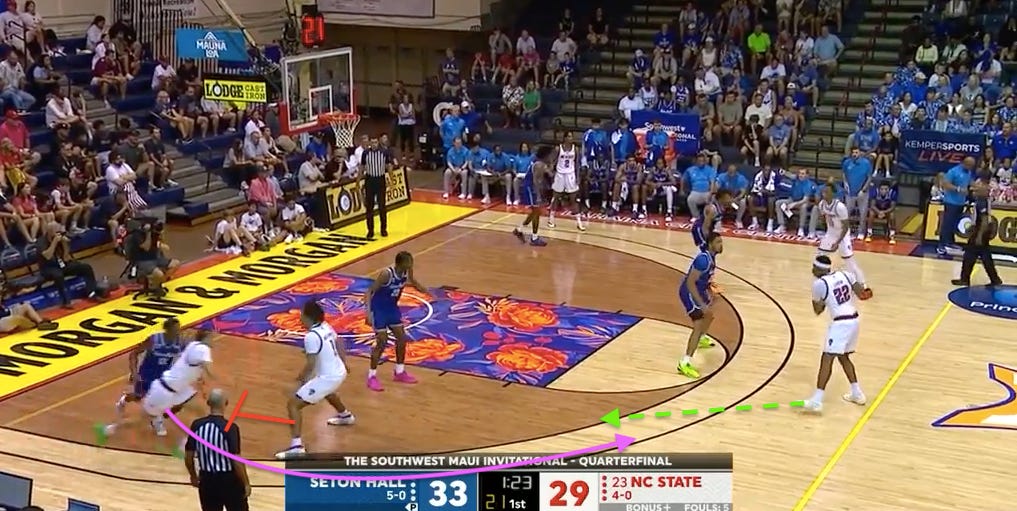
Able darts out of the corner, receives the pindown from Williams and executes a DHO with Lubin, doing an excellent job attacking downhill against Najai Hines (25), a talented defensive freshman center for Seton Hall.
When Able runs this action, NC State’s offense has scored 1.25 points per possession, according to my charting data. That number rises when applied to the entire team, with the Wolfpack averaging 1.57 points per possession on this set this season. That’s a big number.
Up in Chestnut Hill, it’s McNeil’s turn to run the back-side Zoom action off the Angle Pop. Scottie Ebube pops and flows into the action with McNeil. Boston College sends two defenders at the ball, but McNeil showcases his skill, delivering a crafty pass for a layup on the rim run.
McNeil is being highlighted in this movement shooter role, but he’s skilled and he can do some playmaking stuff with the ball, too.
While there are several players on NC State’s roster in the midst of career years, the emergence of McNeil stands out. There’s a beautiful irony here as McNeil, the lone scholarship holdover from last season’s roster, has fit perfectly into Wade and Howard’s offense. Kevin Keatts helped bring McNeil to Raleigh, but the sophomore shooting guard was meant to play in this type of offense — reinforced by the system of Joseph Anderson, the team’s Director of Player Development.
During his freshman season, McNeil showed flashes of his potential, especially late in the year; however, he struggled to nail down a full-time rotation spot for a team in desperate need of shooting. It was perplexing, but that’s water under the bridge now. In fact, McNeil has been unleashed this season with Wade’s full backing: he’s averaging just under 27 minutes per game and 77 percent of his field goal attempts have come from beyond the arc — up from 60 percent last season. He’s evolved into one of the most prolific movement shooters in the country, attempting 15.4 3-pointers per 100 possessions and shooting 41.9 percent from beyond the arc, including a sizzling 46 percent coming off screens.
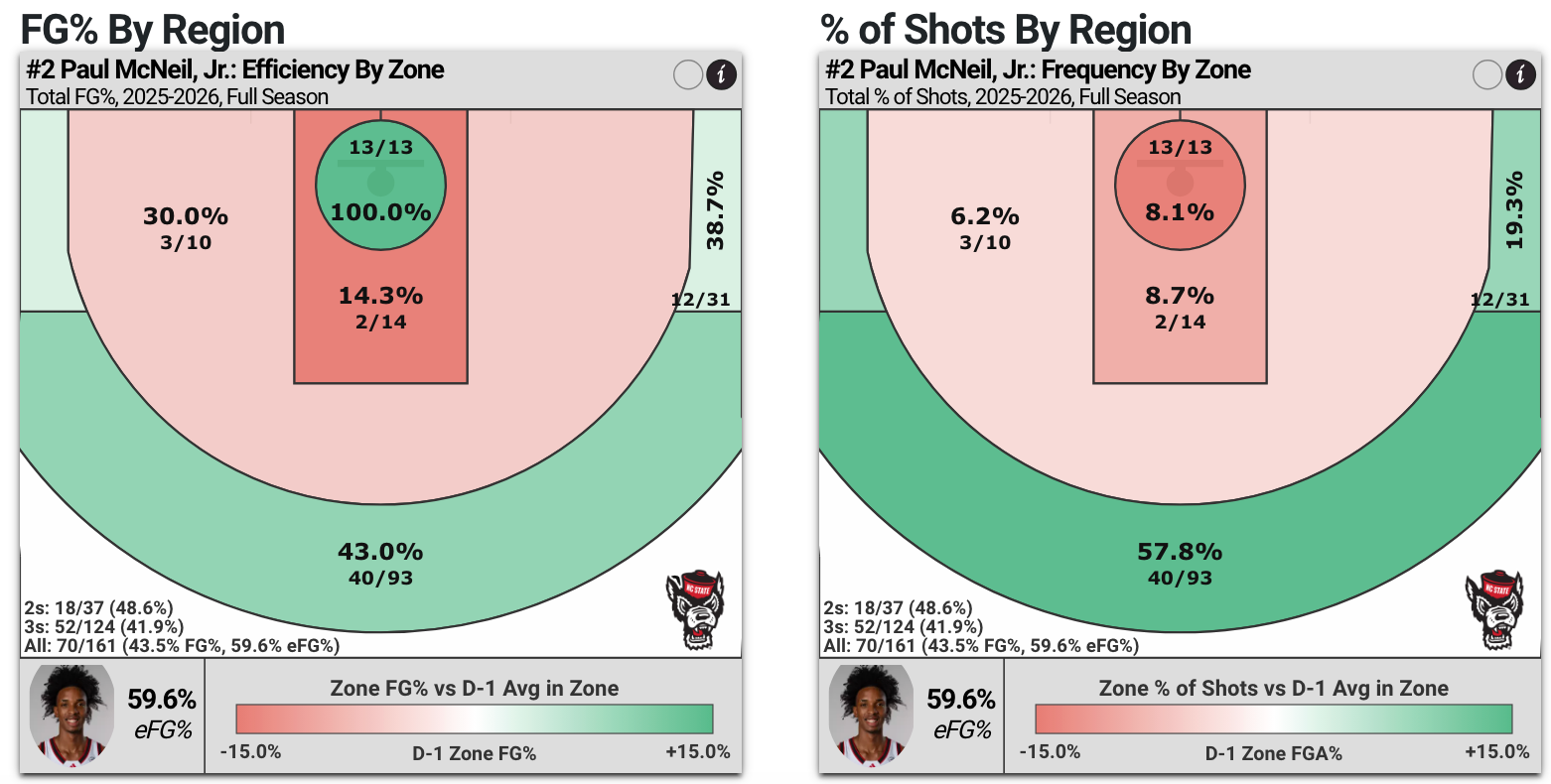
[Shot chart via CBB Analytics]
He’s fully bought into a shot diet of 3s and rim finishes — with 85 percent of his shots coming from beyond the arc or at the basket. McNeil’s shooting has a profound impact on NC State’s offense, too. According to CBB Analytics, NC State has scored 131.5 points per possession this season in 454 minutes with McNeil on the floor. The offensive efficiency drops to 109.9 points per 100 possessions when McNeil is on the bench.
NC State offense with McNeil on: 131.5 points per 100 possessions, 59.9 eFG%, 58.1 2P%, 41.4 3P% (28.5 3P% per 40 minutes), 57.4% assist rate
NC State offense with McNeil off: 109.9 points per 100 possessions, 52.3 eFG%, 49.5 2P%, 37.2 3P% (25.1 3PA per 40 minutes), 52.3% assist rate
This is a trend that’s followed McNeil from his freshman season as he’s morphed into this team’s offensive ceiling-raiser. When he’s on the floor, his shooting, off-ball movement and turnover avoidance have a clear impact on winning. He knocks down shots and navigates a maze of off-ball actions in this system, creating space for driving lanes and open pockets for slips and cuts to the basket. McNeil has also been used as a screener in inverted pick-and-rolls and guard-to-guard actions, which has helped loosen opposing half-court defenses.
From the outside looking in, one of the biggest leaps in McNeil’s development is his commitment to moving without the ball. He’s not just a good shooter; he plays with a high motor and a sharp sense for when to dart into pockets of space. NC State runs all kinds of actions to get him looks curling off screens, but he doesn’t need designed plays to hunt for his shot. McNeil is constantly in motion along the arc, sprinting in either direction to get into the vision of a teammate driving to the basket, ready for a kick-out.
Check out how much ground he covers against FSU. McNeil cuts from the left slot all the way to the deep corner in just two seconds, sprinting into a kick-out as Arceneaux drives and drawing three free throws.
Copeland and McNeil have developed real chemistry playing off each other this season. It’s a natural pairing, reminiscent of Dereon Seabron and Terquavion Smith in the 2021-22 campaign: the downhill driver paired with the off-ball spacing agent. Copeland has 27 assists to McNeil this season, which is the most of any pairing on the roster. According to my charting, 13 of Copeland’s assists have resulted in spot-up 3s for McNeil.
In the Kansas game, NC State ran clever actions to use McNeil as both a screener and a pick-and-pop target for Copeland.
Anticipating that KU will switch 1-5 actions, Lubin sets an early ball screen for Copeland, forcing freshman big man Bryson Tiller onto State’s point guard. Copeland runs a quick give-and-go with Williams to get to the middle of the floor and establish rhythm. This is largely window dressing, however, as McNeil sprints out of the right corner to set a guard-to-guard ball screen for Copeland, with Tiller defending. McNeil then ghosts the screen and slips to the left wing, putting the 6-foot-10, 240-pound Tiller in a precarious position, switching onto one of the best shooters in the country. Tiller is unable to stick closely with McNeil, who flies out to the wing for an open look from deep.
Howard’s schemed up a lot of great looks for McNeil this season using screen-the-screener and “Veer” actions, which I wrote about back in November. Veer is an action in which a screener slips (or briefly sets, then slips out of) a ball screen and then “veers” out to set an off-ball down screen for a teammate. The Pack will get to a lot of these looks out of their most powerful offensive series, like Wide and Angle.
Wide Veer
This is NC State’s Wide Veer action, run for McNeil. It starts with McNeil cutting toward the ball off the Wide screen from the 5, receiving a pass from the 1 and immediately flipping the ball back to the 1.
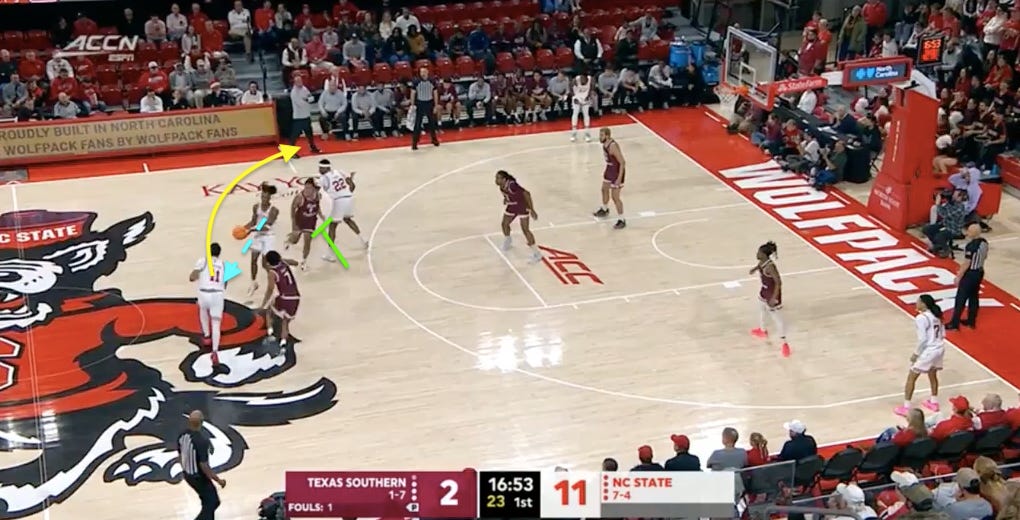
The 1 — Copeland in this case — will take the handoff and drive straight into a step-up ball screen from Lubin, the 5. McNeil fills to the opposite wing.
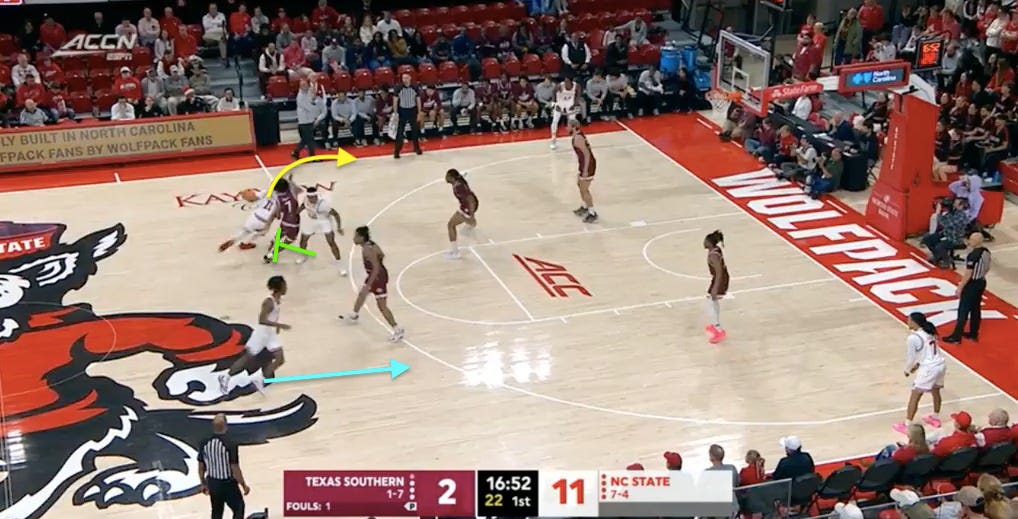
As soon as Lubin finishes his screen for Copeland, he’ll pivot toward the middle of the floor and re-screen for McNeil — veering out to create the down screen action.
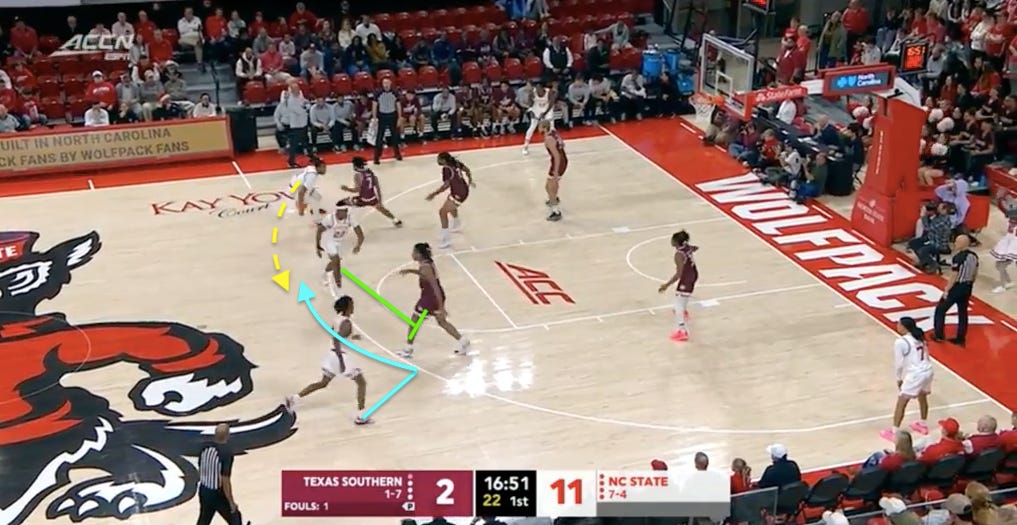
Veer is a tricky action to guard because it forces the defensive 5 to shift quickly from covering the ball screen to helping on the down screen.
Plus, if the defense is in drop coverage, the shooter should come off the down screen into space — with the screen defender below the level. Ebube sets a good screen here for McNeil on the curl, creating separation from Nate Calmese (1), with Omaha Biliew (0) in drop.
NC State runs another very similar variation of Veer off this initial Wide screening action. Instead of having McNeil hand the ball back to the 1 (Breed), he’ll receive the pass, dribble to the wing and flip it to a teammate (Williams) lifting from the corner. The 5 (Sagnia) trails from behind and sets a ball screen for Williams, before veering out to set the down screen for McNeil.
McNeil does a beautiful job attack the drop coverage here, too. He forces the defensive 5 to commit to his drive and hits an open Sagnia on the dive.
In the role of McNeil, here’s Essegian running the same Wide Keep Veer action last season for Nebraska.
Angle Veer
NC State will also use its Angle series to tap into Veer action with McNeil or Able. On this action, the 5 will set the angled ball screen for the 1 and veer to the weak side of the floor. McNeil will lift from the corner and look prepared to set a flare screen for the player on the wing — Williams here against UNC Greensboro.
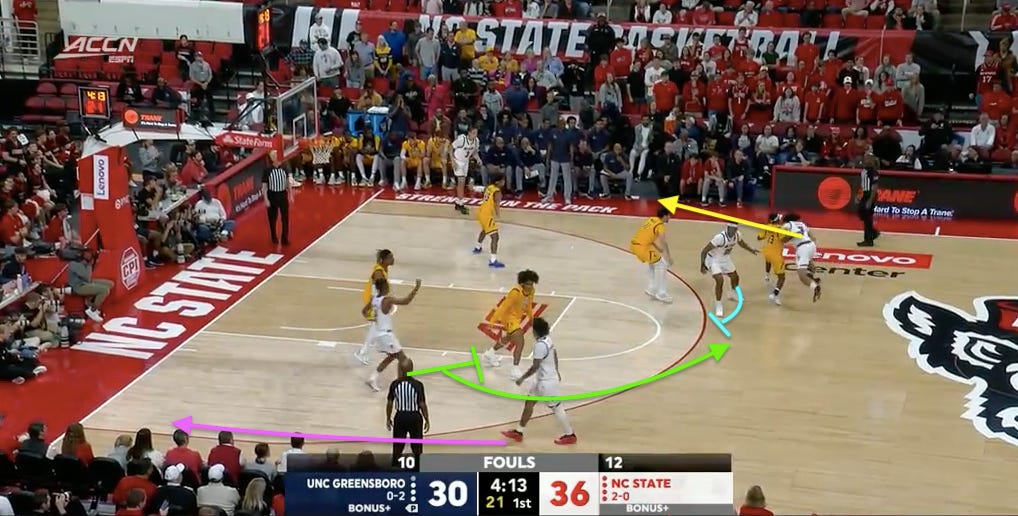
That’s really just dummy action. McNeil will slip the screen for Williams and sprint directly into the Veer down screen from Lubin.
Here’s the same set for an end-of-half play call against UNC Asheville. McNeil slips the flare for Williams and curls into space off the down screen for Lubin for an open catch-and-shoot 3.
According to my charting data, McNeil has made 14 3-pointers coming off down screens this season, along with six 3-pointers off flare screens.
NC State has some really creative sets for McNeil in its arsenal; the Pack keep adding new wrinkles.
5-out Floppy
To open the game at FSU, NC State starts 5-out with Lubin in the middle. Copeland and McNeil are spaced to the right side of the floor. Lubin passes to Williams, who lifts to the left wing. This create a staggered down screen setup to the right. Copeland sets a down screen for McNeil, who curls tightly down into the paint. Lubin slides over and sets a pindown for Copeland — creating “Gaggle” action.
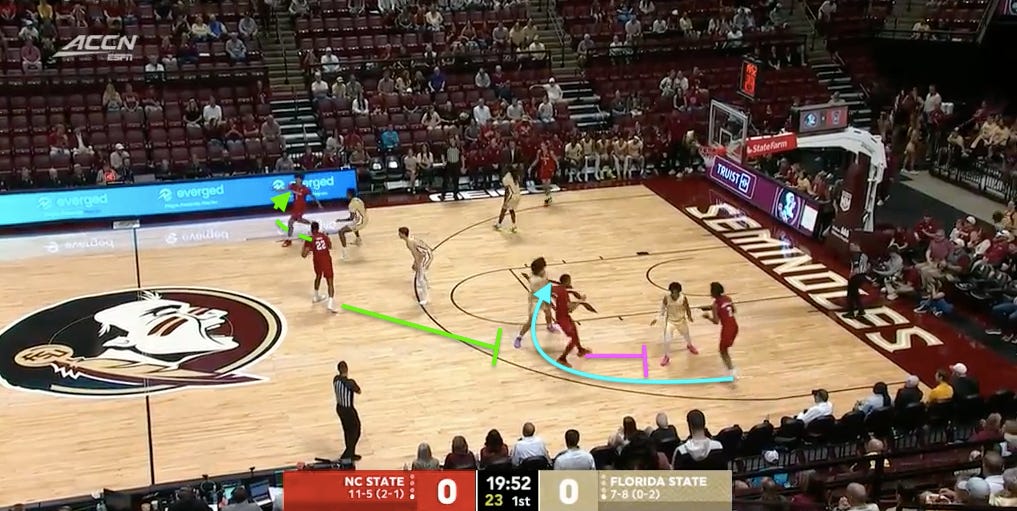
The start of the play is mostly window dressing, though. NC State just wants to move the defense around and get everyone in the proper spots to flow into the preferred look.
With McNeil stationed under the basket in the restricted area and Copeland facilitating up top, the Wolfpack are set to run “Floppy” action for McNeil, who is top-locked by FSU guard Martin Somerville (1). This single-double concept gives McNeil two options: cut to the right side of the floor off a single down screen from Lubin or cut to the left side off double down screens from Breed and Williams.
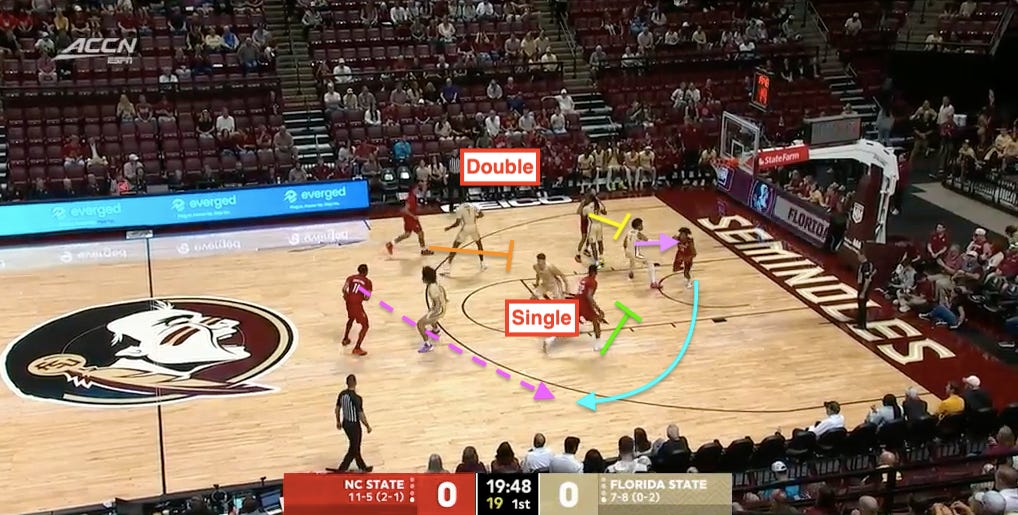
McNeil uses a little off-ball wiggle to sell like he wants to cut to the left, using the staggered down screens. Somerville takes the bait and McNeil sprints to the right, curling Lubin’s screen for a catch-and-shoot 3.
5-out Screen-the-Screener
During the second half at Florida State, the Wolfpack go back to another 5-out stagger look: Williams initiates from the left wing as Lubin and Copeland look poised to set down screens for McNeil in the right corner.
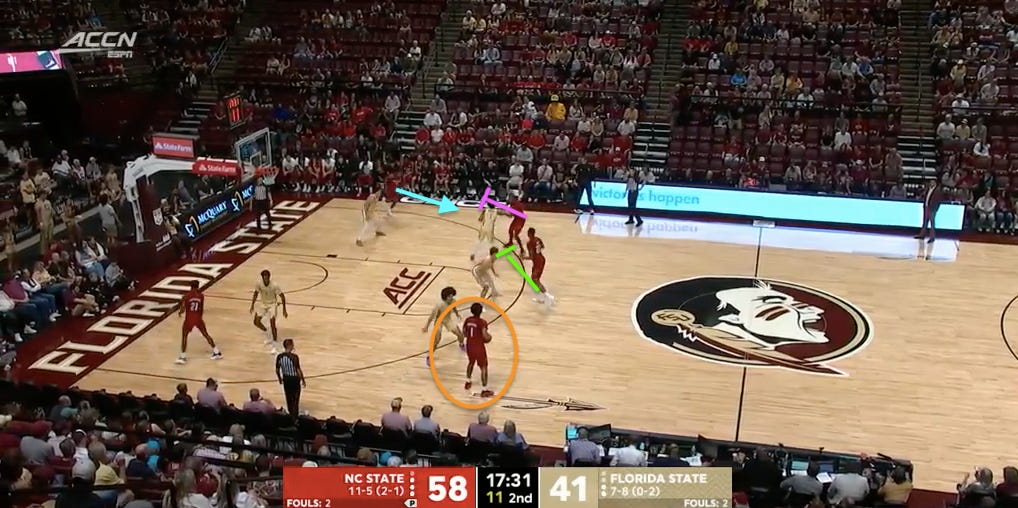
McNeil doesn’t use the staggers, though. Instead, McNeil and Copeland split, with P2 curling to the lane away from the screens and Copeland lifting back up the floor off a down screen from Lubin. Williams will pass to Copeland and cut toward the paint — in the direction of McNeil.
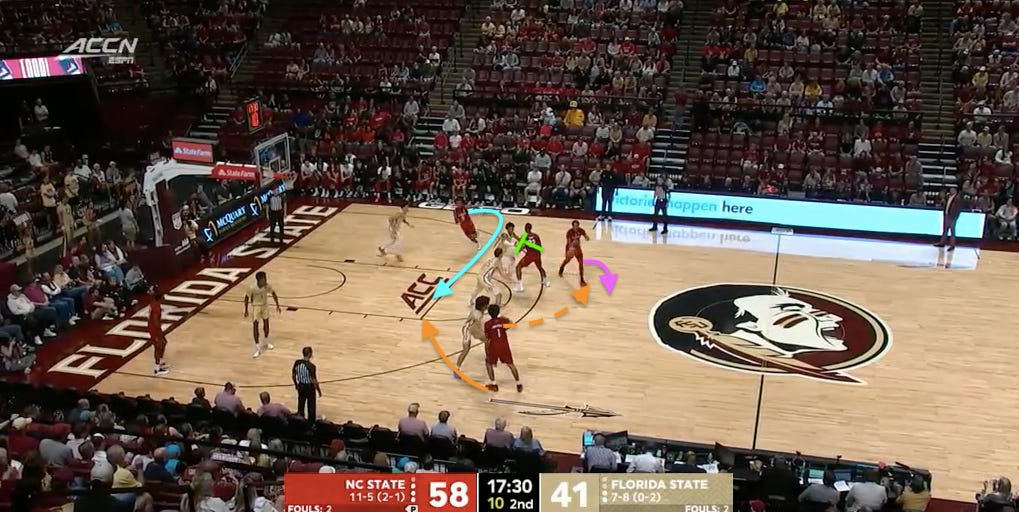
NC State is now perfectly set up to run Veer screen-the-screener action for McNeil, who sets a back screen to slice Williams to the opposite low block. While that happens, Lubin sets a step-up ball screen for Copeland, and the Wolfpack have this symmetrical double screening action.
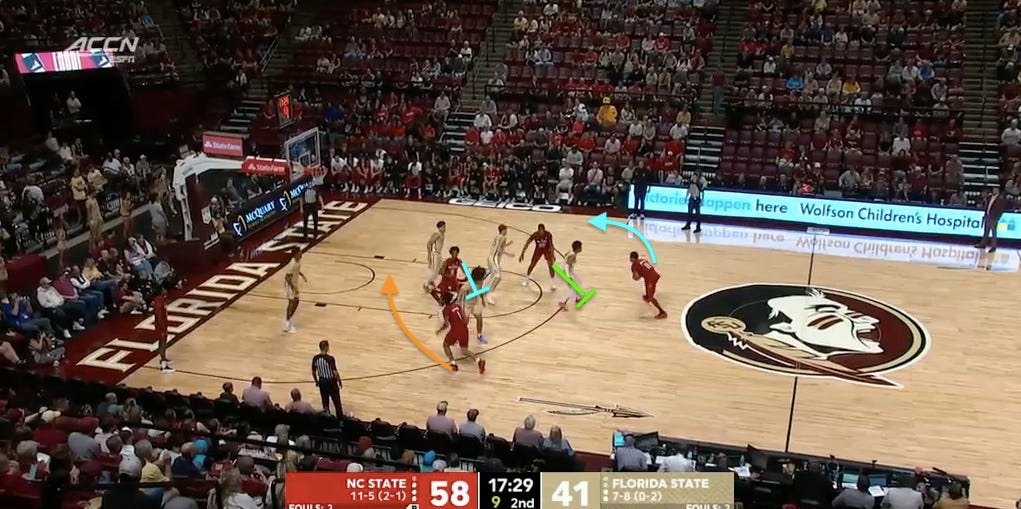
This is a great way to synchronize several of the best features of the offense: Copeland as a pick-and-roll operator, Lubin as a screener, Williams as a post-up threat and McNeil as an off-ball mover. That’s a lot for the defense to deal with at the same time.
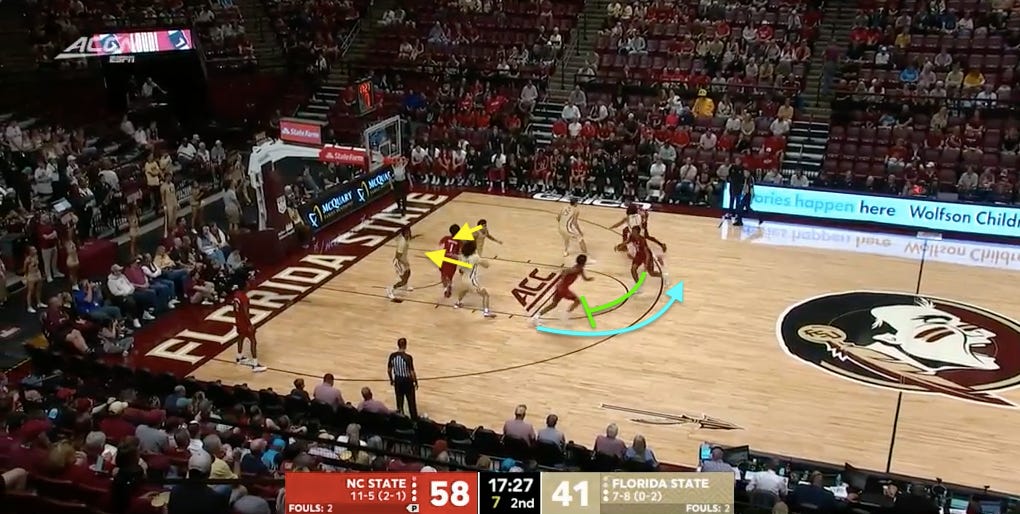
The play highlights the importance of establishing Williams as a post-up target and the power of using McNeil as a screener. As Williams cuts to the post, both FSU defenders involved in the action — Somerville and Lajae Jones (10) — stick with him, worried about a deep post touch. As a result, McNeil runs free and curls into space for an open 3-pointer off Lubin’s screen.
NC State’s offense is built on pace, spacing and constant pressure on the paint. It works because multiple pieces pull the defense in different directions: Copeland’s downhill creation, Williams’ ability to attack mismatches and punish switches, McNeil’s off-ball shooting gravity, Holloman’s movement and connective playmaking and Lubin’s comfort initiating in 5-out looks. Recently, Arceneaux has also carved out a role as a second-side scorer and timely offensive rebounder, helping extend possessions with corner crashes. When all of those parts are aligned, the Pack operate with flow, balance and built-in counters.
The margin will narrow as the schedule stiffens, starting with Clemson’s Top 20 defense next week. Opponents will load up on McNeil, chase him off the line and live with stretches of lower shooting variance, while continuing to go under screens against Copeland and shade help toward Williams. Virginia did an excellent job using Sam Lewis to chase McNeil while also showing him different coverages off screens. In those moments, NC State can’t afford to stagnate or lean too heavily on one creator. The return of Holloman and the continued development of Able as a reliable secondary attacker would go a long way toward preserving that balance.
If those pieces fall into place, NC State’s offense has the depth and adaptability to hold up as the level of competition rises.
No posts
Comments
Nothing yet. Say the first thing.
Sign in to join the conversation.