
There’s been a bit of give-and-take with NC State’s offense this season, but the underlying numbers are clear. The Wolfpack boast a Top 25 offense that plays fast, values possessions and leverages both scheme and rim pressure to generate kick-out 3-point looks. NC State ranks inside the Top 60 nationally in average offensive possession length (16.2 seconds) and scores an elite 1.44 points per possession on trips finished in under 10 seconds (99th percentile). The Pack are also converting at an eye-popping clip on these sub-10 second opportunities, per CBB Analytics: 74 percent on 2-point attempts and 53.4 percent from beyond the arc.
With February right around the corner, NC State also ranks Top 30 nationally across several big-picture metrics:
Turnover Rate: 13.8 percent (No. 14)
Effective Shooting: 56.4 eFG% (No. 28)
3-point percentage: 39 3P% (No. 13)
Moreover, several players are in the midst of career years from an efficiency standpoint. That group includes veterans Tre Holloman — whose true shooting percentage has climbed to 59.2 percent after three seasons at Michigan State (52.4 TS%) — and Ven-Allen Lubin, who is converting 70.5 percent of his 2-point attempts after shooting 61.5 percent across his first three seasons at Notre Dame, Vanderbilt and UNC.
Thanks for reading Split The Action! Subscribe for free to receive new posts and support my work.
Despite that undeniable success, the Pack still have another gear to reach on the offensive end, and this week’s win over Syracuse may have offered a roadmap of sorts. NC State scored more than 1.25 points per possession against an ACC opponent for the third time this season, rolling to an 88-68 victory as Darrion Williams and Quadir Copeland delivered one of their most impressive collective performances. The duo combined for 42 points on 14-of-25 shooting from the floor and added 14 assists.
As NC State’s two primary playmakers, the offense runs through Williams and Copeland. Currently, only 17 High Major players meet the benchmarks of a 20 percent usage rate, a 20 percent assist rate and 40 percent shooting from beyond the arc (minimum of four 3PA per 100 possessions) — a group that includes both Williams and Copeland. While the list features other standout names — such as Christian Anderson (Texas Tech), Darius Acuff (Arkansas) and Josh Jefferson (Iowa State) — NC State is the only program with two players reaching those marks.
NC State is +154 in 432 minutes with Copeland and Williams on the floor together, scoring 1.24 points per possession (92nd percentile), per CBB Analytics. Against Quad 1 opponents, the Wolfpack are +3 in 147 minutes with the duo sharing the floor, while still producing a strong 1.19 points per possession on offense. Copeland has also recorded 30 or more assists to three different teammates this season, including Williams.
Copeland-McNeil: 35
Copeland-Lubin: 31
Copeland-Williams: 30
The production between the two has been significant. With added help from the off-ball gravity of Paul McNeil, NC State has built a Top 25 offense around their complementary skill sets — two roving mismatch pieces with the size to punish smaller defenders and the passing skills to find open teammates when defenses collapse. Simply put, it’s working.
Copeland is generating 44.3 points per 40 minutes — combining his own scoring with points created via assists — which ranks in the 100th percentile. Meanwhile, Williams is creating an impressive 30.3 points per 40 minutes.
That said, it feels like there’s another level for this pairing to reach. It’s not that the offense leans too heavily into a “your turn, my turn” approach; NC State has built an ecosystem where both players can thrive. However, the Syracuse game highlighted additional opportunities to integrate the two more directly within offensive actions. That connection could unlock greater synergy and serve as a pathway to yet another tier of overall efficiency.
Playing Through The Post
Williams has seen his role expand over the last six games. He’s posted a team-leading 27.8 percent usage rate since the win over Boston College, with Copeland just behind him at 25.8 percent. NC State has gone 5–1 over that span, highlighted by an overtime win at Clemson — its best victory and most complete two-way performance of the season.
As the Pack have moved into the heart of conference play, they’ve increasingly leaned on Williams as a post-up threat, a trend I detailed last week at Pack Power.
According to Instat, 21.1 percent of his possessions over the last five games have been used via post-ups — compared to 15.1 percent over his first 14 games of the season. That averages out to 2.8 possessions per game in that stretch.
According to InStat, 21.1 percent of his possessions over the past five games have come via post-ups, up from 15.1 percent over his first 14 games of the season — an increase that averages out to 2.8 post-up possessions per game during that stretch.
The post-up is an effective avenue for Williams, as it allows him to initiate offense from a different vantage point. In the pick-and-roll, opposing defenses can load up, sit in gaps, position help at the elbows and on the blocks — and shrink potential driving lanes.
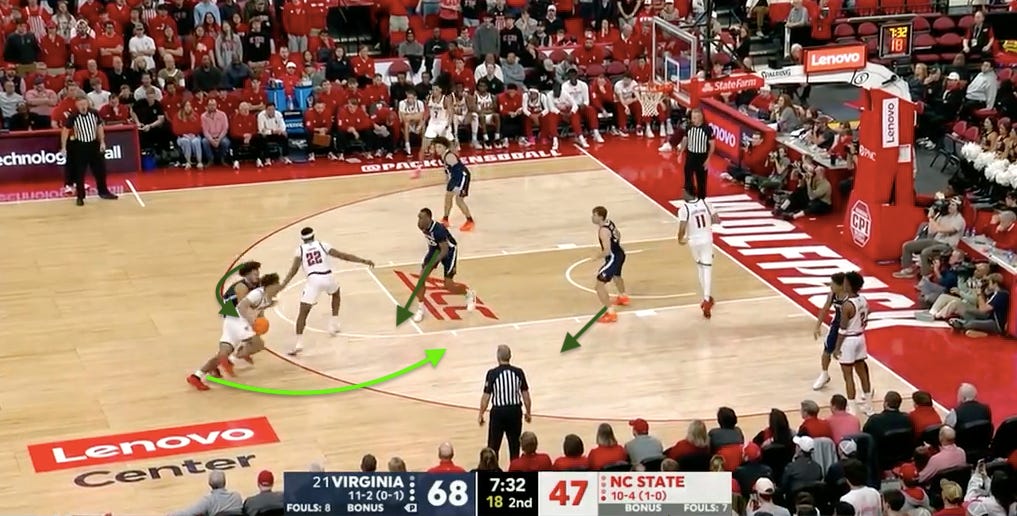
From the post, though, Williams can survey the floor for teammates relocating along the perimeter or cutting toward the basket. Rather than trying to go north-south into traffic and tight windows, he can operate from one side of the floor, with all four potential help defenders pushed to the opposite side. He can shield the ball from his defender and see where the help will come from.
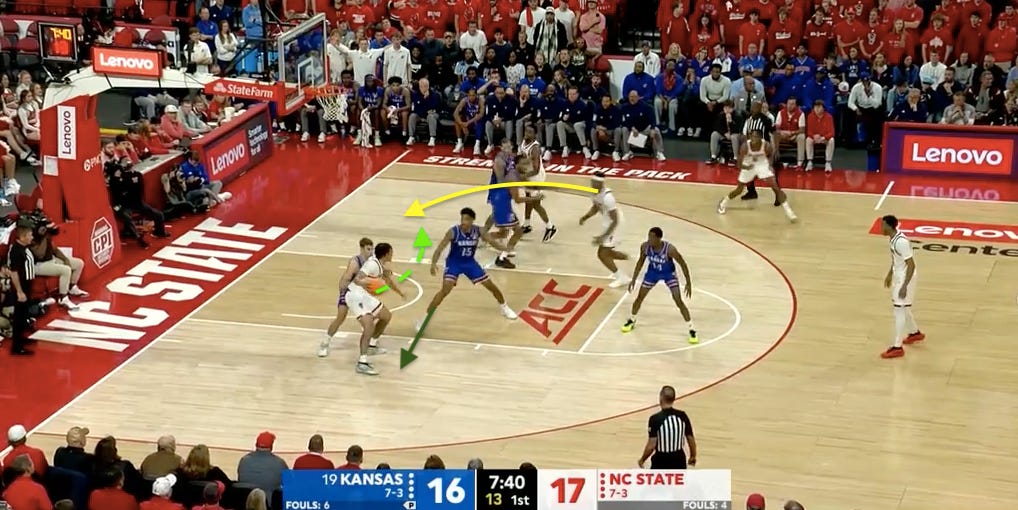
This style of offense may be more static or a tad rotate, but there are ways to inject some dynamism into these possessions, which are effective at drawing two defenders to the ball. Thanks to his ability to bully defenders 1-on-1 in the mid-post, Williams is a magnet for extra defensive attention. Whether it comes as a hard double team or early help shaded in his direction, that post-up gravity consistently creates off-ball opportunities for others.
Now, a post-up for Williams doesn’t guarantee an efficient outcome, though it does tend to be a low-turnover possession type. At times, he’ll settle for difficult fadeaway midrange jumpers without fully pressuring the defense.
On this possession against Kansas, Williams isolates against Tre White (3). He backs White down in the post, but instead of powering all the way to the rim, which would have forced Flory Bidunga (40) to step over and potentially leave Lubin (37 dunks this season) open at the doorstep, Williams spins away and hoists a tough shot with 14 seconds still on the shot clock. Not ideal.
It’s not that Williams can’t make these shots. He definitely can. The issue is process. According to CBB Analytics, he has attempted 135 2-point shots this season with an average distance of 8.6 feet from the basket (3rd percentile) and is drawing just 1.1 shooting fouls on 2-point attempts per 40 minutes (35th percentile).
The takeaway is straightforward: Williams is better off taking 2-3 power dribbles to get closer to the basket. The deeper he attacks, the more likely he is to generate a higher-percentage shot, draw a foul or open opportunities for a teammate. It’s low-hanging fruit to grab; he can improve these numbers.
In the Syracuse matchup, Williams still took midrange shots, which are part of his game, but he was more assertive in post/iso situations. That framework and mentality are what matters most.
After a turnover early in the second half, NC State capitalizes on a cross-match, with shooting guard JJ Starling (6‑4, 205) defending the larger Williams. The Wolfpack run their offense, reversing the ball to the left side, where Copeland feeds it into a post-up for Williams.
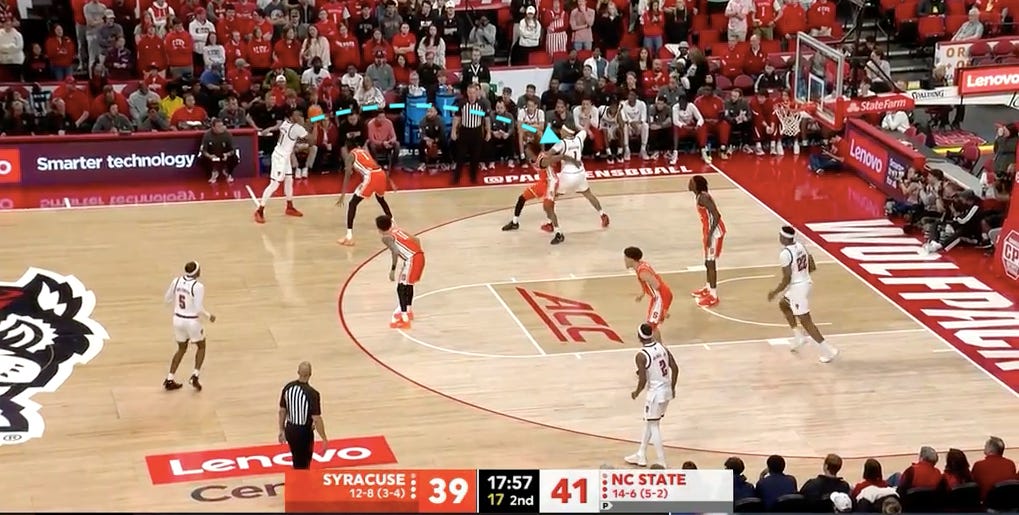
Williams immediately exploits his strength advantage, backing Starling down into the mid-post. As he nears the paint, all four off-ball defenders are keyed on him, including Donnie Freeman (1) on Copeland one pass away, and William Kyle (42) on Lubin in the opposite dunker spot. If either defender steps to help Starling, Williams has a clear lane to find an open teammate.
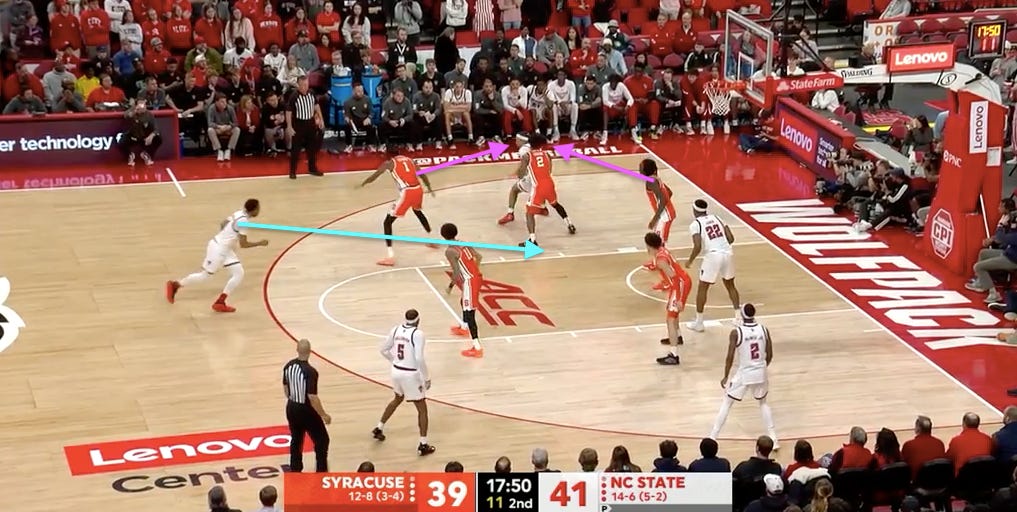
Before a double team can arrive, Williams spins baseline with ease, shedding Starling and forcing the help defense to react as Kyle rotates over. Freeman ball-watches for several seconds and loses track of Copeland, who back cuts just as Williams makes his move. Williams could have gone to either Copeland or Lubin — both are open — but he opts for Copeland, who has a head of steam down the lane. With Kyle pulled toward the ball, the rim is open, allowing an uncontested layup against a set half-court defense.
This wasn’t the only time Williams found Copeland off a post-up opportunity.
About 90 seconds into the game, the Wolfpack ran one of their pet post-up sets for Williams. Starting in a 5-out alignment, they cleared the left side for him to isolate in the post, then ran split action off his initiation: Lubin set a flare/throwback screen for Holloman before slipping to the basket.
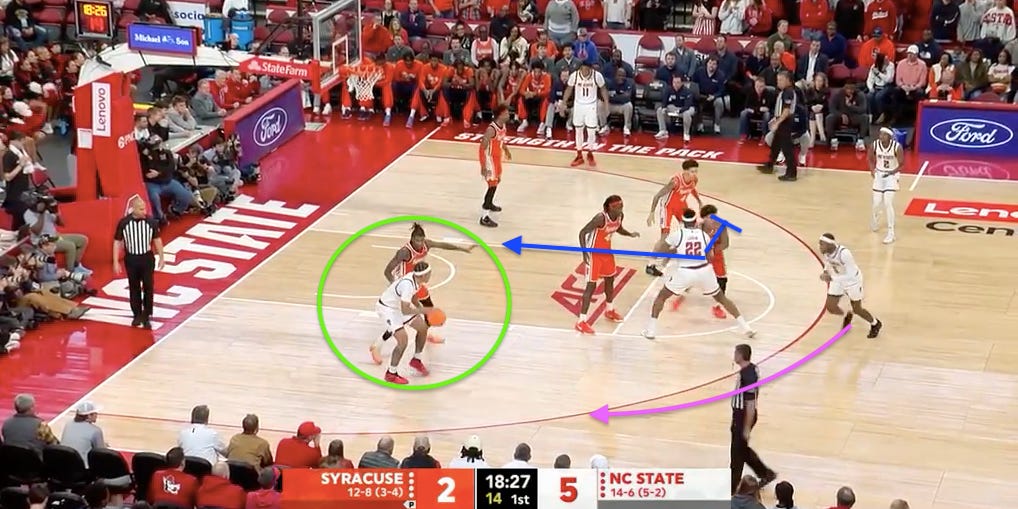
Williams overpowers the talented Freeman, backing him deep into the restricted area and forcing Kyle to help over. This time, Starling rotates down to deny a potential pass to Lubin. That rotation, however, leaves Copeland open on the weak-side wing, forcing Starling into a late closeout when Williams kicks out. Copeland attacks the poor closeout, gets downhill and draws a shooting foul at the rim.
Copeland is drawing 3.7 shooting fouls per 40 minutes on two-point attempts this season, ranking in the 98th percentile nationally, according to CBB Analytics. He clearly has the ability to create for himself and attack defenses in pick-and-rolls, isolation or transition. That said, it’s a positive for NC State to find ways to get Copeland downhill against unsettled defenses — playing off the catch.
According to InStat, Copeland is shooting 75 percent on cut field goal attempts this season. At 6‑foot‑6 and 220 pounds, he’s difficult to defend when cutting toward the basket, especially against a compromised defense. Using the post-up gravity of Williams is an effective way to generate these opportunities, but it’s not the only one.
Also in the first half against Syracuse, Holloman pushes off a turnover and finds his own cross-match. As he attacks Freeman 1-on-1 in space, weak-side help from Nate Kingz (4) crashes off the corner, while Starling (2) rotates behind Kingz to cover Matt Able in the weak-side corner. Once again, Copeland is left unattended and executes a perfect slot cut, sliding down the lane for an uncontested dunk.
When Copeland gets moving as a cutter, he functions as a connective playmaker — a key part of his value as a pro prospect. Wherever he plays next season, he’s unlikely to dominate the ball the way he does in Raleigh. That’s fine, because he’s a smart off-ball mover who can also serve as a connector, helping build or extend advantages.
For example, at Boston College, Copeland pushes the ball ahead to Terrance Arceneaux, forcing a defensive rotation. Williams cuts to the basket, expanding the advantage and Arceneaux finds him as the BC defense collapses into the paint. Rather than staying atop the floor, Copeland slot cuts down the lane, receives a pass from Williams and quickly redirects it out to Able in the corner.
Five half-court dribbles, no ball screens and the result is a wide-open 3 for a good shooter. Again, getting Copeland in motion can have cascading benefits for NC State’s offense, especially when he’s synched up with Williams.
Pick-and-Roll into Post-ups
Williams is a versatile offensive talent, and it’s important that his usage be funneled through multiple avenues. He’s a strong pick-and-roll creator, capable of turning ball-screen actions into switches that can then flow into post/iso opportunities.
That’s why NC State’s inverted ball-screen sets and Pistol action on the outer thirds of the floor are so crucial — they create post mismatches for Williams.
On this possession at Pitt, Williams sets an early drag ball screen for Copeland before popping out to the wing, with Holloman immediately lifting to set an inverted ball screen. Williams draws a switch against opposing point guard Damarco Minor (6‑0, 190) and executes his go-to “Barkley” move — backing a defender down from the perimeter into the post. Minor has a major problem: he has no chance 1-on-1, and Pitt never sends help, resulting in an easy interior bucket and a shooting foul.
NC State runs a similar look in the first half against Syracuse. The Pack find themselves in a favorable spot for an inverted pick-and-roll: McNeil sets a ball screen for Williams, with Syracuse guards Naithan George (11) and Kiyan Anthony (7) defending. As Able initiates, McNeil signals for the ball to be swung to Williams.
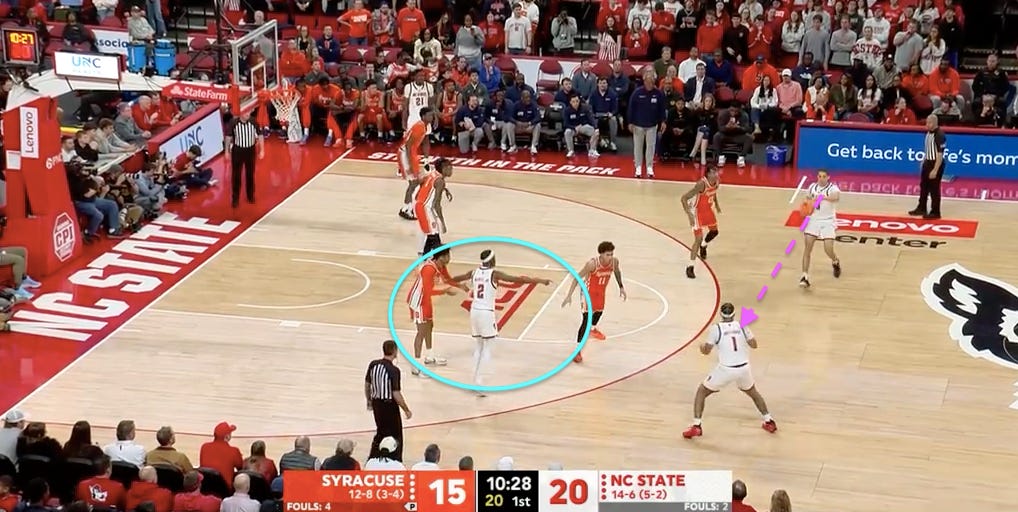
When Williams receives the ball from Able, McNeil lifts for a step-up screen. Anthony switches onto Williams, but he’s flying downhill and quickly turns the corner. Freeman helps over, leaving Sagnia open in front of the rim. Sadiq White (0) and Tyler Betsey (5) collapse on him, and Sagnia draws a foul.
Around The Horn
Copeland and Williams have been used plenty as a screen-roll partnership this season; however, the Syracuse game was their most effective at generating pick-and-pop opportunities.
This part of NC State’s offense got going early. Williams scored a layup directly off the opening tip-off, and on the Pack’s first half-court possession, they flowed into “3 Across” action, with Williams setting a high ball screen for Copeland while Holloman, Lubin and McNeil spaced along the baseline.
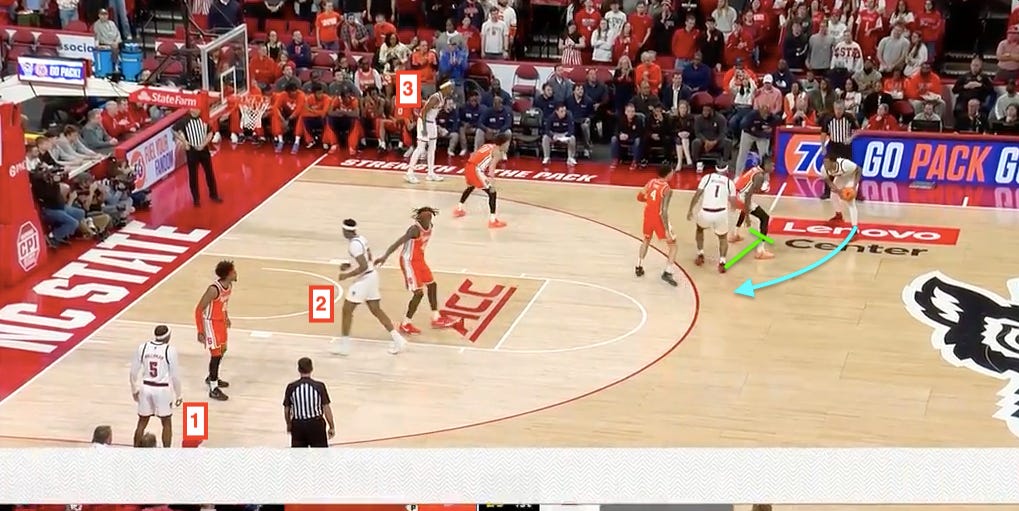
Syracuse stays in front of the ball as Williams slips his screen for Copeland. As Copeland begins sizing up Freeman off the dribble, Kingz steps slightly off Williams on the wing to provide help. It’s not a lot of space, but it’s enough for a quick kick to Williams, who drains a catch-and-shoot 3.
Williams hit five 3-pointers in the game — one shy of his season high (6-of-8 3PA vs. UNC Greensboro) — four of which were assisted by Copeland.
In the second half, Copeland and Williams really started to click in the pick-and-pop. Less than three minutes in, NC State runs “77” action for Copeland: staggered ball screens from Williams and Lubin, with the left corner cleared out.
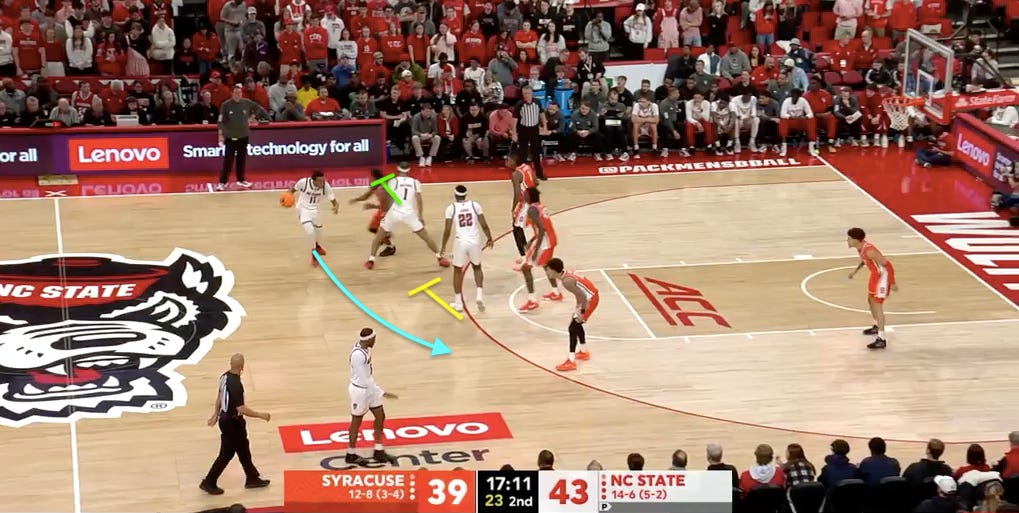
As both Lubin and Williams pop to the empty side, Copeland hits Lubin on the pop. For a moment, it looks like NC State is about to run an inverted 5-4 pick-and-roll, with Williams setting a screen for Lubin.
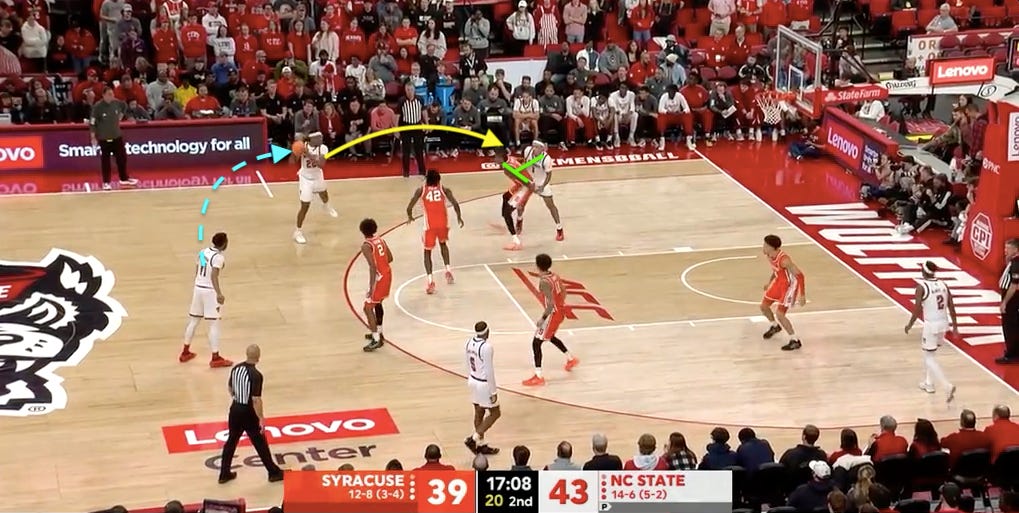
For whatever reason, Lubin doesn’t attack the basket. Instead, he kicks it back to Copeland, and the Pack recycle their offense: Williams lifts to set a slot ball screen for Copeland while Holloman (40.3 3P%) and McNeil (41.3 3P%) space out on the right side of the floor.
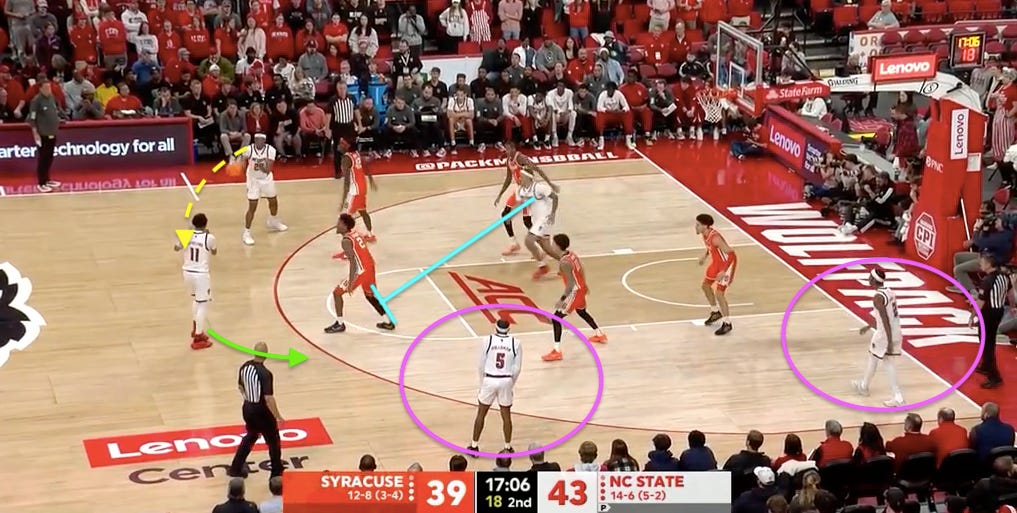
Copeland dribbles left, and Freeman switches off the screen. However, the switch isn’t fully communicated: Starling stays with Copeland, leaving Williams open on the right wing.
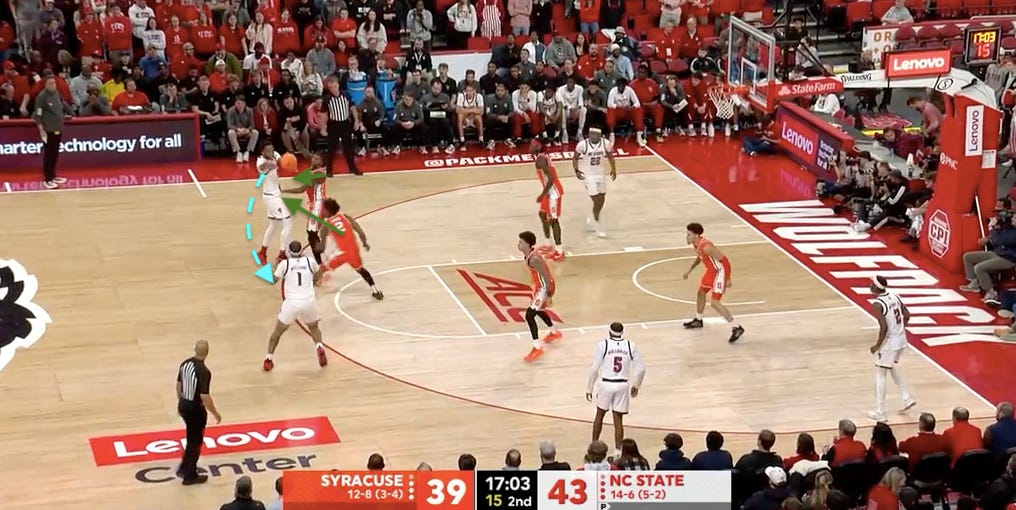
Drawing two defenders to the ball, Copeland kicks it back to Williams. Kingz stunts off Holloman on the wing, and Starling scrambles to contest, but Williams has a clean look and drills another pop 3.
Two minutes later, NC State lines up in a Horns formation: two shooters in the corners — McNeil and Holloman — and two screeners at the elbows, Williams and Lubin.
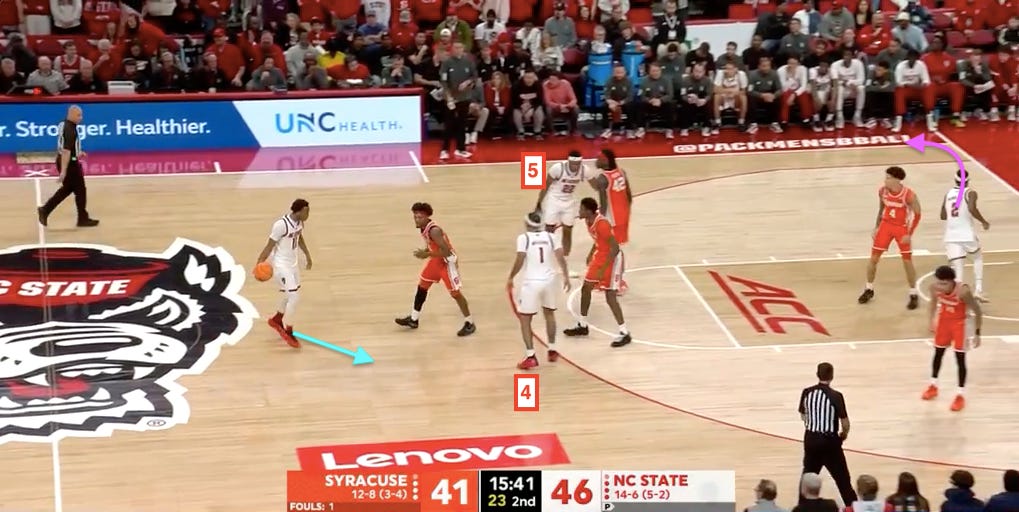
Copeland drives toward Williams, who lifts to the right slot to set a ball screen. Starling fights over the top of the pick, while Betsey drops below it.
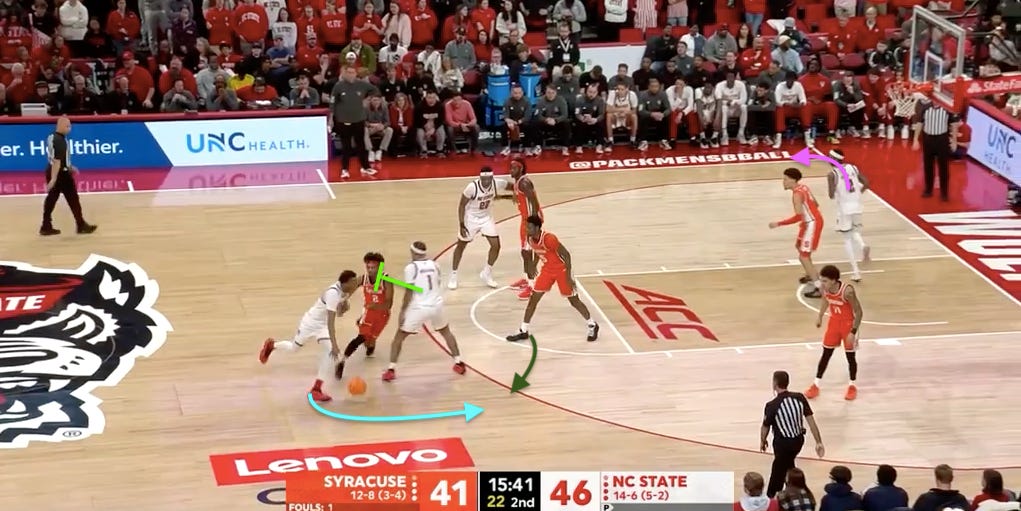
This tactic allows Syracuse to keep a help defender between Copeland and the rim, which is significant. But with Starling chasing the ball from behind, the Orange have two defenders committed to Copeland, leaving Williams unguarded in the middle of the floor.
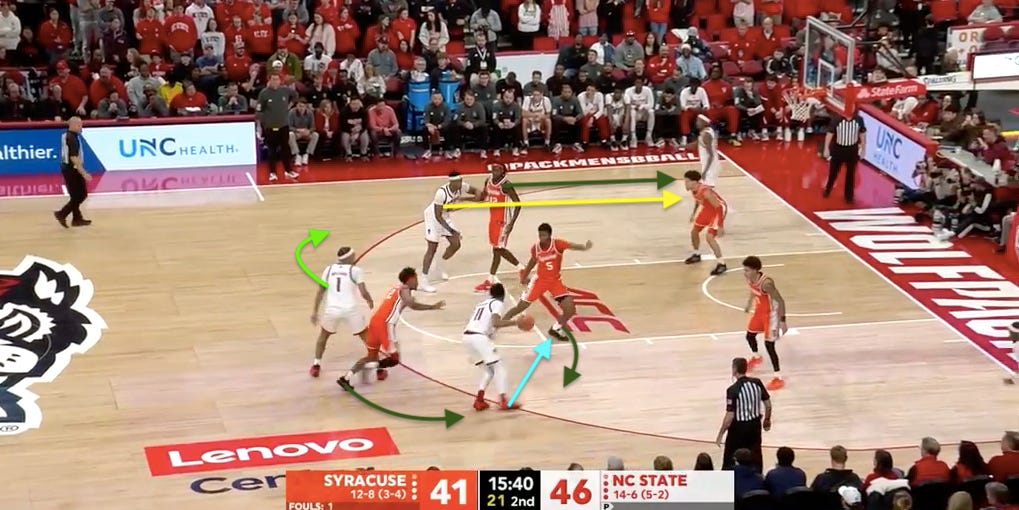
As Williams pops, Lubin cuts to the rim, pulling Kyle — a potential help defender — away from Williams. Now, all five Syracuse defenders are below the free throw line, including Starling, who has his back turned to Williams; no one is in position to effectively close out.
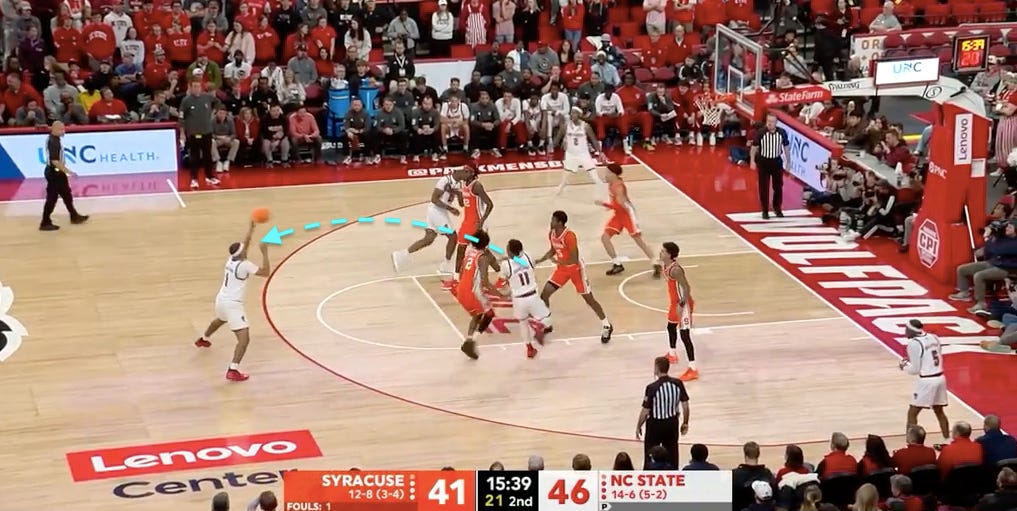
This is too easy for Copeland. He reads the coverage and makes the correct decision — kicking back to Williams for an uncontested 3-pointer.
According to my charting, Williams has made seven pick-and-pop 3-pointers this season, including three against Syracuse — six of which were assisted by Copeland.
Later in the second half, as NC State was about to make its big final run, the Pack returned to the same Horns Pop action between Copeland and Williams. This time, however, Syracuse tried to defend it by “weaking” the ball screen — pushing Copeland away from the pick and toward his weaker left hand. George angles his body between Copeland and the screen, while Freeman lifts to form a sort of box around him.
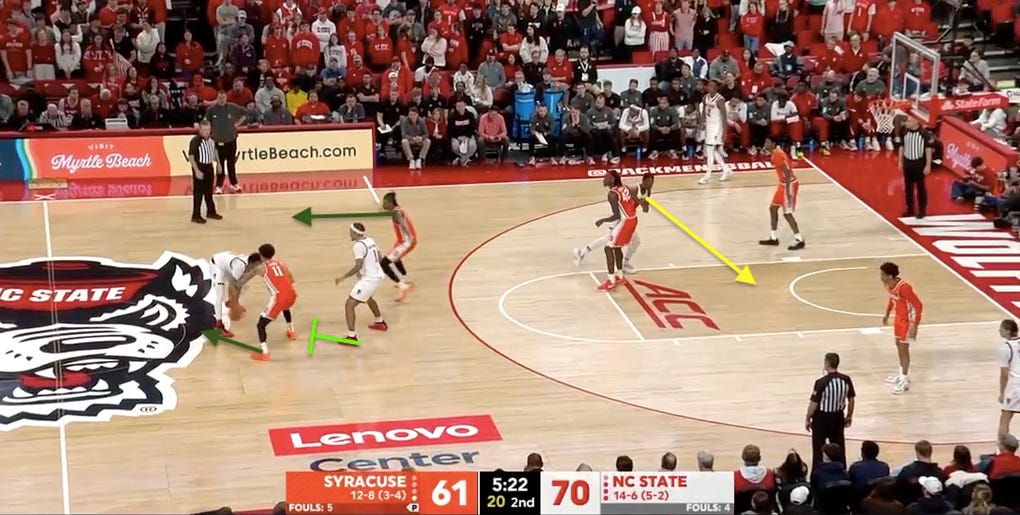
While George and Freeman pressure the ball, Williams drifts back toward the right wing, finding open space. To prevent another catch-and-shoot, Anthony flies out off of Able in the right corner and sprints toward Williams.
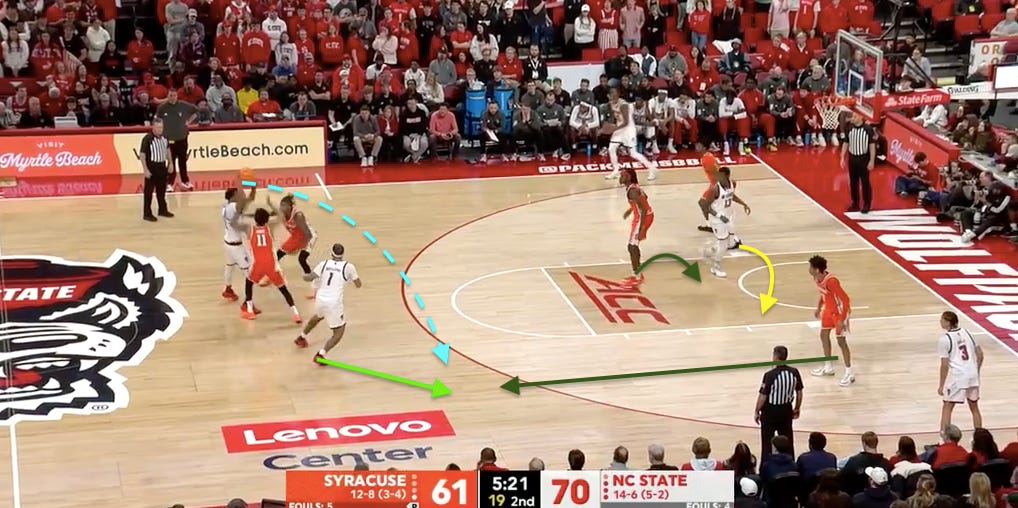
Anthony, however, isn’t under control and quickly loses containment. Freeman scrambles back, but an open lane emerges, and Williams takes it. As he drives, he could kick out to Able, alone in the corner, but instead he sees a chance to attack the rim. This is where Sagnia comes into play. Drawing inspiration from Marcin Gortat and Daniel Theis, NC State’s center sets a deep seal in the paint on Kyle — essentially an off-ball screen that helps clear a path to the basket.
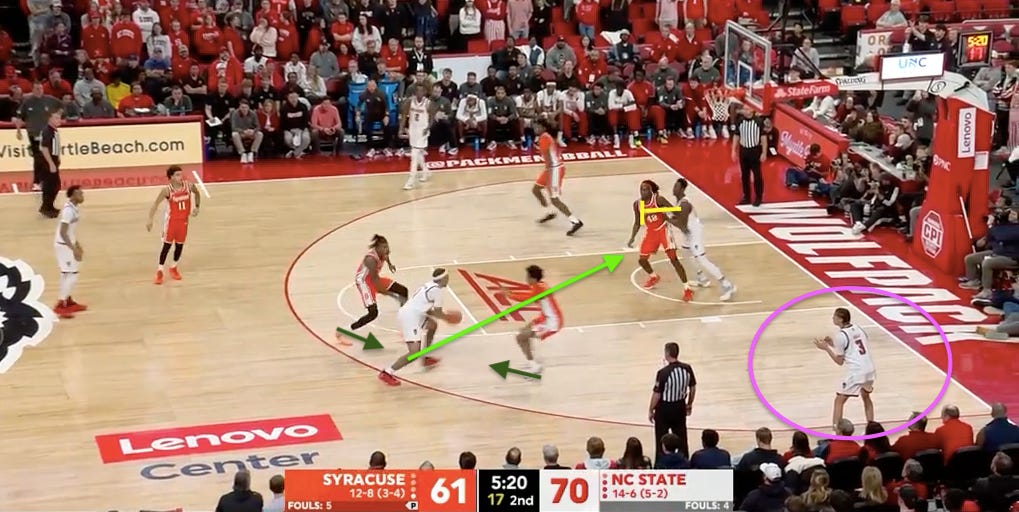
Kyle is one of the best rim protectors in the country. He ranks in the Top 20 nationally with a block rate of 9.8 percent, and opponents are shooting just 47.2 percent on 2-point attempts against Syracuse’s defense. However, Sagnia uses his frame to legally shield Kyle, preventing him from getting all the way to Williams.
Williams hit nine field goals against Syracuse, four of which came off the pick-and-pop — all assisted by Copeland.
As NC State ran the Horns Pop set, the coaching staff found ways to disguise it before flowing back into the action.
The Wolfpack began this after-timeout (ATO) possession in what appeared to be a 5-out set, initiated at the top by Williams.
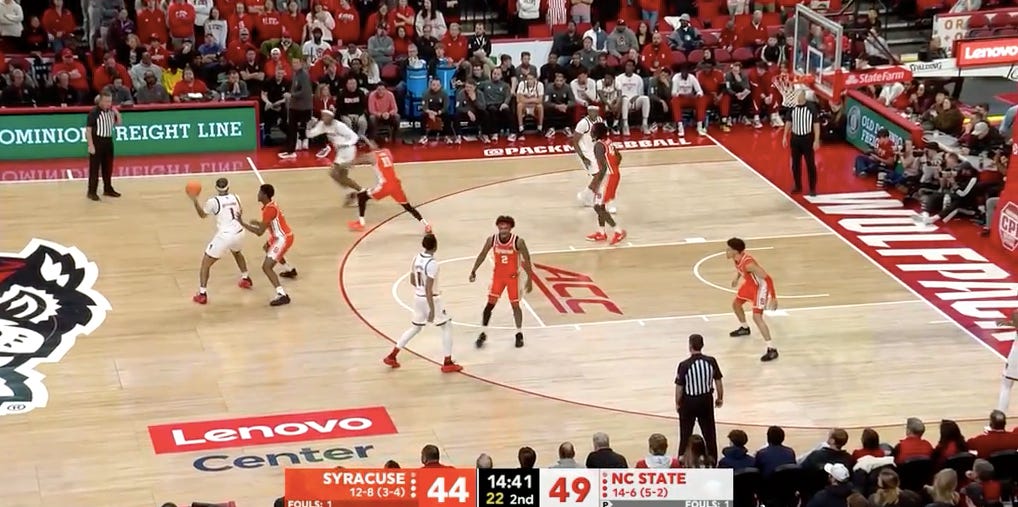
This is all window dressing, though. The ball swings around, and five seconds later, NC State is back in its Horns set.
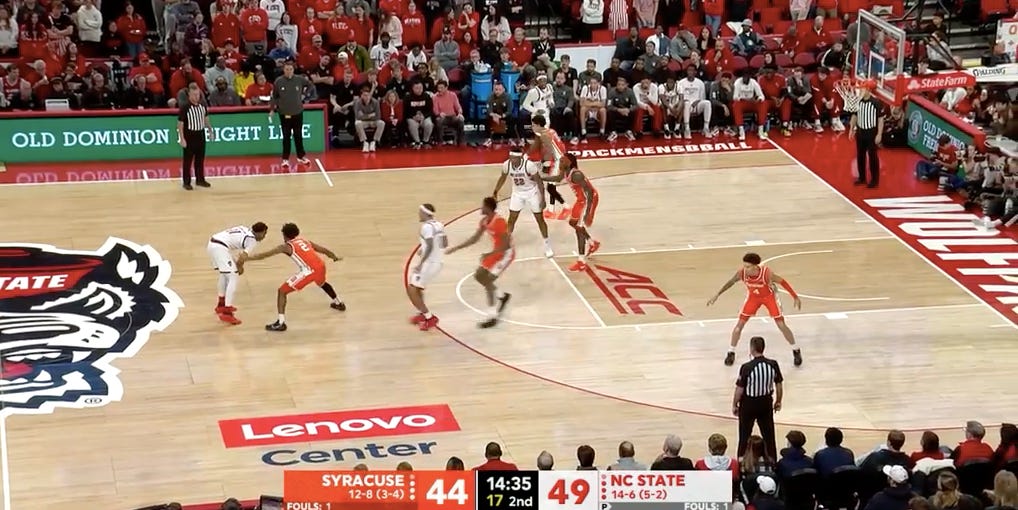
Despite NC State’s chicanery, Syracuse does a much better job defending this possession. Starling initially works to funnel Copeland left, and when Williams sets a screen and Betsey switches out, the defense keeps the ball in front and takes away a pick-and-pop opportunity. Even so, this still creates a mismatch for Copeland, who looks to attack the switch.
Copeland misses the layup, but the process here is sound and it produces a good look at the rim for NC State’s top slasher.
Thanks for reading Split The Action! Subscribe for free to receive new posts and support my work.
Improving Clutch Offense and Other Low-Hanging Fruit
The more juice NC State can get from shared actions with Copeland and Williams — regardless of who’s initiating or screening — the better. Greater synergy between the two primary creators could also ignite NC State’s offense in late-game situations. According to CBB Analytics, the Pack have scored 1.05 points per possession in “clutch” minutes this season, ranking in the 20th percentile. NC State has shot just 46.2 percent on 2-point attempts (10th percentile) and 25 percent on 3-point attempts in clutch minute this season.
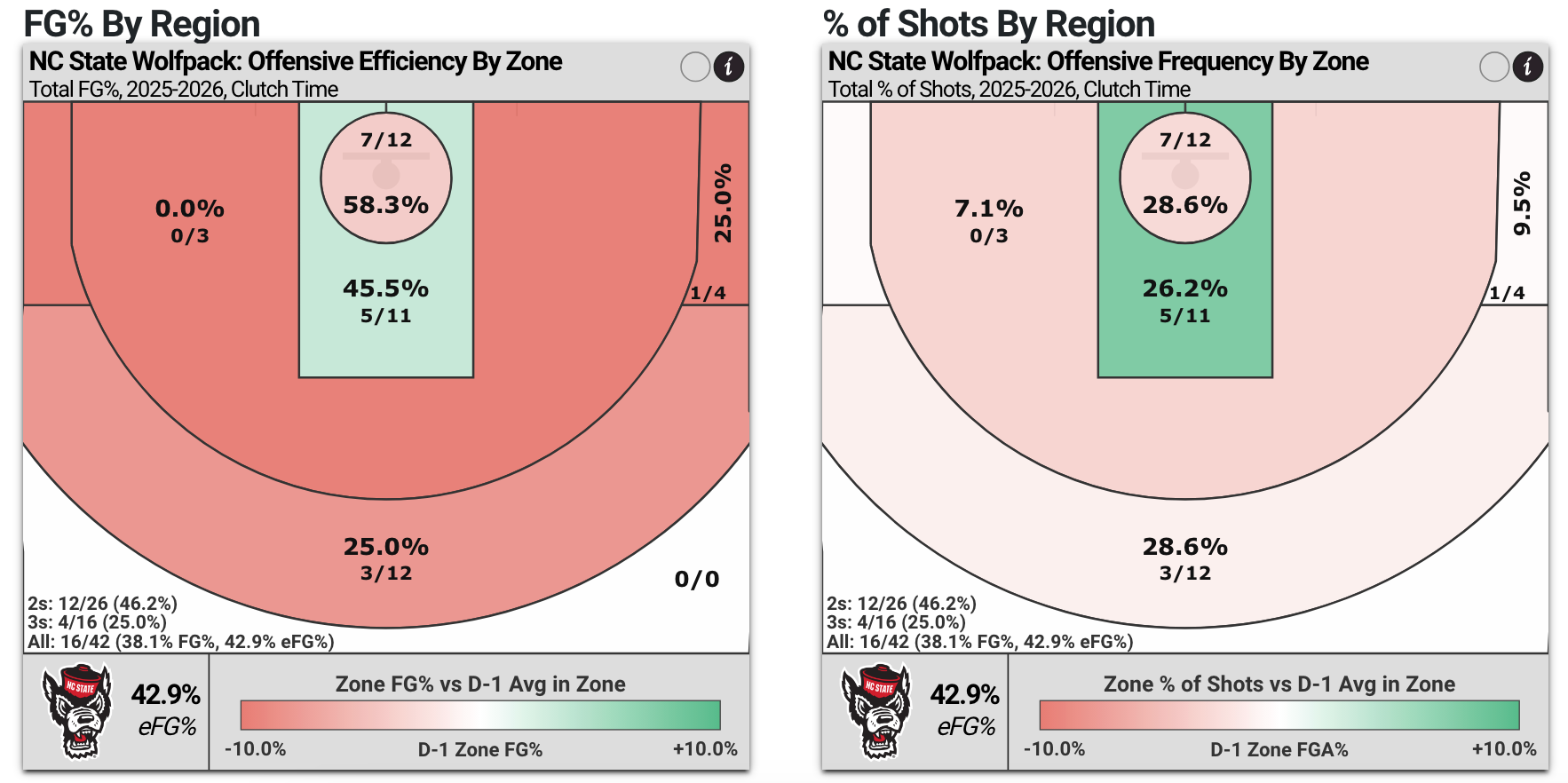
Shot chart via CBB Analytics
However, the Wolfpack have shown they can find ways to ignited Copeland and Williams together in some of these leverage moments, including this pick-and-pop 3-pointer off “Ram Exit” action against Kansas.
Williams has still been highly productive in minutes without Copeland, but his efficiency drops in those possessions. With Copeland on the floor this season, Williams has shot 47.4 percent on 2-point attempts and 43.8 percent on 3-point attempts. Without Copeland, those numbers fall to 37.5 percent on 2s and 33.3 percent on 3s.
(Unsurprisingly, when Williams sits, Copeland takes on an even larger playmaking role: 32.4 percent usage and a 49.4 percent assist rate, compared with 22.4 percent usage and a 35.5 percent assist rate when Williams is on the court.)
The sample size isn’t huge, and there’s likely some noise and bad shooting luck baked into these numbers. Still, they indicate the importance of Copeland in creating more efficient looks for Williams.
In turn, post-up possessions with Williams could create more opportunities for Copeland to play off the movement and attack off the catch.
Williams has 68 assists this season: 25 to Lubin (36.8 percent), 10 to McNeil (14.7 percent), seven to Able (10.3 percent) and seven to Copeland (10.3 percent). That last total seems low given their talents, though a big reason is simply how few unassisted field goals Copeland has this season.
Copeland averages 15.7 unassisted points per 40 minutes, ranking in the 95th percentile nationally. Of his 98 field goals this season, 71 have been unassisted (72.4 percent). In fact, the seven assists from Williams to Copeland are the most of anyone on NC State’s roster.
It should be noted, too, that assists aren’t a perfect catch-all metric for grading things like playmaking and generating open shots for teammates. There are lots of ways to get guys open, including off-ball movement and screens. However, it’d be a boon for State’s offense to use Williams as a means for generating more catch-and-finish looks for Copeland — or vice versa.
Thanks for reading Split The Action! Subscribe for free to receive new posts and support my work.
Comments
Nothing yet. Say the first thing.
Sign in to join the conversation.