
When evaluating Dame Sarr’s freshman campaign at Duke, one thing immediately stands out: his defense. At 6-foot-8 with a near 7-foot wingspan, the freshman from Italy — by way of FC Barcelona’s development system — quickly morphed into Jon Scheyer’s cover corner, capable of locking down high-usage guards at the point of attack while disrupting opposing offenses as a roaming help defender.
But while his defensive instincts, physical tools and motor give him a high baseline, his ultimate ceiling hinges on the development of his half-court offensive game.
To unlock that next level of upside, Sarr will need to convert his flashes of transition offense and spot-up shooting into consistent, self-created offense and better dries against structured sets. Below, we dive into the film, stats and physical profile of Dame Sarr to see how his instant defensive impact stacks up against his offensive growth potential.
There’s much to like about Sarr’s defense, but the most obvious starting spot is his on-ball defense. When watching basketball, it’s natural for the viewer’s eyes to follow the ball. When Duke is on defense, this is often where Sarr will be found at the outset of possessions. Valuing the on-ball defense of Sarr isn’t just about selective attention, though. At 6-foot-8 with a near 7-foot wingspan, with quick hands and smooth lateral movement, Sarr is a force at the point of attack and defending in space along the perimeter.
Duke featured Sarr at the point of attack last season. Assigning him to pressure top-tier perimeter creators, especially high-volume ball-handlers who use a lot of screens and look to create off the bounce, became a cornerstone of Duke’s defensive scheme. Sarr’s length, lateral fluidity and relentless motor make him a disruptive, game-changing defender against elite offensive threats. Look at his extension on this contest, altering a pull-up 3-pointer from Ebuka Okorie (1).
(Quick note: The box score credited Sarr with two blocks in this game, but my unofficial charting counted three, including this contest on the perimeter.)
Okorie was arguably the nation’s premier on-ball creator last season, but Duke gave him fits. The Stanford freshman turned in one of his worst games of the year: nine points on 3-of-9 shooting (1-of-5 from deep), one assist and four turnovers. Turning off Okorie’s water is always a team effort, but Sarr took the primary assignment and did a hell of a job.
Okorie cooked every coverage under the sun with his deep bag of live-ball moves, but Sarr’s combination of discipline and lateral mobility neutralized him on the ball.
With Duke in drop coverage (Patrick Ngongba dropped below the level of the screen), Sarr gets to work against Texas Tech’s Christian Anderson — the nation’s premier off-dribble 3-point shooter last season and, like Okorie, a Top 20 pick in the 2026 NBA Draft. Sarr glides over consecutive screens set by big man JT Toppin (15), consistently staying in front of the drive or deploying excellent rearview pursuit whenever Anderson (4) tries to snake back to keep Sarr on his hip.
These are twitchy, quick-burst guards with elite handles, yet Sarr completely wrecks shop at the point of attack. Anderson erupted against Duke in Texas Tech’s 82-81 comeback win, but all five of his 3-pointers came with Sarr on the bench — hitting them over Caleb Foster, Isaiah Evans or Ngongba on a switch.
Limited by foul trouble, Sarr played just nine minutes against the Red Raiders. Duke was +9 during his nine minutes on the floor and -10 with him on the bench, surrendering 1.34 points per possession, per CBB Analytics. Granted, Anderson’s savvy on-ball creation and screen craft played a role in those fouls. Here, Anderson uses a jail dribble to pin Sarr on his hip and gets him to leave his feet with a well-timed shot fake.
In Duke’s November matchup against Arkansas, Darius Acuff Jr., another dynamic on-ball creator and the No. 7 pick in the 2026 Draft, erupted for 21 points and five assists. However, all eight of Acuff’s field goals came with someone other than Sarr as the primary defender.
Arkansas’ other star guard, Meleek Thomas (a second round pick of the Cleveland Cavaliers), hit five field goals against Duke, but only one came with Sarr as his direct assignment — a spot-up possession where Sarr showed early help at the nail against an Acuff drive.
These matchups offer granular evidence of a season-long trend: Sarr’s defensive impact was nothing short of elite.
CBB Analytics: Sarr ranked in the 100th percentile in Defensive Regularized Adjusted Plus/Minus (DRAPM), which isolates a player’s true defensive impact by combining box score metrics with lineup data to adjust for teammate and opponent quality.
Defensive Win Shares: He landed in the 99th percentile in Defensive Win Shares per 40 minutes.
EvanMiya’s DBPR metric: Sarr ranked fourth in the ACC in Defensive Bayesian Performance Rating. DBPR adjusts for lineup context and estimates the number of points per 100 possessions a team saves relative to the Division I average with that player on the floor.
On/Off Impact: Duke’s defense surrendered just 94.6 points per 100 possessions (45.1 eFG%) with Sarr on the court, compared to 100.5 points per 100 possessions (47.8 eFG%) when he sat.
Historical Context: Sarr is one of just 12 high-major freshman “Wing Forwards” in BartTorvik’s database (dating back to 2007–08) to record a Defensive Box Plus/Minus of 3.5 or higher, joining an elite group that includes Aaron Gordon, Kyle Anderson, De’Andre Hunter, Otto Porter and Zion Williamson.
The Blue Devils were +417 in 893 minutes with Sarr on the floor last season, outscoring opponents by 28.7 points per 100 possessions, according to CBB Analytics. It’s worth noting, however, just how closely Duke tethered Sarr’s minutes to Cam Boozer. Boozer shared the court for 775 of Sarr’s 893 total minutes — nearly 87 percent. Duke was +410 across those 775 shared minutes, but just +7 in the remaining 118 minutes without Boozer.
Assuming this pairing was intentional, the logic is clear: the two complemented each other on opposite ends of the floor. Boozer operated as a roving offensive mismatch — drawing multiple defenders, spraying passes out to open shooters or finding cutters — while Sarr served as the rangy, multidimensional defensive ace who pressured the ball, drained shot clocks and erased mistakes as a weak-side helper.
No matter how you slice the numbers, Sarr was a wildly impactful defender last season, and Duke’s defense was transformed by his presence.
Playing defense at Duke requires versatility across positions and mastery of varied pick-and-roll schemes. Sarr made his mark hounding high-usage guards, but he’s comfortable battling physical, bulkier forwards like Michigan’s Yaxel Lendeborg and Donnie Freeman, or chasing off-ball mover threats like Juke Harris, Alex Karaban and Braylon Mullins.
Each assignment demands unique preparation and technique, and Sarr brings a deep toolbox, sharp instincts and an edge to every matchup. He’s a menace at the point of attack against smaller ball handlers, an assignment-based perimeter stopper against the bigger wings and an off-ball screen navigator against the 3-point shooters.
While added muscle will help him hold ground against physical hybrid forwards or post-up bigs on switches, his college tape proves he can cover 1-4, neutralizing everything from face-up power forwards to off-ball shooters.
Late in the first half against UConn, Sarr is attached to Mullins (24). The Huskies run a screen-the-screener action, setting a Flex screen into staggered down screens for Mullins. Sarr stays in his hip pocket, but instead of having Sarr continue to chase, Duke executes a seamless “veer-back” switch: Maliq Brown switches out to contest Mullins’ curl, while Sarr veers back to stick center Eric Reibe (12), finishing the possession with a box-out and a rebound.
Sarr’s fluid, athletic profile allows him to slide across positions and scheme assignments with relative ease. Watch him here against Arkansas: he starts on Thomas (1) before switching onto power forward Trevon Brazile (7) on a handoff exchange. From there, he picks up Billy Richmond (24) off a Brazile off-ball screen, and caps it off by switching into the post against 6-foot-10, 240-pound center Malique Ewin (12). Sarr brings the possession to a halt, ending all of the window dressing/fluff from Arkansas, by deflecting the entry pass into Ewin.
An added bonus, Sarr is a menace in passing lanes after switches. When he switches onto an opposing 5, any lazy or off-target feed — whether a post entry to Ewin or a lob from Thomas Haugh (10) to Micah Handlogten (3) on the roll — is prime territory for Sarr to jump and turn into a transition opportunity.
As soon as Sarr’s defensive confidence fully clicked last season, his motor started to run really hot. He’ll expend massive energy hounding the ball full-court, shift seamlessly into active team defense and instantly sprint in the other direction when Duke pushes in transition.
Here, SMU runs a 5-out set around Jaden Toombs (10). Sarr is assigned to Jaron Pierre Jr. (5), a recent second round pick of the New Orleans Pelicans. Pierre briefly shakes Sarr by sprinting toward Toombs before planting and cutting backdoor. The sharp change of direction causes Sarr to slip and lose touch with Pierre. Cam Boozer rotates out to cover, but Sarr’s relentless second-effort shines: he recovers all the way from beyond the arc to the restricted area, making up the lost ground to swipe the steal.
Sarr never concedes a possession; if he gets caught behind the play, he’ll fight to erase the advantage. It’s this high-octane motor that unleashes his full physical toolkit and allows his defensive instincts to take center stage.
Sarr’s screen navigation and “stickiness” as a defender transfers seamlessly to his off-ball coverage, too. Whether he’s navigating pindowns, flare screens or handoffs, Sarr’s ability to slink around screeners makes him exceptionally difficult to pick off. He glides past potential contact, leveraging his long strides and wingspan to maintain pressure.
On this possession at Florida State, Sarr begins at the point of attack before shifting into off-ball chase mode as the action flows through the high post. FSU initiates “Zoom” action, prompting Sarr to switch up the line on the down screen for Robert McCray (6). From there, he instantly flashes into the gap as Alex Steen (25) attempts a dribble-handoff with McCray. Sarr completely disrupts the timing of the play, using his length to slice in and deflect the DHO.
On possessions where screeners land solid contact against Sarr’s skinny frame, his competitiveness and recovery traits shine as he fights back into the play.
Here, Wake Forest runs a clever baseline out-of-bounds set to set up Juke Harris (2) for a strong-side corner 3. The Demon Deacons line up in a “Box” formation (four players stacked at the elbows and blocks) and trigger “Loop” action that flows directly into “Floppy” for Harris, who starts at the left elbow before cutting off three baseline screens.
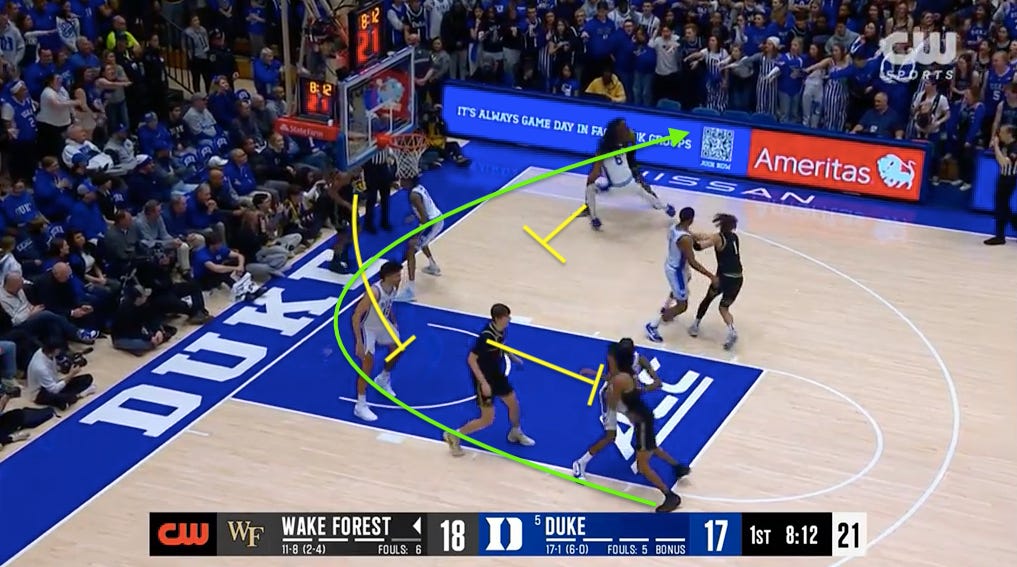
The triple screen creates a complex maze for Sarr to navigate while chasing Harris (87 3PM last season), one of the premier movement scorers in the country. Sarr absorbs contact on the initial back screen from Cooper Schwieger (13) and has to re-route around his own teammate, Cameron Boozer, who gets caught in the congestion. Near the tail end of the play, Sarr slides around a (moving) down screen from Tre’Von Spillers (25) to close out and contest Harris without fouling.
During the matchup against Okorie last season, Sarr was so blistering on the ball that Kyle Smith and Stanford tried to get Okorie as an off-ball mover in “Floppy” action. Even then, Sarr continued to hound the talented freshman guard.
If opponents try to move their primary creators off the ball to grant them breathing room, Sarr makes it nearly impossible for them to touch it again. Case in point on this possession against Louisville: Sarr picks up Ryan Conwell (3) full-court, face-guarding the star guard and completely denying him the ball during a high-stakes second-half possession in a one-point game.
Of course, a clever offense like Louisville tries to turn Sarr’s face-guarding against him. Here, Conwell sets a screen for Adrian Wooley (14), generating an open 3-pointer. From a process standpoint, though, this is an inefficient possession for the Cards. Only two players touch the ball: Wooley and Kasean Pryor (7), a career 28.1 percent 3-point shooter, who bricks his look from deep following 18 dribbles from Wooley.
When the two sides met up in Durham, Sarr continued to work as a use off-ball chaser on Conwell. Louisville runs screen-the-screener action for Conwell on this possession, looking to get J’Vonne Hadley (1) a post touch or Conwell a look coming off a down screen. When Conwell sets the slice screen for Hadley, Sarr opens up and helps in the post for a second — allowing Cam Boozer to get back to Hadley — before racing out with an excellent closeout on Conwell.
While Sarr’s defensive reputation is headlined by his on-ball stopping power, focusing solely on the point of attack undersells his all-court impact. Sarr is equally potent as a team defender: shrinking gaps, executing impromptu peel-switch rotations, and offering the kind of weak-side rim protection that elevates his overall floor and ceiling.
Matched up against Syracuse, Sarr starts in the left slot — one pass away from the ball — as JJ Starling (2) lifts to set a ball screen for Nate Kingz (4).
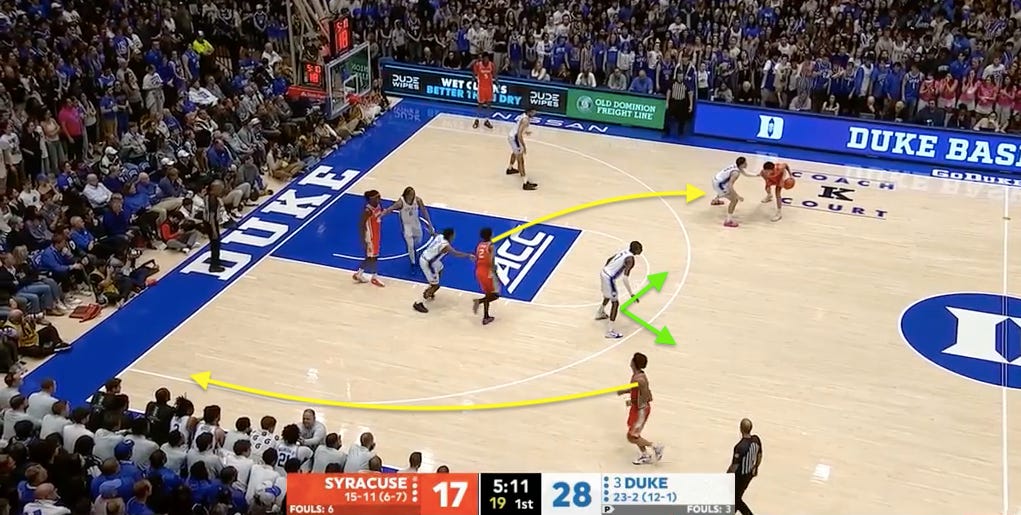
As Kingz drives middle, Sarr shows early help off Naithan George (11), digging down to the nail. The moment Kingz sprays the pass out to George in the corner, Sarr is already in motion, sprinting out to take away the open 3. He covers ground on the closeout, stays down on George’s pump fake and immediately slides into position to contain the baseline drive.
In the span of roughly five seconds, Sarr corrals two drives, snuffs out an open look from beyond the arc and forces a deflection. He can make stuff like this look fairly routine.
Next, UNC’s Luka Bogavac (44) attempts to attack Boozer off the bounce in transition. Bogavac looks to have a lane into the paint, but Sarr is positioned in the gap once again, waiting to pick his pocket. The sequence culminates in a clean swipe-and-score for Sarr on the break.
Following in the footsteps of Sion James, Sarr became the next Duke wing to make an impact with peel switches. In this scheme, a off-ball help defender “peels” off their original assignment to take over a driving ball handler who has beaten their primary defender, prompting the original defender to rotate out and cover the help defender’s open man or a secondary cutter.
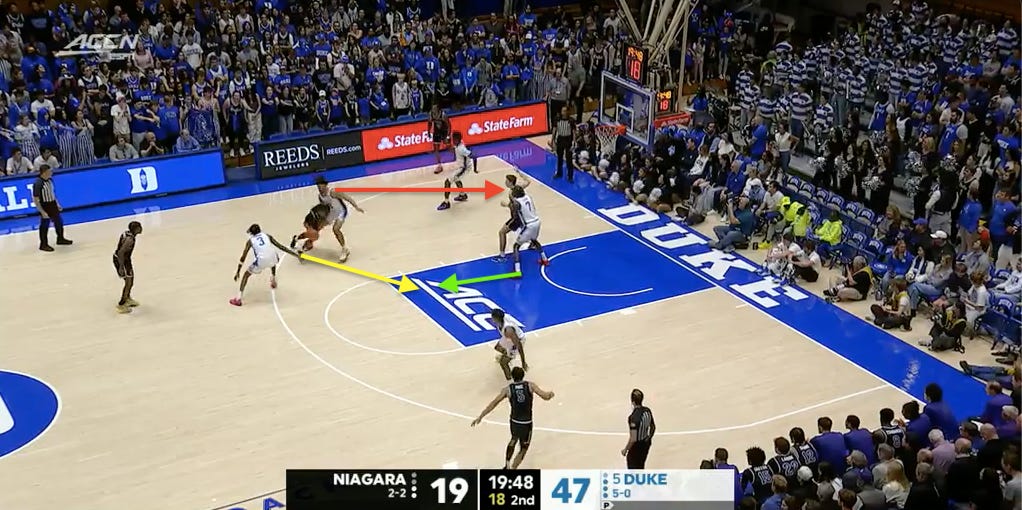
This is switching on the fly without a screen: as the Niagara ball handler drives past Cam Boozer, Sarr steps over to wall off the ball while Boozer sinks into the paint to cover his man
A few minutes later in the same game, Foster gets taken off the bounce; however, Sarr peels in off the short corner and stops the straight-line drive to the rim. Foster covers back to Sarr’s initial assignment in the corner.
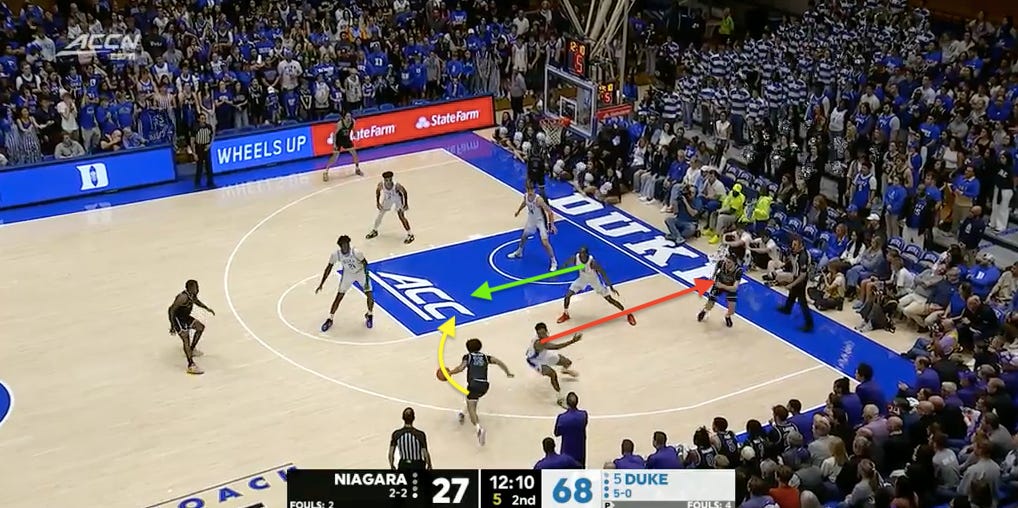
Ultimately, Sarr contains the ball and ends the possession with a rejection. The block will show up in the stat sheet for Sarr, but he doesn’t get that without a solid bit of reactive playmaking.
Sarr’s work behind the play is impressive, too.
Clinging to a four-point lead and desperately trying to avoid an NCAA Tournament upset against Siena, Duke defends this slot ball screen with Cam Boozer hedging—placing two defenders on the ball. With the three Siena players outside the action spacing the floor above the arc, a wide-open roll lane opens up for the screener. It’ll be up to Sarr, as the low-man defender, to plug the hole.
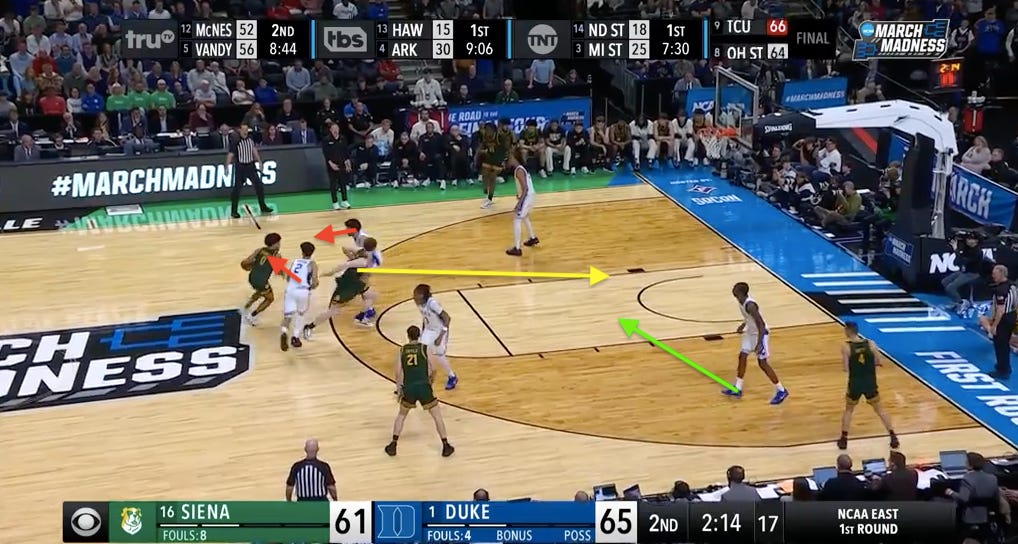
For a split second, it looks like a guaranteed dunk for Siena’s center; however, Sarr flashes to the rim from the weak-side corner and — like LeBron James blocking Tiago Splitter in Game 2 of the 2013 NBA Finals — erases a high-percentage look on a game-altering possession.
Here against UNC, Cameron Boozer hard hedges a slot ball screen between Bogavac and Zayden High (1). Boozer sticks with Bogavac for several dribbles, pulling away from High as Trimble — defended by Sarr — shakes up the left wing. Sarr could easily ball watch or listlessly follow Trimble up the floor, but he spots High wide open in the point as Bogavac drives baseline. Decisively abandoning his assignment, Sarr crashes down on High just as he receives the pass from Bogavac. High thinks he has an uncontested layup, but Sarr soars in from behind to pin the shot against the glass, rejecting a great look on the doorstep of the rim.
That anticipatory piece is what makes you dream big about his defensive potential. Sarr can already drag opposing offenses into the mud with his point-of-attack defense and flood the middle of the floor off the ball, gumming up gaps and passing lanes. If he takes another step forward as a anchor along the back line and becomes a true deterrent in the most valuable real estate on the floor, he becomes the ultimate mesh WiFi for Duke’s defense: covering every single inch.
According to CBB Analytics, 27.9 percent of Sarr’s total points last season came on fast breaks, which ranked in the 95th percentile nationally for his position group. Given his half-court limitations — along with Duke’s personnel and scheme — it made complete sense for Sarr to leak out and hunt transition opportunities as often as possible. Do work before the defense sets up.
Sarr was often at the point of attack atop the defense, backstopped by players like Cam Boozer, Cayden Boozer, Brown and Ngongba, who could serve as outlet passers. Off a turnover or defensive rebound, Sarr would take off, sprinting his way to easy buckets.
Unsurprisingly, the Boozer twins accounted for many of those finds. In fact, no two players assisted Sarr more last season than Cam — an outstanding outlet passer who dished out 19 assists to Sarr — and Cayden, who added 16. Combined, the twins set up 35 of Sarr’s 84 field goals, an impressive 41.7 percent.
Much like a speedy wide receiver running a fly route, Sarr has a knack for getting behind the defense. However, he doesn’t always cash in. Part of that stems from his handle; the rest is simply a matter of developing better poise and comfort in the open floor.
As dangerous as Sarr can be on the break, his lack of a reliable handle, functional upper-body strength to absorb contact, and wiggle hindered him as an open-court driver last season. Watch Boozer hit Sarr with an outlet pass against Cal: Sarr has room to operate with only one defender to beat, 6-foot-3 point guard Justin Pippen. But Sarr never attempts to cross over or change direction; he simply dribbles straight into the defender, gets too deep, stalls between counters and gets his shot blocked.
This is a ridiculous outlet from Cam Boozer. After grabbing a rebound against UNC, he turns and snaps a pass from Duke’s restricted area all the way to the opposite 3-point line, hitting Sarr in stride with no defender between him and the basket. This should be a simple catch, one-dribble and dunk for Sarr as his long strides chew up the court. Instead, Sarr takes three steps without dribbling and gets whistled for a travel.
He’s close to becoming an even more efficient transition target, but Sarr will need to clean up some of these miscues in advantage situations.
During his time with Barcelona’s senior team, Sarr displayed great feel and technique as a cutter. That instinct translated to Durham, where he consistently knew when to make his move rather than standing stagnant on the perimeter waiting for a kick-out pass. Instead, Sarr stays active, turning unscripted reads into high-percentage looks around the basket.
As the Blue Devils looked for ways to involve the lower-usage wing in the half court, they tapped into this aspect of his game. While Sarr functioned primarily as a spot-up threat, cutting was a tool to get him moving and turn him into a rim-pressure threat.
According to CBB Analytics, the average distance on Sarr’s 2-point attempts was just 4.0 feet, ranking in the 94th percentile nationally. The only two Duke players with a shorter average distance were the team’s centers: Ngongba (3.3 feet) and Brown (2.3 feet).
In Chapel Hill, Duke runs its “L” series into 5-out offense, with Ngongba initiating from the high post. This split action has become a signature 5-out look for Duke and Scheyer: Sarr lifts out of the left corner looking like he’ll set a flare screen for Evans — only to slip it and capitalize on UNC’s off-ball switch. When both defenders flock to Evans (thanks to his off-ball gravity), Sarr cuts free toward the rim, and Ngongba hits him right in the seam for an easy dunk.
With more of the offense set to funnel through Ngongba, this connection should feature heavily in Duke’s half-court package next season, especially as the two prepare for their second year together. John Blackwell’s 3-point gravity could prove to be an important unlock in these looks, pulling defenders away from the cut — like Evans last season. This should also be a boon for freshman forward Cam Williams, another rangy athlete who can attack lifted defenses with basket cuts.
Here’s a similar setup against Wake Forest: Ngongba initiates in 5-out with Sarr and Evans spaced to the right wing. Sarr sets the flare screen and Wake Forest switches, putting Myles Colvin on Sarr. After the switch, Colvin face-guards Sarr, perhaps anticipating a DHO between Ngongba and Sarr. Instead, Sarr cuts straight down the slot, and Ngongba hits him in stride to draw a shooting foul at the rim.
Ngongba is one of several talented frontcourt passers on the roster, which is notable given how central face-up passing is to the 5-out and pinch-post concepts in Duke’s half-court offense. Despite the departures of Boozer and Brown — two exceptional passing bigs — Duke remains loaded in this department with Joaquim Boumtje-Boumtje, Drew Scharnowski and Maxime Meyer joining the program.
Sarr’s work as a cutter is another area where added muscle will pay dividends: interior finishing. He has great length, reliable hands and a knack for slipping into open pockets of space, but he struggled to finish through contact last season.
On this ACC Tournament possession against FSU, Duke attacks with a small-ball lineup and inverted action, featuring Cam Boozer as a nominal 5 initiating the offense at point center. With three wings dotting the arc, Sarr starts near the left dunker spot as Duke looks to flatten out the defense and create driving lanes for Boozer.
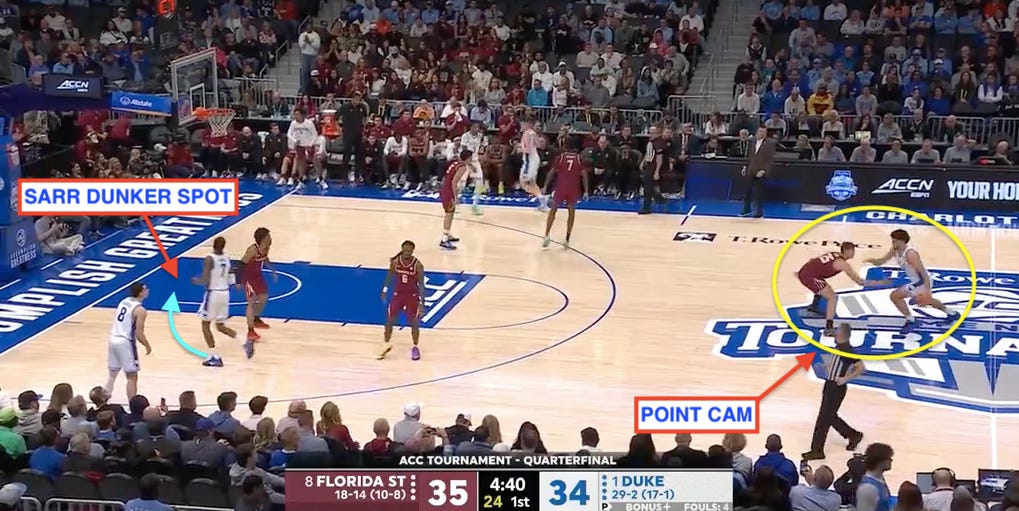
Boozer turns the corner, forcing Martin Somerville (1) to leave Sarr and help on the downhill drive. Sarr is wide open in the dunker spot, and Boozer makes the correct read by hitting his uncovered teammate. This would be an uncontested look if not for Kobe MaGee (5) rotating down from Nik Khamenia in the right corner. The 6-foot-5 MaGee displays strong two-handed verticality, but Sarr shows very little pop as he struggles to finish over the shorter defender.
Per CBB Analytics, Sarr shot 57.4 percent at the rim this season, which ranked in the 45th percentile nationally. He also drew just 1.1 shooting fouls per 40 minutes. These are the types of plays Sarr needs to finish with more force. There is low-hanging fruit here, and if Sarr amps up his physicality and finishing package around the hoop, he can quickly boost those numbers.
The geometry of the college game differs from the NBA, where the corner 3-pointer helped spark a revolution over the last decade-plus. In college hoops, there isn’t the same distance gap between the top of the key and the corner as there is at the professional level.
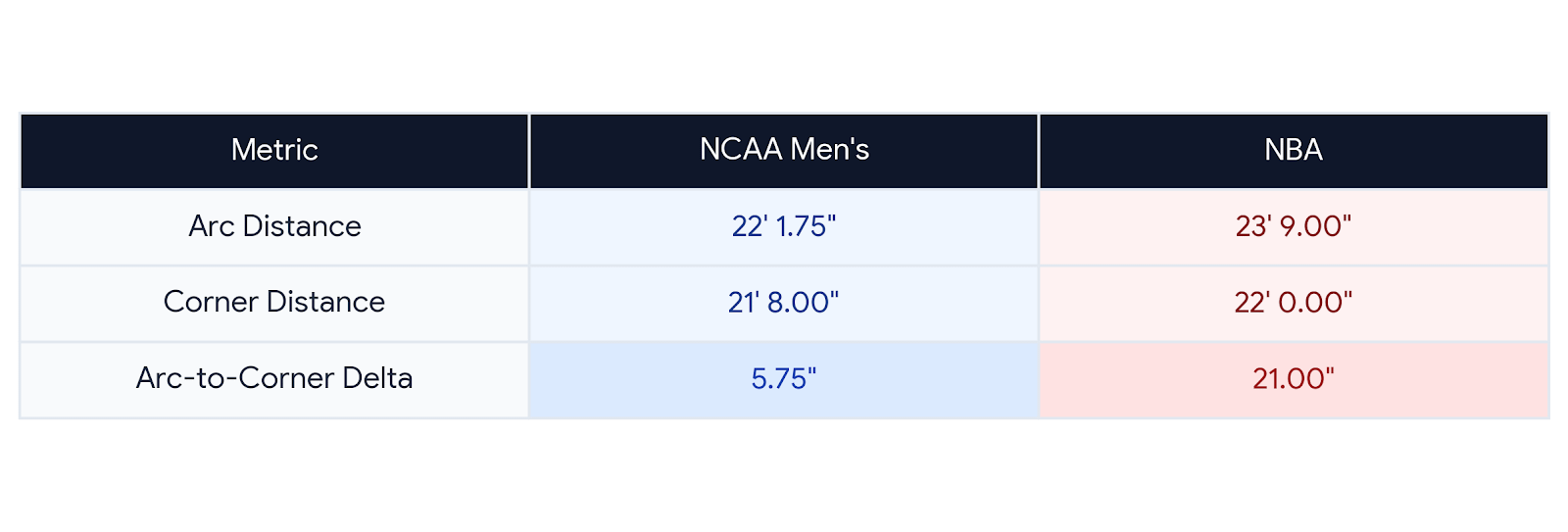
However, even if the college arc doesn’t offer the exact same exploitable inefficiency as the NBA line, it’s still closer, and thus an empirically easier shot. Plus, smart offenses like Duke occupy the corners with shooters to maximize space in the half court. The Blue Devils ranked in the 98th percentile as a team in terms of corner 3-point frequency: 14.3 percent of their total field goal attempts were of the corner 3 variety.
This is where Sarr was frequently stationed as a freshman: working the corners. With nearly 64 percent of his overall shot attempts coming from beyond the arc, Sarr hit 32.3 percent from deep while launching 8.9 3-point attempts per 100 possessions.
As I noted last season, Sarr exhibited stark 3-point shooting splits between the corners and above the break. During his freshman year, Sarr shot 34-of-83 (41 3P%) on corner 3-pointers, per CBB Analytics. Those looks accounted for 39.9 percent of his total field-goal attempts, placing him in the 99th percentile nationally.
By comparison, 24.0 percent of his total attempts came from non-corner 3-pointers (25th percentile), where he connected on just 18 percent (9-of-50 3PA).
Context is crucial here, and statistical noise likely explains some of this variance. Still, Sarr displayed far greater confidence and efficiency on the shorter attempts. Beyond 25 feet, he managed just 4-of-13 shooting from deep, per CBB Analytics.
His free throw shooting is more concerning, though. Just as he did during his final season at Barcelona, Sarr struggled from the stripe, shooting 53.2 percent (33-of-62). That’s worrisome in terms of projecting his touch, but mechanical improvements to his release and base offer genuine reasons for optimism regarding his spot-up shooting.
This was something I mentioned in my pre-Duke scouting report of Sarr, he had a habit of knocking his knees together when shooting off the catch. Without a strong, stable base, shot mechanics can break down quickly, leading to off-balance attempts and wobbly landings.
For example, look at this frame of Sarr competing for Italy at the U18 EuroBasket two years ago: both knees bend inward as he enters his gather.
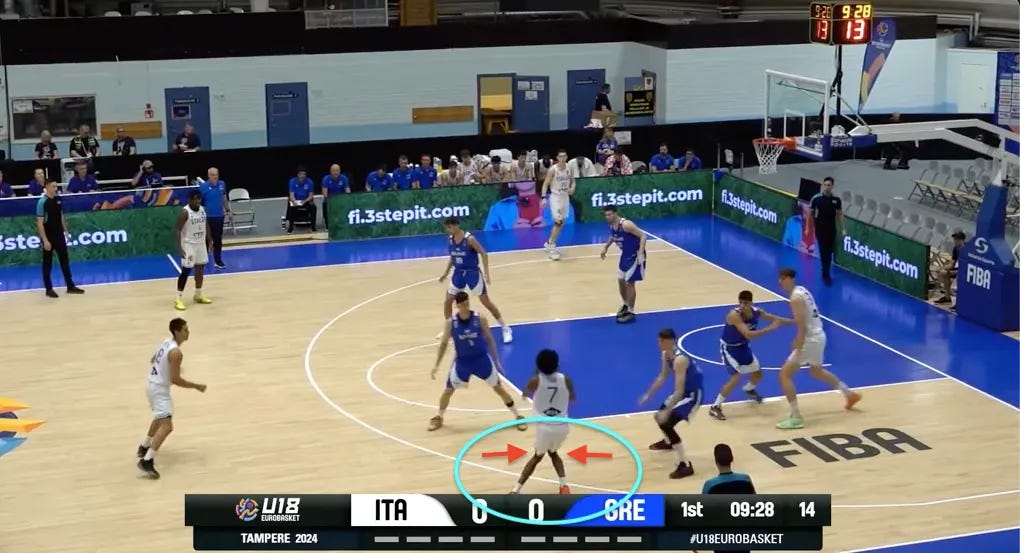
A year later at Barcelona, Sarr showed clear progress in 2025 by improving his base strength and balance. That said, there were moments when his knees would bow inward.
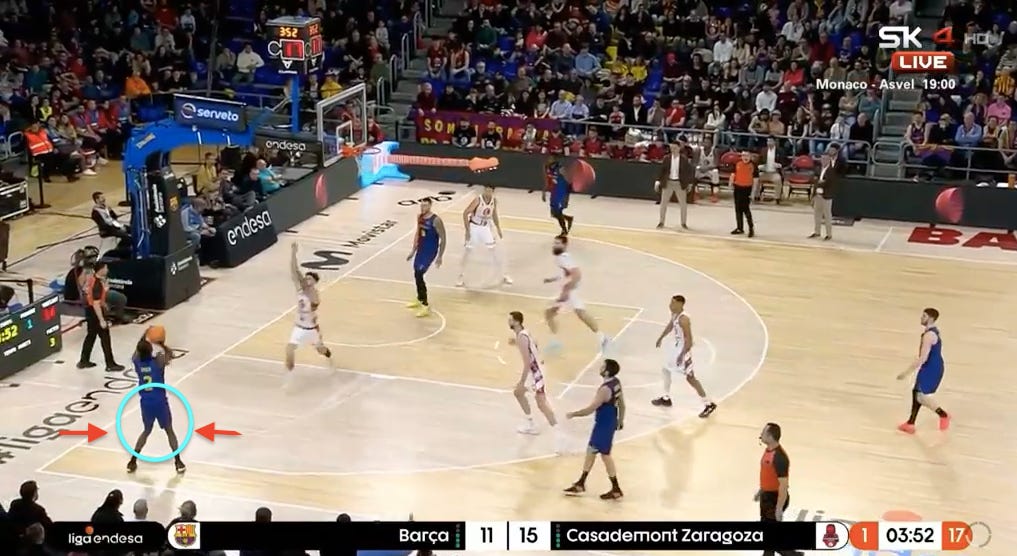
Credit goes to Duke’s staff, Sarr, another coach or all the above, because he made major strides with his lower-body mechanics and base as a 3-point shooter this past season.
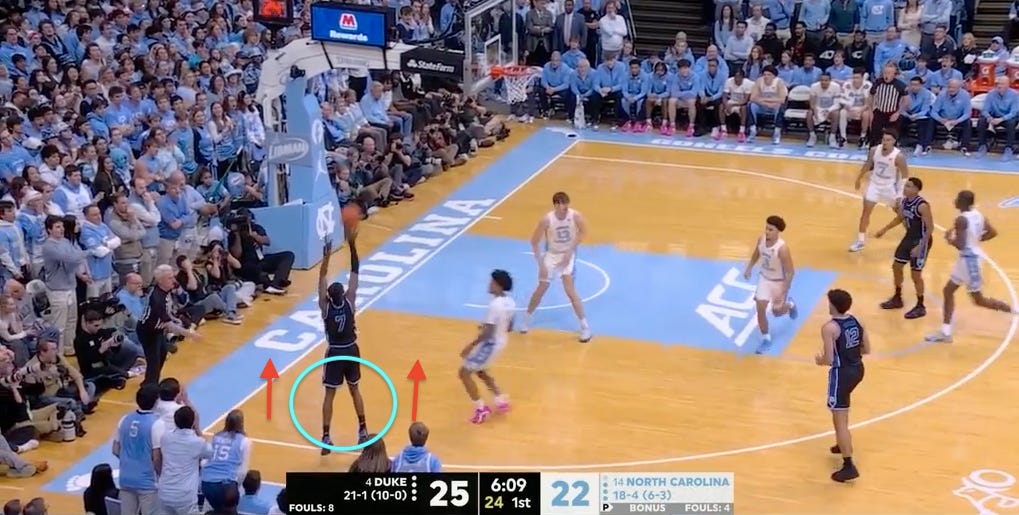
As a result, Sarr shot a pretty good ball off the catch, especially from the corners, where the improved process allowed Sarr to cleanly get into his motion off slight movement.
While many of Sarr’s 3-point attempts come on stationary spot-ups, he’s flashed good relocation instincts — hustling his way into high-value catch-and-shoot looks.
Here, after a Brown offensive rebound, Pittsburgh’s defense is scrambled. As Evans drives to the rim, the Panthers collapse on both the ball and Cam Boozer cutting through the paint. An opportunistic Sarr capitalizes immediately, relocating from the top of the key to the right corner for a wide-open kick-out 3.
Sarr hasn’t shown much comfort or smoothness shooting off hard movement; he still needs time, space and his feet set to get catch-and-shoot jumpers off cleanly. We’ll see if that expands next season, but for now: static spot-up looks will continue to dominate his 3-point portfolio.
If Sarr makes even a modest leap as a spot-up shooter and plays with more physicality as a finisher, he has the potential to be a menace as a catch-and-go slasher. Given his length and quickness, Sarr should consistently put pressure on the rim against hard closeouts and tilted defenses.
On this possessional NC State, Matt Able (3) takes an undisciplined approach, as the threat of Sarr’s corner three forces a wild closeout. With Boozer sealing Ven-Allen Lubin (22), Sarr gets a clear lane to the basket and explodes to the rim so quickly that Paul McNeil (2) doesn’t even have time to load up and contest.
However, the inconsistencies with his drives and the struggles of playing with force and powering through contact limit some of his vertical pop and finishing around the basket. If that weak-side contest comes from a better defender, and Sarr doesn’t have a clear path to the cup, the process can go sideways.
Arkansas wing Billy Richmond is an athletic freak and a demon on defense. From a Horns set, Sarr receives a kick-out from Cayden Boozer and skates past a poor closeout from Darius Acuff. Instead of powering up to dunk over Richmond, who rotates off Khamenia in the weak-side corner, Sarr angles his body and tries to get the ball up on the glass, opening up a portal for Richmond to swat the attempt.Despite his struggles, Sarr still showed promising flashes, using his combination of balance, guile and long limbs to finish in traffic.
Duke runs a designed post-up for Cam Boozer out of its “L” series against Kansas. The Jayhawks double Boozer and are forced into rotation when he skips the ball to the weak-side corner. Just as Duke’s staff drills, Darren Harris makes the extra swing pass to Sarr on the wing. Sarr attacks the closeout, displaces Melvin Council Jr. (14) as he gets downhill into the paint and plays through the contact to convert the layup.
(According to my charting data, though, this was Sarr’s only and-one finish last season.)
Sarr didn’t receive many live-ball passing opportunities as a freshman, but these catch-and-go moments opened up a few windows.
The Blue Devils flow into their secondary offense out of a drag ball screen between Boozer and Brown. As Syracuse puts two defenders on the ball, Sarr lifts along the right wing. Boozer kicks, and Sarr slashes. With his drive pulling in multiple defenders, Sarr spots Khamenia in the weak-side corner and delivers an accurate skip pass right into his hands for a corner-pocket 3.
Again, there’s still work to be done here, but the flashes — when combined with Sarr’s frame and competitiveness — are worth betting on. Duke’s roster features plenty of ball handlers for next season, including Foster, Blackwell, Boozer, Deron Rippey Jr. and Bryson Howard, alongside several frontcourt playmaking hubs in Ngongba, Scharnowski and Boumtje-Boumtje. While Sarr needs to step into more on-ball reps, these catch-and-go looks present a solid foundation for his development.
Sarr is an outstanding defender with good positional size/length. If he can continue to build strength while refining the fluidity of his spot-up 3-pointer and free throw stroke, he’ll remain a high-value piece for Scheyer and solidify his status as a legit NBA 3-and-D prospect. However, the area of his game with the most room for growth is his on-ball shot creation and playmaking
As a freshman, Sarr was deployed primarily as an off-ball spacer: a role that yielded a modest 15 percent usage rate and largely tasked him with finishing sequences initiated by others:
Sarr averaged 3.2 unassisted points per 40 minutes (11th percentile)
77.4% of total FGM were assisted (91st percentile)
56.1% of 2PM were assisted (92nd percentile)
51.4% of rim 2PM were assisted (83rd percentile)
According to my charting data, Sarr made just a single unassisted 3-pointer last season: an isolation step-back against TCU in the NCAA Tournament (rather than off a pick-and-roll). To say this shot was out of character would be an understatement, but the move itself was filthy, creating effortless space for the step-back.
This profile aligns with his previous role with Barcelona’s senior team. Sarr has been molded into a 3-and-D wing — anchored by elite defense and complemented by occasional glimpses of live-ball creation. He doesn’t need to take flight as a lead ball handler this season; that isn’t in the cards, barring an outlier developmental leap.
That said, his mix of size, athleticism and off-beat driving verve provides the template for a player who can do more with the ball. Expect opportunities for Sarr to operate as a secondary creator and second-side ball handler in Duke’s offense this season. The Blue Devils can simplifying things, too, by designing looks that involve a ball screen and a quick 1-2 read, like this zone possession vs. Florida State.
Extra reps will certainly help, but for Sarr to make a real leap, that added strength needs to translate into finishing through contact and absorbing bumps at the rim.
He looked stiff and upright at times with the ball in his hands last season, leading to awkward drives downhill where he struggled to navigate tight lanes and absorb contact. Occasionally, it feels like Sarr tries to avoid his weakest tendencies in advance, but he doesn’t quite have the handle in space to pull it off.
However, when Sarr plays loose and poised, there’s a funk and creativity to his playmaking package.
Late in the shot clock against St. John’s, Sarr dribbles right off a screen from Boozer to draw a switch. Ruben Prey (17) is a capable perimeter defender for a big, but Sarr still turns the corner on the 6-foot-10 Prey. As Sarr drives, Brown tries to shield Zuby Ejiofor (24) on a deep seal. Ejiofor swims around Brown’s screen to contest Sarr — pulling a second defender to the ball and leaving Brown open at the rim. Falling out of bounds, Sarr lofts up what appears to be a wild, desperate shot attempt; instead, it’s a crafty lob pass back to Brown, who draws a foul on the cut finish.
In their NCAA Tournament matchup against UConn, Cam Boozer sets a down screen for Sarr in the middle of the floor, then immediately lifts to set a step-up ball screen. UConn’s defense is in sound position: Tarris Reed (5) drops in coverage, Alex Karaban (11) digs into the gap to Sarr’s right and Solo Ball (1) fights over the screen to pursue from behind.
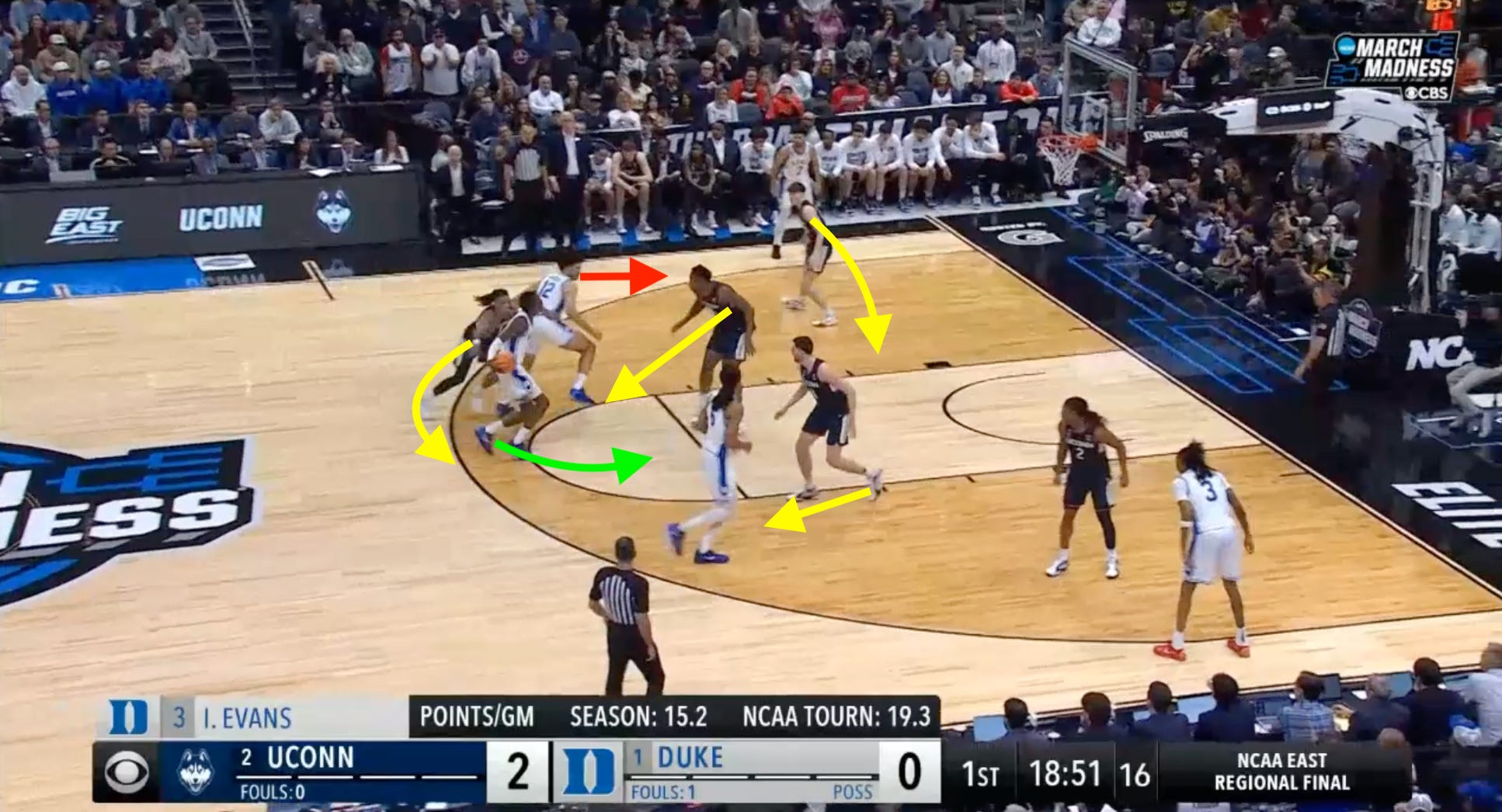
Early in the game, though, Sarr actively looks to challenge the defense with the ball. He uses a right-hand hang dribble that carries him deeper into the paint, putting direct pressure on Reed’s drop coverage: either commit more attention to Sarr and open up Boozer on the roll, or stick to Boozer and expose the rim for a driving finish. Reed tries to stunt at Sarr and recover to Boozer, but Sarr stays aggressive and goes straight to the hoop.
This isn’t a super explosive, above-the-rim finish from Sarr, which provides a snapshot of where he stood as a pick-and-roll driver last season. According to my charting data, this was one of only two unassisted rim finishes Sarr generated out of the pick-and-roll all year. If not for Reed vacating the lane, this attempt likely gets squashed, but here, it gets the job done here despite only a token contest from Karaban.
On this possession against UNC, Sarr starts out by setting an inverted ball screen for Cam Boozer. Jarin Stevenson (15) contains Boozer’s drive, forcing a reset to Sarr at the top of the key. Working out of flow, Brown lifts up to slip a ball screen for Sarr, who drives left with Henri Veesaar (13) in drop coverage.
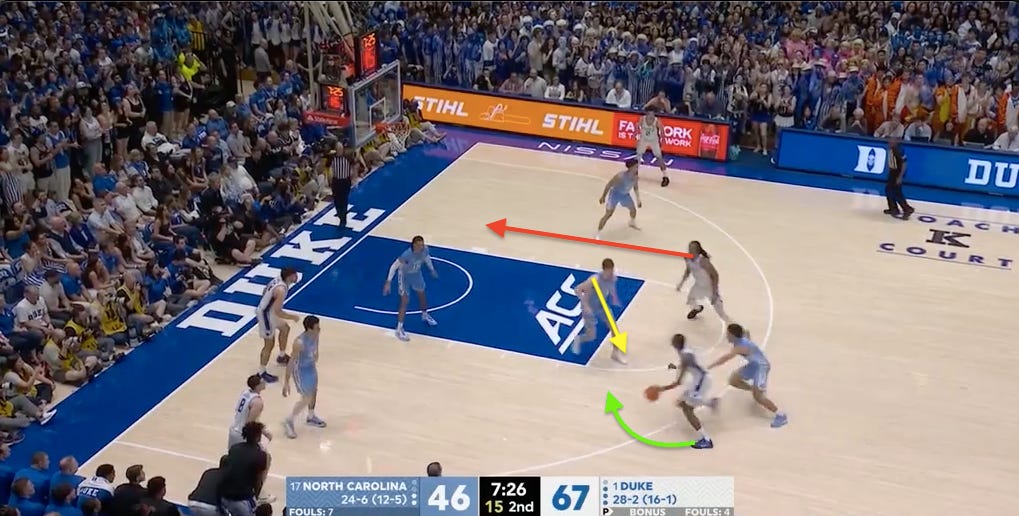
With UNC’s defense loaded to that side of the floor and Sarr offering little threat as a pull-up shooter, Veesaar should stay home on Brown’s roll. That’s not what happens, though. As Sarr approaches the paint, Veesaar gets antsy and shades toward the ball. On the back side, there’s no tag from Seth Trimble (7) and Brown has a clean runway to the rim — allowing Sarr to take advantage and loft an easy lob finish.
These flashes of poise and manipulation against drop coverage suggest there is untapped upside for Sarr with the ball. They also highlight clear growth in his pick-and-roll decision-making compared to earlier in the season.
Moreover, there were a couple of occasions last season where Sarr took advantage of scrambled defenses, getting downhill on pick-and-rolls or dribble-handoffs following an offensive rebound. For instance, this rim finish is set up and assisted by Boozer, with Ngongba providing an additional seal in the lane, but Sarr shows a bit more burst on his path to the rim.
After an offensive rebound by Ngongba, Duke resets into an empty-side pick-and-roll with Sarr as the initiator. Donnie Freeman (1) does a poor job hedging out, allowing Sarr to glide past the screen defender and turn the corner downhill. William Kyle (42), an excellent rim protector, rotates over to contest, but Sarr has inside leverage with a good angle and explodes to the rim for the layup.
Dame Sarr’s primary value proposition lies in his game-changing defensive profile. At 6-foot-8 with a near 7-foot wingspan, Sarr established himself as one of college basketball’s premier defenders as a freshman, comfortably guarding positions 1-4. His lateral quickness, screen navigation skills and motor help him to neutralize top-tier creators, while his instincts as a help defender — highlighted by peel switches, gap help and rim protection — make him an all-court defensive talent.
Offensively, Sarr thrives in a low-usage, high-efficiency roles. However, he could scale his game up next season. Sarr excels in the open floor and displays a good feel for finding open pockets as a cutter in Duke’s 5-out offense. While his free throw percentages present concerns as an indicator of touch, Sarr proved to be a reliable spot-up option from the corners (41 3P%) after making notable mechanics-based improvements to his release.
To fully unlock his ceiling and expand beyond a 3-and-D archetype, though, Sarr’s immediate focus must be physical development and on-ball growth. Adding upper body strength will improve his finishing through contact (57.4 FG% at the rim) and allow him to convert downhill catch-and-go drives more consistently.
If Sarr can refine his handle and build off his flashes of live-ball playmaking, he has the tools to evolve into an elite high-major force and bolster his status as an NBA prospect.
No posts
Comments
Nothing yet. Say the first thing.
Sign in to join the conversation.