
Note: This story was originally published in May on The Devils Den, the 247Sports site dedicated to Duke coverage. With TDD’s permission, I am sharing my scouting report on Joaquim Boumtje Boumtje here as well, now that he’s officially at Duke. Huge thanks to TDD for their flexibility. Since that initial publication, Boumtje Boumtje has collected consecutive championship titles and MVP trophies, first with Barcelona at the EuroLeague Next Gen Tournament, and then with the United States at the FIBA U17 World Cup. If you would like to read more about JBB in FIBA play, check out my piece on several of the top prospects from that event, which was published in early July.
The do-it-all, playmaking 4 is a staple of Duke basketball. While the prevalence of that positional archetype became standard under Mike Krzyzewski, it has evolved during the Jon Scheyer era. With a stylish 5-out offense, the Blue Devils feature and maximize their talented 4s and 5s: Kyle Filipowski, Cooper Flagg, Cameron Boozer, Maliq Brown and Patrick Ngongba.
Now, with an April 2026 commitment, Joaquim Boumtje-Boumtje has a chance to become the next link in that chain.
Sections of Joaquim Boumtje-Boumtje scouting report:
At 7-foot, 230 pounds, Boumtje-Boumtje has tremendous size and mobility, though he isn’t a particularly springy or explosive athlete. He’s more of a glider, using long strides and his wingspan to make plays on both ends of the floor.
While Boumtje-Boumtje is somewhat slender right now, he’s fairly well filled out and has the frame to add strength. He also doesn’t lack physicality or shy away from contact, whether slashing to the rim, sealing in the post or crashing the defensive glass. There are possessions where he shows strong absorption as a driver, which complements his length and overall skill set.
The most appealing aspect of Boumtje-Boumtje’s game is his combination of size and movement. That’s the primary reason to buy into his long-term upside. He’s coordinated, with solid footwork and balance, which he pairs with good offensive feel — as a frontcourt creator.
At the moment, the southpaw relies heavily on his left hand for both ball-handling and finishing, which isn’t surprising given his age. This will require development, but it’s relatively low-hanging fruit. While his trajectory is progressing quickly, with Boumtje-Boumtje eligible for the 2028 NBA Draft, he has two years to refine his game. Patience and sustainability should be the focus; as he transitions to college basketball, he’ll need to adapt and scale his game to a more physical style against older competition.
This creates an interesting opportunity for Duke and its developmental staff. Can Duke become the first program to truly foster multi-year growth for a reclassifying prospect? Jayden Quaintance remains one of the top center prospects for the 2026 NBA Draft despite appearing in just 28 games across two college seasons due to injuries. But while his college career never fully took off, it was also split between two programs: Arizona State and Kentucky.
JBB is often labeled a positional tweener, caught between power forward and center. However, he projects more clearly as a full-time 4 who could eventually log minutes as a small-ball 5. He doesn’t possess the above-the-rim explosiveness to anchor a defense as a solo rim protector and dominant rebounder.
Offensively, he doesn’t fill the traditional role of a 5, either. He played the 4 in Barcelona’s system, alongside talented centers such as UNC commit Sayon Keita, Mohamed Dabone (one of the top international prospects), Abdrahamane Kone and Mohamed Namakan Keita. JBB doesn’t operate out of the dunker spot or consistently rim-run after setting ball screens. Instead, he prefers to pop into space along the slots and wings.
If anything, that profile makes him a natural fit as a jumbo playmaker in Duke’s system. He can function as a trailer in Duke’s secondary break, then initiate offense as the team flows into its sets. JBB is well-suited to run 4-5 pick-and-roll, come off down screens, facilitate from the high post and space the floor as a pick-and-pop threat.
A significant portion of Boumtje-Boumtje’s upside is tied to his ability to create with the ball in his hands. That said, as he works to scale his game within Duke’s system — particularly in a crowded, ultra-talented frontcourt — he’ll also need to thrive off the ball. JBB posted a massive usage rate of just under 29 percent this season across all competitions with Barcelona’s junior teams, per RealGM, emerging as one of the primary go-to scorers in Spain’s Liga U.
Assuming he remains in Durham for the 2027-28 season, JBB could approach that level of usage as a de facto sophomore. In the meantime, it’s important that he lean into being a downhill finisher off movement, operating as a half-court cutter and running the floor in transition.
On this possession, Barcelona plays through Dabone in the right slot, with a low split action in the strong-side corner. Boumtje-Boumtje starts in the right corner. As Dabone turns to face, Nikola Kusturica — a highly regarded wing prospect in Barcelona’s system, one that every high-major program in the country should be after — cuts toward JBB. Just before Kusturica can set a down screen, the two split in opposite directions. Boumtje-Boumtje cuts backdoor along the baseline, and Dabone finds him for a reverse layup.
Those half-court cuts can also open passing opportunities for Boumtje-Boumtje. He has a strong feel for pace, moving without the ball and advancing it ahead of the defense’s rotations.
Here, JBB cuts to the right short corner against Real Madrid’s zone. As soon as he receives the entry pass, he immediately looks opposite and fires a skip pass over the top. While it doesn’t lead directly to a shot, it creates an advantage and puts the defense into rotation — eventually producing an open spot-up look from the left wing.
Duke is loaded in the backcourt, but the Blue Devils are poised to run much of their offense through Ngongba next season. He’s already one of the most talented passing big men in the country, whether operating from the low post or initiating at the top of the key. A healthier, better-conditioned version of Ngongba — with another offseason of development — should emerge as one of the premier half-court hubs in Division I hoops.
As Cam Williams and Boumtje-Boumtje look to build chemistry with Ngongba, they’ll find success if they cut hard in Duke’s split actions, get on the offensive glass and run the floor.
Early against Stanford, Duke flashes Ngongba to the pinch post and has Boozer set a flare screen for Isaiah Evans, with the weak-side corner emptied following Dame Sarr’s cut. Evans draws two defenders to the empty side, allowing Boozer to slip to the basket for a layup off a sharp read from Ngongba.
Next season, Duke will rely heavily on John Blackwell’s 3-point gravity to open up these types of cuts, which benefit JBB and Williams.
Boumtje-Boumtje is also an opportunistic transition player. He looks to get out and run, and in the open floor his long strides make him a quality finisher on the break.
After an impressive back-line steal from Kusturica, JBB sprints the floor and finishes the play, punctuating a rim-to-rim fast break with just one dribble. Dabone initiates the thrust up the court with a well-timed hit-ahead bounce pass.
JBB isn't just a pure finisher in transition; he can also function as a link-up player and connective passer, helping teammates get into high-percentage looks with timely deliveries and strong open-floor vision, as shown in this find against Bayern Munich.
This part of JBB’s game should fit well alongside Sarr, a fellow Barcelona alum and open-floor threat, as well as guards like Caleb Foster, the turbo-charged Deron Rippey Jr. and Cayden Boozer — a pacey transition player and skilled hit-ahead passer. That group is complemented by athletic rim-runners Williams and Drew Scharnowski (44 dunks, 75.2% FG at the rim), both of whom can finish above the rim. Sarr and Sebastian Wilkins also provided athleticism and transition pop as two big wings on the roster.
On this transition opportunity, Boumtje-Boumtje establishes early post position, spins into the paint against a cross-match and finds Kusturica on a delayed cut.
Duke’s defense projects as an elite unit next season. According to Bart Torvik’s 2027 model, the Blue Devils are projected as the No. 2 defense in the country. Deflections, steals and long rebounds should all serve as a green light for instant offense in transition.
The 7-foot Boumtje-Boumtje presents another intriguing option who should be able to provide some positive impact.
For a big man prospect, Boumtje-Boumtje already shows a fairly advanced catch-and-shoot jumper. He profiles as a positive stretch option in the frontcourt, with the ability to score from both deep and midrange.
It’s a basketball cliche to praise the aesthetics of a lefty’s jumper, but his upside goes beyond visual appeal. There’s real fluidity to his shot as he takes the ball on the catch and flows into his gather. JBB doesn’t have a hitch; he moves cleanly into his jumper, finishing with a wrist snap and a high release that allows him to get it off over contests.
According to RealGM, Boumtje-Boumtje shot 32.8 percent from beyond the arc in the 2025-26 season (40-of-122 3PA) across all competition, while attempting 4.1 3s per game (7.1 3PA per 40 minutes).
Like any young shooter preparing for a jump in competition, Boumtje-Boumtje will need to continue honing his shooting motion, streamlining it for efficiency and speed. This becomes especially important for spot-up and pick-and-pop shooters as the defenders and defensive schemes they face grow bigger and more complex.
JBB shows some intriguing shot-making tools, including a step-back from the corner on this possession, but he's forced to work off the dribble because he doesn't quite have the confidence to get the initial spot-up look off against a closeout.
To be clear, this is more of a marginal adjustment than an existential one. JBB has a quick, feathery release off the catch, but he played on loaded Barcelona junior teams this season, often matched against smaller defenders. Those physical advantages will shrink when he faces veteran high-major athletes, so the more compact his release is against high-level contests, the better.
There’s plenty of versatility to his shot-making, too. He isn’t strictly a spot-up three-point shooter. Boumtje-Boumtje can be used as a target off down screens and handoffs, and his game also features midrange touch.
Boumtje-Boumtje runs a pick-and-roll at the top of the floor against Real Madrid. After the defense switches, he gives up the ball, then relocates, gets it back and knocks down a tough step-back midrange jumper late in the shot clock.
JBB is also advanced in his ability to shoot off movement, especially for a 7-footer: down screens, flares or dribble handoffs. There just aren’t many players at his size, particularly at his age, who can do this type of work with pace and fluidity coming off pindowns.
(Note: I love this play design from Barcelona. It’s a great use of the “Iverson” cut as a decoy to set up “Elevator Door” action to the left wing for JBB.)
On this possession, Barcelona initially appears set to run “Flex” action, with Boumtje-Boumtje setting a baseline screen for Kusturica from the left corner.
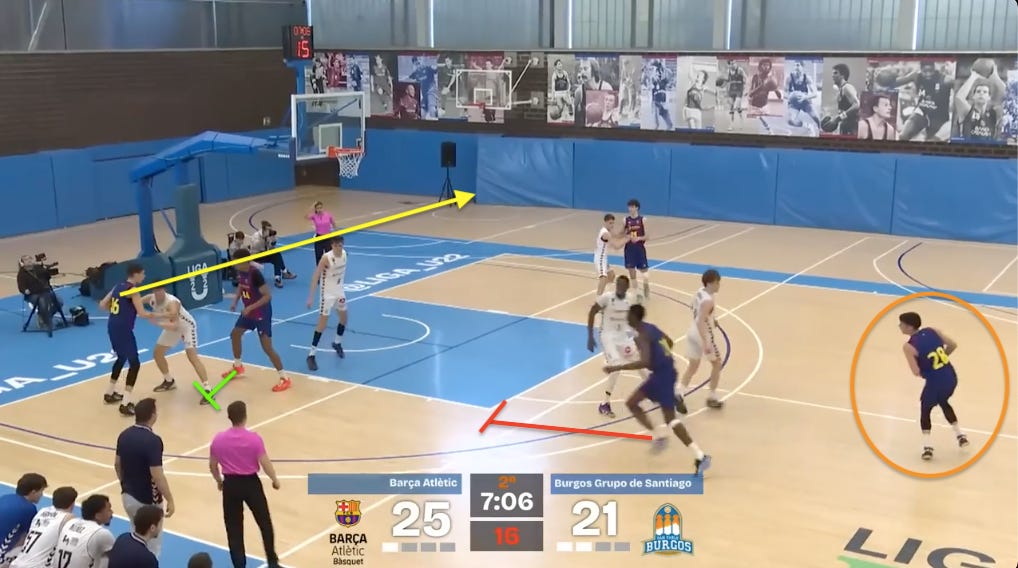
Instead of cutting along the baseline off JBB's Flex screen, Kusturica lifts to the left wing, curling off a down screen set by the Chapel Hill-bound Keita. After Kusturica's rejection, JBB sprints to the right side of the floor, running off a wide pindown.
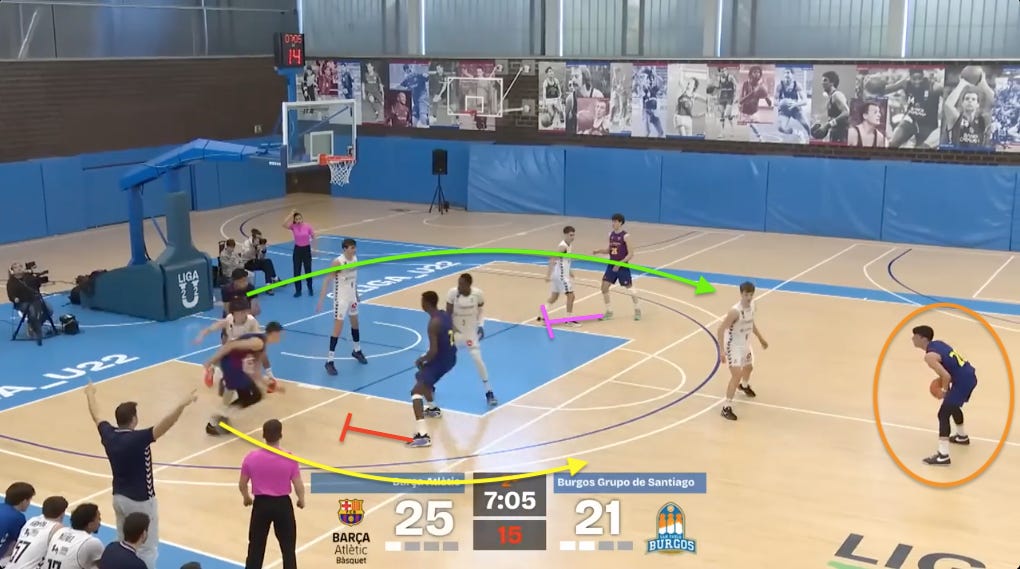
With his defender stuck on the down screen, JBB comes off flat, squares his feet and shifts directly into his motion. This is a strong display of movement shooting from Boumtje-Boumtje, and it’s a reminder that defensive 4s are often not the most effective at chasing players around screens in off-ball actions.
After an offensive rebound for Joventut Badalona, JBB sprints to the corner and becomes a kick-out option out of a random handoff against a scrambled defense. He flows right into his jumper and drills the triple.
An added reason for optimism: JBB reinforces belief in his long-range shooting potential with a strong free-throw percentage — 78.2 percent from the line — an important indicator of shooting touch.
With his ability to shoot off the catch, Barcelona used Boumtje-Boumtje in a variety of pick-and-pop actions this season, especially out of “Horns” or “3 Across” sets. The pop is a simple but effective way to create half-court advantages — particularly early in the shot clock — and get JBB into space above the break, where he can look for his jumper.
Late in the first half against Real Madrid, JBB gets a clean look on the pop out of Barcelona’s “3 Across” set, with three players spaced along the baseline and the 1 and 4 working ball-screen action in the middle third of the floor.
Once again, Boumtje-Boumtje is comfortable shooting off slight movement, and he can really stress matchups when defenses choose not to switch these screens.
This action type is en vogue right now. “3 Across” has become a popular series in college basketball, especially as several high-major programs lean more heavily into double-big lineups. In fact, here’s an after-timeout possession for Duke at Louisville, with the Blue Devils going to 3 Across to get Boozer a 3-pointer. Foster draws two defenders and finds Boozer for a pop 3 in the slot.
You can expect the Blue Devils to get into these ball-screen actions out of 3 Across with a variety of combinations from their frontcourt rotation.
The stretch elements of JBB’s game — pick-and-pops and trail possessions — enhance his fit alongside a 5 who likes to rim-run, post up or both. JBB can help create spacing in double drag actions, where he sets the first ball screen and pops while the 5 sets the second screen and dives, or in hi-lo sets, where he pops and the 5 seals inside for position.
These hi-lo actions allow JBB to build or maintain advantages as a connective passer, syncing up with the five on quick hitters that punish rotating defenses.
With a strong seal from Kone, Boumtje-Boumtje sees a window and delivers a slick bounce pass on the hi-lo entry.
This is another way Duke can blend and generate synergy from its frontcourt combinations. The Blue Devils used a lot of hi-lo action in the 2025-26 season — an obvious fast track for offense given the collective passing talent of Boozer, Ngongba and Brown, including out of secondary break.
Boozer proved to be the perfect trail man in these scenarios, drawing defenders with his three-point gravity and linking up with Ngongba and Brown. It’s premature to compare JBB to Boozer, an incredibly skilled and physically developed prospect even before arriving in Durham. That said, Boumtje-Boumtje should still be able to find success along similar pathways within Duke’s system.
Whether off pick-and-pops, curls around down screens or spacing outside the action, the gravity JBB generates with his jumper creates catch-and-go opportunities against closeouts and rotating defenses.
JBB can cover ground with long strides and smooth, polished footwork in these situations, but his catch-and-go drives also unlock some of his best moments playing with force.
Of the games I charted, this is one of my favorite drives from Boumtje-Boumtje. He gains baseline leverage with a quick first step, then uses his right shoulder to carve his way to the rim — absorbing contact and finishing through it for an and-one layup.
Barcelona goes to more pop action for JBB out of 3 Across. Off the catch, he attacks the feet of the Madrid big man scrambling to close out. With his defender backpedaling, Boumtje-Boumtje drives downhill, uses a half-spin to create separation and finishes with his left hand for another and-one.
This is where Boumtje-Boumtje has a chance to become a special prospect: can he continue to grow as an on-ball creator? He already has the tools to elevate an offense as a play finisher, connective passer and tertiary facilitator. However, his skill set is diverse enough to suggest a pathway toward driving offense through live-ball creation.
Boumtje-Boumtje doesn’t necessarily need a ball screen to initiate, though his isolation game remains somewhat limited. He prefers to drive left or get to his jumper when pushed right. It’s a work in progress, but he can create separation with his handle, including on step-back attempts.
Real Madrid’s defense disrupts the initial ball-screen action as JBB initiates the possession for Barcelona. When the ball cycles back to him, he goes to work and creates space with a snappy step-back dribble.
It’s also encouraging when JBB leans into his physicality on these isolated drives. Moves like this don’t show up often, but they’re simmering beneath the surface and could become more prominent as he adds strength. Sequences like this hint at a future where JBB can function as a mismatch weapon: hunting switches, attacking varied matchups and forcing defenses to send help.
Boumtje-Boumtje slips a screen along the left wing, then receives the ball for a more isolated look. Instead of settling for a jumper or trying to beat his man off the dribble, he initiates a “Barkley-style” drive — backing down from the perimeter. With no help coming, he powers his defender into the paint, finishing with an up-and-under move while drawing a foul.
Barcelona also used him coming off down screens in early offense within its “Wide” action. Also known as “Single Away,” this is a 5-out high pindown set by the player at the top of the key for a trailing weak-side guard, wing or big.
After the initial pindown, JBB can catch and flow directly into 4-5 pick-and-roll, including this possession with a step-up ball screen from Dabone. Trento switches the 4-5 action, but matched against the opposing 5, JBB flashes his handle and a bit of wiggle — crossing over and getting downhill with his left hand.
Here's more Wide action for JBB against Real Madrid, again flowing into 4-5 screen-and-roll with a step-up. This time, the opposing 5 plays drop coverage below the level of the screen, allowing Boumtje-Boumtje to dribble into a pull-up elbow jumper.
On this possession against Baskonia-Alves, Boumtje-Boumtje gets another switch. He attacks immediately off the 4-5 ball screen with a crafty in-and-out crossover — using his right hand — to get downhill into a gap before returning to his left for an inside-hand finish.
This is an excellent move from Boumtje-Boumtje, but it also highlights his reliance on his left hand. Long term, the hope is that he can not only finish this drive with his right, but also rise up and punch it home over the top with a dunk.
Against Bayern Munich, JBB gets a middle-third ball screen from Dabone. Munich switches the action, and Boumtje-Boumtje drives right against his new defender. As he gets downhill into the paint, though, he doesn’t create much separation or space. The angle to the basket isn’t great, and when he tries to get back to his left for another inside-hand scoop, he ends up shooting it into the bottom of the rim.
Boumtje-Boumtje isn’t totally opposed to finishing with his right hand. However, he’s less comfortable driving in that direction, which leaves him exposed to digs and swipes at the ball, and he doesn’t finish with the same level of force.
In that same ANGT matchup against Baskonia-Alves, JBB gets an open-floor opportunity along the right flank early in the game. Instead of attacking downhill on a straight line, he veers left into an unnecessary spin before coming back right, where he’s unable to finish through contact.
JBB runs another pick-and-roll with Dabone against Gran Canaria. He has a lane to the rim, but instead of powering through to his right, he opts for a Euro step in the middle of the lane, which gives the opposing center time to rotate over and swat a somewhat soft attempt at the basket.
Defenses will spot and scout these tendencies and look to push him in that direction, steering him toward his right hand. There’s plenty of time for him to develop that side, but it’s worth noting that — at this stage — he struggles going that way when there’s traffic in the paint.
JBB can be an effective passer when there’s a preexisting advantage, whether in the open floor or on connective reads off the catch. Given his skill set, though, Boumtje-Boumtje also flashes impressive playmaking upside as a primary initiator, operating in pick-and-roll out of Barcelona’s Wide series.
This is one of the traits that adds to his appeal as a screen-and-roll creator. He doesn’t develop tunnel vision with the ball; Boumtje-Boumtje can read defenses, identify openings and find teammates for high-quality looks at the rim. That includes some clever manipulation.
Early against Bayern, Boumtje-Boumtje works a step-up ball screen from the left slot, flowing out of “Wide” action. Munich’s 5 is positioned below the level of the screen but still fairly high — likely to deter the jumper. JBB counters by faking a gather into a shot, drawing the big off his feet and opening up Barcelona’s five on the roll.
Now, his scope as a passer in these ball-screen situations is a bit narrow. With a live dribble, he doesn’t yet show the same all-court vision he displays as a spot-up or post-up/cut passer. That said, JBB’s ability to find his rim-running teammate is notable, especially when he’s able to engage the back-line defender and make — what Jon Scheyer would call — quality “paint decisions.”
JBB doesn’t yet have the brute force to consistently overpower capable post defenders, though he can keep them off balance with a series of fakes and step-through moves. With his speed and length, Boumtje-Boumtje can carve out post position for low-block finishes on hi-lo feeds and quick duck-ins.
Barcelona borrows a page from Matt Painter’s playbook at Purdue and runs a scripted hi-lo action out of a Box set. JBB sets a cross screen to help clear the weak side, then seals in the paint for a lob over the top.
On this end-of-half play, Barcelona generates a hi-lo touch for Boumtje-Boumtje off a roll-replace action from a “3 Across” design. With his defender engaged in the ball screen, JBB is able to establish deep position and seal, creating a passing window. From there, his hands and fundamentals stand out as he snags a tough pass in traffic and keeps the ball high for the finish.
Here’s another after-timeout play against Munich as Barcelona goes to Horns hi-lo action, with Dabone popping and Boumtje-Boumtje sealing in the paint.
Notice, though, that JBB often has to spin off his right shoulder to finish with his left hand on these interior looks. Similar to some of his perimeter limitations, Boumtje-Boumtje can struggle when post defenders force him to his right.
On this post-up off the right block, the Real Madrid defender is physical in denial, preventing JBB from turning middle and getting to his left hand. As a counter, Boumtje-Boumtje spins toward his right, but he doesn’t create much separation and still tries to finish with his left, which gets blocked.
He isn’t automatically drawing double teams when he touches the ball in the post, so Boumtje-Boumtje isn’t yet the type of interior threat who consistently picks defenses apart as a passer, though he did post a 15.5 percent assist rate across all competitions this season, per RealGM. He can, however, function efficiently as a low-post passer within designed actions that feature cutters.
To that end, Barcelona would occasionally run this split-post action with JBB starting on the right block and facing the middle of the floor.
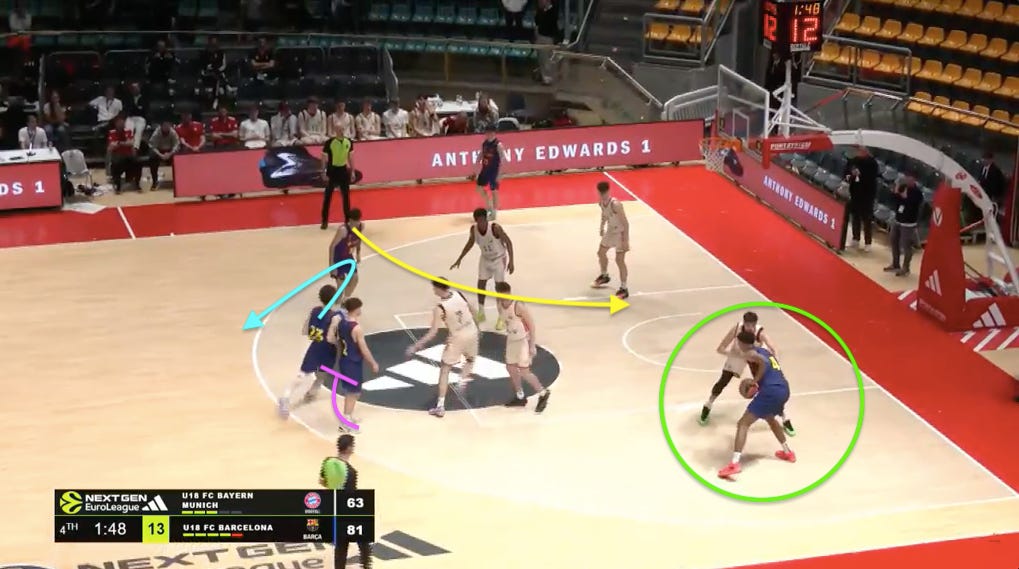
Three off-ball players converge in the middle of the floor. Two of them move in the same direction and loop around one another: one cutting to the rim, while the other, the player who initiated the entry pass, curls back toward the ball off a down screen. It’s a simple read, nothing overly complex, but precision matters, and JBB delivers a timely pass for a layup on the cut.
Barcelona goes to more of a low split action in the right corner on this possession against Trento, with Boumtje-Boumtje now operating from the right elbow. Trento defends the split cut well, but JBB still tries to force the pass, resulting in a turnover.
Duke orchestrates a lot of its offense through the high post, with split cuts, basket slips and flare screens orbiting around the middle hub. That’ll be the domain of Ngongba, in particular, and Scharnowski next season, but given JBB’s size and feel as a passer, expectations should also include some 5-out initiation from the slots, elbows and the top of the key.
This side of the floor is where Boumtje-Boumtje most clearly reinforces his identity as a 4: defense. Modern basketball has embraced a more positionless framework, including decentralized playmaking structures, frontcourt shooting and increased switching schemes, along with more positional cross-matching on defense. While that can blur traditional roles at times, there’s still an old axiom: you are the position you defend. On defense, JBB guards forwards for Barcelona.
Working in concert with his primary assignment, Boumtje-Boumtje doesn’t block a high volume of shots in the traditional big-man sense — stonewalling drivers in drop coverage or rotating as a weak-side rim protector, though he mixes that in from time to time. In those pockets of space, he shows very good awareness and anticipatory skills on this side of the floor.
By the numbers, he was a fairly disruptive defender, leveraging his size and activity to post a 2.4 percent steal rate and a 3.3 percent block rate. As a help defender on the back line, JBB showed the ability to cover ground and complete multiple rotations within a single possession.
He’s most impactful as a team defender when helping in gaps and passing lanes, where he can use his length and anticipation skills to create havoc and force turnovers.
Boumtje-Boumtje is in the gap on this play and slightly overplays trying to get back to his man, forcing him to spin around. Still, he’s able to extend and get his hands on the pass, coming up with the steal and flowing right into a behind-the-back dribble, which leads to a grab-and-go finish on the break.
JBB posted strong rebounding numbers this season, too, but he’ll need to show he can translate that impact against larger, more physical defenders at the college level. At 7 feet, there are plenty of reasons to believe he can make the leap, including his ability to secure contested and out-of-area rebounds. That part of his game feels fairly stable.
There’s also the on-the-ball portion of his defense.
When covering ball screens, JBB was used in a variety of coverages, but switching was his primary look, and that’s likely to remain the case at Duke, though the Blue Devils leaned more heavily on hedging with 4 fours last season, primarily to keep Cam Boozer out of difficult matchups. Boumtje-Boumtje is long, smooth laterally and sturdy enough to switch and contain a range of positional types.
He may struggle against some of the more jittery, twitchy drivers, but he can hang in a variety of matchups and is capable of deterring shots with either hand.
No posts
Comments
Nothing yet. Say the first thing.
Sign in to join the conversation.