
NC State’s Top 20 offense delivered one of its most efficient performances of the season in an 85–45 win over Liberty. The Wolfpack scored 1.26 points per possession, shot 21-of-36 on two-point attempts (58.3 2P%) and 10-of-24 from beyond the arc (41.7 3P%) and posted a turnover rate of just 11.9 percent (8 turnovers).
Eight players scored six or more points, including four in double figures. NC State assisted on 17 of its 31 field goals, good for an assist rate of 54.8 percent.
Thanks for reading Split The Action! Subscribe for free to receive new posts and support my work.
Early on, NC State looked to isolate Darrion Williams and get him going in the mid-post. There was also plenty of 5-out action in the offensive mix. However, one of the more striking features of the Wolfpack’s attack was its intentional use of guards as ball screeners.
This isn’t a new concept for Will Wade. Last year at McNeese State, his team frequently played “matchup ball” by having guards serve as on-ball screeners, often targeting smaller defenders with 6-foot-6 point guard Quadir Copeland — a tactic I detailed in my breakdown of Wade’s pick-and-roll offense back in March.
When assistant coach Adam Howard, now NC State’s offensive coordinator, oversaw Nebraska’s offense, his scheme likewise employed numerous guard-to-guard actions, including this “Weave” concept intended to generate a switch for Bryce Williams (3).
The Wolfpack have also used guard-guard screening actions this season. The difference against Liberty was the sheer volume of guard screens and the spacing template built around those actions.
According to my charting, NC State’s offense had 19 half-court possessions featuring a guard setting a ball screen that was integral to the play’s design and outcome — not including guard-guard handoffs. That’s a high volume, and it’s the most in a single game for the Pack this season.
Now, to understand how and why this approach was so effective, let’s take a look at three different concepts NC State used to flow into these guard-guard screens: 3 Across, Ram and Flow.
3 Across
One of the more popular half-court pick-and-roll setups in college hoops right now is a spacing template often referred to as “3 Across.” The concept is simple: three offensive players are spaced across the baseline while two others run a pick-and-roll action above the key.
This alignment lets the offense dictate matchups by choosing which players — and which defenders — it wants involved in the action. By placing two shooters in the corners instead of the wings and keeping another player near the rim in the dunker spot, the offense flattens the defense and creates double-gap driving lanes. With no offensive players at the wings, there are no help defenders stationed at the elbows.
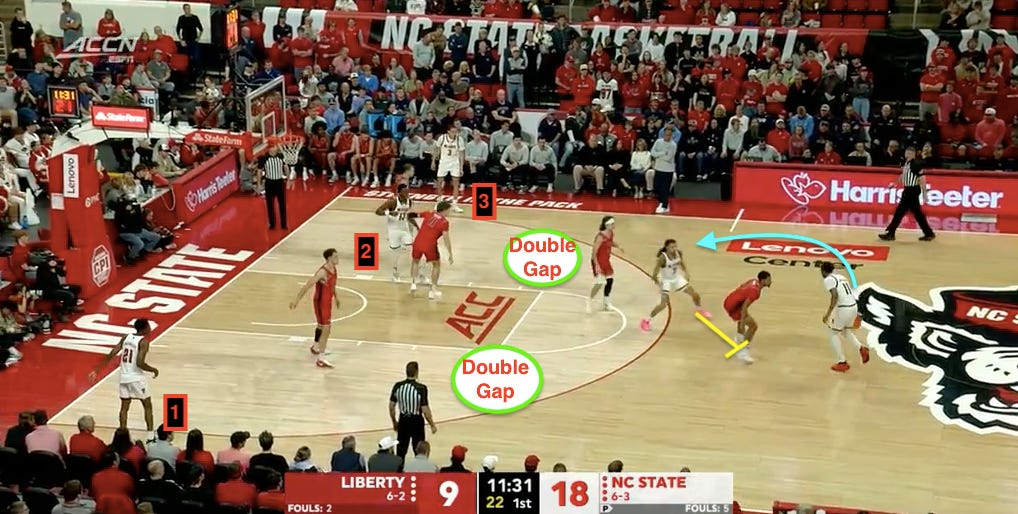
In theory, this forces the defense to guard the action 2-on-2, and the offense can make it even tougher by exploiting the double gaps. If the screener sets the pick flat — with his back to the baseline rather than angled — the ball-handler can drive in either direction. And if the defense involves a third defender to help on a pop or a drive, it should open up a teammate for a kick-out 3 or a look right at the basket.
Often, the offense will have one of the bigs, the 4 or the 5, set the ball screen while the other sinks to the dunker spot.
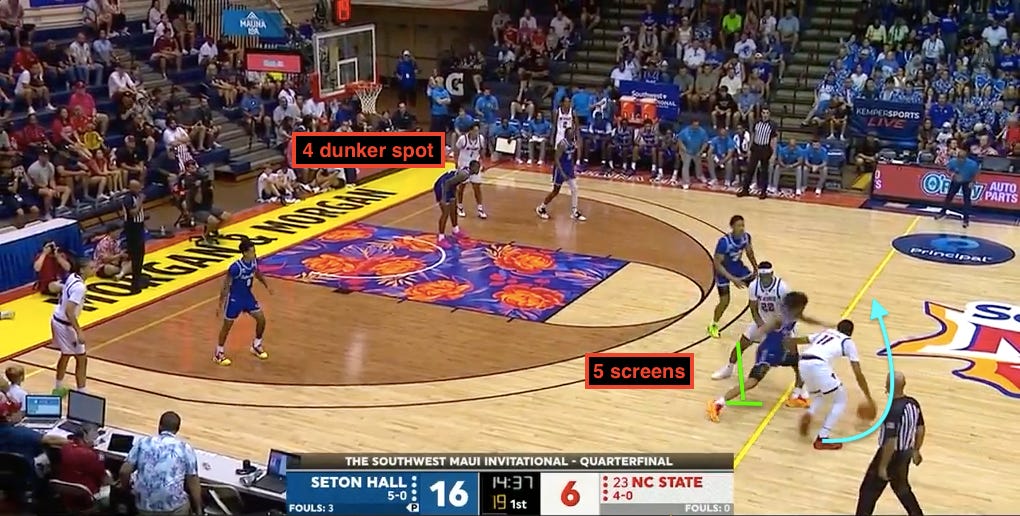
During the Liberty game, the Pack kept the 5 stationed near the basket; however, instead of using the 4 as the screener, they had one of the guards set the ball screen. (If you watch the NBA, the Charlotte Hornets have made this guard-guard ball screen setup the focal point of their offense this season.)
In fact, here’s the first time NC State scored out of what I’m calling “3 Across Small.”
While Breed ultimately scores on this possession, NC State is able to target 5-foot-10, 170-pound point guard Colin Porter (0) — the smallest player on the court — by forcing a switch with the larger Copeland.
If the defense switches the guard-guard action, the offense can attack the size mismatch. That’s exactly what McNeese and Wade did in the NCAA Tournament last season against Purdue point guard Braden Smith (6-0, 170), opening the second half with a guard-guard screen to give Copeland a more favorable matchup to attack.
Less than a minute later, NC State used the same 3 Across spacing template — Matt Able and Terrance Arceneaux in the corners, Musa Sagnia in the dunker spot — this time with Copeland screening for Breed. After Breed swings the ball back to Copeland, he cuts to his right and sets a quick brush/down screen for Able, who attacks downhill off the catch, drives left and gets into the paint for an and-one finish.
According to CBB Analytics, Able is 7-of-16 on 2-point attempts (43.8 2P%) inside the paint but away from the rim this season. This was also his first and-one of the season.
Toward the end of the first half, NC State began using Able as the screener in these actions, working in tandem with Copeland. It’s a simple but effective use of the freshman wing, who can shoot on the move and slash downhill on catch-and-go drives.
Defended by Porter — who was repeatedly forced to navigate this action — Able screens for Copeland. Porter switches onto Copeland, triggering an immediate backdown near the left elbow. As Copeland begins to post Porter, JJ Harper (9) shows early help; it’s not a full double-team, but he shades slightly in Copeland’s direction. This creates a long closeout for Harper when Copeland kicks out to the wing. Harper scrambles to contest a capable shooter, and Able (35.6 3P%) takes advantage, gliding downhill with long strides for a lefty dunk.
Able now has two dunks on the season, with this being his first on a half-court possession.
Conversely, if the defense wants to avoid switching and instead show and recover, the screener can slip into space on a pop or short roll.
On the next trip down the floor, NC State ran the same action: Able screening for Copeland. This time, Liberty chose not to switch. Instead, Porter showed on Copeland, preventing the initial drive and giving Harper time to get back to the ball. Able took advantage of the coverage, popping into space above the arc. Porter sprinted to close out, but Able shot-faked, reset and drilled a clean look from deep.
Ram: Screen-The-Screener
One of the other ways NC State initiated guard-guard ball screens against Liberty was through a sideline out-of-bounds play featuring screen-the-screener action.
To start, one of the guards (Breed) zips up the floor above the arc and receives the entry pass. Once the ball is in play, the 5 (Sagnia) turns and sets a down screen for a shooter (Able) coming out of the weak-side corner. The down screen isn’t designed for a direct catch-and-shoot opportunity; it’s screen-the-screener action. Sagnia sets the pick for Able, placing Able’s defender a step behind him. Able then sprints to set a run-out ball screen for Breed, while Arceneaux clears to the right corner.
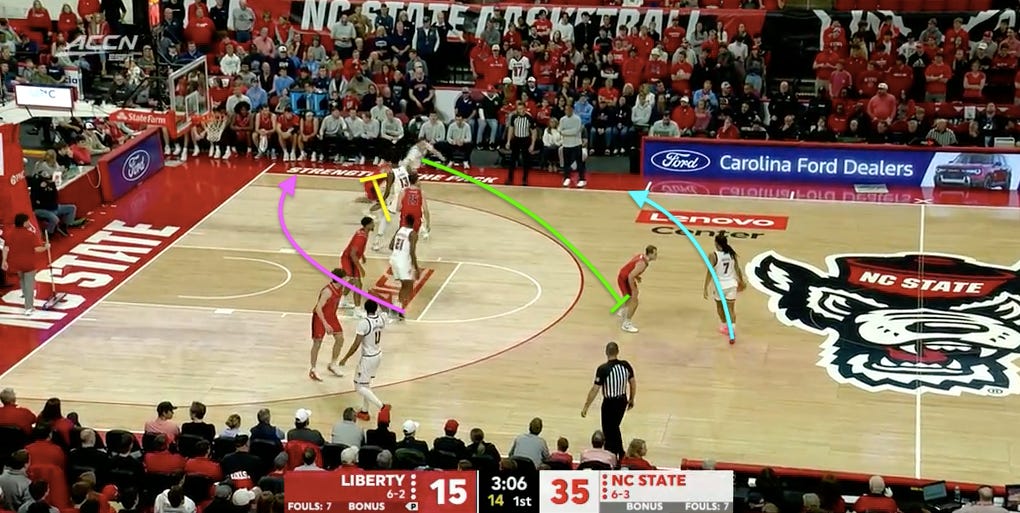
Ritchie McKay’s squad switches the action, but Breed’s new defender is slightly off balance, allowing State’s point guard to turn the corner and drive downhill for a layup. Sagnia also deserves credit here: his deep seal keeps the back-line rim protection away from Breed.
Earlier in the first half, the Wolfpack ran a similar version of the same action: Tre Holloman initiates, Paul McNeil serves as the guard screener (running off a pick from Williams) and Ven-Allen Lubin is the other big. Instead of clearing to the opposite corner, Lubin drifts down to the dunker spot. McNeil “blurs” or “ghosts” his intended screen for Holloman, slipping out to the left wing.
Here, the defense doesn’t switch and does a better job keeping the ball in front, but Holloman uses a wicked crossover to shake his defender and get into the paint.
Flow
C State ran “Wide” action — a 5-out down screen in the middle third of the floor for a player in early offense — targeting Williams three times against Liberty.
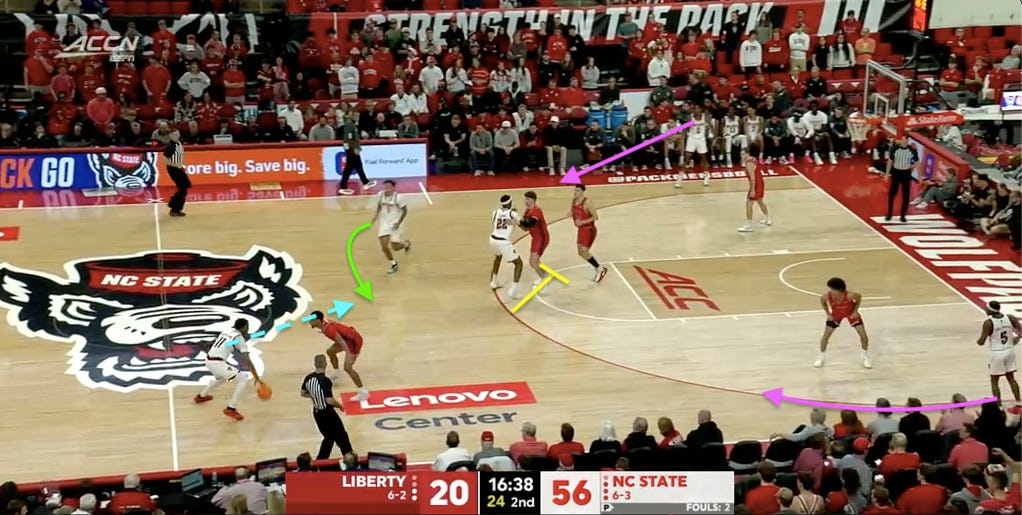
Wade and Howard run a variety of clever sets off this initial Wide action, using it as a lever to launch a series of 5-out handoffs, screens and back cuts.
After receiving a pass from Copeland, Williams dribbles right and hands it off to Holloman, who lifts up from the right corner. Holloman then passes to VAL in the middle of the floor, and NC State is now in its 5-out setup.
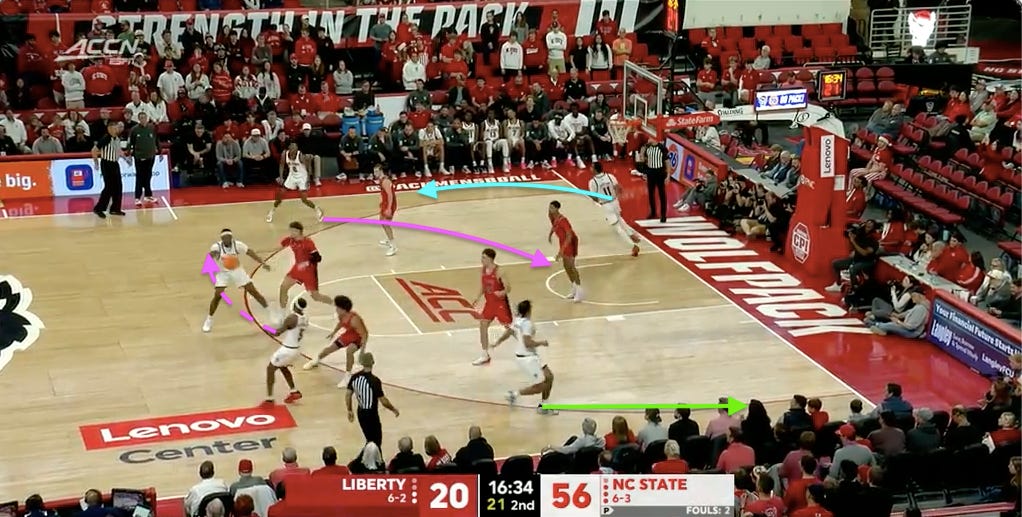
As soon as Lubin has the ball, McNeil is on the move, cutting through the lane at a 45-degree angle. Copeland continues his movement, running down through the lane and sprinting back up along the left wing to set up a dribble handoff with Lubin. The defense keeps the ball in front, forcing NC State to reset the offense halfway through the shot clock. The Pack then get into their “Flow” game, with Holloman and Copeland engaging in random guard-guard screening actions.
Holloman misses the 3-pointer, but Lubin cleans things up with a put-back layup.
After the Liberty win, NC State must turn the page quickly. Kansas comes to Raleigh this weekend, boosted by the return of star guard Darryn Peterson and a Top 10 defense that ranks third nationally in block rate at 18.8 percent. This will be the toughest challenge the Pack has faced all season.
Thanks for reading Split The Action! Subscribe for free to receive new posts and support my work.
Comments
Nothing yet. Say the first thing.
Sign in to join the conversation.