
Note: This story was originally published last week at The Devils Den, the 247 Sports site dedicated to covering Duke. With TDD’s permission, I’m sharing my latest scouting report on Duke’s offense here, too. Big thanks to the team over there for their flexibility.
Pick your cliche: the first four weeks of the 2025-26 season for Duke were both a sprint and a gauntlet. Whether at home, on the road, or at a neutral site, the Blue Devils have covered ground and stacked victories. Ranked in the Top 10 nationally in both offensive and defensive efficiency, Duke sits at 10-0 with wins over four Top-30 KenPom teams — Kansas, Arkansas, Florida and Michigan State — plus an opening-night victory against a Top-55 Texas squad.
Thanks for reading Split The Action! Subscribe for free to receive new posts and support my work.
It’s hard to believe, but the Blue Devils are already a quarter of the way through their schedule. With only three games remaining before the start of the new year — including a tantalizing matchup with JT Toppin, Christian Anderson and Texas Tech up in New York City — it’s the perfect time to take the pulse of where the offense stands.
Pick Up The Pace
When the Indiana Pacers ran their way to the 2025 NBA Finals, their frenetic style reintroduced “pace of play” to the forefront of basketball discourse throughout the spring, summer and fall. Whether it’s an intentional philosophical shift, the byproduct of new personnel or simply statistical noise from a 10-game sample, Duke is playing faster on offense this season. In fact, this is Jon Scheyer’s fastest team since he took over as head coach. According to KenPom, the Blue Devils average 15.4 seconds per offensive possession, which ranks in the Top 35 nationally and represents nearly a two-second drop from a season ago.
2022-23: 18.7 seconds
2023-24: 17.5 seconds
2024-25: 17.1 seconds
2025-26: 15.4 seconds
This has created a significant delta between Duke’s pace of play on offense and defense, with opponents averaging 19.0 seconds per possession against Scheyer’s squad (No. 361 nationally). This is one of the downstream effects of Duke’s ability to drain the clock by picking up full court, switching the majority of 1-4 exchanges and blitzing (or switching) ball screens when Maliq Brown mans the center spot. The Blue Devils force opponents to find offense later in the shot clock.
The biggest addition to Duke’s roster this offseason was, of course, Cameron Boozer. The freshman from Miami has become the frontcourt hub around which the offense revolves. While Boozer is a versatile passer in the half court, his distribution in the open floor is significant as well.
In keeping with Boozer’s commitment to the fundamentals, he’s an excellent outlet and hit-ahead passer. His skills in this area hark back to players like Wes Unseld and Kevin Love. Even when Boozer doesn’t record the direct assist in transition, these passes accelerate Duke’s pace and generate efficient looks against a defense that’s compromised.
The open-floor passing of Cayden and Cameron Boozer blends seamlessly with the connective ball movement from players like Nik Khamenia and Brown. Unsurprisingly, Duke’s offense is taking more shots early in the clock while still targeting the money areas of the floor: dunks and threes.
During the 2024-25 season, 25 percent of Duke’s total field-goal attempts came with 20-30 seconds left on the shot clock, per CBB Analytics. Through the first 10 games of this season, that number is way up to 34.8 percent. The vast majority of those attempts have come either at the rim or from beyond the arc: 192 of 207 attempts, or 92.8 percent.
Clutch Minutes, Kill Shots, Cam + Evans Inverted Action
At times this season, Duke has looked dominant. The Blue Devils rank No. 4 nationally in adjusted efficiency and, according to Evan Miyakawa’s site, are tied with Gonzaga for the second most double-digit scoring runs in the country with 16. Virginia leads with 17. Conversely, Duke has allowed only one such double-digit run in the other direction.
Despite the undefeated record and plenty of promising indicators, the wins haven’t come without some nervy moments. Victories over Texas, Kansas and Arkansas all came by nine or more points; however, each required Duke to erase a deficit with physical defense, attention to detail in transition defense and sharp offensive execution.
So far, the Blue Devils have been rather efficient down the stretch of close games. Even when the pace slows, Duke has hit the right notes late in games. According to CBB Analytics, Duke’s offense has scored 1.56 points per possession in “clutch” moments — defined as the final five minutes with a point differential of five or fewer — which ranks No. 45 in Division I basketball.
The Blue Devils have shot 52.6 percent on half-court attempts in clutch possessions this season, including a scorching 6-of-9 from three, per CBB Analytics. Moreover, Duke has excelled in the possession battle during these moments. The offense has turned the ball over on just 6.8 percent of its clutch possessions while also rebounding 41.7 percent of its own misses.
As I noted here after the Florida game, one of Duke’s foundational late-game actions in these moments is the inverted pick-and-roll, with Boozer — a big man — as the ball handler and Isaiah Evans, a high-level off-ball shooter, as the screener.
On the final possession of that game, Duke flowed out of its L Series into an inverted action with Boozer and Evans. As Evans set the screen, both Florida defenders involved in the play lunged at Boozer. This coverage allowed Evans to slip free and pop to the opposite slot. With Boogie Fland failing to stunt from the left corner, Evans knocked down an open look from deep.
This was the same play Duke ran to close the first half against Kansas, which also resulted in a pick-and-pop 3-pointer for Evans, again assisted by Boozer. Evans has 10 field goals off Boozer assists this season, the most of any teammate and the second most of any two-man combo on Duke’s roster.
When Duke needed a bucket late in the second half at Michigan State, Scheyer repeatedly ran the inverted action from different setups.
Down five points and after a timeout, Duke shifted to a 5-out look with Boozer operating in the middle of the floor, flanked by Evans and Ngongba on the right. Meanwhile, Caleb Foster and Khamenia ran a small exchange on the left wing to occupy the defense, while Evans sprinted in from the right corner to set a screen on freshman power forward Cam Ward (3).
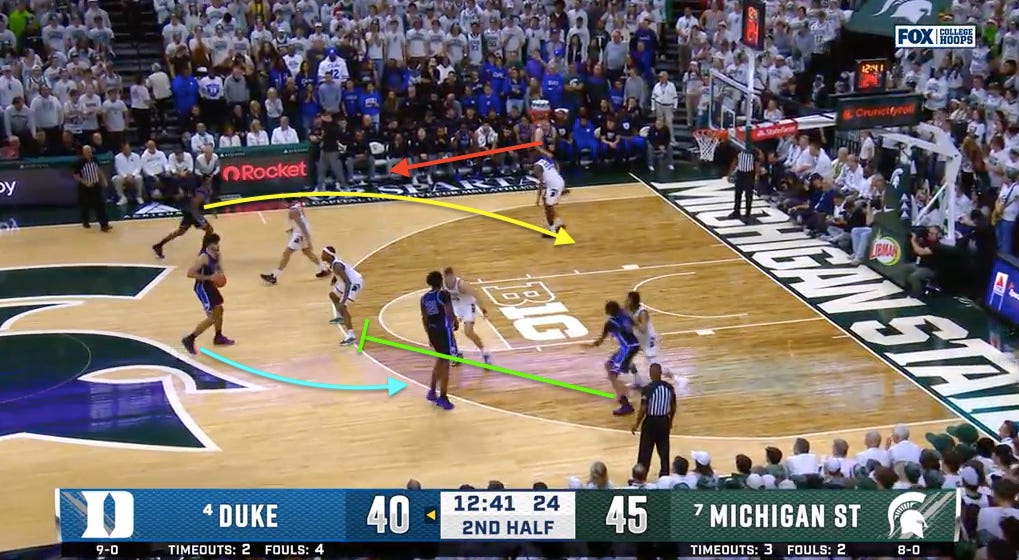
Evans gets enough of the 230-pound Ward with his screen to create space for Boozer, who attacks quickly and drives downhill to his right hand. Jordan Scott (6), another freshman, sticks with Evans, not wanting to let him pop free for a 3 on the left wing. However, Scott fails to show or hedge on Boozer, allowing him to turn the corner with no resistance. Boozer doesn’t see a help defender until he’s halfway down the lane, and he quickly shakes off Carson Cooper (15) with a nifty Euro-step.
On the very next possession, the Blue Devils set up the same action: an inverted pick-and-roll with Boozer and Evans in the middle of the floor. Unfortunately for Tom Izzo, the Spartans get their wires crossed. As the defense scrambles to get set, Ward starts on Evans, but Cooper nudges him toward Boozer instead of guarding the ball himself. Regardless, Michigan State’s coverage is poor, and before Evans can even set the screen, Boozer steps into a wide-open triple.
The Blue Devils stuck with the Boozer-Evans combo later in the game, but they made sure to run it out of different looks, forcing the Spartans to adjust their coverage from various positions and against alternating movement patterns.
For example, with about a minute to play and up two points, Duke ran what I refer to as its “Horns Ghost Flare” action. The play starts with Evans lifting from the right slot toward the ball handler as if he plans to set a screen. Meanwhile, Khamenia cuts along the baseline, exiting the right corner and effectively clearing that side of the floor for Boozer — opening a triple gap to drive into. If Boozer attacks to his right off the action, help must come from the weak side. Just before the screen is set, however, Evans darts out beyond the arc, streaking to the left wing off a flare screen from the 5 in the opposite slot.
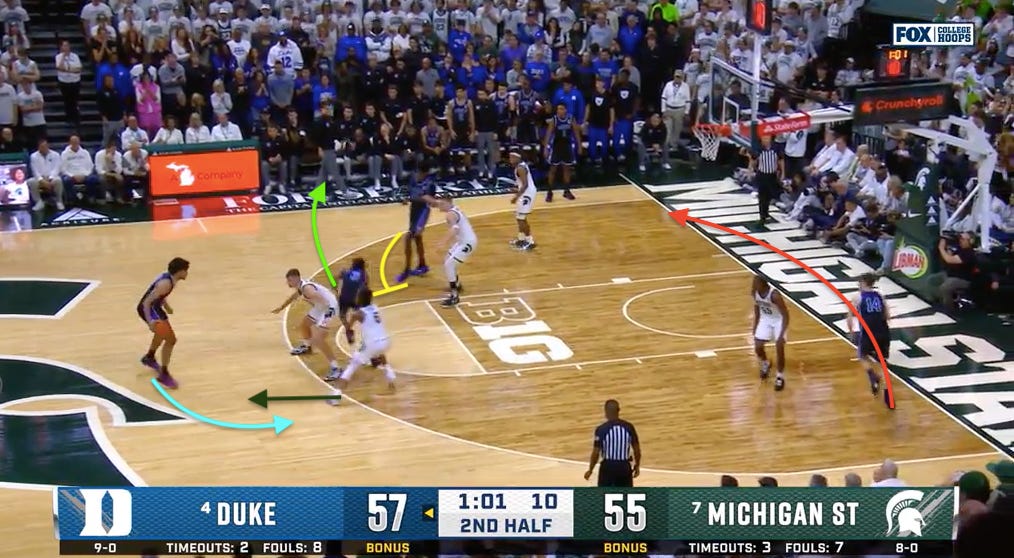
With Michigan State refusing to adjust and switch the action, a lot of pressure falls on Scott, who must be ready to show on Boozer while also sticking with Evans — essentially trying to be in two places at once against two elite shooters. Evans complicates matters by slipping his screen and then running off a flare screen from Patrick Ngongba.
This time, Scott shows on Boozer, giving Evans the initial separation. As Scott scrambles to recover to his man, he must navigate Patrick Ngongba’s flare screen. Scott goes under the screen and fights to close out, which forces him to cover a lot of ground. Jeremy Fears (1) tries to help, sprinting from the weak-side corner to contest, but Scott’s closeout draws just enough contact for Evans to earn a shooting foul and three free throws.
The set at MSU included a small tweak to a play Duke has run down the stretch of several big wins this season, including the victory over Texas in Charlotte. Normally, the play is run with Boozer spaced in a corner rather than initiating the action. Here’s the same action against the Longhorns: amid the chaos, both defenders chase Evans, leaving Foster (42.4 3P%) open for a walk-up, uncontested 3-ball.
On Duke’s final half-court possession at Michigan State, the Blue Devils put the nail in the coffin, running another inverted Boozer-Evans action from what I refer to as their “3 Across” package. This setup features two players involved in a pick-and-roll in the middle third of the floor, while three others — Khamenia, Ngongba and Foster, in this case — spread across the baseline. Beyond allowing the offense to choose which players to involve in the action and dictate matchups, it opens double-gap driving lanes on both sides of the floor and forces the defense to cover the screening action 2-on-2.
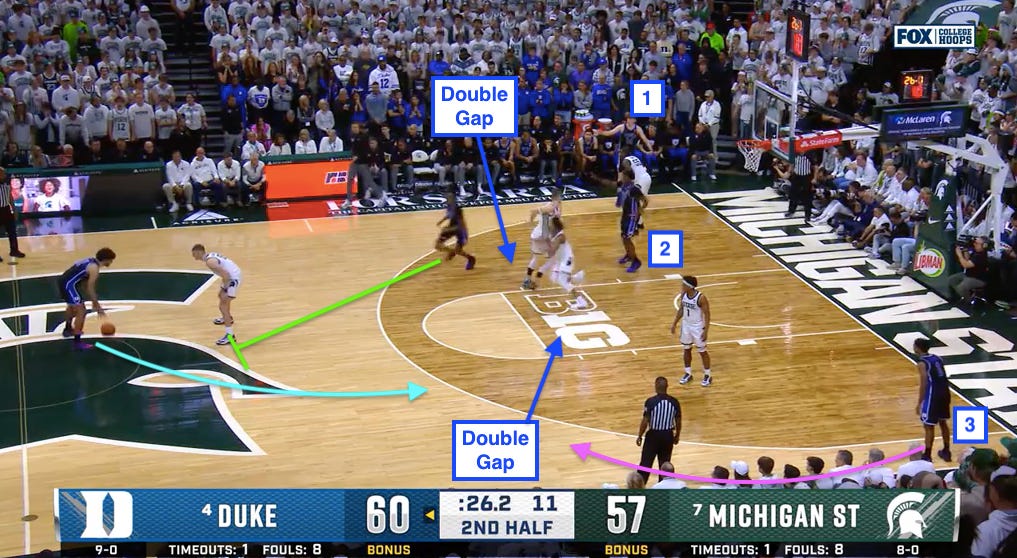
The Blue Devils stress that 2-on-2 defense even further by inverting the action and having Cam lead the dance as the ball handler. Scott shows momentarily on Boozer, but after getting burned by Evans on the previous trip down the floor, he’s anxious about where to be, who to guard. This gives Boozer an opportunity to drive into the double gap. Cooper slides left but doesn’t get back in front of Boozer until he reaches the lane. As Boozer spins, Fears takes a chance and doubles the post — a cat-and-mouse battle the two had played all afternoon in East Lansing. Boozer senses the double, picks up his dribble, avoids a turnover and kicks out to a wide-open Foster.
According to CBB Analytics, Boozer has assisted 2.7 3-pointers per 40 minutes this season.
Duke has run pick-and-roll out of this 3 Across alignment frequently this season. However, Boozer is usually the screener on these possessions, including the first play of the game at Michigan State. Here, Cam screens for Foster, who turns the corner, draws help and kicks out to an open Khamenia in the corner.
In a sense, the Blue Devils bookended this game with the same play type — both resulting in catch-and-shoot 3s, with Boozer showcasing his versatility by operating on both sides of the action.
Khamenia has now made seven corner 3-pointers this season, according to CBB Analytics, second on the roster only to Dame Sarr, who has 10.
Thanks for reading Split The Action! Subscribe for free to receive new posts and support my work.
Cam, The Screener
Speaking of Cam Boozer as a screener: while he’s excellent operating the pick-and-roll, he’s used more frequently as a screener in Duke’s offense, and he’s still devastating in that role.
Duke has run this Horns-Iverson combination into a step-up ball screen with Boozer as the screener on 17 possessions this season, according to my charting. Foster has been the ball handler on 13 of those plays, with Duke scoring or drawing a foul on nine of them, including this after-timeout possession against Arkansas.
This set was a go-to for Duke last season with Sion James and Cooper Flagg, especially when the Blue Devils wanted to create playmaking opportunities for Flagg on the short roll. Now, Duke is using the same concept with Boozer.
Another one of Duke’s primary methods to get Cam going as a screener is with empty-corner ball screens. This is Duke drawing water from the same well it used with previous frontcourt playmakers: Kyle Filipowski and, again, Flagg. Clear out a side of the floor, empty the corner and run two-man screen-roll action.
The Blue Devils don’t just drift listlessly into these sets; there’s pace and purpose. They’re deliberate with 5-out spacing, positioning players around the arc in specific spots for optimal cuts or kick-out opportunities.
Beyond the spacing, Boozer adds extra juice to the action with a pitch-and-chase approach. He starts with the ball in the middle third of the floor, passes out to the wing for the soon-to-be ball handler and sprints in that direction to set a screen. It’s tough to defend.
Here, against Florida, Evans drives baseline and gets to the rim quickly for a layup.
Scheyer has leaned on this action for years. The Jeremy Roach-Filipowski empty-corner two-man game was Duke’s failsafe from 2022-24. The difference now is Duke’s spacing template. Instead of placing the other big man on the opposite wing, Sean Stewart sits in the right dunker spot. This positions an immediate help defender between Flip and the rim, but with Miami putting two defenders on the ball, Flip can still exploit the 4-on-3 situation and skip wide to Tyrese Proctor for a 3-pointer over Kyshawn George’s (7) contest.
Nowadays, Duke often favors spacing the five out to the wing, allowing that player to cut through the lane as the empty-side action develops, though that isn’t always the case.
Regardless, Boozer is a powerful weapon as a screener because he can threaten any coverage the defense throws at him. Switch, and he can isolate against a smaller player. Ice or blitz the ball screen, and he can short roll into a pocket of space. Drop coverage, and he can pop for a 3-pointer or attack the rim against a hard closeout.
This is an impressive kick-out pass on the drive by Darren Harris. Boozer attacks a scrambled closeout and gets to the rim for a layup.
Evans Movement: The Key to Unlocking 5-out Flow?
The Blue Devils have assisted on 63 percent of their field goals this season, a Top 20 mark in Division I. Only one player on the roster has a usage rate above 22 percent: Cam Boozer (30.5 percent). This is an egalitarian offense, with one primary option and a host of other players contributing within a detailed playmaking hierarchy.
Currently, there are 10 ACC players shooting 60 percent or better on two-point attempts, with block rates above three percent and assist rates above 10 percent. It’s an impressive list that includes Henri Veesaar of UNC and Georgia Tech’s Baye Ndongo, but the only team with three players meeting these benchmarks is Duke: Boozer, Ngongba and Brown.
For this 5-out offense, led by its collection of frontcourt passing hubs, Duke needs to find flow through its reads. Instead of calling a set every possession, players move to spots and circulate the ball through a series of screens, split cuts and passes. The more chemistry guys have playing off of one another, the snappier the reads will become. That’ll build as the season goes along.
Another key to maximizing an offense built around Boozer, Ngongba and Foster — a solid pick-and-roll creator but not someone Duke wants using 30 ball screens per game — is Evans. His off-ball movement is oxygen for this offense.
With far more responsibilities this season, Evans has shown signs of development. While his 3-point shooting has slipped slightly (32.4 3P% on 15.4 3PA per 100 possessions), he has increased both his usage and assist rate — up to 10.6 percent from 6.5 percent last season. He’s also attacking downhill more frequently, both as a ball handler and off of down screens.
During the 2024-25 season, Evans drew 2.6 fouls per 40 minutes, with only 9.8 percent of his field-goal attempts coming at the rim (11th percentile). Given his slender frame, Evans will likely never be an elite downhill finisher, but he’s attacking the rim far more frequently this season: as a sophomore, 20.4 percent of his field-goal attempts (42nd percentile) come at the rim, where he’s shooting 75 percent (83rd percentile). He’s also drawing 3.5 fouls per 40 minutes — nearly one more foul per 40 minutes than last season — and has made 16 2-point field goals, just one fewer than his rookie campaign.
According to my charting data, Evans is 12-of-33 on 3-point attempts (36.4 3P%) coming off screens this season, including preseason games against UCF and Tennessee. That’s pretty good, but he can take it up a notch. Here’s the breakdown of those attempts, categorized into down screens and flare screens:
8-of-20 3PA Off Down Screens (40 3P%)
4-of-13 3PA Off Flare Screens (30.8 3P%)
Through the first 10 games (12 including preseason), Duke has yet to run last season’s primary action to get shooters like Kon Knueppel, Tyrese Proctor and Evans open looks off a flare screen, which I refer to as their “Down Flare” action. It’s a re-screen sequence in which a player coming out of the corner runs off a down screen, then returns to the initial corner via a flare screen from the 5.
The Blue Devils have run plenty of actions to get Evans going off screens this season; it’s a core tenet of their offense. However, I’m sure they’re waiting to break out the “Down Flare” at some point — perhaps situationally when they need a 3.
Another go-to Evans action is Duke’s 5-out wide pindown play, known simply as “Down.” This is another building block for the offense and has been a key feature in previous seasons with other movement shooters in the lineup, including Dariq Whitehead, Tyrese Proctor, Jared McCain, Kon Knueppel, and Darren Harris. It’s a simple action, but effective.
Evans is an elite shooter, and he’s been Duke’s primary option in this action this season. Early on, however, he hasn’t been particularly efficient shooting the ball out of the set. According to my charting data, Evans is 1-of-5 on 2-point attempts and 1-of-4 on 3-point attempts — with the lone 3-pointer coming in garbage time against Niagara — on “Down” possessions.
Here, you can see Cayden Boozer signaling “Down” with the thumbs-down gesture while bringing the ball up the court.
When Evans hits those shots, defenders are forced to chase him over the screen, opening up curls and driving lanes. This can also create the 2-on-1 situations that Duke’s offense seeks to generate. If Evans curls the screen tightly and his defender trails from behind, he can turn the corner and snap into an impromptu 2-on-1 against the defensive center, with the 5 rolling to the rim.
Evans and Brown (92.3 2P%) have connected twice on this exact passing combination this season.
This was also an important action last season for generating Knueppel-Maluach screen-roll opportunities.
With his gravity and the defensive attention he commands, Evans will have passing opportunities this season. He can struggle at times in terms of accuracy when passing on the move, but when he’s more judicious with the ball, misfires are less frequent.
These flashes of passing are notable not only because they help get Ngongba (18 dunks) and Brown (14 dunks) rolling to the rim for high-percentage finishes, but also because they can free up teammates in Duke’s split-action sets. Those combinations can be especially powerful if another talented shooter, like Boozer, is involved, while allowing Ngongba to function as the passing hub.
When Evans gets moving, it creates an electric current through Duke’s 5-out offense. The defense bends, defenders are forced to make tough decisions and this opens up space for Blue Devils to cut or relocate. That’s where Brown, Ngongba and Boozer can come alive as high-post distributors.
Lineup Thoughts: Khamenia Starting
Duke’s two most-used lineups this season feature four overlapping players: Foster, Evans, Cam Boozer and Ngongba. The swing spot rotates between Sarr, who started the first eight games, and Khamenia, who started in wins over Florida and Michigan State.
Unsurprisingly, both lineups have performed very well:
Foster/Evans/Boozer/Ngongba/Sarr: +47 in 81 minutes, net rating of +35.3 points per 100 possessions, offense 120.9 points per 100 possessions, defense 85.6 points per 100 possessions
Foster/Evans/Boozer/Ngongba/Khamenia: +15 in 32 minutes, net rating of +28.5 points per 100 possessions, offense 115.9 points per 100 possessions, defense 87.4 points per 100 possessions
In this small sample, there’s a noticeable split against Quad 1 opponents. Duke is +15 in 32 minutes with Foster, Evans, Boozer, Ngongba and Khamenia on the floor. According to CBB Analytics, every minute with this lineup together has come against a Quad 1 team. This has been Duke’s best lineup in these games, and by a significant margin.
On the other hand, the same four players with Sarr replacing Khamenia are -8 in 25 minutes against Quad 1 opponents, with the offense dropping to just 102.1 points per 100 possessions.
Much of this can likely be chalked up to 3-point shooting variance, and it shouldn’t reflect negatively on Sarr. He’s a terrific prospect and has been outstanding as a versatile defender this season. He’s been assertive on the ball and along the perimeter, using his length and quick hands to make life difficult for opponents, including key stretches against Michigan State when Duke went zone and Sarr was at the point of attack. He’s also been a menace as a gap defender, using his wingspan and recognition skills to disrupt play, as evidenced by his impressive 4.2 percent steal rate.
That said, Sarr’s offense has been inconsistent. He looks comfortable shooting from the corners, running the floor in transition and working as a cutter, where he’s shown good timing. It’s a classic case of a young wing adjusting to the 3-and-D archetype. His usage profile fits, too: 15.6 percent overall this season, dropping slightly to 14.7 percent against Quad 1 teams.
Sarr’s skill set is tantalizing, especially with more time to develop. But unless he’s in catch-and-finish or catch-and-go situations, where he can make quick decisions with the ball, his offensive process can be a bit clunky. While he plays with force on defense, Sarr struggles with physicality and contact on offense, often getting bumped off his spots and having difficulty finishing near the basket.
The Blue Devils run an empty-side pick-and-roll here against Arkansas, but as Sarr dribbles off Ngongba’s screen, he’s bumped by Karter Knox (11). Half expecting a foul, Sarr wobbles and throws a poor pass that’s easily intercepted by Trevon Brazile (7).
Sarr’s struggles in pick-and-roll and isolation situations show up in his playmaking numbers: he has just nine assists to eight turnovers this season in 205 minutes of action. He’s also struggled shooting in Quad 1 games, going 2-of-11 from beyond the arc (18.2 3P%).
By comparison, Khamenia is 25 pounds heavier than Sarr, making him — at this stage — better equipped to absorb contact on offense. This play comes in transition, with Khamenia delivering an excellent catch-and-go finish. He attacks from the corner, power dribbles against the 6-foot-11, 240-pound Bryson Tiller (15), and uses his elbow to spin off the larger defender for a reverse layup.
Duke runs much of its 5-out offense through Boozer, Ngongba and Brown, with Foster going up a level as the team’s lead guard. However, the Blue Devils need more playmaking juice from their perimeter players in the half-court. Playing Cayden Boozer and Foster together (+35 in 50 minutes) in a dual point-guard lineup is one way to do this, as is starting Khamenia on the wing.
Khamenia has real craft as a ball handler and can create opportunities out of the pick-and-roll. He can operate in second-side or empty-corner actions as a secondary playmaker. Here, for example, Khamenia shows his craft attacking Howard’s Bryce Harris (34) in drop coverage, freeing himself and finding Ngongba for a layup.
While Khamenia has the ability to scale up his usage, he’s malleable and excels in a variety of off-ball spacing roles. He’s shooting efficiently from deep (40.6 3P%), crashing the offensive glass (8.5 percent offensive rebound rate) and serving as a connective passer — all traits Duke values in its lower-usage wings. He’s purely additive. It’s not identical, but Khamenia is hitting many of the same offensive notes that Sion James did last season.
Ultimately, Duke needs contributions from both Khamenia and Sarr this season, which is similar to Duke’s point guard rotation, too: both Foster and Cayden Boozer must perform for this roster to hit its ceiling. I’m confident Sarr will find pathways to production on offense. Scheyer has mentioned this after multiple games, and with frontcourt passing hubs like Boozer, Ngongba and Brown, Sarr should be able to generate offense as a cutter and by attacking downhill on handoffs.
Thanks for reading Split The Action! Subscribe for free to receive new posts and support my work.
Comments
Nothing yet. Say the first thing.
Sign in to join the conversation.