
Mastercard’s 2025 annual report is 117 pages long.
Most investors never read a single one of them.
I get it. The document looks like it was written by lawyers, for lawyers. Because large parts of it were.
But buried inside those 117 pages is everything you need to understand a business. The strategy. The risks. The numbers. How the CEO gets paid.
The trick is knowing that you don’t read an annual report cover to cover. You read 5 sections and skip the rest.
I use the same 5-stop map on every company. Mastercard’s 10-K is the example below.
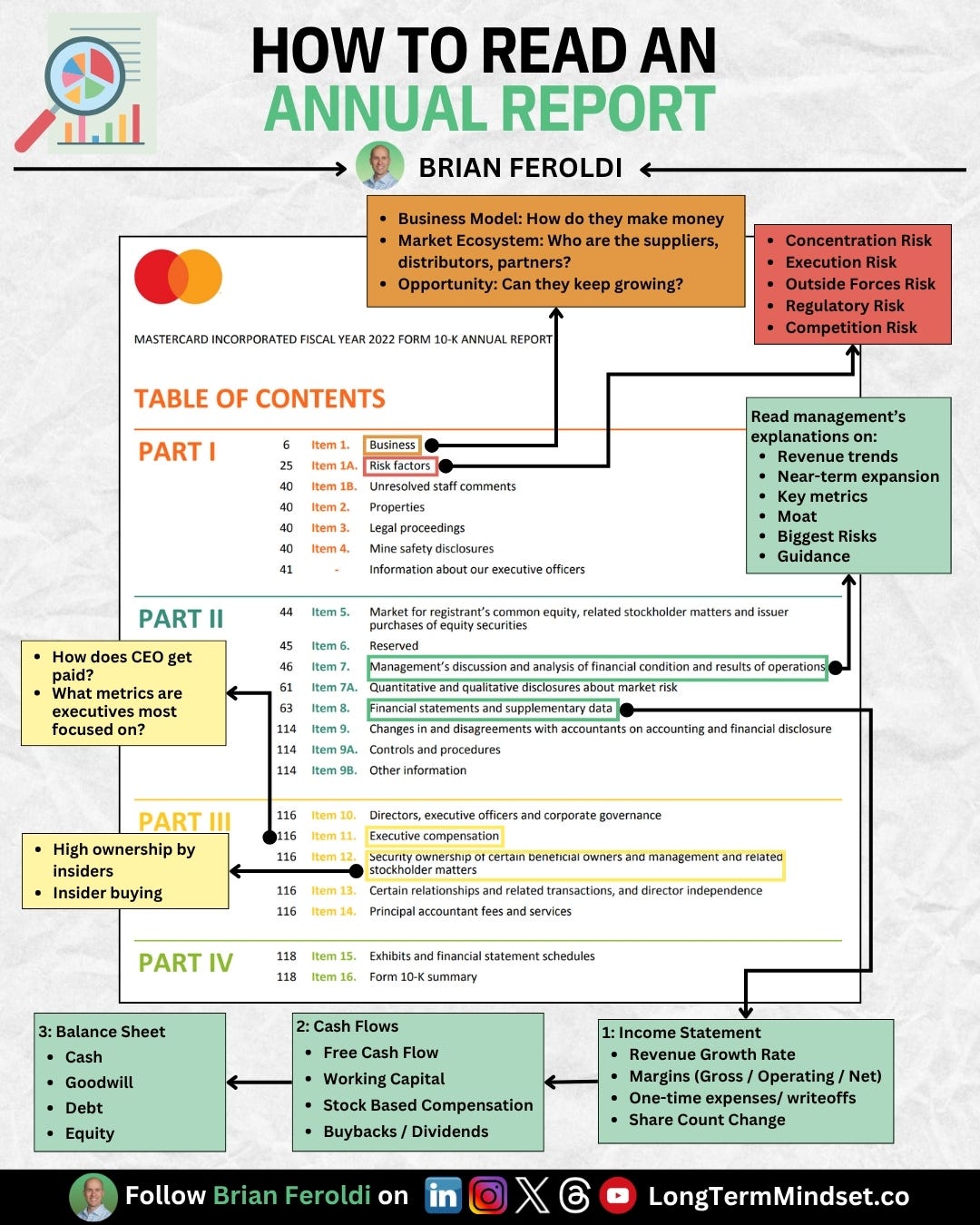
Start with the table of contents
Every annual report (the official name is Form 10-K) follows the same structure. The SEC requires it.
That’s great news for you. Once you learn the map for one company, you know the map for every company.
Open the table of contents and find these 5 stops.
Stop 1: The Business (Item 1)
Mastercard’s business description starts on page 6.
This is the company explaining itself in its own words. As you read, answer 3 questions:
How does this company make money? Not the mission statement. The actual mechanics. Who pays them, and for what?
Who else is in the picture? Suppliers, distributors, partners. Mastercard doesn’t issue cards or lend money. Banks do that. Knowing this changes how you see the whole business.
Can they keep growing? Look for how management describes its opportunity.
If you can’t explain how the company makes money after reading Item 1, stop. Don’t buy the stock. Warren Buffett calls this the circle of competence, and it’s the cheapest risk management tool that exists.
Stop 2: Risk Factors (Item 1A)
Page 27 in Mastercard’s case.
Most of this section is boilerplate. Every company on Earth warns you that recessions are bad and cyberattacks exist.
Skim past that. You’re hunting for risks specific to this business:
Concentration risk. Does one customer or product dominate revenue?
Execution risk. Is the strategy dependent on something hard to pull off?
Outside forces. Currencies, interest rates, supply chains.
Regulatory risk. For Mastercard, this one is real. Governments love to scrutinize payment networks.
Competition. Who is coming for their lunch?
Companies are legally required to tell you what could go wrong. Take them up on the offer.
Stop 3: Management’s Discussion & Analysis (Item 7)
The MD&A is where management explains the year in plain(ish) English. It starts on page 49 of Mastercard’s report.
Read it for their explanations of:
Revenue trends, and why they happened
Key metrics management tracks
Near-term expansion plans
The moat, in their words
The biggest risks they’re watching
Guidance for what comes next
One tip: compare this year’s MD&A to last year’s. When the story keeps changing, that tells you something.
Stop 4: The Financial Statements (Item 8)
Page 64. This is the heart of the report, and I read the 3 statements in a specific order.
First, the income statement. Check the revenue growth rate. Check the margins: gross, operating, and net. Watch for one-time expenses or writeoffs muddying the picture. And check the share count. A shrinking share count quietly boosts your ownership every year.
In 2025, Mastercard grew net revenue 16% to $32.8 billion and earned $15.0 billion in net income. That’s a net margin over 45%. Margins like that are rare, and they tell you the moat is real.
Second, the cash flow statement. Profits are an opinion. Cash is a fact. Look at free cash flow, working capital swings, stock-based compensation, and how much went to buybacks and dividends.
Third, the balance sheet. Check the cash pile, the debt load, the goodwill (a record of past acquisitions), and equity. You’re asking one question: can this company survive a bad year?
Stop 5: Executive Compensation and Ownership (Items 11 and 12)
Almost everyone skips this. Don’t.
How the CEO gets paid tells you what the CEO will do. If bonuses are tied to revenue growth alone, expect growth at any cost. If they’re tied to returns on capital, expect discipline.
Then check insider ownership. High ownership by insiders, and better yet insider buying, means the people running the company eat their own cooking.
Your homework
Pick one company you own. Pull up its latest 10-K on the company’s investor relations page or SEC.gov.
Read those 5 sections. Skip everything else.
It takes about 45 minutes. When you’re done, you’ll understand that business better than 95% of the people who own it.
Wishing you investing success,
Brian
Comments
Nothing yet. Say the first thing.
Sign in to join the conversation.