
Over the past several weeks, we’ve reviewed numerous ways to value companies across the Business Growth Cycle, including finding the total addressable market (TAM), using multiple ratios, and building simple discounted cash flow models.
These are all helpful valuation tools investors can use.
But what if you’re a self-described growth investor? Does valuation still have a place in a growth investor’s process?
To better explain this, let’s broadly define value and growth investing, exploring the differences between these two schools of thought.
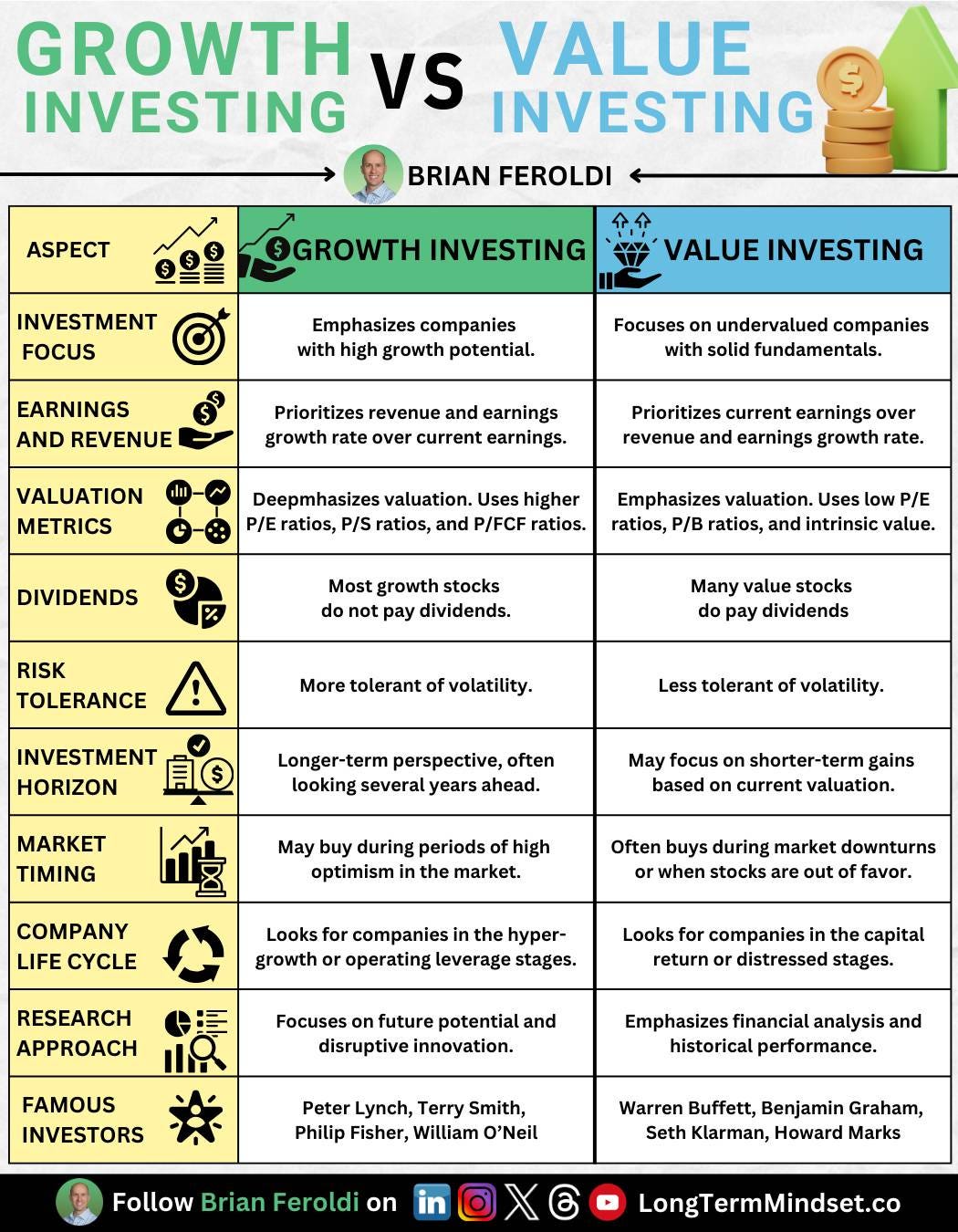
What is value investing?
Imagine trying to buy a dollar bill for fifty cents. That is how value investors approach investing.
Value investors often attempt to find the intrinsic value of a stock, whether by using a discounted cash flow model or a variety of multiples, such as the P/E ratio.
When a stock trades at a decent enough discount to its intrinsic value, value investors will buy it. When that stock trades at a premium to its intrinsic value, value investors will sell.
Value investors rarely put their capital at risk until they’re buying an asset with a wide margin of safety, the discount between the asset’s intrinsic value and its current price.
Author and famed value investor Benjamin Graham once said:
To have a true investment, there must be a true margin of safety. And a true margin of safety is one that can be demonstrated by figures, by persuasive reasoning, and by reference to a body of actual experience.
Value investors can realize enormous gains by staying disciplined and repeating this process many times.
What is growth investing?
Again, painting with broad strokes, but growth investors are not usually looking to buy dollar bills with fifty cents.
Instead, growth investors will often have no problem paying a dollar or even more for a dollar if they’re convinced that it will grow into two, three, or more dollars over time.
While growth investors don’t completely ignore valuations, they’re usually more interested in finding companies that can profitably grow in the years ahead.
The growth could come from various sources, including a young upstart company disrupting an industry, a company well-positioned in a growing sector, or a company that possesses substantial competitive advantages that allow it to take market share from competitors.
While value investors are averse to taking risks without a margin of safety, growth investors understand that they will often buy losing investments. They believe the gains from their winners will more than make up for their losses from losers.
As Amazon.com founder Jeff Bezos said, “Given a 10% chance of a 100 times payoff, you should take that bet every time.”
Why all investors need to be value and growth investors
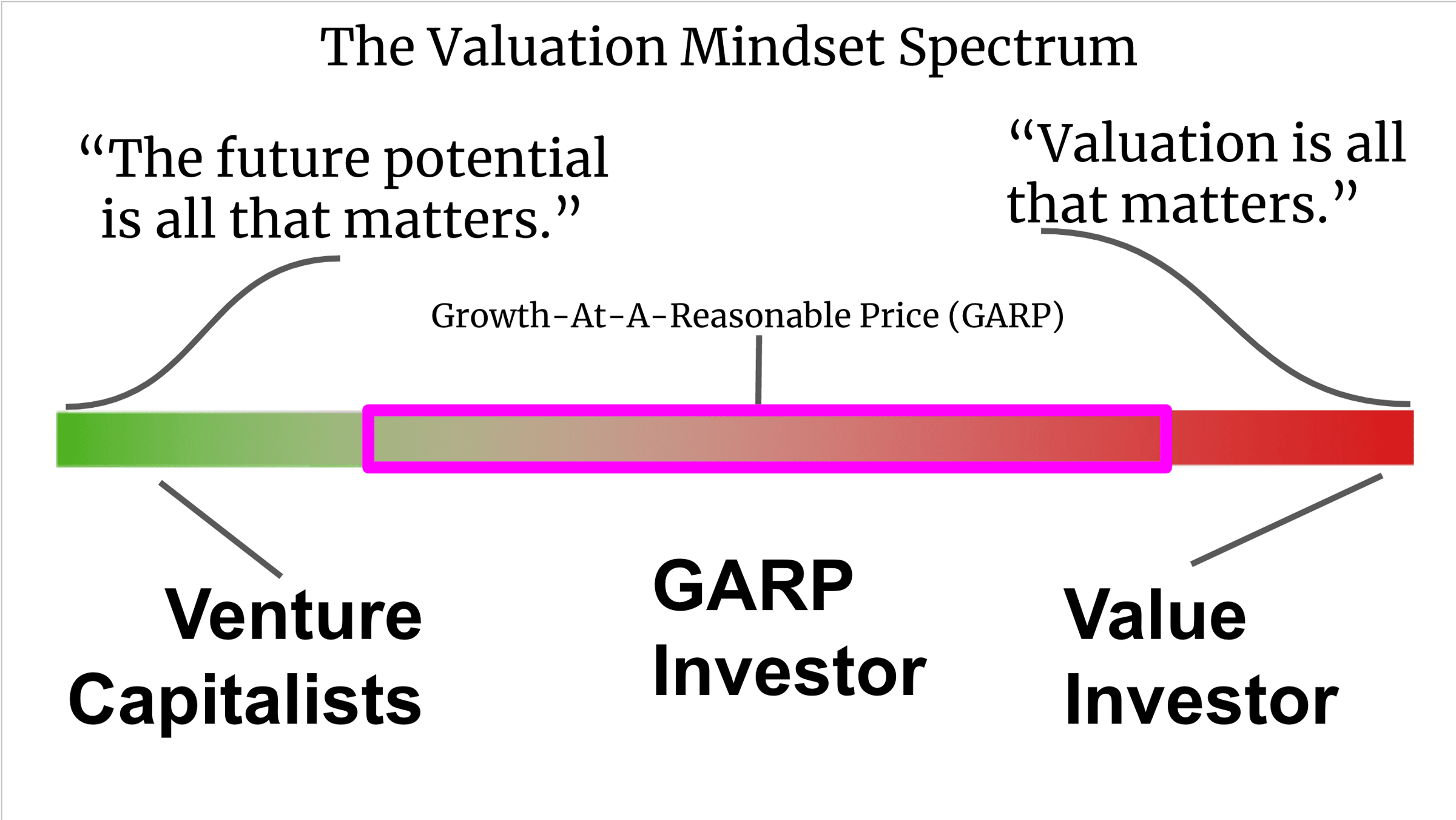
Almost all investors would do well to incorporate aspects of both value and growth investing into their investment process, no matter where they lie on the Valuation Mindset Spectrum.
At the height of the 2021 market frenzy, Upstart was trumpeted as a company that might disrupt Fair Isaac, the provider of the famous FICO score.
FICO is a score credit providers use to test the worthiness of potential borrowers. Upstart believed it could use artificial intelligence and machine learning to provide better predictions of future defaults.
Yet at the height of the mania, Upstart already sported a higher market capitalization than FICO, the company it was trying to displace.
Growth investors would have done well to incorporate valuation techniques to see that Upstart’s valuation at the peak made it extremely difficult, if not impossible, to realize gains from that point forward.
Conversely, imagine how costly it would be to have not invested in Amazon 20 years ago because its valuation did not offer a wide enough margin of safety.
Joined at the hip
As we observed in our previous lessons on the discounted cash flow model and reverse discounted cash flow, growth is crucial when valuing a company.
In his 1992 shareholder letter, Warren Buffett said growth and value investing were joined at the hip:
In our opinion, the two approaches are joined at the hip: Growth is always a component in the calculation of value, constituting a variable whose importance can range from negligible to enormous and whose impact can be negative as well as positive.
Wishing you investing success!
- Brian Feroldi
No posts
Comments
Nothing yet. Say the first thing.
Sign in to join the conversation.