
WELCOME to #TheatreClique — my emphatically intermittent newsletter dedicated to encouraging you to click out to some of the most interesting, intriguing & noteworthy writing about drama, theatre & performance (at least, so says me)…
This Week's #TheatreCliquery:
This installment of #TheatreClique clicks out to pieces that consider the limits of creative resistance to AI, the balance of order and creativity, and the then and now of “contemporary Gay theatre.” Plus commentary about my experience of recent productions, including Animal Wisdom, Jerome, Slanted Floors, and Elephant Shoes. And for this week’s opener, in celebration of this week’s drop of two never-before-released songs — “You Can't Get A Man With A Gun” and “I Got Lost In His Arms” — from Reba McEntire’s brief 2001 run headlining Annie Get Your Gun on Broadway. For those who don’t know/remember, Reba was the second of three “replacements” — arriving after Cheryl Ladd but before Crystal Bernard — that producers brought in to extend a production that earned Bernadette Peters a Tony in 1999. Hers was also the only performance to accrue Broadway legend status. And thanks to YouTube’s most intrepid/invaluable musical theatre archivist Aurora Spiderwoman, here’s a glimpse into how Reba’s vocal dexterity and comedic charm made her Annie Oakley the one I most wish I could travel through time to witness… and if clicking the embedded image below routes to an error message, try clicking here.
EDITOR’S NOTE: whenever possible, whenever linking to paywalled pieces, I try to “gift” the article to #TheatreClique readers. In other words, clicking out to articles in the New York Times, Washington Post, Philadelphia Inquirer, Atlantic, and Wall Street Journal should neither present hassle nor burn through your current allotment of free views. Here’s hoping more outlets — hello LATimes! hi NewYorkMagazine! yo NewYorker!— adopt similar technologies for subscribers soon...
#NowClickThis…
Wherein I highlight a handful of the most click-worthy links I’ve encountered in the last few…
American Theatre profiles one of the steadiest forces on the ABQ theatre scene: Duke City Rep.
at Aeon, cultural historian (and drama scholar) Martin Puchner meticulously considers the limits of emerging "Creative Resistance” movement among artists/writers in the context of his own intentional experimentation with AI for the past three years and his wish for more writers and artists to do the same;
Princeton Alumni Weekly’s Julie Bonette reports on Princeton University’s decision to “pause” funding for the transformative Trenton Arts at Princeton program;
at Theater Wow, veteran arts/theatre writer Jim McDermott adds to his growing collection of fascinating deep dives in to overlain histories of La Cage aux Folles;
at Mighty Fond of You, writer/advocate Tanya Ward Goodman reflects on her experience of Legacy Lab NM — a convening of artists, writers and archivists [that] pondered the care and keeping of what remains — and the “idea that creating some order can make room for more creativity”;
and THIS WEEK’S MUST-READ…
and at Another Eye Opens, veteran culture/arts writer Don Shewey draws from some of his own archive to reflect on the then and now of “contemporary gay theatre.”
Thoughts from That One Theatregoer Who Likes Pretty Much Everything:
Wherein I offer capsule commentaries on what I liked best (or found most compelling) about the shows I’ve recently engaged... A full accounting of my 2026 theatregoing can be found HERE.
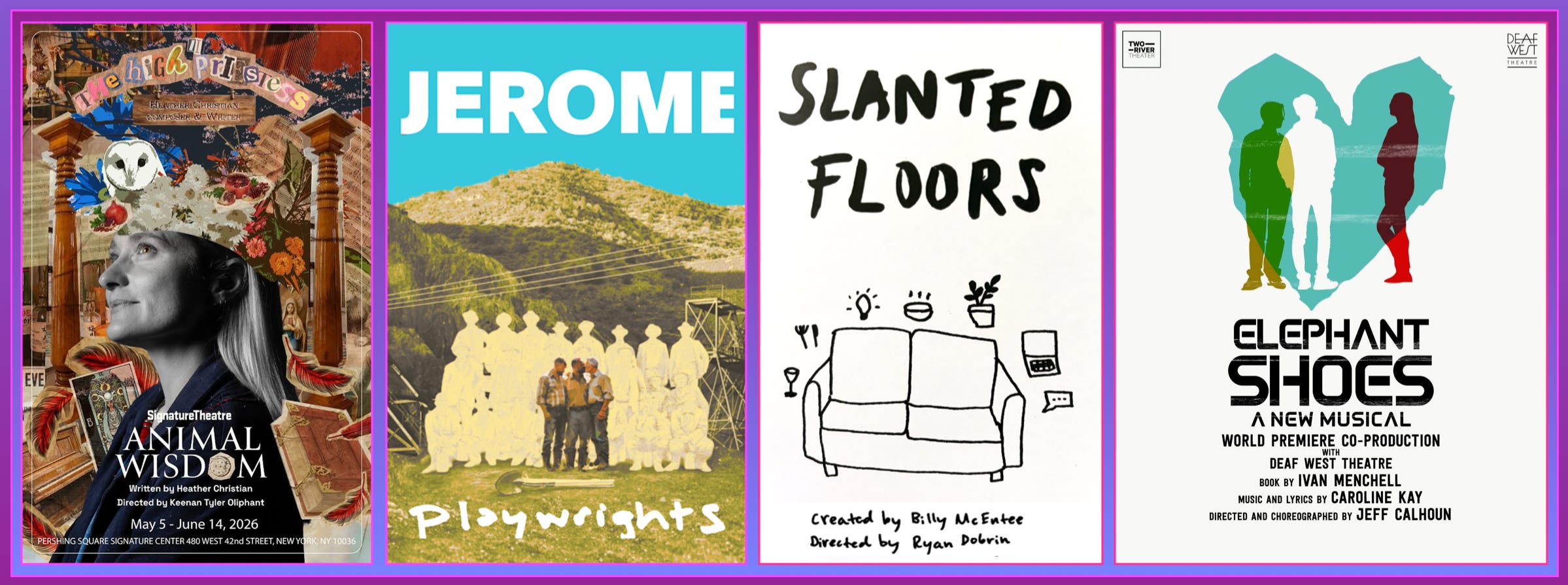
#090: Animal Wisdom
Music and Lyrics by Heather Christian • Directed by Keenan Tyler Oliphant • NYC : Off-Broadway • Signature Theater Center (Linney) • June 2026.
Barely two weeks (and eight other shows) separated my two encounters with Heather Christian’s musical-ritual/ritual-musical, Animal Wisdom. As I entered the transformed space, I was delighted to return to this carefully curated yet still cluttered backyard, a response that itself stirred a quiet concern. I worried vaguely whether this experience might somehow be less — less surprising? less moving? less profound? — on a second pass. By way of reminder, this is what I said about that “first” encounter:
Animal Wisdom is a theatrical conjuring — of energy, of spirit, of community, of compassion, of healing, of release — [that] immediately started plucking at strings of emotion, experience, memory, and wonder residing deep within me so… Indeed, in one shadowy shocking surprise of a moment, the song and the staging so vividly mirrored some of my own — deeply private, mostly unarticulated — experiences that I actually said out loud: “oh she gets it…” A remarkable piece… and an extraordinary experience… and one I’m already looking forward to experiencing again in a few weeks. Wowza.
That first encounter so shook me that I seriously considered opting out of my long-booked subscriber-ticket to see Animal Wisdom on closing day. But then I read the inimitable Don Shewey’s brief note: “Kenita R. Miller so thoroughly inhabited the central role of ‘H,’ the author’s stand-in, that we immediately booked tickets to see it again with the alternate ‘H,’ Emma Duncan, curious to see how many other colors a different actor can bring to this wild, moving, compassionate experience.” I thought, “If Don saw Kenita and wants to go back to see Emma, I should go back to see Kenita, even though I so loved Emma in the role.” And so I did. And I am so glad I did. My experience, on second pass, was an experience of Animal Wisdom in the obverse. Where the first time I connected most deeply with the second half of the show, this time I dropped more deeply into the first. And where I connected with Emma’s “H” as a charismatic character, I was profoundly captivated by Kenita’s “H” as a conductor — as a guide on a journey, as the leader of an ensemble, as a transmitter of energy. Where I first saw the ensemble, community chorus and design accretively, as component elements of a well constructed show, this time I experienced them more holistically, as constitutive elements animating the show as a living breathing organism. I was truly enthralled by Kenita R. Miller’s virtuousic embrace of the task of actor-musicianship as a vocalist. Indeed, Miller’s performance might be the first I’ve seen to truly unlock the kind of work a singing actor must do when both inhabiting and animating Heather Christian’s distinctive music theater with and for an audience. An extraordinary production — expertly directed, designed, performed, and house managed — that I would probably be booking another ticket for if the production hadn’t already closed. Now, if only there were a cast recording — complete with full liner notes and bonus tracks (like, say, three versions of the same song sung by each of the three H’s: Heather, Kenita, Emma) — for me to pore over… May it be so.
See also:
Vulture’s Sara Holdren celebrates Animal Wisdom as “a spiritual autobiography tucked inside a requiem mass mixed with a folk-blues concert, all steeped in the haunted, brackish waters of the Mississippi delta”;
at New York Theatre Review, veteran journalist/critic Roma Torre wrestles with “the difficulty of passing judgment on a work which some will find utterly transcendent while others [will] tire of trying to make sense of it all.”
#091: Jerome
Written by John J. Caswell Jr. • Directed by Dustin Wills • NYC : Off-Broadway • Playwrights Horizons (Rubin) • June 2026.
When I first saw the Playwrights Horizon blurb for John J. Caswell’s Jerome, my response — part tantalized curiosity, part wary trepidation — startled me.
Jerome, a ghost town in the secluded Arizona backcountry, is home to Con and Doane, an aging gay couple who’ve built a quiet life far from the chaos of cities and other people—until a stranger arrives, fleeing his damaged past, and falls into their arms. Set at the height of the AIDS epidemic, John J. Caswell, Jr.’s new play is an unexpectedly funny, delicately wrought story of survival, even in the harshest of deserts.
I worried that such a scenario might hit a bit too close to home for me. Literally. (I fled NYC in the early/mid90s and retreated home to rural New Mexico — just down the road from an artsy former ghost town — where I developed a number of complex, charged, and important-to-me relationships with older, mostly coupled gay men.) To be clear, I have never abandoned an ill loved one, nor have I ever been part of a throuple; Jerome and Madrid are not the same, not by a long shot; and, believe you me, you can’t just swap Arizona for New Mexico — even if plenty of folks, including some who’ve known me for decades, consistently ask me whether I’ve gone home to Arizona lately. And even though I found Dustin Wills’s production of John C. Caswell’s Wet Brain dazzlingly true to my experience of similar themes, I experienced a strange-to-me measure of internal resistance to actually getting myself to Jerome. (True confession: I paid for TDF tickets to two previous performances — once early in the run, once midway through — only to chicken out and leave both unclaimed come showtime.) Then came an unexpected Tuesday matinee on a day when I needed an afternoon show, so I sucked it up, claimed my ticket, took my seat, and… it was fine. I most appreciated Jerome as the work of someone who came up amidst the many long-reaching shadows of the high desert southwest. How mountain homes can feel like encampments inside nature and against the world. How folks protect their barbed-wired privacy even as they treasure their chosen community of distant neighbors. How pretty much the only thing newcomers and oldtimers have in common is that somehow they ended up there and, quite often, that can be enough. How everyone has their own ways around guns, government, and god — not to mention race, gender, and sexuality — so it’s best just to live and let live and not talk about that stuff. So I do appreciate John J. Caswell’s insistence on bringing the worlds of the US Southwest to the stage. Even if I did struggle mightily with the particulars of Jerome. (I try not to be a chronology-queen but the distance — and differences — between 1987 and 1993 and 1997, especially in terms of the historical realities of AIDS, are vast, specific, and meaningful; I regret that more dramaturgical care was not taken on that front with Jerome.) And even if I didn’t fully connect with (or even comprehend) the triangulated relationship dynamic that drives this play, and even if I was perplexed by the absence of a credited intimacy choreographer, I marveled at Stephen Spinella’s capacity to turn a heart-opening joke from the fierce vulnerabilities stirred by aging; at Jeorge Bennett Watson’s stolid tenderness; and — as the walking disaster with a tantalizing abdominal “v” — Ken Barnett’s feral, self-centering portrait of a particularly hazardous kind of late-blooming gay beauty. And I found Dustin Wills’s scenic design — a “smoking psychic caldera” as per the New York Times — as consistently captivating as the play Jerome was fascinating. Even if I was frequently frustrated by both. So, yes, I am glad to have finally taken my seat to experience the world of Jerome and to be reminded how the sediment of memories, sensations, and stories from that particular moment in history remain so foundational to who I am today.
See also:
at The Hat, theatre writer/critic Billy McEntee talks to Caswell and Wills about their “rigorous development approach and the world — seldom depicted on stage — they are bringing to audiences”;
Talkin’ Broadway’s Marc Miller parses Jerome’s strengths and liabilities and ultimately decides “but these three guys feel real, and their travails, individual and interpersonal, do reach the heart”;
at BroadwayWorld, freelance arts/culture writer David Clarke talks to actor Stephen Spinella about why he considers Jerome “one of the most beautiful, profound plays I've done in my career.”
#092: Slanted Floors
Created by Billy McEntee • Directed by Ryan Dobrin • NYC • Off-Broadway : Greenpoint, Brooklyn • June 2026.
Billy McEntee’s Slanted Floors is a beautifully acted and expertly directed theatrical rumination on intimacy, on connection, and how our habits of being in the world can get in the way of either (or both). Staged as an intimate immersive production featuring two actors and performed for a six-person audience in a walk-up apartment in Brooklyn’s Greenpoint neighborhood, the show unfolds in five passages.
SPOILER ALERT: What follows is a detailed summary of the content of Slanted Floors. If that’s not for you, please skip past the shaded block.
I would consider the first passage of Slanted Floors to be the “Arrivals” — the pre-show part of the evening when the guests are greeted by that evening’s house manager and guided into the main living space of the smallish apartment where they are assigned, by name, to their seats. Three seats on the couch, plus three chairs placed next to the couch or the archway or the door to another room. I was assigned to the chair, with couch at one elbow and a turntable at the other. During this first passage, some of the guests chatted. One — a middle aged gent from Long Island — broke the ice by asking how everyone found out about the production, confessing that he worried it might have been a scam since there were no public listings and you just sent your money to a random venmo account. Most of the others, aside from me and my partner, were gay men somewhere on either side of thirty known to each other but who did not arrive together. These three all worked in the theatre, which is how they said they knew about the piece. So we were all gay, all guys, three millennial, three middle aged. As the house manager shared the evening’s house rules — it’s immersive but not interactive, bathroom’s over there but don’t use it during the performance, a meal will be served — another person entered to refill waters, confirm settings on various switches, and serve our “amuse bouche” for the evening (a delicate skewer of fresh crispy vegetables served in a lovely small earthenware dish). In a whoosh, our little dishes were cleared as the women left the space and the play’s next passage began with the entrance of Adam Chanler-Berat (as Kaplan). A voice message from Kaplan’s boyfriend Teddy (Kyle Beltran) plays from the turntable, cuing us to the fact that we are observing Chanler-Berat’s Kaplan move, as if in a brisk time-lapsed montage, through his day as a freelance writer working from home. Chanler-Berat moves swiftly through his day — writing, doing yoga, taking meetings, etcetera — all while a television feeds a chaotic and funny stream of images, sounds that shape Kap’s day. The next passage begins as Kaplan first tidies the house and himself in preparation for Teddy’s arrival home from his office job (working in some kind of theatre company or literary agency) and then their shared preparations of the meal they (and we) would share. (Our meal was comprised of a lush carrot-ginger soup with an olive foccacia. I’m not much of a soup person so I didn’t finish mine.) As the couple swaps report on their respective workdays, we begin to learn about Teddy as we also note what Kap is and is not saying about how he spent his day. The fourth passage begins when Teddy asks Kap if he might share the big idea he’s been working on. In what is the theatrical heart of Slanted Floors, Teddy narrates a story of a speculative future world in which a mass movement of people leave the city and opt to dwell in small intentional, self-sustaining communities, except for “Vacation Day” when they can go wherever they want to go and do whatever they choose to do. Kap listens, as do we, to Teddy’s extended monologue. Then, in the play’s fifth passage, Kap and Teddy move through what appears to be their end of evening routine — cleaning up, playing a quick puzzle game, readying for and settling into bed — all as unresolved questions about Teddy’s story (and Kap’s palpably ambivalent response to it) lingers in the air. There’s an extended moment of silence as the two lay wordlessly in bed next to each other — Teddy reading a magazine, Kap looking at his phone. The lights go out. And that’s the end of the play.
Adam Chanler-Berat’s Kaplan is a live wire of impulse and Kyle Beltran’s Teddy is a steady pulse of intention. It seems immediately clear why these two characters became boyfriends in their twenties but, by the final moments of Slanted Floors, I wasn’t convinced of their long-term compatibility. Even so, there’s a thrum of ineffable beauty in simply witnessing Beltran and Chanler-Berat (who are in a real-life long-term relationship) perform together. To watch as they observe and listen to one another with such alert familiarity feels startlingly intimate. Fortified by the artfulness of Ryan Dobrin’s production — the manner in which we are welcomed; the way the pair wordlessly bring us in to them as they serve and clear our soup bowls, how Beltran’s Teddy holds our gaze as he puts us in his story — integrates each member of the audience into this powerful circuit of intimacy in fascinating and occasionally electrifying ways. (I have no idea how Dobrin staged Slanted Floors so that a gorgeous stage picture met my gaze no matter where I happened to look.) I’m not sure I know what the play is about. Maybe something about how sharing an artistic sensibility/aesthetic is foundational to truly enduring intimacy? I’m not sure. And I’m not sure I care. Because McEntee’s and Dobrin’s Slanted Floors made for a distinctive, delicious (even though I didn’t eat my soup), somewhat peculiar, yet undeniably captivating “only in NYC” theatrical experience. So grateful I had the opportunity to experience it.
See also:
Vulture’s Jason P. Frank talks to Chanler-Berat and Beltran about “what it feels like to perform in such close quarters” in Slanted Floors;
[from 2025] at CultureBot, theatre writer/advocate Francisco Mendoza talks to Slanted Floors playwright McEntee about how the piece explores “the flimsy relationship between storyteller and audience, and the act of durational listening” especially in a world so defined by our relationship to and through our screens.
#093: Elephant Shoes
Book by Ivan Menchell • Music & Lyrics by Caroline Kay • Directed & Choreographed by Justin Calhoun • Red Bank, NJ : Two River Theater (Reichnitz) • June 2026.
An original (and actually funny) romantic comedy that is also a fully-bilingual musical — ASL and Spoken English — Elephant Shoes arrives as an illuminating, enjoyable, and often quite moving demonstration of the power of accessible theatre in action. In this co-production with DeafWest, pathbreaking director/choreographer Jeff Calhoun artfully deploys many of the foundational techniques of Deaf Theatre — including shadowing, ASL choreography, visual vernacular storytelling, and integrated text captioning — in ways that both rehearse “new” audiences to appreciate them and also developing these techniques as in theatrically exciting ways. The story is an adaptation of an oft-told tale that we’ve seen before (quite recently, actually). An ambitious tech developer (who happens to be deaf), Cy is deeply committed to bringing his new product: smart glasses that can translate spoken speech to ASL (or vice versa). Cy lives with Chris, Cy’s CODA childhood best friend and compulsive womanizer. Enter Roxy — short for Roxanne — the gorgeous, talented, and quite anxious computer engineer that Cy is finally able to hire when two angel investors sign on to bring his product to market. As Cy, stage/screen/DancingWithTheStars star Daniel Durant anchors the production with vulnerability and gravitas, while Broadway musical theatre veteran Taylor Iman Jones captures Roxy’s mercurial messiness and charm. But it’s hunky and hilarious James Olivas — who signs as effortlessly (and beautifully) as he sings — in the role of Chris that brings the whole show together. Indeed, the fact that Chris and Cy each depend on the other to communicate with Roxy transforms this adaptation of the Cyrano-story in emotionally complex ways. As example, a heartbreaking triangulated love “duet” in the second act — when we see Roxy and Cy texting all through the night but its Chris’s voice that she (and we) hear — is unlike any musical theatre love song I’ve ever experienced. It’s absolutely gorgeous. And utterly devastating. Same goes for Cy’s big solo at the end of the first act, which Durant performs to great effect without vocal shadowing. With consistently compelling supporting performances from a winning ensemble of deaf and hearing artists, amplified by Colin Analco’s gorgeous ASL choreography and Caite Hevner’s dynamic projections, this TwoRiver/DeafWest collaboration delivers an excellent production of a solid, original, and very contemporary musical that feels ripe and ready to take that big next step. Here’s hoping it does.
See also:
Caden Zane Marshall (aka TheMusicalDealer) is both an ASL interpreter and an encyclopedically-inclined expert on contemporary musical theatre recordings; he goes deep into the particulars of Elephant Shoes in this video review;
at Performance Matters, a cohort of deaf and hearing arts practitioners and educators — including Joanne Weber, Thurga Kanagasekarampillai, Connor Yuzwenko-Martin, Chris Dodd, and Crystal Jones — detail the principles and practices of deaf aesthetics theory, which reflects how “deaf theatre makers don’t add access [but put] access in the script from the start.”
TRANSPARENCY DISCLOSURES for #260623: Tanya Ward Goodman is my longtime friend. I am friendly with Martin Puchner and Don Shewey as professional colleagues.
Until next time, dear #TheatreClique, please share this newsletter with those friends, colleagues and students who might appreciate the opportunity to encounter the many voices gathered in each week’s edition. Errors and oversights published in the newsletter will be corrected in the archival versions. And, in the meantime, keep clicking those links — good writing needs good readers and our theatre clicks count!
Comments
Nothing yet. Say the first thing.
Sign in to join the conversation.