
WELCOME to #TheatreClique — my emphatically intermittent newsletter dedicated to encouraging you to click out to some of the most interesting, intriguing & noteworthy writing about drama, theatre & performance (at least, so says me)…
This installment of #TheatreClique clicks out to pieces that reflect on the experience of reading Judith Malina’s diaries; learning from the works of Stephen Sondheim; and tracing the history of Broadway Bares. Plus, a quick bit of brazen self-promotion and some commentary about my experience of recent productions, including Fallen Angels, ||: Girls :||: Chance :||: Music :||, Mrs. Christie, and Derangements. And then, in a new feature, a quick concluding #ASIDE about the allegedly “low ratings” of the Tony broadcast. And for this week’s opener, I lift the latest contribution from Artifacts, a history of the pathbreaking queer theatre company Hot Peaches.…and if clicking the embedded image below routes to an error message, try clicking here.
EDITOR’S NOTE: whenever possible, whenever linking to paywalled pieces, I try to “gift” the article to #TheatreClique readers. In other words, clicking out to articles in the New York Times, Washington Post, Philadelphia Inquirer, Atlantic, and Wall Street Journal should neither present hassle nor burn through your current allotment of free views. Here’s hoping more outlets — hello LATimes! hi NewYorkMagazine! yo NewYorker!— adopt similar technologies for subscribers soon...
Wherein I highlight a handful of the most click-worthy links I’ve encountered in the last few…
at American Theatre, dramaturg/scholar Rachel Shteir shares her thoughts on reading the vibrant diaries of Judith Malina, as recently published by Northwestern University Press;
BoyCulture’s Matthew Rettemund talks to choreographer/director Jerry Mitchell about 30+ years of Broadway Bares;
at Complete Works, writer/director Isaac Butler goes deep into why he was so “surprised to read two different pieces in the New York Times Opinion section about how Broadway needs to be more serious”;
at 3Views, dramaturg/administrator Emily Chakerian reflects how the recent play A Woman Among Women opens questions about how any normal community might transform into an eclectic, dramatic ensemble;
at The Hat, playwright Else Went thinks about how the experience of a jury summons and a reading of The Normal Heart opened questions of certainty, compromise, and belonging;
STUDY INVITATION: All those involved in the assessment of arts faculty in higher education are invited to participate in “a study that explores the perspectives of university faculty and administrators regarding theatre, dance, and related disciplines, the roles and values of collaborative approaches to research in these fields, and the role of collaborative research in faculty evaluation.” Participation involves completing an anonymous online survey, which should take about 15-30 minutes to complete. All responses will be kept confidential. To learn more about the study and to complete the survey, click here;
and THIS WEEK’S MUST-READ…
at The Sondheim Hub, scholar/writer Stacy Wolf considers “how students, performers, and audiences continue to reshape the questions we ask of [Stephen] Sondheim’s work today.”
Wherein I highlight noteworthy current or soon upcoming opportunities for remote theatregoing.
17th Annual National High School Musical Theatre Awards
The 2026 Jimmy Awards are a national celebration of outstanding student achievement, recognizing individual artistry in vocal, dance, and acting performance and elevating the importance of theatre arts education in schools. Bowen Yang hosts.
streams at 730pET on Monday 6/22 live via YouTube, available on-demand through the evening of Thursday, 6/25 • FREE
Wherein I briefly highlight noteworthy current or soon upcoming things happening in my life, world, or work…
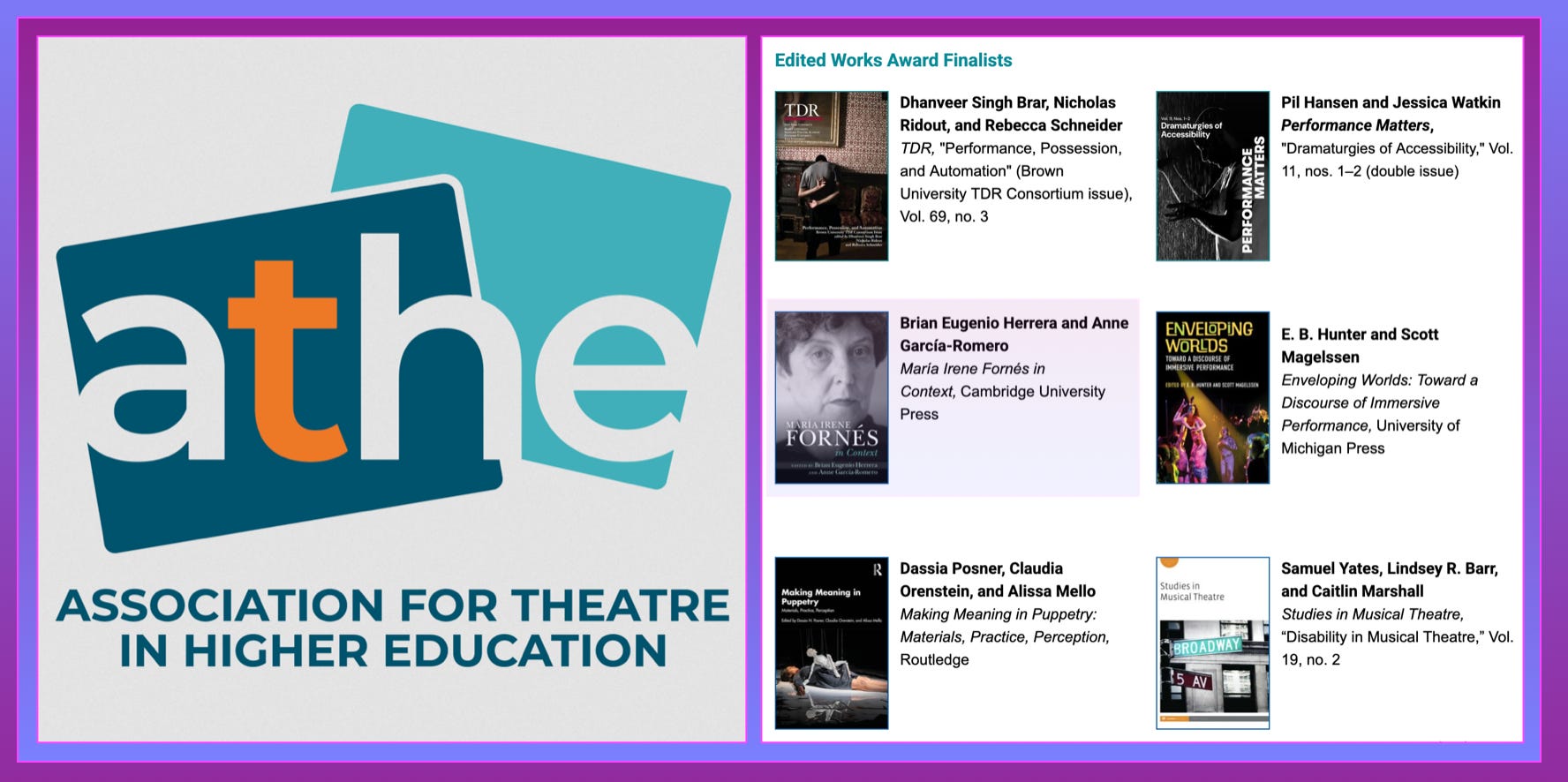
I am so honored (and pleased) that Anne Garcia-Romero’s and my edited volume María Irene Fornés in Context has been named a finalist among this year’s Edited Works Award from the Association for Theatre in Higher Education. The award recognizes those those books and journal issues demonstrating distinguished “complex and critical engagement” and “scholarly innovation and new methods, including models of collaboration.” Here’s hoping that this recognition will expedite the publication of a (slightly more affordable) paper edition of the volume!
And the nominees for the 2026 ATHE Edited Works Award are…
Dhanveer Singh Brar, Nicholas Ridout, and Rebecca Schneider • TDR 69.3 “Performance, Possession, and Automation.”
Pil Hansen and Jessica Watkin • Performance Matters 11.1-2, “Dramaturgies of Accessibility.”
Brian Eugenio Herrera and Anne García-Romero • María Irene Fornés in Context (Cambridge University Press).
E. B. Hunter and Scott Magelssen • Enveloping Worlds: Toward a Discourse of Immersive Performance (University of Michigan Press).
Dassia Posner, Claudia Orenstein, and Alissa Mello • Making Meaning in Puppetry: Materials, Practice, Perception (Routledge).
Samuel Yates, Lindsey R. Barr, and Caitlin Marshall • Studies in Musical Theatre 19.2, “Disability in Musical Theatre.”
Congratulations to all the nominated teams! Final winners and honorable mentions for all ATHE Awards will be announced at the ATHE’s 2026 Conference in Baltimore next month.
Wherein I offer capsule commentaries on what I liked best (or found most compelling) about the shows I’ve recently engaged... A full accounting of my 2026 theatregoing can be found HERE.
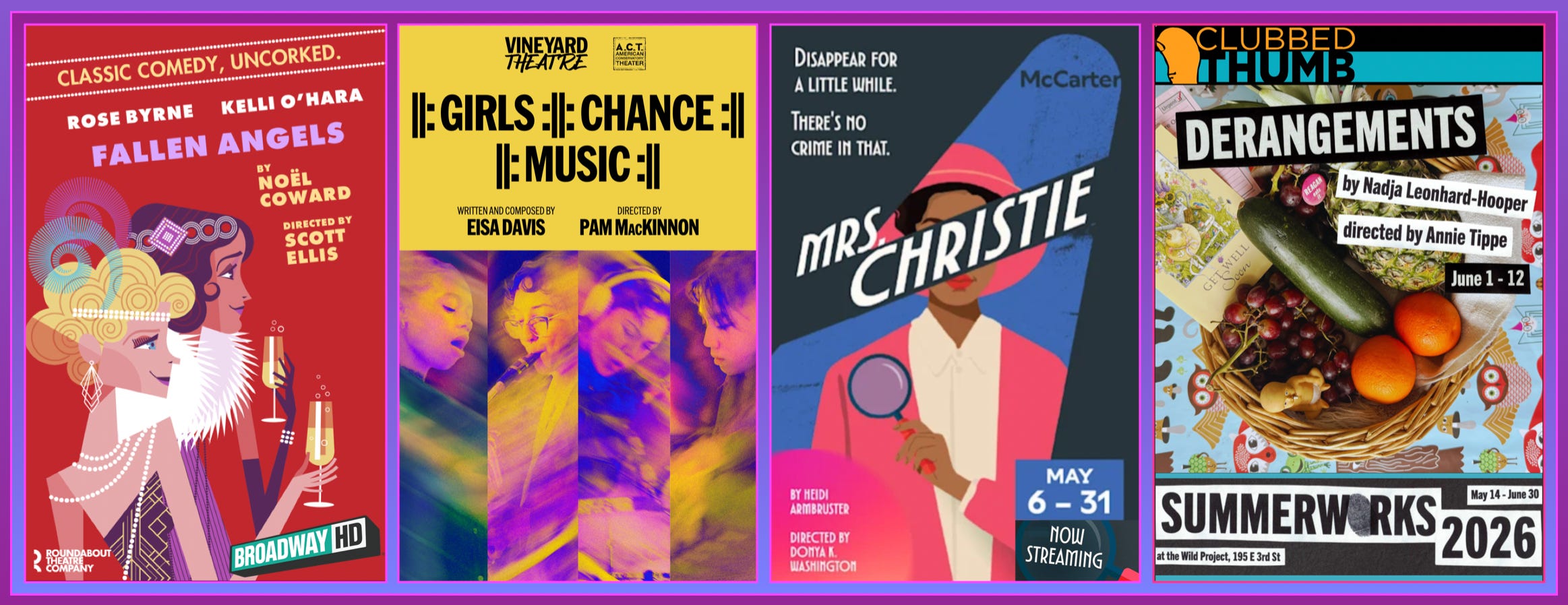
Written by Noël Coward • Directed by Scott Ellis • NYC : Broadway • Roundabout Livestream via BroadwayHD • June 2026.
There is something so specific about the moment in commercial Anglophonic playwriting that crests a hundred years ago, right before the talkies take over. The hyperlingual verbal patter. The spectacularly specific costumes. The situationally comedic (or dramatic) scenarios. Always so blithely diverting but also kinda totally negligible. As if playwrights were writing for tonight but not tomorrow, with little concern for the literary durability of the work in either the archive or the repertoire. Thanks to the intrepid efforts of NYC’s Mint Theater Company, I’ve had several recent encounters with this dramaturgical style but not even that prepared me for the utterly irrelevant, serious silliness of Noël Coward’s 1925 chestnut Fallen Angels as staged by Scott Ellis for Roundabout (and which I caught streaming via BroadwayHD). Indeed, I wondered why I’d never heard of Fallen Angels — fan as I am of the more canonical Coward. But once the broad shenanigans (and broader accents) of this production began, I realized that Fallen Angels perfectly distilled the spirit of a particular style of pre-talkies theatrical frippery — unfettered by either Prohibition or the Production Code — that somehow quickly fell out of commercial fashion as the 1930s began. But like a hopelessly garish geegaw of a broach discovered in great-great-grandmama’s jewelry case, it is fascinating to see this particular treasure polished and displayed with such luxuriating pleasure as in this Roundabout production. But, aside from the visual delights of set and Jeff Mahshie’s Tony-winning costumes, the most delicious aspect of this production was the opportunity to see two beautiful and much-adored actresses — Kelli O’Hara and Rose Byrne — each doing things we’ve not seen them have the high-profile opportunity to do before. (Who knew Kelli O’Hara had such physical comedy in her? And in stilletos, no less?) And for an actressexual like myself, the opportunity to spend two hours in the very posh company of two such performers on a bantering, bickering binge definitely had its rewards. (Though I should note that I’m pretty sure that each and every one of their shared scenes would utterly fail the crucial third point of the Bechdel test.) And I daresay that if this production had not been captured by BroadwayHD, I’m sure this production too would disappear into the drunken fog of theatrical memory. But, even so, Fallen Angels will remain for me a new benchmark as a exemplarily lush comedy of bad manners.
See also:
Deadline’s Greg Evans listens as Byrne and O’Hara discuss their “comedic influences, reveal a stage trick or two, and what they learn from Broadway audiences night after night”;
at Cote Notices, theatre writer/critic David Cote appreciates how the many swings taken by Fallen Angels, “go down easy as box wine.”
Written & Composed by Eisa Davis • Directed by Pam MacKinnon • NYC : Off-Broadway • Vineyard Theatre • June 2026.
There’s something about the structure of Eisa Davis’s remarkable memory play with music ||: Girls :||: Chance :||: Music :|| that makes me think of the experience of suddenly discovering a small cache of long-forgotten stuff at the bottom of a box or a drawer. You know how when you open that random envelope or squished box how a cascade of vivid memories can leap to life? How shuffling through that fading snapshot, this handwritten note, a crumply program for some concert or play, and whatever this mangled nametag was for can spark an urgent, absorbing, incoherent, triggering montage of sensations? How these shards of suddenly reactivated memory are always somehow always both invigorating and unsettling? Well. That was my experience of Eisa Davis’s weirdly wondrous ||: Girls :||: Chance :||: Music :||. Directed with care by Pam MacKinnon, Davis’s play shoots us through an unexpected memory hole of time to a particular summer (sometime in the 90s maybe) in a particular place (Berkeley definitely) where four prodigiously gifted teens enrolled in a summer music program for girls become an unlikely ensemble. There’s classical vocalist Fax (the staggeringly vulnerable Hillary Fisher), who sings with perfect precision but who has yet to actually hear her own voice. There’s pianist Rile (Yeena Sung), who’s more inclined to the play the music in her head than whatever’s on the page. There’s Clementine (Gianna DiGregorio Rivera), who’s always playing some woodwind or another — though mostly flute and mostly by herself. And then there’s drummer Margot (the incandescent Naomi Latta) — surly, shy, with a chaotic home life if you can even call it that but seemingly always capable of finding a rhythm that one or more of the other girls want to follow even when she’s not sure about following it herself. In ||: Girls :||: Chance :||: Music :||, Davis distills — in often captivating if occasionally elliptical/abstracted vignettes — a viscerally specific portrait of these girls and, through them, a potent excavation of how we experience (and how we remember) becoming ourselves. With the support of beautifully specific scenic and sound design — and exhilarating lighting design by Russell H. Champa — MacKinnon’s astonishing ensemble of gifted actor-musicians twines the particular urgency of adolescence with the peculiar intensity of art-making in convincing and compelling ways. And if specific passages or moments might have been more or less clear for me — so what? That’s how the most potent memories play, whether in our hearts or our minds or onstage in ||: Girls :||: Chance :||: Music :||.
See also:
at Cote Notices, theatre writer/critic David Cote confirms that “there’s something very special very special about this show with the finicky title” which he describes as an “engrossing coming-of-age tale whose unfeigned openness honors its characters’ wisdom and fragility”;
at Culture Sauce, veteran arts writer/editor Thom Geier celebrates the mesmerizing too-muchness of Davis’s evocation of female adolescence.
Written by Heidi Armbruster • Directed by Donya K. Washington • Princeton, NJ • Livestream from McCarter Theatre Center (Berlind) • June 2026.
An often intriguing and occasionally diverting concoction of a play, actor/playwright Heidi Armbruster’s Mrs. Christie bends time (and history) to activate a thoughtful puzzler about love, loss, and re/discovering one’s guiding sense of purpose. Set (mostly) in the mansion outside London where Agatha Christie lived and worked, the play brings two unrelated stories — Christie’s famously legendary disappearance, on the one hand, and Christie-superfan Lucy’s atttendance at Christie-themed festival, on the other — together in the fold. Between the two interweaving narratives, there are, of course, secrets to reveal, red herrings to debunk, and mysteries to solve before both heroines rediscover their footing on their path (back) toward themselves. Along the way, there are surrealish forays to semi-real worlds — not to mention the delightful companionship of two wise interlocutors — Monsieur and Jane — who bear a striking resemblance in both manner and appearance to, respectively, Hercule Poirot and Miss Marple. Oh! And then there’s that witty wise maid, who both is and is not the same person in the 1920s and 2020s. This tumble of delightful detail in Donya K. Washington’s production can be a treat. But it can also make it tricky to follow (or care about) the actualization of the two heroines or their parallel storylines. Plus there’s the question of tone — which, in this production, seemed to careen from the cozy stylings of, say, Midsomer Murders to the full-blast cringe comedy of, say, Difficult People. I’m not sure whether streaming this production diminished my appreciation of or engagement its broad approach, especially in Christiana Clarke’s odd intensity as Agatha, but I was glad for the gentle wit conveyed in the performances of Evan Zes and Gina Daniels (as Monsieur and Jane) and Polly Lee’s presence as the aforementioned house maid/manager; these three became my invaluable guides through the myriad narrative traps and production trappings of Mrs. Christie.
See also:
NJArts’s Jay Lustig confessed to find the “loud and frantic tone of much of the play off-putting” but “there certainly were some laughs along the way, and Armbruster did tie together the play’s themes in a neat and surprisingly moving way”;
Arts News Now’s Lori Goldstein talks to playwright Heidi Armbruster about her dramatic interest in Christie’s “champagne nihilism,” where everyone’s supposed to “keep calm, carry on, have drinks before dinner, and don’t get murdered.”
Written by Nadja Leonhard-Hooper • Directed by Annie Tippe • NYC : Broadway • ClubbedThumb @ TheWildProject • June 2026.
One origin story for Nadja Leonhard-Hooper’s deliriously unhinged manic comedy Derangements is that it founds its beginnings as part of the playwrights submission for ClubbedThumb’s 2025 Biennial Commission, which honored Christopher Durang (1949-2024) and “how powerful and much-needed savage humor like his is in a world like ours today.” Which it totally makes sense because, like so much of Durang’s ouevre, Derangements makes no sense whatsoever… except of course when considered from that place in the pit of your stomach that opens after you’ve been heaving from laughter. The play, ostensibly, tells the story of two longterm-but-casual friends who meet for dinner and have a transformative/traumatic encounter with a flasher (note: all these definitions are simultaneously correct in the world of the play) played with fervor by Danny Wolohan. After this dinner, Roxanne (an unabashedly delulu Crystal Finn) — who believes everyone is coming on to her — somehow becomes immaculately pregnant, while Anne Marie (the incrementally panicked Hannah Cabell) — who doesn’t believe in much — starts losing her capacity to remember nouns. Separately and together, Roxanne and Anne Marie try to get well, which of course means that they’re also soon caught in the snares of various wellness cult/ure/s. A surprising, savvy, and scathingly funny commentary on the everyday terrors routinely visited upon women’s bodies within a patriarchal/capitalist society, Derangements lives out the frenzy suggested by its title. I found myself thinking “WTF is happening” in one second and “of course, WTF else would be happening” in another. Put another way, the comedy of Derangements makes no sense because — really, just look around — there is no sense to made of this moment in time. (A moment of time, it should be noted, that is the 1980s and now, and everything in between, which — as a trained historian of US culture and history — actually strikes me as completely correct.) Inhabited by a knockout cast of the sort ClubbedThumb is famous for (including one of my favorites Camila Canó-Flaviá, appearing here — in one of many characters — as the DuoLingo Owl), and directed with the precision necessary for farce by Anne Tippe, Derangements is a firehose of frenzied hilarity, a nightmarishly funny rollercoaster of a romp, and one that I only wish I could experience again… and again… and again. Because, really, what better way to understand how it feels to be alive in this nation right about now than to join a bunch of people in the dark to share Derangements.
See also:
at Engaging with Melodrama, dramaturg Susana Kuhn ponders how Derangements plots its many “twists and turns, a roller coaster that seems to fly off the tracks, landing safely back or, if you dare to open your eyes, maybe never left at all”;
The New York Times’s Helen Shaw counts the “zany adventure” of Derangements’s her favorite among a smorgasbord of gorgeous Off-Off Broadway shows;
Wherein I offer programming notes regarding the ongoing publication of #TheatreClique. Also an occasional space for me to capture a thought or two that I just need to put somewhere.
One of the journalistic boilerplates I find most tedious is “Newsflash! Tony Awards Broadcast Ratings Are LOW!” So with the requisite reports that this year’s broadcast dipped again in the ratings, I craved some context.
So here are some 2026 Tony Broadcast Ratings : Fun Facts;
The 2026 Tonys were the only broadcast from the (deservingly beleaguered) CBS Network to crack the week’s top ten in the Neilsen chart for 6/1-7/26;
The 2026 Tonys broadcast was actually viewed by 5.08 million viewers, which is either couple hundred thousand more than the 4.85 million who watched the 2025 Tonys, or about the same as 2025’s time-zone adjusted 5.1 million. (The reported 1% or .78% decline in viewership appears to be about the “share” of total viewers, not a decline in the actual number of viewers.)
The Survivor50 finale was reportedly viewed by 5.6/5.8 million people. Since 2021, the Survivor finale has toggled between the 4.5-5.6 million mark, where the Tonys broadcast has been on an upswing from 2.6 million in 2021 to 5+ million in both 2025 and 2026.
Does any of this matter? I’m not sure, but I suspect it might. Mostly because 2026 marks the 10th (and final) year of The Tonys contract with CBS. (A contract brokered with CBS’s then-president — and big Tony fan — Les Moonves… remember him?) So it’s as yet unclear where (or whether) the Tonys will be broadcast in 2027. But I suspect that The Tonys’s reputation for notoriously “low” ratings will prove a factor in any future negotiations. And even though CBS has been a dedicated broadcast partner for The Tonys since 1978, I wouldn’t presume that the network’s current executive leadership cares a whit about that legacy. So here’s hoping that, like the fabulous invalid it celebrates, The Tonys finds its way to some kind of live televised/streamed celebration in 2027. We shall see…
Comments
Nothing yet. Say the first thing.
Sign in to join the conversation.