
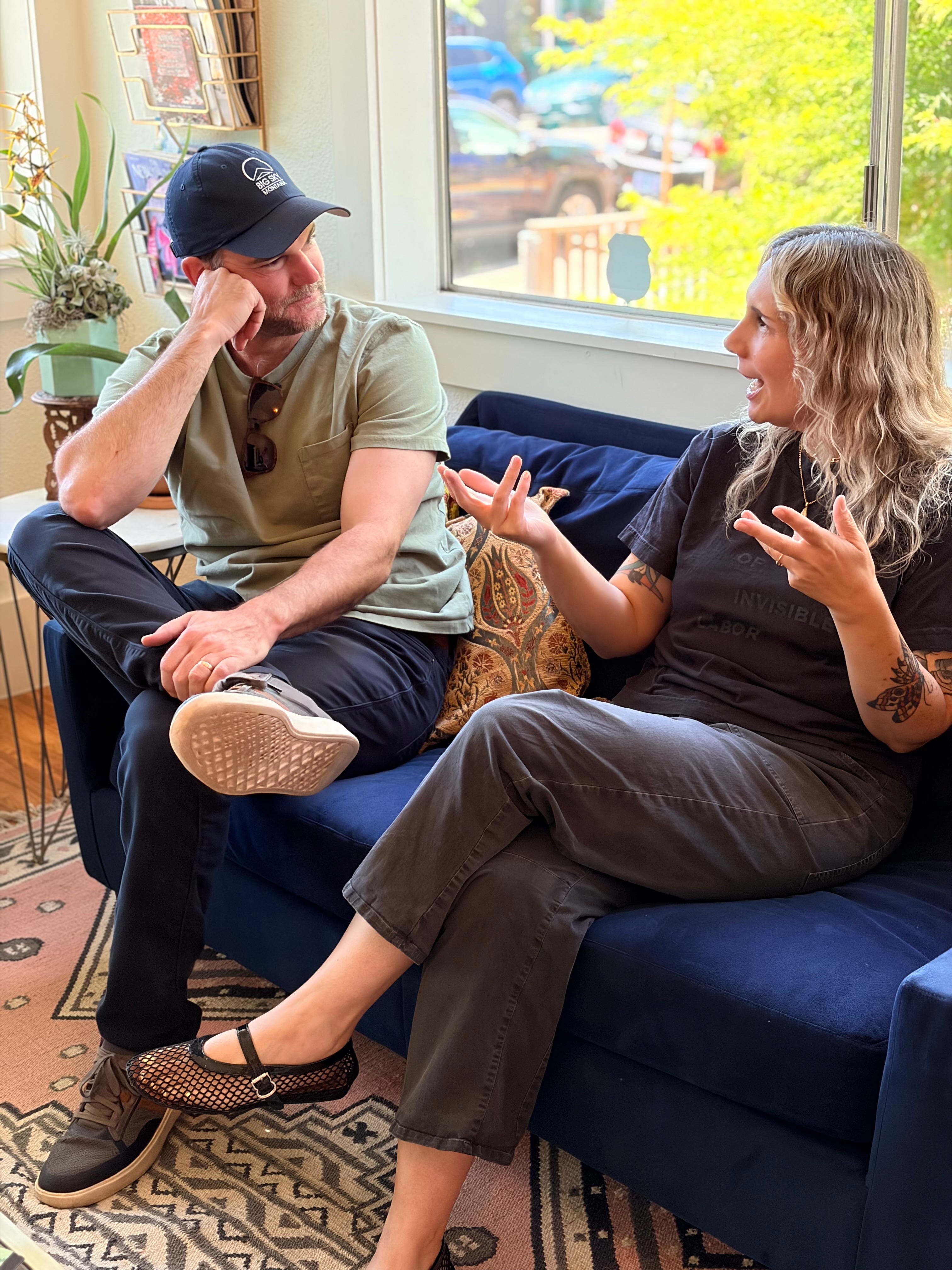
This is the second half of my Q and A with Trinity Toft, my good friend and licensed clinical social worker in Portland Oregon. Not only is she a badass with some sick tattoos, she also has some amazing insight into relationships and individual mental health. You can read the first half of our interview HERE.
Brian: One thing I’d love people to understand is what couples therapy actually looks like. A lot of men are terrified of taking that first step. So when a couple comes in, what’s your process? Do you start by asking a lot of questions? Are you looking for the root issue?
Trinity: Usually I start by asking, “Why do each of you think you’re here?” Almost always, they tell two different stories. In individual therapy, a client might say, “I’m doing everything and he doesn’t listen, “ but I’ve only heard one perspective at that point. I’m curious about both sides. What’s this relationship look like from each person’s experience?
Just last week I met with a longtime individual client and her fiancé. They came in to talk about parenting—she already has a child from a previous partner–and they wanted to figure out his role as a stepfather and how to best communicate.
We ended up talking about money.
We discovered they attached completely different emotional meanings to money based on their childhoods.
Brian: That’s fascinating. I bet those kinds of things become much bigger than people expect.
Trinity: They really do!
So in talking about his communication methods, we ended up talking about his childhood, how it was affecting the way he was parenting, and patterns he hadn’t recognized before.
At the end he said, “Wow, this was really helpful. I’d like to come again.”
That’s really my role—to help both people feel safe, not to be on anyone’s side.
I’m very relational. I want it to feel like we’re just having a conversation. Then I can gently say, “Let’s pause there. What’s underneath that anger?” People don’t ask men that very often. Instead it’s, “You’re angry,” or “You’re yelling.” I’m more interested in asking, “What’s happening underneath?” Maybe somebody hurt you. Maybe you’re feeling pressure. Maybe you’re struggling with how you’re expected to show up in the world.
Brian: That’s interesting because I think the default assumption is often that men are just being babies, which, I mean sometimes that’s justified—but I also think men are just super sensitive and we just don’t know what to do with those feelings.
Trinity: You’re not wrong.
Brian: So part of what you’re doing is creating space, to try to uncover some of the deeper issues that aren’t being spoken, maybe?
Trinity: I’d say that’s accurate. The second part is helping people build new behaviors. I think about therapy through what’s known as The Three A’s:
Comments
Nothing yet. Say the first thing.
Sign in to join the conversation.