
The Great Bacterial Reef: #NeoArmory:
“Surgeon’s log. Stardate 2026. Infection, the first and final frontier of orthopaedic surgery. These are the voyages of 5 stage revision surgery to eradicate whatever the petridish grows…”
But, hold on. What if you implant can fight the fight even before the fight has started? That’s where NanoCept, a proprietary antibacterial surface technology from Onkos Surgical. Unlike traditional coatings, this non-eluting, nanoscale surface is designed to actively reduce bacterial contamination deposited during the surgical procedure itself.
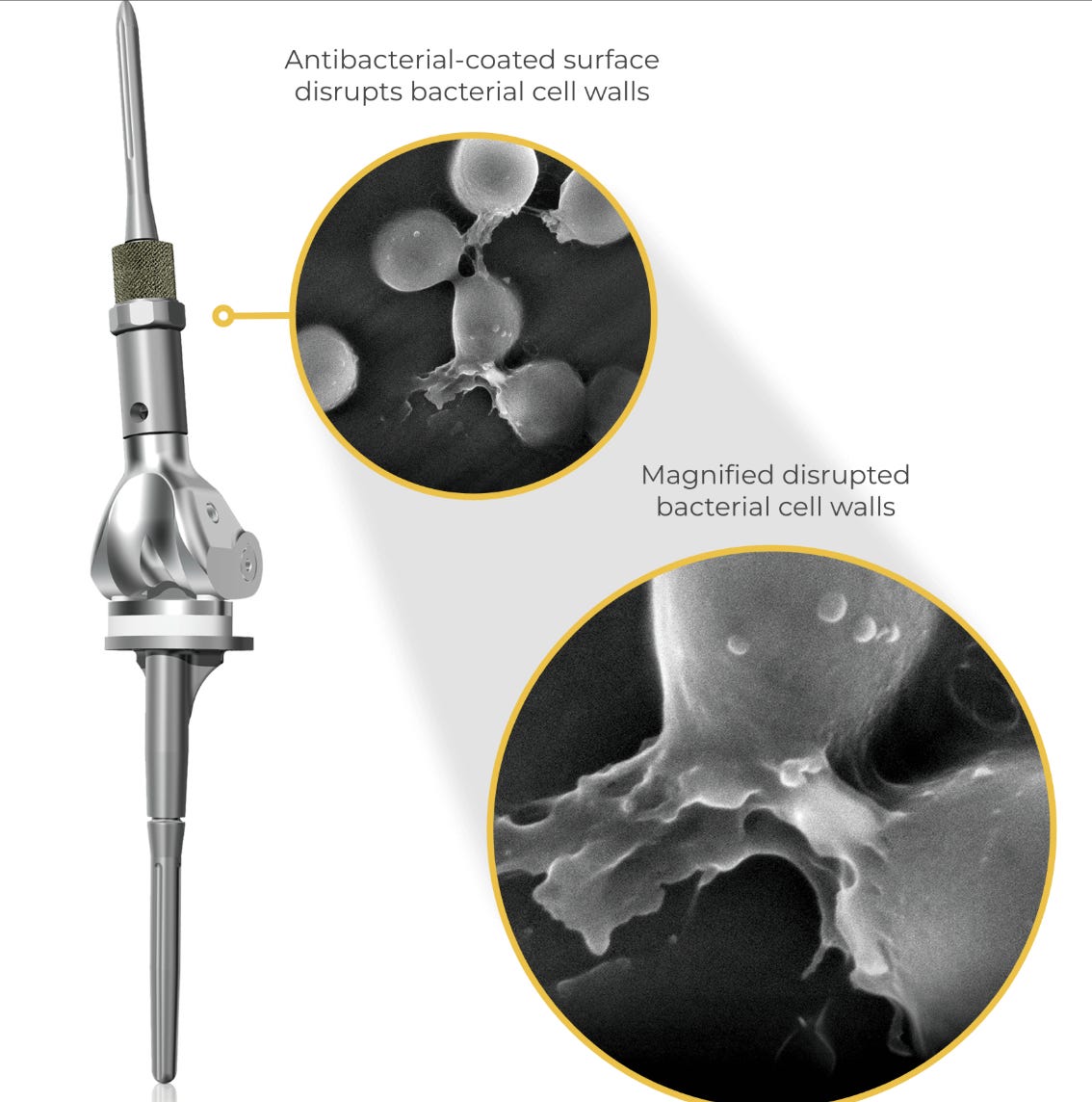
It is a Non eluting coating made of quaternary ammonium compound called methacryloyloxydodecylpyridinium bromide (MDPB). (Yep, that one). They claim 99.999% kill rate of bacteria found in OR and excellent biocompatibility. It is already available in their own ELEOS reconstruction system.
If this can show good results in long(-ish) term studies, may be 1 and 1.5 Stage revisions for infections can become more prevalent.
Making a safer window for HTO: #SurgicalPearl:
Medial opening-wedge high tibial osteotomy (OW-HTO) is a joint-preserving option for younger, active patients with varus-aligned medial-compartment knee osteoarthritis. However, releasing the medial collateral ligament (MCL) and protecting the vessels and nerves behind the tibia can be technically stressful—particularly during a surgeon’s learning curve, which has been reported to span 27–42 procedures.
Matthieu Ollivier group describe a “second-window” approach. Instead of working entirely through the standard medial exposure, the surgeon creates an additional window behind the superficial MCL. A periosteal elevator is carefully advanced along the posterior tibial cortex, creating a passage for a posterior tissue retractor. This retractor sits directly against the tibia, shielding the posterior neurovascular structures while the osteotomy is performed.
The deep MCL and its proximal tibial attachment remain intact. The distal superficial MCL is released and retracted separately, improving access to the medial tibia. After the saw cuts, the surgeon can feel the posterior retractor through the osteotomy gap, confirming completion of the posterior cortical cut before opening the wedge. MCL tension can then be fine-tuned using limited posterior-fibre release or pie-crusting.
The proposed advantages are better neurovascular protection, less retractor crowding, reduced tension on the MCL and more controlled ligament release. It may also reduce incomplete osteotomy, which can contribute to tibial plateau fracture—reported in roughly 1–11% of OW-HTOs.
Check out the full video of the technique here
300% mortality rate – is it even possible?
Back in the day when speed is safe and delay is death!
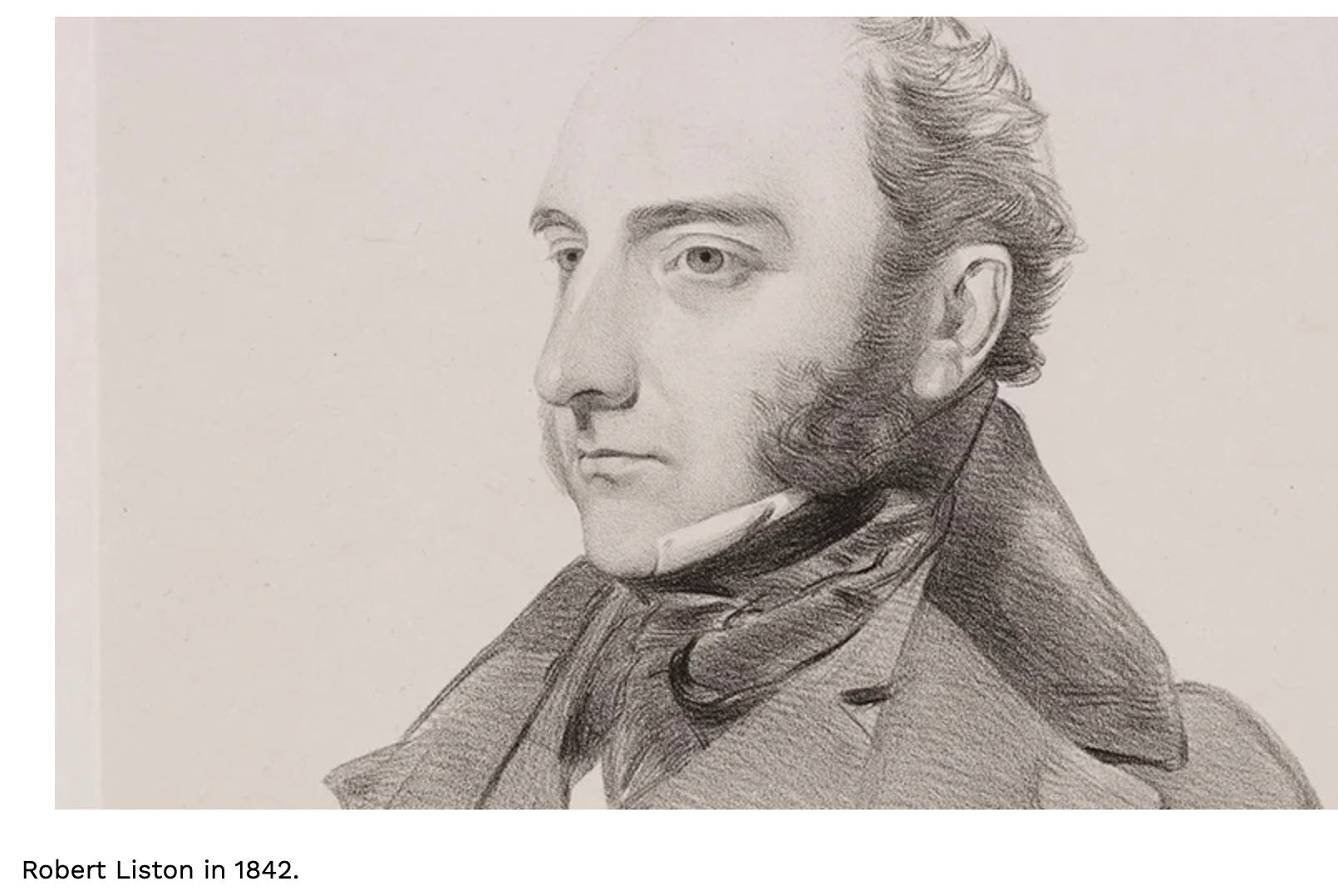
Robert Liston (1794-1847) was the diligent follower of the philosophy! In the early 19th century when anaesthesia was not even in the cooking pot of thinking. To alleviate the patients suffering or at least decrease the suffering to save the lives through surgery, the faster a surgery is performed, the better. So, there was the question of speed over safety, but they were not fortunate enough ask that question.
Liston was called the “fastest knife in the west end.” Can you imagine that he used to finish a leg amputation under 2 and half minutes, routinely. He even got it at 28 seconds once? Do you remember that recurring scene from the movie series “Equalizer” where Denzel Washington is shown timing his fights? Our man was something like that and it paid him well. While other surgeons had a mortality of 1 in 4, Liston had. 1 in 10, pretty impressive right? He had his fair share of complications and that one surgery became famous, for the right reasons.
Now, our “fast” surgeon was performing a leg amputation and by mistake, he cut off the thumb of his assistant and when he pulled the knife back, accidentally cut of the coat tail of an enthusiastic spectator who was standing too close. The spectator died instantly believing that he was stabbed, which he was not but out of fear, he died of shock. The assistant later died of gangrene and finally the patient on whom the surgery was performed died later, likely of infection, leading to the infamous surgery which had a mortality of 300%.
Coming to the present days, speed is still good, but not at the cost of safety. We are fortunate to have anaesthesia and infection control protocols, and we should remember “safety trumps speed.”
Packed Cell Transfusion, not so soon! #MostCited:
Blood is a limited resource, and there are concerns about risks, including transmitted infections. If a liberal transfusion strategy does not improve clinical outcomes, or if it is equivalent, then adopting a more restrictive approach should be recognised as the standard of care.
JL Carson et al. in their Cochrane review compared 30-day mortality and other clinical outcomes for participants randomised to a restrictive transfusion threshold of 7-8 g/dL versus a liberal transfusion threshold of 9-10 g/dL for all clinical conditions. Upon analysing 61 trials with 27,639 patients, it was noted that restrictive transfusion strategies reduced the risk of receiving at least one RBC transfusion by 42%. When combining all clinical contexts, restrictive transfusion strategies did not modify the risk of 30-day mortality or any other outcomes compared to liberal strategies.
The key takeaway? In most clinical contexts, there was no evidence of harm from a restrictive compared with a liberal transfusion strategy. So, the next time your anaesthetist asks for a transfusion prior to surgery with a higher threshold, this evidence will help you to push the patient into the theatre without an actual transfusion yet.

Events to check out:
Eurospine 2026 07 – 09th October 2026 Gothenburg, Sweden
Indian Arthroscopy Society Annual Meeting 2026 08 – 10th October 2026 Kolkata, India
The 41st Annual Orthopaedic Research Meeting of the Japanese Orthopaedic Association 15th – 16th Oct 2026 Gifu, Japan
Have a fabulous month ahead guys. See you all next week.
Comments
Nothing yet. Say the first thing.
Sign in to join the conversation.