
What If You Could Undo the Mistake? #NeoArmory:
What if — in surgery — you could undo a mistake after committing to it? Rotator cuff repair doesn’t usually allow that luxury. A few millimeters off in tension — too tight or too loose — can quietly decide the fate of the repair. And traditionally, once you tension an anchor… you live with it.

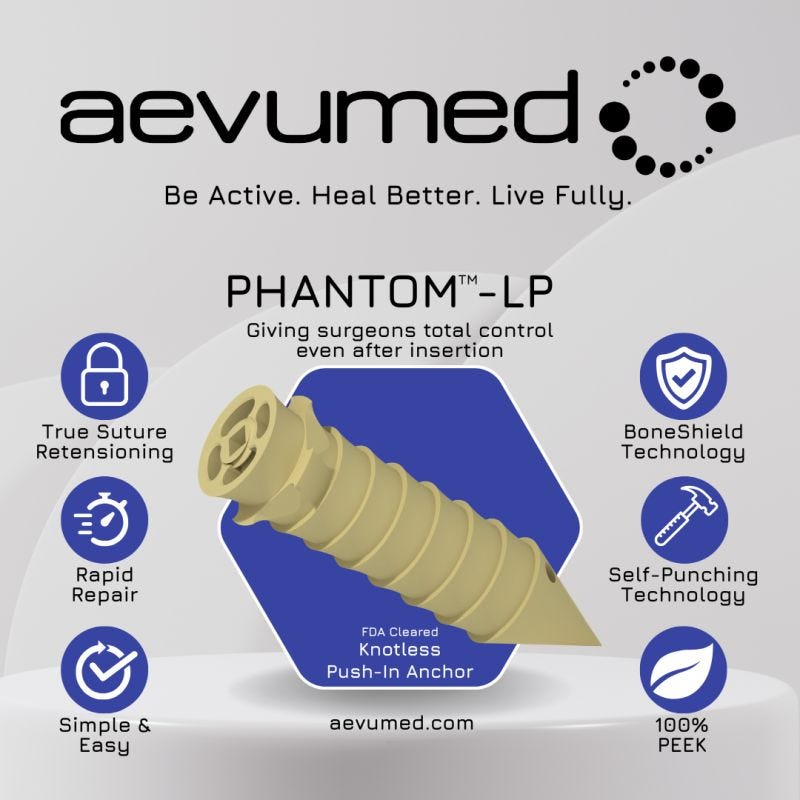
Enter the PHANTOM-LP Anchor — and its sibling, the FASE Anchor
What makes these anchors stand out is not just being knotless or PEEK-based. It’s the concept of retensioning. Sutures can be adjusted after implantation - locked, unlocked, and fine-tuned multiple times during surgery. For the first time, we’re seeing intraoperative reversibility becoming part of anchor design.
Most anchor innovations have been about: Strength, Material and Pullout
This is about decision-making under uncertainty. Instead of a binary “set and hope,” we now have: Set → assess → adjust → re-lock. Check the cool video of this technology here
But - and this is important:
Robust independent clinical outcome studies on retensioning technology are still limited.
Long-term comparative data is needed to truly validate whether this translates into lower re-tear rates or better healing.
The Latarjet Encore: More Than Just a Procedure #FromTheHistory:
We’ve spoken about him before — in our deep dive on the Latarjet procedure, and that compelling academic face-off with Albert Trillat. But the more we read about Michel Latarjet… the more it felt like one article just wasn’t enough.
So here’s an encore.
Michel didn’t just grow up around anatomy, he grew up inside it. His father, André Latarjet, carried forward the legendary Testut-Latarjet, the anatomy bible for French medical students. At home, dinner tables weren’t about small talk - they were covered in anatomical diagrams, proofs, and debates that would eventually make their way into textbooks.
For Michel, anatomy wasn’t a subject. It was a way of life. But here’s where it gets interesting. He wasn’t the stereotypical academic. Not even close.
Michel was deeply into skiing and mountaineering — at a serious level. This wasn’t a weekend escape; he chaired the ski commission of the French Alpine Club. And just when you think that’s enough range… He adds music. A professional-level pianist, playing duets with his violinist wife, immersed in Lyon’s cultural scene, eventually becoming president of the Philharmonic Society in 1965.
So what do we see when we step back?
A master anatomist | A surgeon who gave us a game-changing procedure | A competitive sportsman | A refined musician.
All of this — under the shadow of a giant father and a legacy that could have easily boxed him in. But it didn’t. He expanded. He thrived.
Maybe that’s why we keep coming back to Latarjet. Not just for the procedure, or even the Trillat rivalry — but for what he represents. You don’t have to be one thing. You can build depth and range.
And sometimes, the most complete surgeons are shaped far beyond the operating room.
“Anchors Aweigh! What to Do When Your Suture Anchor Says ‘I Quit’? #SurgicalPearl
So there you are, cruising through a rotator cuff repair, and your shiny suture anchor decides to pull a Houdini and bail out of the bone. Panic? Nope. The gang at Seoul National Hospital tackled this exact drama in over 1000 surgeries and came up with a few slick bailout moves.
Out of 1076 shoulder cases, 52 anchors misbehaved—48 during surgery, 4 after. Women, older patients, those with pre-op stiffness, and massive tears were repeat offenders when it came to anchor drama. Pullouts were more common with soft anchors (5.4%) than screw-ins (3.3%).
So, what did they do?
Buddy Screwing: Basically, tag-teaming two anchors together like conjoined twins—worked okay but had the highest failure rate (3/16 failed).
Anchor Re-do at a New Spot: Shift the party to a sturdier neighborhood in the bone—worked decently, though 2/17 failed post-op.
Cement Augmentation: Inject some PMMA glue magic into the hole—messy but 100% success (though only tried in 2 cases).
BASP (Bar Anchoring with a Steinmann Pin): The showstopper! Slide a threaded pin into the original site, flip it like a ninja baton inside the bone, tie it up, and boom—92% healing rate with 0 failures. Bonus: reuses the original site and looks badass.
Lesson? When the anchor bails, don’t lose your cool. With a few clever tricks (and a trusty Steinmann pin), you can still sail this ship to safe shores
Sling or Brace post cuff repair ?! It doesn’t matter
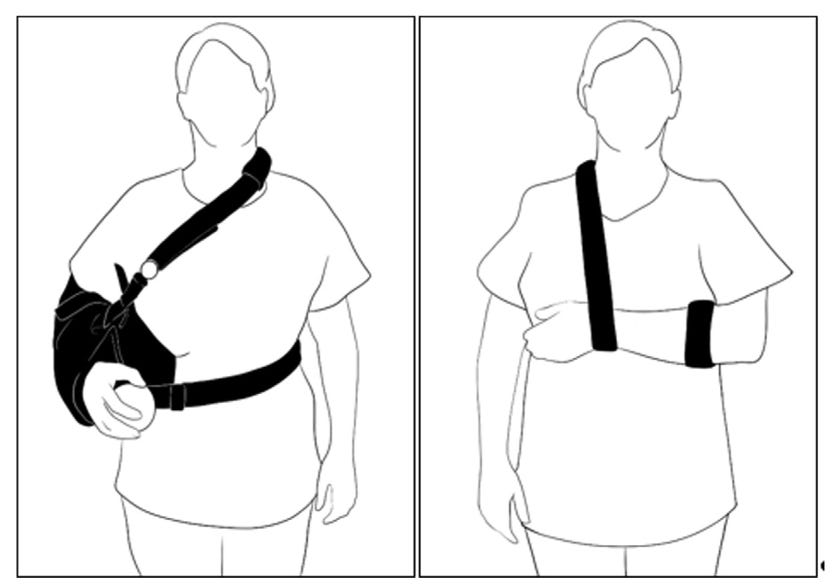
There is a dilemma between the usage of brace or sling in the post-operative phase of rotator cuff injury since the former is a strict immobilisation protocol with the advantage of suture protection at the risk of joint stiffness, while the latter is more patient friendly that allows early mobilisation.
F Schonweger et al. tested this ambiguity in their randomised controlled trial among 110 patients, where one group used a brace for 6 weeks after surgery (3 weeks day and night, then 3 weeks only at night), while the other group used a simple sling for 2 weeks only. They found at 6 months follow-up that arthroscopic rotator cuff repair using postoperative sling immobilisation was not inferior to immobilisation with a brace, having no differences in terms of functional scores, pain levels, general health, and risk of tendon re-rupture.
Interesting Events to check out:
10th Basel Elbow Course 22 – 24th April 2026 - Basel, Switzerland
OARSI 2026 World Congress on Osteoarthritis 23 – 26th April 2026 - West Palm Beach, USA
27th EFORT Annual Congress Málaga 2026 04 – 06 May 2026 - Malaga, Spain
Comments
Nothing yet. Say the first thing.
Sign in to join the conversation.