
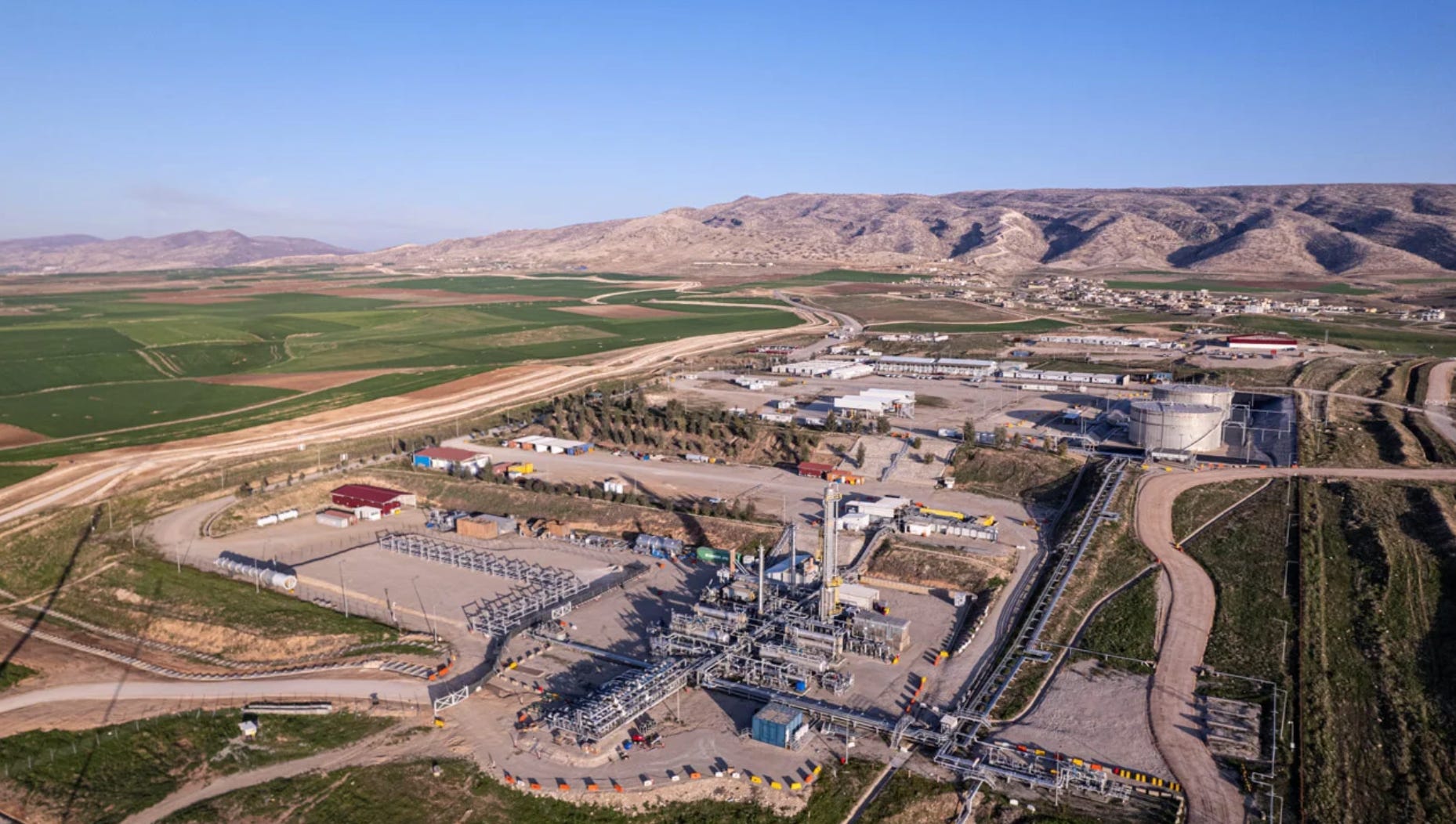
The Shaikan Oil field
*Please read the disclaimers at the base of this report. The author may maintain a short position in the company (or companies) mentioned below. Does not constitute a recommendation to buy or sell the securities mentioned herein. Do your own due diligence. This report constitutes opinion journalism and commentary and should not be read as investment advice. For Permitted Recipients only (UK - see disclaimers).
Gulf Keystone has a long and chequered history in Kurdish Iraq. Effectively a single asset company it has a majority working interest stake in the Shaikan oil field in Kurdistan (the Hungarian company MOL own the remainder). Quite what that stake is still remains a source of confusion.
Currently, the company’s oil production is shut-in given the recent conflict in the region, with drones reportedly attacking facilities in Kurdish Iraq earlier in the conflict. In theory though, with a peace settlement, oil will soon once more flow into the pipeline to Turkey. However, this only represents the start of GKP’s problems.
Gulf Keystone has issued massive dividend payouts (over $350m since 2022), despite clearly needing considerable investment to achieve its stated goal of getting production up above 100,000 barrels a day. Yet the position of the receivables ($185m) it believes are owed it remains unclear, along with its actual working interest in the field (58%, 61.5% or 80% depending on certain imponderables). Meanwhile, given the sanctioning investment in water handling in 2025 and historic commentary we can surmise increasing water ingress in certain wells that have been curtailed along with presumably an expanding gas cap, whilst gas flaring continues at a constant rate.
A material part of the GKP investment case is that the receivables GKP claims the KRG owe it will be repaid. Yet it is clear the KRG dispute this. There seems little to no possibility of the latest iteration of the company’s FDP (field development plan) being approved without settlement of a mysterious cost audit with the KRG and potential downward adjustment of its receivables. That settlement is due this year according to company statements. But this whole thing has drifted on for years. Perhaps it is in the interest of both parties (management to avoid admitting a material writedown of receivables, and the KRG because of the complexities of dealing with Iraq and other interested parties, and because it is a payment that they probably don’t need to make) to let it drift. What does seem to be apparent is that a cost audit as mentioned in past reports (ever since 2020!) would likely have been carried out by Deloitte or another big audit firm given the presence of regular Deloitte audits of the oil and gas sector on the KRG’s website all the way through to Q1 2023. So the question is - where is the report and what are its contents?!
Relations between the company and the Kurdish MNR have long been tricky. It is hard to envisage the latest iteration of the company’s FDP (field development plan) being approved without settlement of a cost audit with the KRG and potential downward adjustment of its receivables. Moreover, the company has almost run out of (claimed) unrecovered cost oil, while its share of profit oil is ratcheting down from 30% towards 15% as the R-factor (gross revenues / gross costs) on its PSC moves from 1 to 2.
There is confusion and obfuscation over GKP’s actual working interest in the field, with reserves stated in their Annual Report at 80% working interest, but elsewhere they mention having tentatively agreed to give the Kurds 20% of the gross field interest, lowering their own working interest to 61.5%, albeit with a lower (20%) capacity building payment. Prior to 2016 the working interest was stated at 58% with a cost exposure of 64%. A downward adjustment in working interest clearly has have implications not just for future cost and profit oil, but also historic cost oil calculations. The problem with all of these “variations” which are often referred to as “tentative” is that nothing seems to be written down; its often on a handshake, eg with a previous oil minister, Ashti Hawrami, who died two years ago.
The company continues to include language in its Annual report and other documents about a potential “cost audit” by the KRG. This mysterious “cost audit” has made its appearance on the pages of GKP’s annual report for a number of years. Yet there is no elucidation on the matter. Has the cost audit been completed? Who was the auditor? Was it a big auditing firm (we assume so)? Do management know the conclusions of the audit? If so, and given this is a material price sensitive matter, why not announce it to shareholders? What information have GKP’s own auditors been provided with on the subject? As an wise old head once wrote, “absence of information is information of absence”.
Given the late payment of invoices and other question marks over working interest we are concerned that Gulf Keystone may have over-invoiced for cost oil in historic invoices in the past with the risk of the KRG blocking payment of current and future invoices or adjusting them to claw back this historic cost oil. The constant changes or “tentatively agreed” changes to the PSC don’t really favour Gulf Keystone in this regard: if 20% of the field has gone from contractor share to carried interest is 20% of the cost oil from that “carry” recoupable? It’s unclear.
Furthermore, if Gulf Keystone only includes “cost and profit oil receipts” in its R factor calculations, then presumably if it was paid out on the remaining receivables its true R factor would be materially higher, meaning its future profit oil would be materially lower. On an accounting basis though, given receivables should be treated as sales, its profit oil is overstated: if the company believes its receivables are recoverable it should account for its profit oil and therefore ultimate oil entitlement on the basis of a lower R factor.
A recent revised lifting or export agreement by the KRG with a lower pricing mechanism has now been proposed which the company hasn’t accepted, apparently triggering a mismatch between what the company is invoicing the KRG for and what the KRG is prepared to pay. Its unclear what implications (if any) this would have on cost and profit oil calculations.
According to the 2025 annual report there is cost oil of $152.7m unrecovered for the Shaikan Contractor or $122.2m net to GKP. It seems that GKP was able to shift on an accounting basis some of what it claimed was its outstanding cost oil balance from 2022-2023 sales of $28.3m:
The Company’s 2025 net entitlement reflects the effective recovery in the second half of the year of $28.3 million of cost oil owed to GKP from the outstanding October 2022 to March 2023 receivable balance. Consequently, the total receivable balance for 2022-2023 exports sales as at 31 December 2025 reduced to $122.8 million net to GKP (comprising $92.1 million cost oil and $30.7 million profit oil net to GKP). Including receivables in relation to September to December 2025 export sales, the combined total owed to GKP amounted to $184.6 million as at 31 December 2025 (comprising $141.8 million cost oil and $42.8 million profit oil).
We are unclear what that “recovery” really is - is it a rebadged 2025 era receivable or a verifiable recovery of the older vintage receivable? It would certainly be odd for the KRG to be paying older vintage receivables before the result of its cost audit have been published, unless, perhaps, this is all they expect to pay (ie they have completed the cost audit already).
However, when we read the independent auditors report we can find this little nugget of information:
“At the end of the year, no amounts had been received in respect of October 2022 to March 2023 oil deliveries, however the balance of this receivable decreased for the cost oil component rebilled and exchanged to trade receivables from the 2025 export sales”
So, it would appear that a rise in 2025 vintage receivables reflects not just amounts owed for the last two months or so of the year but also a true-up of oil sales reflecting “the expected reconciliation to international prices, reflected in the realised prices for international revenue”. This amount forms around half the $64.8m related to amounts receivable from 2025 export sales.
Clearly however, this “bulge” in 2025 receivables reflects the “re-allocation” of payments from the KRG to an older receivable, as we have seen in the auditors report. The rebilling and exchange of these receivables therefore doesn’t change the risk profile of the total outstanding amount and seems pretty misleading.
In the table below we can observe the shift down in receivables from past due to 2025 related receivables, which on the face of it seems to flatter the real situation.
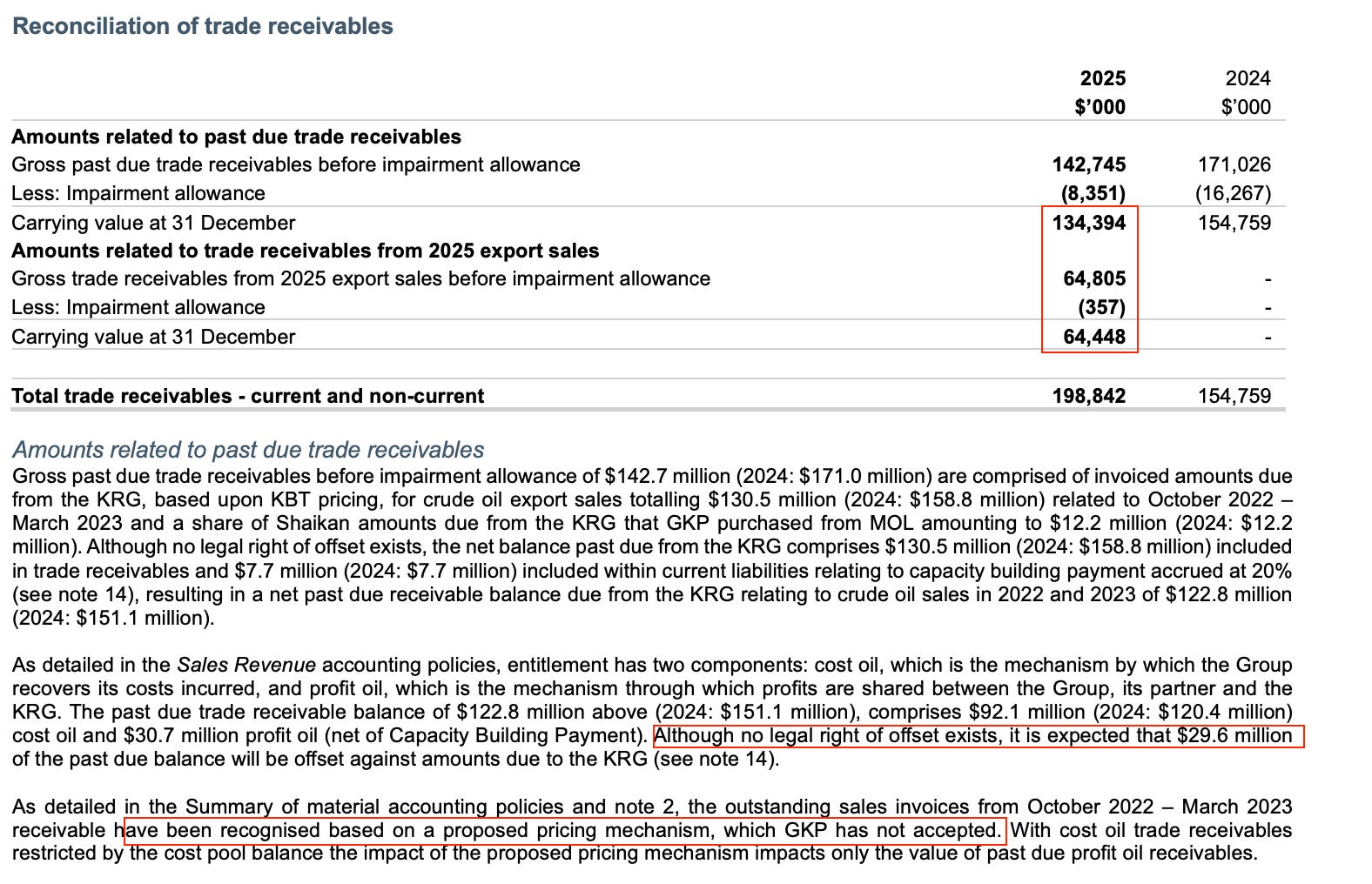
Overall GKP states that the combined total it is owed amounts to $184.6m at the end of 2025 (comprising $141.8m cost oil and $42.8m profit oil), which is less than its net receivables balance of $198.8m, despite that balance being discounted by an impairment allowance.
Moreover there are other offsetting amounts sitting in payables (approx $100m) that offset some of these receivables including capacity building payments on profit oil, and a $29.9m straight “offset” of old receivables.
In short any balances owed could end up being a lot smaller, or non-existent on a net basis.
While GKP continues to bill up to its perceived net entitlement (36% = 61.5% of 40% cost oil plus 61.5% of approx 26% of 60% profit oil), its future net free-cash generation could ultimately end up being its diminishing profit oil as the R factor rises (profit oil falls from 30% to 15% on a sliding scale as R factor moves between 1 and 2), minus whatever capacity building payment is deducted.
Below the paywall below we map out valuation scenarios and why current valuations may be challenging, and investigate the underlying challenges with the reservoir which the above ground questions have so far obscured. Please consider subscribing.
Comments
Nothing yet. Say the first thing.
Sign in to join the conversation.