

*Please read the disclaimers at the base of this report. The author may have positions (long or short) in the companies named in this report. Does not constitute a recommendation to buy or sell the securities mentioned herein. Do your own due diligence. For Permitted Recipients only (UK - see disclaimers).
When I opened Gotham City’s research expose on Carvana the other week I must say I was excited to read what I hoped would be the final coup-de-grace which would expose once-and-for-all Carvana’s allegedly fraudulent and misleading accounts and related party self dealing. No doubt, as Hindenburg Research had earlier reported, Ernie Garcia II had trousered billions selling down CVNA shares; no doubt Garcia Pere had another family of companies in the space running auto-loan books and physical dealerships. Finally, no doubt, DriveTime’s (or rather affiliate Bridgecrest) had been building up its auto-loan book assets and clearly had overlaps and business transactions with Carvana. The big “Kahuna” of red flags (and there are many) was Carvana’s seemingly unexplained “gains on loan sales” which make up a disproportionate amount of CVNA’s profits and cashflows. So here apparently with the release of the DriveTime accounts and GoFi statements would be the final proof that DriveTime was boosting Carvana’s profits and shifting losses on loans to their books?
Umm, no, not really…..
Before plunging into the details, it is worth recalling some of the recent history of Carvana, which has already survived one near death experience after an absurd Covid-induced moon-shot rally.
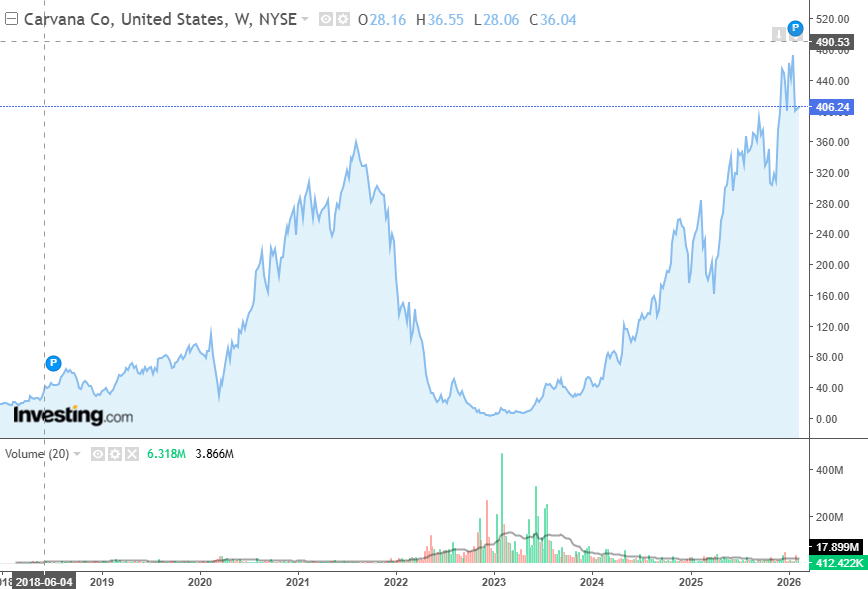
That really is quite the chart. With the company virtually left for dead in 2022, 2023 saw an aggressive cost cutting programme, a debt restructuring with a bond haircut, interest rate relief with interest payments converted to PiK payments, and an equity raise. Since then the company has powered back to new dizzying heights, while insiders (especially Ernie Garcia II) continued to sell shares.
I’m not going to go into the history of Garcia II’s conviction over Lincoln, or the past life of Ugly Duckling (DriveTime’s predecessor), although consistent themes emerge, the main one being that the shares (and their monetisation) are the real business. Carvana share sales by the Garcia’s provide liquidity for them and presumably prop up the Garcias’ private companies if required with last-resort financing.
No, what piqued my interest was Nate Anderson’s original Hindenburg report last year and the more recent Gotham report.
First up - Hindenburg. You really pay attention when they write something and they have after all done some fantastic reports. Remember Nikola? Anyway. Their key claim was the following:
“Our research uncovered $800 million in loan sales to a suspected undisclosed related party, along with details on how accounting manipulation and lax underwriting have fueled temporary reported income growth – all while insiders cash out billions in stock.”
This was followed up by discourse on Carvana’s main loan purchaser, Ally Financial stepping back and a new third party stepping in:
“With Ally pulling back, a new, unnamed buyer has quietly emerged exactly when Carvana needed it. In the past two quarters, Carvana sold $800 million in loans to an “unrelated third party.” The mystery buyer made up 18.3% and 16.3% of total loan sales in Q2 and Q3 2024.
Lien filings reveal the buyer is likely a trust affiliated with Cerberus Capital, where Carvana Director Dan Quayle is Chairman of Global Investments, indicating the new buyer is an undisclosed related-party, contrary to the company’s claims.”
Hindenburg also cites warranty reimbursements from DriveTime that are favourable to Carvana, borrower extensions on its own loan book delivered by Bridgecrest, and selling cars wholesale (cars not loans) to DriveTime to manage its own growing inventory.
Lets take the Cerberus story first. Hindenburg link the new loan sales to Towd Point Auto Trust (A1 and A2), whose principal office links back to Cerberus’ head office:
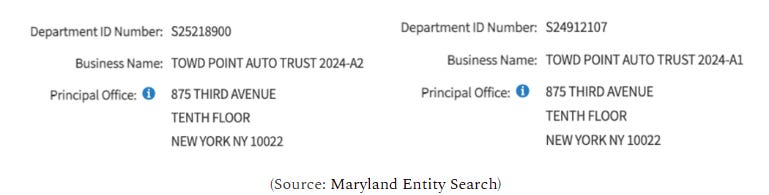
A third trust (A3) had reportedly been launched. All while former US Vice President Dan Quale (a board member of Cerberus) was both on Cerberus’ leadership team, was selling stock in Carvana, and was a Director of Carvana.
This is all interesting, and potentially crosses related party lines but I don’t think in and of itself (amidst all the detritus of the financial world we currently swim in) that it represents a “humdinger”. Cerberus or its investors could be getting a decent deal on subprime auto and Cerberus needs to make money for its investors. A relationship might “grease the wheels” (!) but the deal could still “functionally” pass muster.
So we move onto the other claims:
Large percentage of sub-prime or non-prime loans sold by Carvana
Favourable warranty reimbursements from DriveTime
Borrower extensions on CVNA loans serviced by Bridgecrest (A Garcia controlled entity)
Material wholesale selling of cars to DriveTime
The first point is the clearest and easiest point to make. Much circumstantial evidence illustrates Carvana selling cars with subprime customers and very generous credit criteria (eg $5000 income a year and over 18 years old!!). However, the extent of these sales in proportion to less subprime isn’t clear in the Hindenburg piece. The snapshot that it quotes below is clearly largely subprime but that is because these are the bottom of the ABS pile, many of which will presumably end up being part of the retained loan interest that Carvana keeps on its books (and represent part of its gain on loan sale, along with cash gains).
Below we’ve snipped a more recent Morningstar Filing for the 2025 N1 series:
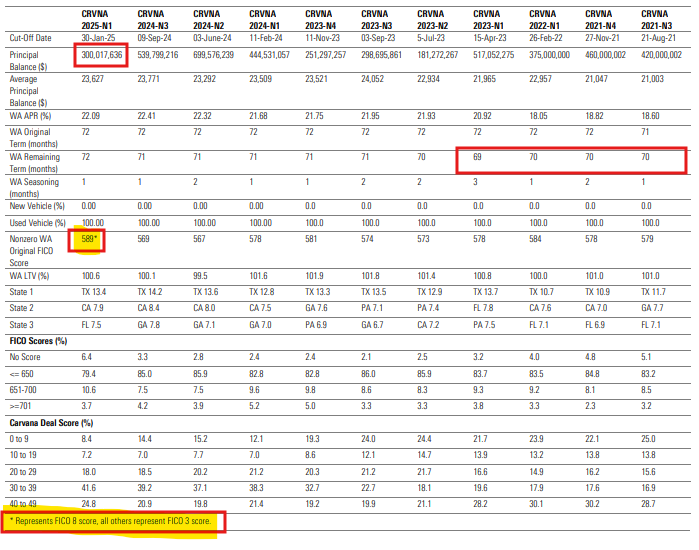
Several things seem apparent:
a). Look at the weighted average remaining term of the older loans - almost the length of the original term. Whilst portfolio shifts (write offs and highest quality shortest duration loans paid off first) can explain some of this it suggests that a big chunk of loans have been amended or extended - borrower extensions. Not a good sign.
b). The FICO score. Carvana moved to FICO 8 in 2025, which is a more modern standard than base FICO but crucially is more forgiving in nuanced ways - so a higher score is not necessarily indicative of higher quality - it in fact may be much lower quality than historic tranches.
c). Finally deal size. The deals have got smaller. Is the appetite lower? It could be, however, during the period we have seen considerable P-series issuance, offsetting the lower level of N-series issuance.
What the Hindenburg note doesn’t really make clear, is that Carvana’s N (non prime series) is only a part of Carvana’s issuance. For example, Carvana’s P4 note in 2025 had the following breakdown according to S&P Global:
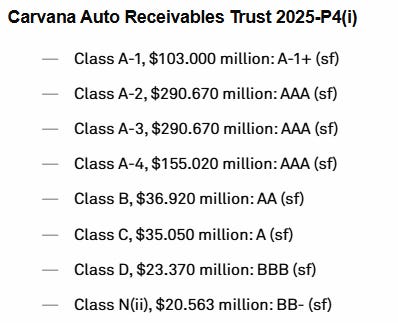
These prime issuance series notes have very modest sub-prime weightings, unlike the Class N note series earlier. And there is significantly more issuance of these primes.
Even in N series, the Prime subdivision is significant, at least according to Morningstar’s preliminary ratings:
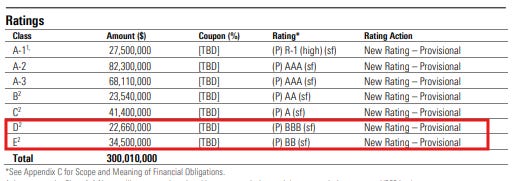
As you can see - less than 20% of the issue is rated below A on a provisional basis.
In fact the last N shelf issuance was in February 2025 so the vast bulk of the recent issuance has been prime shelf issuance with relatively small sub-prime tranches. Historically as Hindenburg have claimed about 40% of Carvana ABS issuance has been N-shelf, hence their claim:
“Almost 44% of Carvana’s loans it sells in ABS deals are non-prime. Over 80% of its recent non-prime ABS deals have weighted average FICO scores in the “deep subprime” range, the riskiest levels, per Morningstar data.”
Yet this is a little misleading: as we have seen, the vast majority of Carvana’s issuance has been P-shelf (prime) with a relatively low percentage of that being subprime (<10%), while within the N-shelf (subprime) tranches over 80% of the loans are categorised by Morningstar as Prime (A, B, C). If you split these shelves by sub-rating then a much lower slice than 44% is sub-prime.
Especially in the light of recent prime shelf issuance, Hindenburg’s sub-prime case against Carvana seems somewhat exaggerated.
There is one caveat, however. Within the N-shelf issuance it does appear that Cumulative Net Loss expectations from S&P Global have risen, while extensions are modestly below where Hindenburg last pegged them:
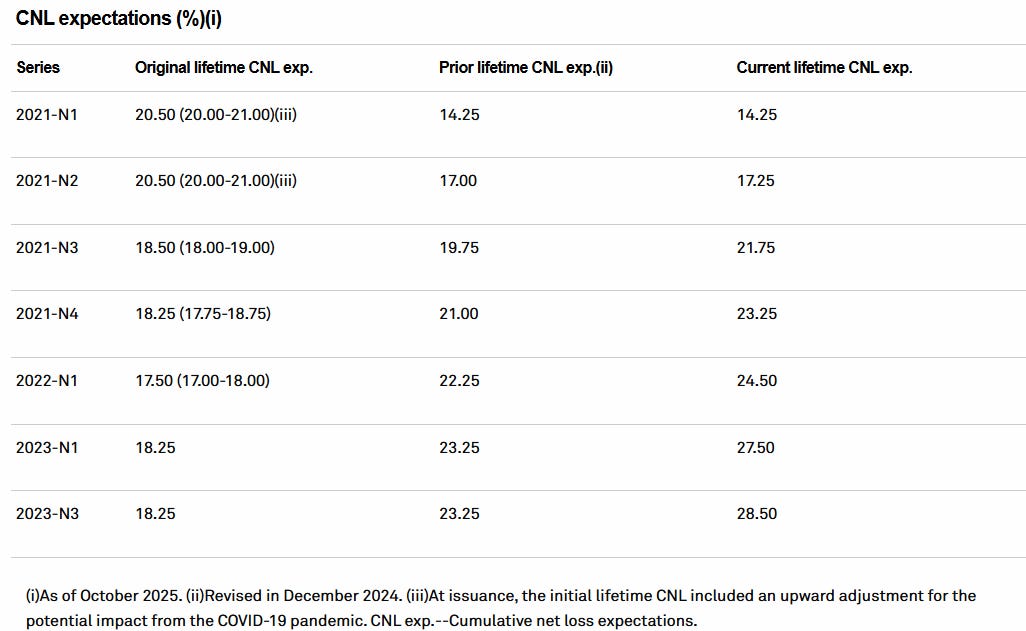
Among these issuances >61 day delinquencies are higher than peers (10-20 days) but this also reflects the poor performance of loans raised at that time and the limited remaining time/outstanding left on the loans. Recent S&P Global updates suggest that issuer extensions and delinquencies have continued to rise across the sector. Hindenburg states that Carvana’s partner DriveTime/Bridgequest has opted for extensions en masse rather than raising delinquencies, per interviews it has conducted.
Further into its report, Hindenburg provides circumstantial (interview-based) evidence that DriveTime is “pushing back” a greater percentage of warranty based revenue to Carvana than would be normal for a servicer. That may or may not be true, but evidence remains circumstantial at best.
The rest of Hindenburg’s report picks over Carvana’s historic reported (and declared) inventory sales (of cars) to DriveTime, and loans-for-sale book that had been rising (although not uniformly) through recent history (up to end 2024). They suggest that loans sold were moved around over quarter end breaks to manage profit or optimise for Garcia share purchases or sales. Finally of course, loan-for-sale accounting avoids the need to take write-downs or adjustments on those loans while they are on the balance sheet. Other red-flags raised include audit committee members sitting on both boards (DriveTime and Carvana) and the auditor, Grant Thornton, auditing both companies, suggesting, according to Hindenburg, a conflict of interest.
So, regarding Hindenburg’s report, there’s a lot of arguably murky stuff that is surfaced, but also some shortcomings of the way they portray Carvana’s subprime and prime shelf offerings. In short, they discount the prime element of the subprime ABS and the relatively small sub-prime component within the prime shelf filings. That obviously excludes any analysis of the Cerberus or Ally Financial purchases but remains a big part of their argument. I don’t feel it is a conclusive case.
After the paywall jump below, we move onto Gotham City’s Report and their big scoop - the surfacing of the DriveTime annual report for 2024 (and GoFi’s for the same year).
Comments
Nothing yet. Say the first thing.
Sign in to join the conversation.