
Let’s cut the fluff.
If your product is struggling — if users aren’t sticking around, growth is flat, and morale is tanking — you’re not alone.
But what worries me more is how often teams fail to confront why.
They ship more features. Tweak the onboarding. Rebrand.
Still nothing sticks.
And slowly, the doubt creeps in — Is this product just… broken?
But here’s the truth: most product problems don’t come from a single failure.
They stem from not knowing what kind of problem you’re really facing.
A Mental Model to Diagnose Product Pain
Over years of working with dozens of product teams — from seed-stage startups to Fortune 500s — I’ve seen this pattern again and again:
Every product challenge falls into one of three categories:
Direct Internal Factors
Indirect Internal Factors
External Factors
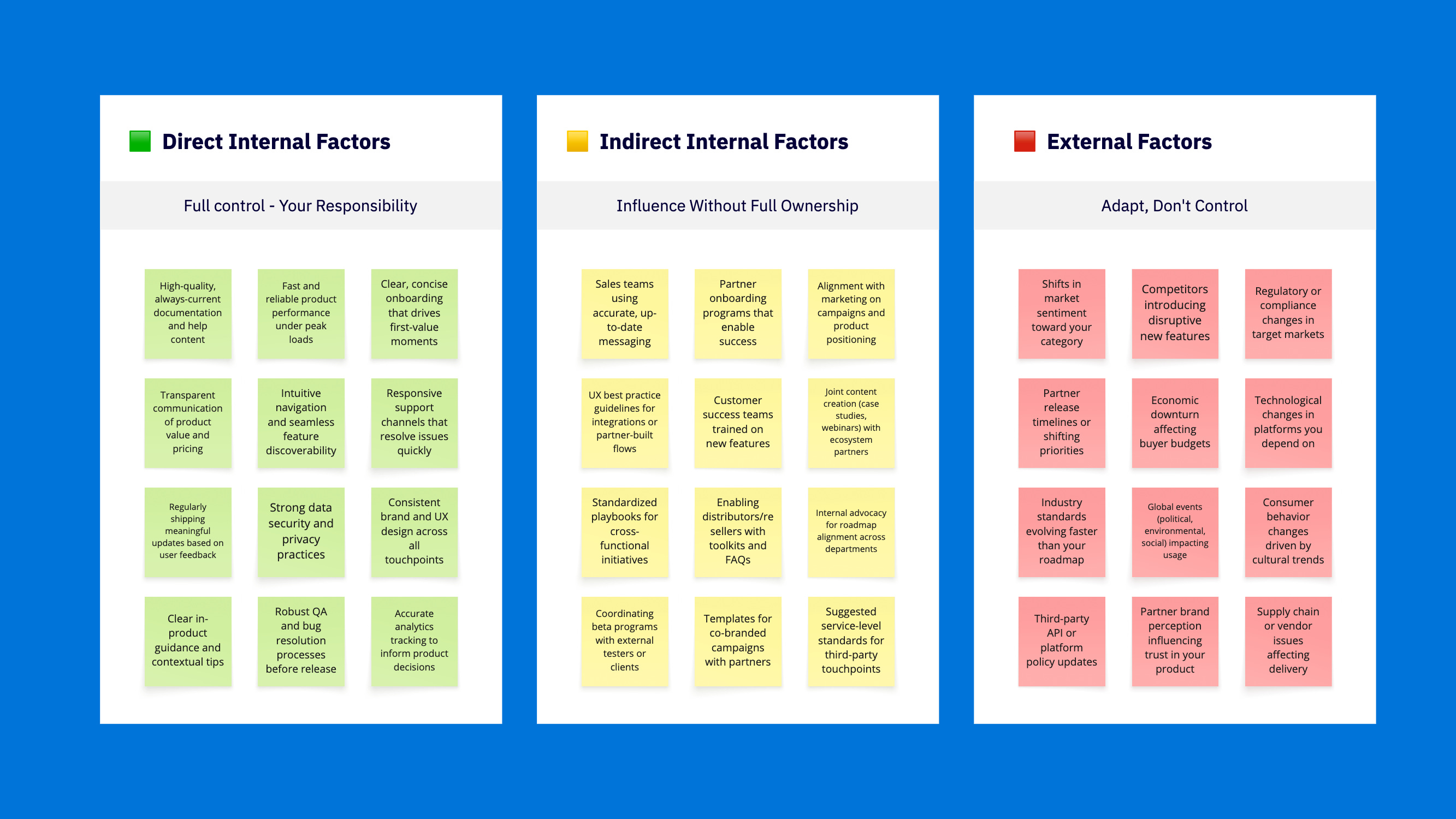
And if you can’t sort your problems into these buckets, you’re flying blind.
Worse — you might be fixing the wrong things while the real problems fester.
Let’s break them down.
1. Direct Internal Factors
These are 100% on you. No excuses. No one else to blame.
If it’s inside your walls, under your control, and still broken — fix it.
Examples:
Confusing onboarding flows that repel users on Day 1
Unclear product value on the landing page
Critical features half-built or hard to find
Buggy UI, laggy performance, or frequent downtime
A support system that’s slow or non-existent
No clarity on which user segments you’re actually serving
Why it matters:
These are the basics. The fundamentals. If these are weak, everything else is built on sand.
You might blame marketing. Or say it’s “a sales problem.”
But if your product doesn’t deliver value clearly and consistently, you’re setting every team up to fail.
When in doubt, Ask yourself:
Are we delivering the value we promised — and is that promise even clear?
Would I use this product every week if I were the user?
What would I fix if I had only 30 days to save this business?
2. Indirect Internal Factors
You don’t fully control these — but they’re still your responsibility.
This is where many teams lose the plot.
They say things like:
“That’s marketing’s job.”
“That’s the partner’s UX.”
“That’s out of our scope.”
No. If it impacts your product’s success, you need to care.
Examples:
GTM teams using outdated messaging or pitching the wrong benefits
Partnerships where your product is buried under 5 layers of navigation
Training material that confuses more than it teaches
Customer success teams unable to explain your newest features
Internal silos that keep you from seeing the full user journey
Why it matters:
These factors live in the gray zone. But users don’t care whose job it is — they just want the product to work.
Ignore this zone and you’ll suffer death by a thousand paper cuts.
Fix it, and you’ll unlock momentum you didn’t know you were missing.
When in doubt, Ask yourself:
What friction are users hitting outside the product that still reflects on us?
Where are we depending on others — and how can we reduce that risk?
Are we hiding behind org charts instead of solving the actual problems?
3. External Factors
The hard truth: some things are simply out of your control.
But that doesn’t mean you’re off the hook.
These are forces you can’t change — only navigate.
Examples:
A key partner deprioritizing your integration
Shifting industry sentiment or consumer behavior
Regulatory blockers or compliance hurdles
Macroeconomic downturns, layoffs, or changing budget cycles
Emerging competitors reframing the entire category
Why it matters:
If too many of your problems live in this bucket, it’s time for a deeper conversation.
Sometimes, your idea just isn’t viable anymore.
Sometimes, the market moved on — and you didn’t.
And sometimes, you’re fighting a battle that no amount of effort will win.
When in doubt, Ask yourself:
How long can I afford to keep pushing in this direction?
Am I solving a problem people still care about?
What would it take to pivot — and what am I afraid to admit?
The Real Problem: Misdiagnosis
Here’s the kicker: most teams don’t fail because they’re incapable.
They fail because they’re solving the wrong problems.
They throw resources at features when the real issue is trust.
They relaunch websites when the problem is product clarity.
They blame retention when the market simply doesn’t care.
But once you understand what type of problem you’re dealing with, you can:
Stop wasting energy where you have no leverage
Fix the issues that are actually in your control
Decide — with eyes wide open — whether to persist or pivot
This post isn’t about doom. It’s about honest diagnosis.
Because clarity is your sharpest tool in a foggy product landscape.
So if you’re stuck, try this:
✅ Make a list of everything that’s not working
✅ Label each item:
• Direct (we own this)
• Indirect (we influence this)
• External (we must adapt to this)
✅ Then ask yourself:
Which problems are we ignoring because they’re uncomfortable?
What’s actually worth fixing — and what’s not ours to fight?
Are we holding on too tightly to a product that no longer fits the market?
The answers won’t always be easy. But they’ll move you forward.
And sometimes, that’s the difference between a product that survives…
and one that finally starts to thrive.
If this is your first time here:
👉 Get introduced to the Product Hierarchy of Needs framework to see if you’ve got more direct internal factors than you think
Find this content helpful? Be sure to subscribe so you don’t miss the next product tips, series and frameworks to help take your product to the next level!
Comments
Nothing yet. Say the first thing.
Sign in to join the conversation.