
“And because, in all the Galaxy, they had found nothing more precious than Mind, they encouraged its dawning everywhere.”
I was probably fourteen or fifteen years old when I read Arthur C Clarke’s 2010: Odyssey Two (published in 1982), in which this quotation appears. At the time, the idea felt like a religious awakening: an expansion of my imagination into a strange yet welcoming cosmos. Who were these ancient and yet futuristic beings who seeded intelligence across the galaxy as a gardener seeds flowers in the garden? Might this story, or something close enough like it, be true?
And what is the Mind? What, if anything, makes it so special? Such are among the real world questions that eventually led me to philosophy, not only as a career, but also as a personal spiritual calling. Spiritual, not in any theological sense, but rather in the sense of espiritu, energy, self-discovery and self-expression, pursuit of and struggle for meaning.
What makes Mind special? Here is one answer: the mind is the seat of human imagination, our intellectual and at the same time emotional capacity to create, to dream, to transform the meaning of things, sometimes ex nihilo perhaps, but always ex media res, out of the ordinary, out of the familiar, out of the expected, out of the predictable.

Daydreaming: a disappearing art. Photo by Joshua Rawson Harris, unsplash dot come.
But this capacity for imagination is in decline. No, more than that: it’s under attack.
And I wish to draw special attention to one particular technological innovation spearheading the attack. It’s called Generative AI.
2.
Allow me to relate an anecdote to you.
One of the activities I often assign to my students early in my intro philosophy course, is a ‘create your own religion’ game. I encourage the students to have fun with it: even to be silly and ridiculous. They’ve made religions based on Taylor Swift lyrics, or based on RuPaul’s Drag Race, as examples. I provide a simple template for students to follow, which leads to a short writing assignment they’ll do later. Otherwise they’re free to imagine whatever they wish.
And there are always a few students who can’t do it.
There’s always a few who sit in their groups, not talking much, staring uncomfortably at each other or at the walls, and giving up within less than a minute to play with their phones instead. They’ll call me over to them to say they don’t know what to do, they don’t know what the assignment is about, or what the instructions mean. Some of them might shake with the physical symptoms of anxiety.
It’s not their fault. They believe that knowledge flows from a Google search and from almost nothing else; they’ve lived that way their whole lives and they have been rewarded for living that way. But you cannot google your own imagination. So an assignment like mine leaves them lost.
Whither imagination? It withers on the vine. Why?
Because, among other reasons, we’re out-sourcing our brains to the fantasy-industrial complex. We’re no longer thinking for ourselves.
3.
When was the last time you sat down to write something— by hand?
Writing requires patience. Writing requires time. You can start a sentence with one thought in mind, and finish the same sentence with another. Writing is a form of daydreaming: it opens the space for thoughts to drift, move, and flow; to touch other thoughts, changing them and changing themselves; to combine, divide, rejoin, and grow into discovery. Meanwhile there can be a whole sensory gestalt involved: the feel of the pen in your fingers, the scratch of its tip on the paper. Writing happens with all your senses together.
Writing is also a reaching-out to others: for we write in hope of delivery to a reader, even if the reader is your own future self. And writing is also a relationship with time: for the reader is always in the future.
All that thinking, expressed into writing, massages and moulds our brains along the way. Neural pathways complexify. Intelligence gestates and develops. This is the main reason we teach children in school to write. It’s the reason some educational jurisdictions are re-introducing cursive writing to the curriculum. The shortcut of typing, which I will never claim is immoral, requires the preparation of writing, learned at an early age.
But I say again: writing takes time. And it’s time that students and their future employers often believe they do not have.
And where there is a natural need for speed, or perhaps an artificially stimulated want for it, there is an entrepreneur developing a shortcut for us— for a price.
4.
Text-generative artificial intelligence is a glorified auto-correct, and it will never be anything more than that. *1 It is a reduction of billions of sources of data to a bland mathematical average. But it is surrounded by a billion-dollar aura of talking points and techno-utopian prophesy, which makes thinking about it difficult. Some questions go unasked because the language we use prevents the possibility of asking them.
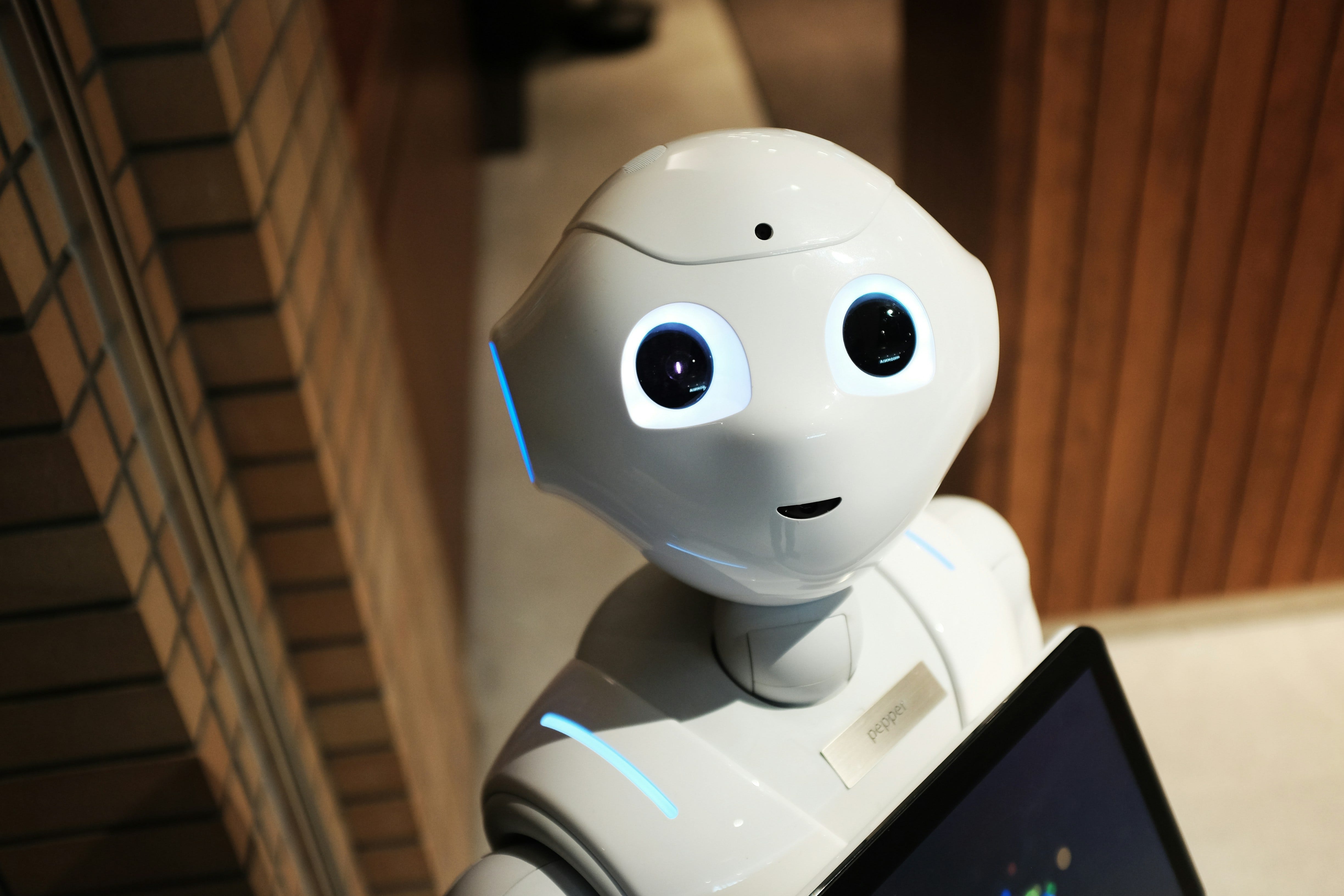
Cuteness: a weapon of seduction in the war for your brain. Photo by Alex Knight, on unsplash dot com.
For example, consider the oft-repeated the statement “AI is here to stay”.
On its face, it may be true; even so, it’s unhelpful. It is the verbal equivalent of shrugging our shoulders. The technology is not going away only because the corporations who created it are rich, powerful, and financially incentivized to integrate it into our lives. No other forces are at work here: no inevitability of nature, no commandment from God. It’s an incessant striving of money for more money, and it is nothing more.
Whenever it is claimed that “AI is here to stay”, we should always respond with the counter-point that nothing in human affairs is inevitable. In affirming that counter-point, we can immediately reclaim our human capacity to decide for ourselves whether or not to integrate any given new technology into our classrooms, or indeed into our lives.
As another example: consider the talking point “AI is a tool.”
This is another statement that mystifies rather than clarifies the nature of the technology. It makes the AIs feel no different than pocket calculators. Whenever it appears, we should immediately respond like this:
(a) Tools can be expected to be useful. But in the context of college education, an AI text generator is the opposite of useful, for reasons that I shall explain shortly.
(b) From the claim that it’s a tool, it does not follow that we must therefore use it.
(c) The claim “It’s a tool” must prompt the questions “What kind of work is this tool designed to do? And what values does that kind of work represent?”
If it is countered that “tools are value-neutral”, it must be replied that There is no such thing as a value neutral tool. Even something as everyday as a hammer implies various values; if nothing else, a hammer implies the value in the kind of work that a hammer can do, or which a hammer is designed to do especially well. Thus we can see the significance, even the heavy urgency, of questions like: What kind of work can an AI-text generator do? And what is the value of that work?
5.
But suppose we took one of those talking-points at face value. “AI is a tool.” What kind of work will the nature of the tool itself suggest? Recall the famous statement of Canadian philosopher Marshall McLuhan: “The medium is the message”.*2 The presence and the nature of the technology itself, quite apart from its applications and effects, is itself a force in the world. Where is that force leading us? Why is it leading us there? What will we gain, and what will we lose? Our questions must be such as these. Much as the video camera, as a tool, is an externalization of the sense of sight (another McLuhan-ism), the AI text generator, as a tool, is an externalization of our minds, particularly our cognition-capacity for researching, critical reasoning, and decision-making. This, too, raises important questions about what will become of us as human beings if we export those cognition-capacities to technology.
As a college prof, one of my questions is “What will students learn by using this tool?” And the answer, it seems to me, is: Nothing.
We learn best by doing things; this is one of the few propositions that every theory of education holds in common with every other, from the industrial and regimented systems of the 19th century to present-day Montessori schools and flipped-classrooms. Its obverse is also tried-and-tested: whatever we are doing, that’s what we’re learning.
So, if we allow students to use text-generative AI, at least some of the ‘doing’ part of their education will not be done by the students. In other words: when students don’t do something, they don’t learn to do it. Handing off a task to an AI is not the same as learning that task.
A tip from the field of Information Science may be helpful here. In that field, knowledge is a step in the transformation of data into effectiveness: that is, the ability to do things.*3 One recalls Francis Bacon’s famous motto: Ipse scientia potestas est— ‘knowledge is power’. But a student who depends on data that they did not analyze for themselves will not translate that data into effectiveness consistently or reliably. They will make mistakes, and they will fail to accomplish tasks. On this view of things, data that cannot be translated into effectiveness is not knowledge. And so, we see how AI text generators are purveyors of anti-knowledge.
To be quite blunt: the only thing one can learn from handing a task to an AI is whether or not that task can be handed to an AI.
In the case of my field, philosophy, the skills are irreducibly human. Good philosophy is asking good questions. Good philosophy is organized curiosity. It’s imagination, enquiry, inspiration, and discovery. It’s also struggle, to be sure; and it requires serious logical discipline. Philosophy is also the utter destruction of falsehoods, illusions, and injustices. It is the stubborn and yet loving search for the real, the true, the good, and the beautiful.
If the students let the AI do all the searching and struggling, they will do no learning. Or, to be more precise, they will learn how to make AI appear to do the things that they should do themselves. Carried to its final possible extent, students who rely too much on AI will never arrive at their own thoughts about goodness, reality, truth, nor beauty, nor even the meaning of their own lives. They will only parrot whatever the AI tells them. They will have surrendered their free and beautiful minds to the algorithm, and to the corporations that design them.
And what will that algorithm do with their minds? It will flood them from every direction with a single medium-as-message. I can express that message in four words: “Stay in your lane.”
Stay in your lane. Ask only the permitted questions. Stay in your lane. Chase only the permitted dreams. Fall in love with who we tell you. Buy the toys and things we sell you. Hate the people who we say hurt you. Stay in your lane, and stay in your lane. And everything will be fine.
Whither imagination? It withers on the vine— for we doth remain in our lane.
6.
And this is all terribly ironic. Because a childhood in which parents encourage imagination can become an adulthood capable of innovation— the by-word of technocrats, investors, and government forecasters everywhere. It’s a magic power-word which such people say will solve all our problems for us. It’s the tech-bro equivalent of mana from heaven.
But if we cannot imagine for ourselves, we cannot innovate.
Or, maybe the rich will do all the innovating. The rest of us will stay in our lanes, singing songs of thanksgiving and praise.
7.
As another example, consider a practical profession: Nursing. Students in my college’s Nursing program need problem-solving skills, social and interpersonal skills like team-building and empathy for patients, decisiveness, initiative, memory recall, procedural intelligence, mathematical and scientific literacy. None of these skills can be practiced by playing with ChatGPT. Furthermore, nursing is an applied science, an all-application kind of profession, whose knowledge-foundation and whose ethics is, of necessity, evidence-based. ChatGPT’s inability to distinguish facts from fiction is a direct subversion of the necessity for evidence-based knowledge. This can put the lives of patients in danger. Imagine a nurse who uses ChatGPT to look up the side-effects of a drug they’re administering to a patient, or who uses it to assess a patient’s symptoms and risk factors during intake and triage, or to find the policy on administering a heartbeat-slowing medication to a patient whose BMP is below 50. They have to be able to think for themselves in order to do those things. If they are accustomed to following the AI’s instructions, they won’t know how to think for themselves. One obvious problem is that the AI might output a mistake: prompting a nurse to provide the wrong treatment. Another problem, and a worse one, is that the nurse trained by an AI might not be able to tell when the AI makes a mistake. This can put patient’s lives into even greater risk, as a nurse may form bad habits based on the AI’s advice over time, leading to more patients staying sick or getting sicker, or dying. [I am grateful to Prof. Erin Jameson, RN, for discussing with me how AI affects her profession.]
8.
“And because, in all the Galaxy, they had found nothing more precious than Mind, they encouraged its dawning everywhere.”
Our minds are beautiful. Our minds are ourselves. It is by thinking that we live at all in this world. It is by expressions of thinking— that is, talking, singing, writing, touching, relating, imagining, exploring, discovering, loving, and inventing— that we find the necessary conditions for the possibility of a flourishing and meaningful human life.
Computers cannot think. They take no initiative on their own unless pre-programmed to do so. They make no decisions, again unless pre-programmed. They do not ascribe meaning to the data they process: we do. Computers do not care about anything, and they have no feelings. If it is said that they have thoughts, there is no person there to think them; if it is said that they make decisions, there is no person there to whom may be ascribed agency.
Human beings can think— when we want to. We can take initiative, make decisions, and ascribe meaning to phenomena. We care about things; we have feelings. Our brains do not process digital information; we are not computers.
But thinking is hard. Most people find deep thinking uncomfortable. We need to be encouraged to it, and shown its value. It requires practice, and good role-modelling, and a teacher’s unlimited patience and unconditional kindness. And it requires a student’s imagination.
Artificial “Intelligence” cannot bring those values to your life, because computers cannot care about anything. It is has the appearance of emerging from a mystery-box like the unwrapping of a birthday gift, and so can be mistaken for thinking. But there is no thinking happening: there is only the processing of digital data, and our ferverent religious wish for a deus ex machina to deliver us a shortcut to utopia.
We already live in a society where anti-intellectual forces have the greater share of prestige in the news media and in mass entertainment. Let’s not surrender to those forces in advance; let’s not give those forces any help. My argument is not a diatribe against novel technologies. It is a plea for the preservation of our humanity.
Footnote 1: Those big neural-net AIs running on quantum computers, doing astronomically hard tasks like protein-folding or chemical-bond simulations, are different from the text-generative AI that I’m discussing here. We must be careful not to conflate them together.
Footnote 2: “McLuhan: Now The Medium Is The Massage”. The New York Times, 19th March 1967.
Footnote 3: See: Lai Ma, “Meanings of Information: the Assumptions and Research Consequences of Three Foundational LIS Theories.” Journal of the American Society for Information Science And Technology, 63(4); 716-723, 2012.
No posts
Comments
Nothing yet. Say the first thing.
Sign in to join the conversation.