
I'm being a little flippant with my headline, obviously. But perhaps not completely.
At this time of year I like to revise and update my Outline History of Western Philosophy, and its accompanying Glossary. This year I felt a need to emphasize a certain pattern, which may be old news to some of you, but which might be an interesting way to frame my courses in the coming teaching term.
It's the way in which a large transformation in our material, social, and political circumstances, prompts a transformation of the culture's overall worldview, such that old ideas long regarded as obvious, universal, rational, clear, and stable, come under radical doubt. This leads to a resurgence of relativism.
And as that relativism proves itself unable to help with anything or even proves to make things worse, we struggle for a new worldview and a new sense of meaning.
Something like this happened in the aftermath of Alexander The Great's empire, the fall of the Western Roman empire, and the French Revolution.
Let’s look a little closer at the latter.
The grand plan of the Enlightenment had its problems. Various people, especially artists, began to worry about what it might have excluded. As the Greek poet Euripides had noted more than a millennia before in The Bacchae, people cannot live without an avenue for the expression of their passions.
Furthermore, some Enlightenment thinkers realised that unfettered reason need not lead to utopia: it could just as easily lead to populist tyranny, which no Enlightenment thinker wanted. (Kant’s work, coming as it does at the tail end of the movement, is a response to this problem.)
Enter Romanticism. It begins as a political movement of protest and rebellion: an assertion of the rights of individuals and of the working class against hereditary aristocrats and landlords. The storming of the Bastille prison in Paris in 1789, and the rescue of the political prisoners held there, is perhaps its most archetypal expression.
As an artistic and intellectual movement, Romanticism was also a response to the loss of trust in the ‘certainties’ of universal Reason and divine providence; a loss of trust brought on by the observable fact that the grand project of the Enlightenment was agonizingly slow to deliver its on promises— especially its political promises.
But the immediate aftermath of the French Revolution was not a republican utopia of freedom, brotherhood, and equality. Instead it was The Terror, and the Napoleonic Wars.
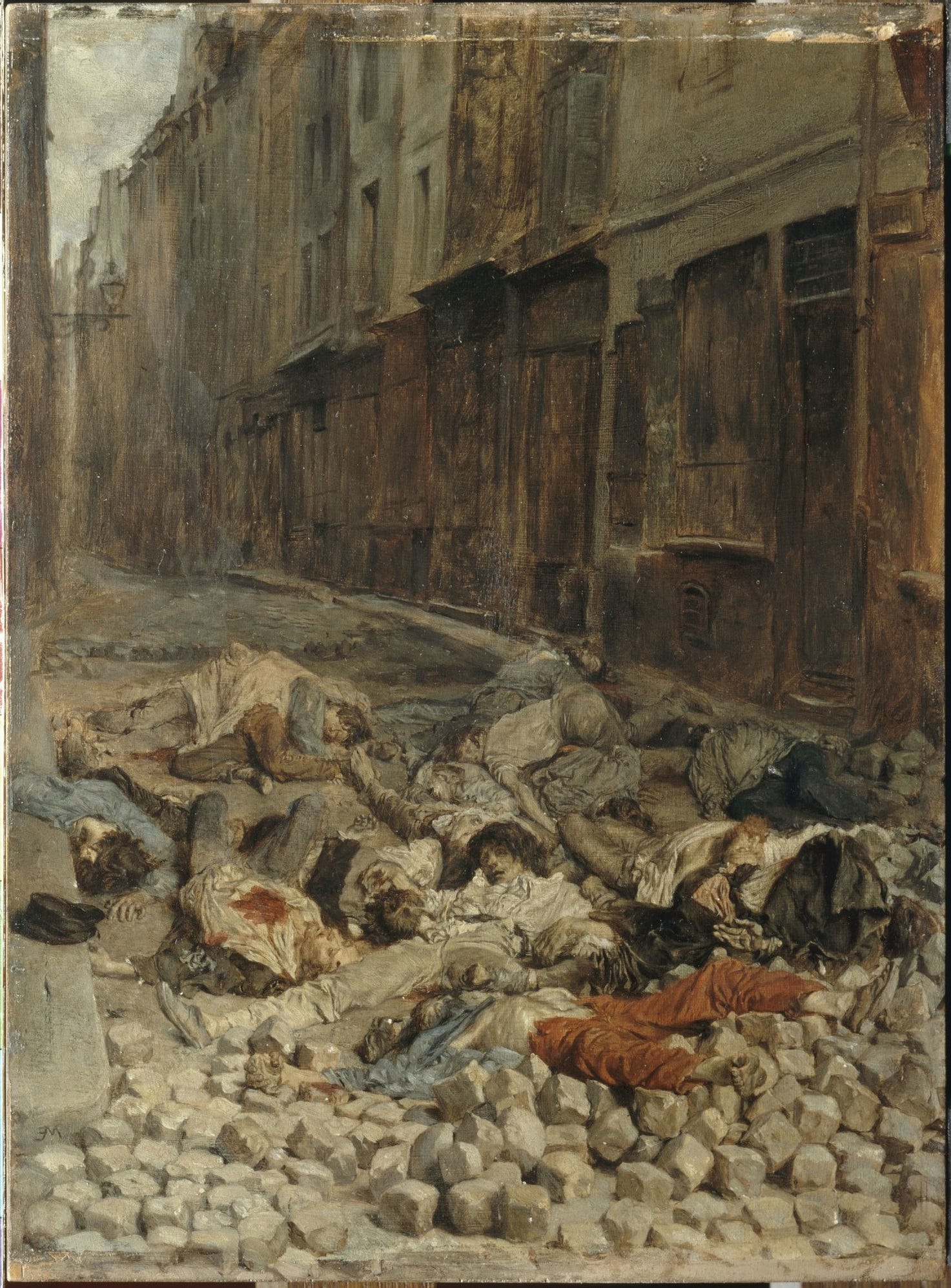
[Image: Meissonier, The Barricade, 1848]
Many Romantics became disillusioned with revolutionary politics. But they did not want to go back to the Old Regime either. Romantics therefore looked to what they thought were the best available alternatives:
(1) Individualism, individual expression, originality, authenticity, and freedom.
(2) Romantic love,
(3) Passion over reason and rationality,
(4) The worship of nature (including its dangers; in fact, especially its dangers); for some, this also included a revival of pantheism and the worship of Greek pagan gods,
(5) The privileging of childhood and innocence,
(6) Imagination and infinity, creativity, artistic innovation; the pursuit of beauty (including both the sublime and the grotesque),
(7) Death, sacrifice, legacy, and apotheosis.
What I think these things have in common is not only the epithet ‘Romantic’; they are also avenues in which to struggle for meaning in a world that seemed to be crumbling to pieces around them.
So, the question we may need to ask ourselves: are we in such a period now? What new big ideas are on the way?
What rough beast, his hour come at last, slouches toward Bethlehem to be born?
No posts
Comments
Nothing yet. Say the first thing.
Sign in to join the conversation.